Unit 7: Secondary Function & Tonicization
Anatomy of Harmonic Function: Secondary Chords
1. Fundamentals of Tonicization
To understand Unit 7, you must distinguish between maintaining a key and temporarily borrowing from another. This unit focuses on chromaticism—the introduction of notes outside the current key signature.
Tonicization vs. Modulation
- Modulation: A long-term change of key. This is confirmed by a cadence in the new key and usually lasts for a significant phrase or section.
- Tonicization: A temporary shift where a chord is treated briefly as if it were the tonic. This usually involves just two chords: the secondary chord and its target chord.
The Concept of Secondary Function
In a standard major scale, the dominant (V) naturally pulls to the tonic (I). However, any major or minor triad in the key can have its own "dominant" applied to it.
By adding accidentals to create a temporary dominant or leading-tone chord, we intensify the pull toward a chord other than the main tonic. This creates a moment of Tension (Secondary Function) $\rightarrow$ Resolution (Target Chord).
2. Secondary Dominant Chords ($V/x$)
Definition
A Secondary Dominant is a Major triad or Dominant 7th chord that serves as the dominant to a diatonic chord other than the tonic. It functions exactly like a $V \rightarrow I$ progression, but shifted to a different scale degree.
Notation
These are analyzed using "Slash Notation" (not to be confused with pop/jazz slash chords).
- Top (Left): The function of the borrowing chord (Always $V$ or $V^7$).
- Bottom (Right): The target chord (Roman numeral of the diatonic chord being tonicized).
Example: $V/V$ is read as "Five of Five."
Rules for Secondary Dominants
- Quality: The secondary dominant MUST be a Major Triad or a Dominant 7th Chord ($Mm7$). You will almost always need to add accidentals (raise the third of the secondary chord) to make it major.
- Target: You can tonicize any major or minor diatonic chord (ii, iii, IV, V, vi).
- Note: You typically do NOT tonicize diminished chords ($vii^\circ$) because they cannot serve as a stable temporary tonic.
Common Secondary Dominants in Major Keys
| Analysis | Target Chord | Relationship | Example in C Major |
|---|---|---|---|
| V/V | V (Dominant) | Resolves to G | D Major chord |
| V/vi | vi (Submediant) | Resolves to Am | E Major chord |
| V/IV | IV (Subdominant) | Resolves to F | C7 (add $B\flat$) |
| V/ii | ii (Supertonic) | Resolves to Dm | A Major chord |
Note: $V/IV$ in a major key requires lowering the 7th of the scale to create a $Mm7$ quality (e.g., in C Major, C-E-G-B$\flat$ to target F).
3. Part Writing Secondary Dominants
Writing secondary dominants requires strict adherence to voice-leading rules, particularly regarding the Temporary Leading Tone.
Spelling the Chord
- Identify the root of the target chord.
- Go up a Perfect 5th to find the root of the secondary dominant.
- Build a Major triad (or Dominant 7th).
- Review the key signature and add necessary accidentals to ensure the triad is Major and the 7th (if present) is minor.
Resolution Rules
When moving from $V^{(7)}/x$ to $x$:
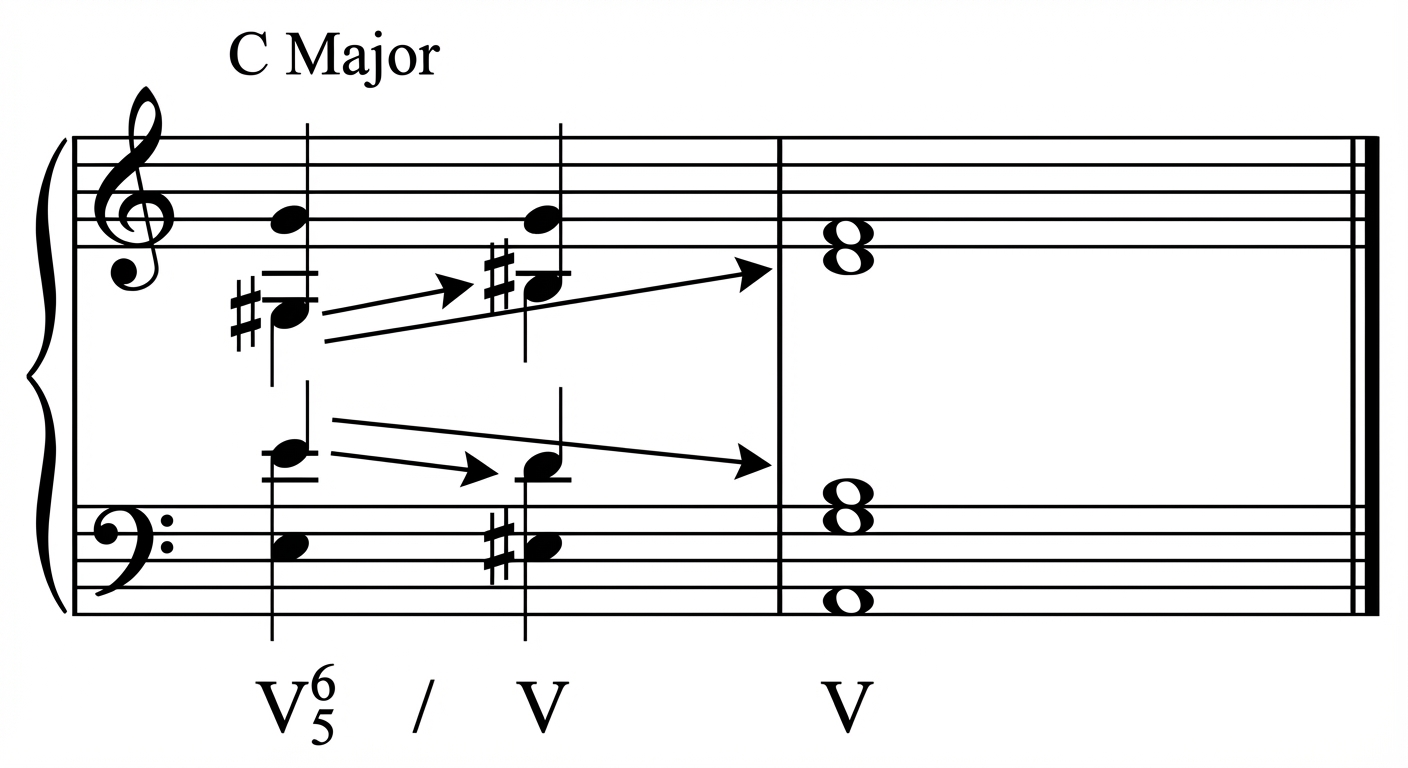
- The Temporary Leading Tone: The third of the secondary dominant functions as the leading tone to the target chord.
- Rule: It MUST resolve UP by step.
- Example: In $V/V$ in C Major (D-F#-A), the F# is the leading tone to G. It must move F# $\rightarrow$ G.
- The Chordal Seventh: If utilizing a $V^7/x$:
- Rule: It MUST resolve DOWN by step.
- Example: in $V^7/V$ in C Major (D-F#-A-C), the C is the 7th. It must move C $\rightarrow$ B.
- Avoid Parallels: Watch for parallel fifths and octaves, especially when the root moves by step (e.g., $IV \rightarrow V/V$).
Irregular & Deceptive Resolutions
While secondary dominants usually resolve to their target (regular resolution), they can resolve deceptively.
- Deceptive Resolution of Secondary Function: $V/x$ resolves to $vi/x$ (the submediant of the target key).
- This is frequent in specific progressions, such as a sequence.
4. Secondary Leading Tone Chords ($vii^\circ /x$)
Just as we can borrow the Dominant, we can borrow the Leading Tone chord ($vii^\circ$).
Definition
A secondary leading tone chord is a diminished triad or diminished 7th chord built on the leading tone (half step below) of the target chord.
Notation
Quality Differences
Unlike secondary dominants (which are always Major/Dominant), secondary leading tone chords vary in 7th quality:
- Secondary Diminished Triad ($vii^\circ/x$): Rarely used in AP theory part-writing due to voice leading difficulties (doubling rules).
- Fully Diminished 7th ($vii^{\circ 7}/x$):
- Constructed of stacked minor 3rds.
- Highly chromatic.
- Used to tonicize both Major and Minor chords.
- Half-Diminished 7th ($vii^{\phi 7}/x$):
- Used primarily to tonicize Major chords.
- Diatonic to the major scale of the target.
5. Part Writing Secondary Leading Tone Chords
Spelling the Chord
- Identify the root of the target chord.
- Go DOWN a minor 2nd (half step) to find the root of the $vii^\circ/x$.
- Build the diminished chord. Add accidentals to ensure the root acts as a leading tone (half step below target).
Resolution Rules
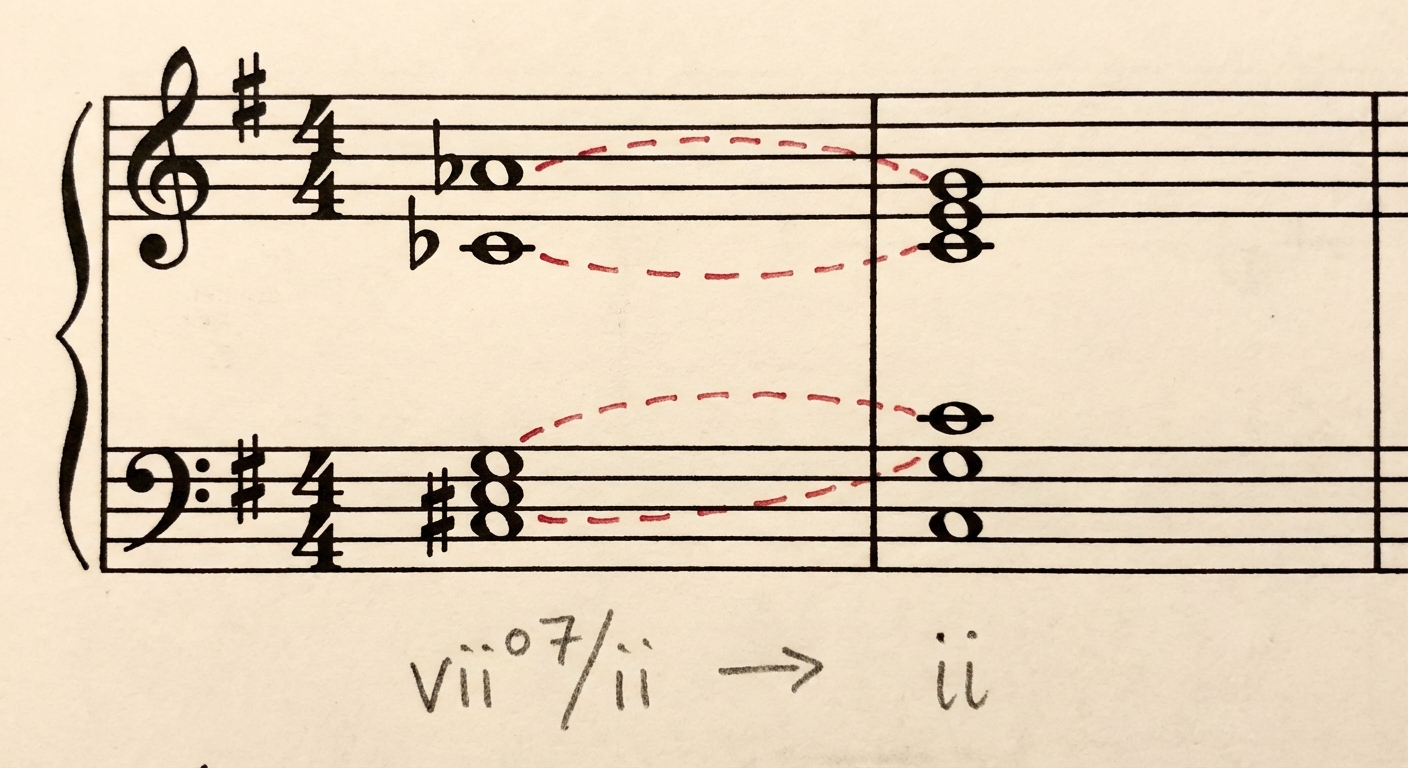
When resolving $vii^{\circ 7}/x \rightarrow x$:
- Root Resolution (Temporary Leading Tone): The root of the secondary chord must resolve UP by step to the root of the target.
- 7th Resolution: The 7th of the secondary chord resolves DOWN by step.
- Fifth Resolution: The 5th of the chord typically resolves down by step to avoid parallel 5ths, forming a doubled third in the target chord.
6. Context: Closely Related Keys & Sequences
Secondary functions are often used in the context of modulating to closely related keys or in harmonic sequences.
Defining Closely Related Keys
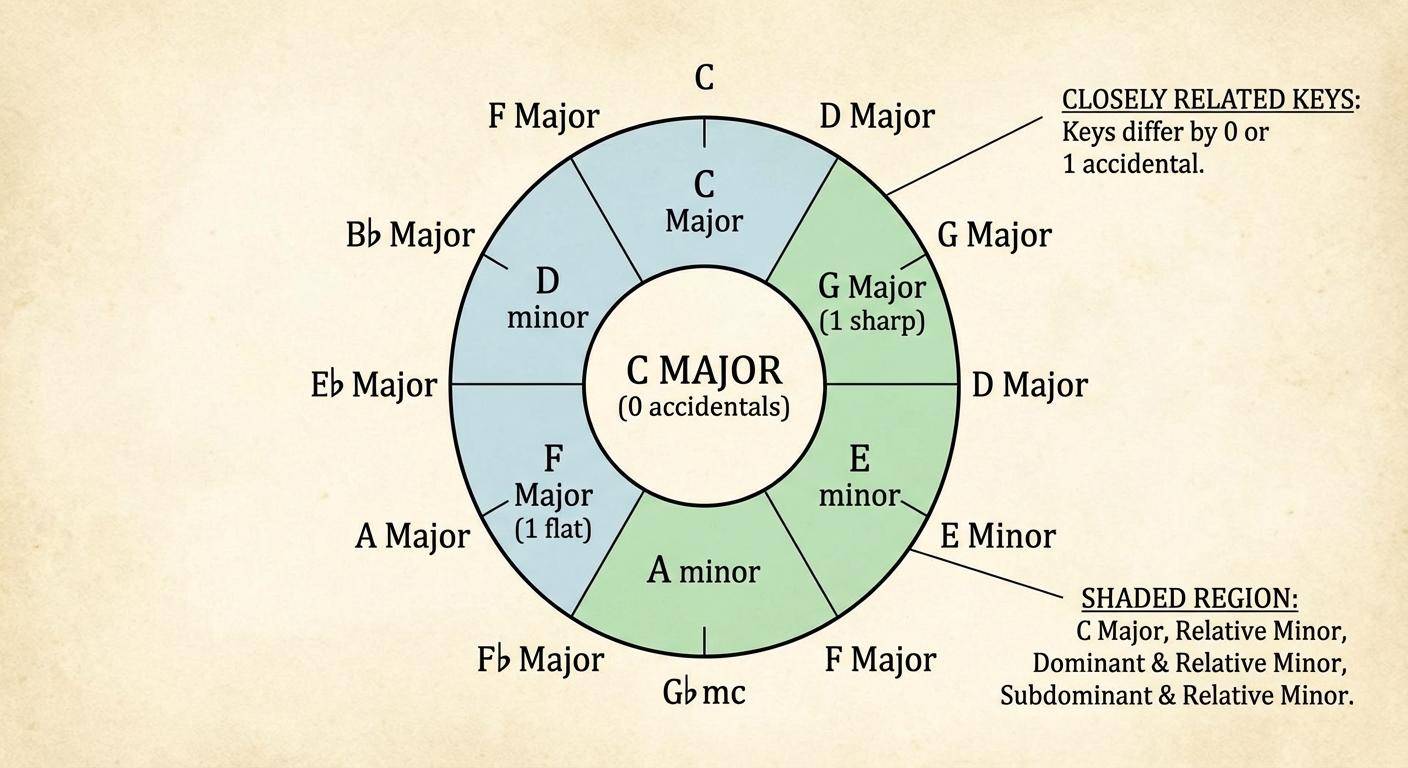
In AP Music Theory, closely related keys are defined strictly as keys that differ by no more than one accidental from the primary key.
Visualizing on the Circle of Fifths:
- The original key (Center)
- The key one step clockwise (Add 1 sharp)
- The key one step counter-clockwise (Add 1 flat)
- The relative minors/majors of all three keys above.
Example Classification (C Major):
- Original: C Major (0)
- Dominant: G Major (1 sharp) & its relative e minor.
- Subdominant: F Major (1 flat) & its relative d minor.
- Relative: a minor.
- Counter-Example: C Major and c minor are parallel, but NOT closely related (3 flats difference).
Harmonic Sequences
Secondary dominants are frequently found in Circle of Fifths Sequences.
- Standard Diatonic Sequence: $vi - ii - V - I$
- Chromatic Sequence (applied dominants): $V/ii \rightarrow ii \rightarrow V/V \rightarrow V \rightarrow I$
- Effect: This creates a chain of dominants, driving the music forward with high energy.
7. Common Mistakes & Pitfalls
Confusing Visual Slash Notation ($C/G$ vs $IV/V$):
- Mistake: Thinking $IV/V$ means a IV chord with a V in the bass.
- Correction: In Roman Numeral analysis, the slash means "Applied To." $IV/V$ is logically impossible (subdominant of the dominant is just the tonic!). Always read it as "Function OF Target."
Forgetting Accidentals:
- Mistake: Writing a $V/V$ but leaving it as a minor triad (e.g., D-F-A in C Major).
- Correction: A dominant function MUST be major. You must raise the third (D-F#-A).
Resolving the Temporary Leading Tone Down:
- Mistake: In a $V^7/IV$ to $IV$ progression (C7 to F), moving the E down to D.
- Correction: The third of the secondary dominant (E) is the leading tone to F. It simply must resolve up to F.
Misidentifying $V/IV$:
- Mistake: Analyzing a I chord as $V/IV$ just because it moves to IV.
- Correction: To be $V^7/IV$, it must have the lowered 7th (creating a Dominant 7th interval). In C Major, C-E-G is just I. C-E-G-Bb is V7/IV.
Parallelism in Resolution:
- Mistake: Moving all voices of a $V/V$ parallel to the $V$ chord.
- Correction: This creates parallel fifths and octaves. Contrary motion is essential. If the bass moves up (D to G), the upper voices should generally move down or settle.
8. Summary Table: Secondary Functions
| Term | Description | Chord Quality | Roman Numeral Example |
|---|---|---|---|
| Secondary Dominant | Dominant of a diatonic chord | Major Triad or Dom 7th | $V/vi$ |
| Secondary Leading Tone | Leading tone of a diatonic chord | Dim Triad or Dim 7th | $vii^{\circ 7}/V$ |
| Target Chord | The chord receiving the resolution | Any Major or Minor triad | $V, vi, ii, etc.$ |
| Tonicization | Treating a chord as a temporary tonic | N/A | N/A |