Unit 1 Study Guide: The Foundations of Rhetorical Analysis
The Rhetorical Situation
Before you can analyze an argument, you must understand the environment in which it was created. No text exists in a vacuum. Every speech, essay, or letter is born out of a specific moment and directed at a specific group for a specific reason. In AP English Language, this ecosystem is called the Rhetorical Situation.
Components of the Rhetorical Situation
To break down the rhetorical situation, strict attention must be paid to the relationship between the speaker, the audience, and the subject. This is often visualized as the Rhetorical Triangle.
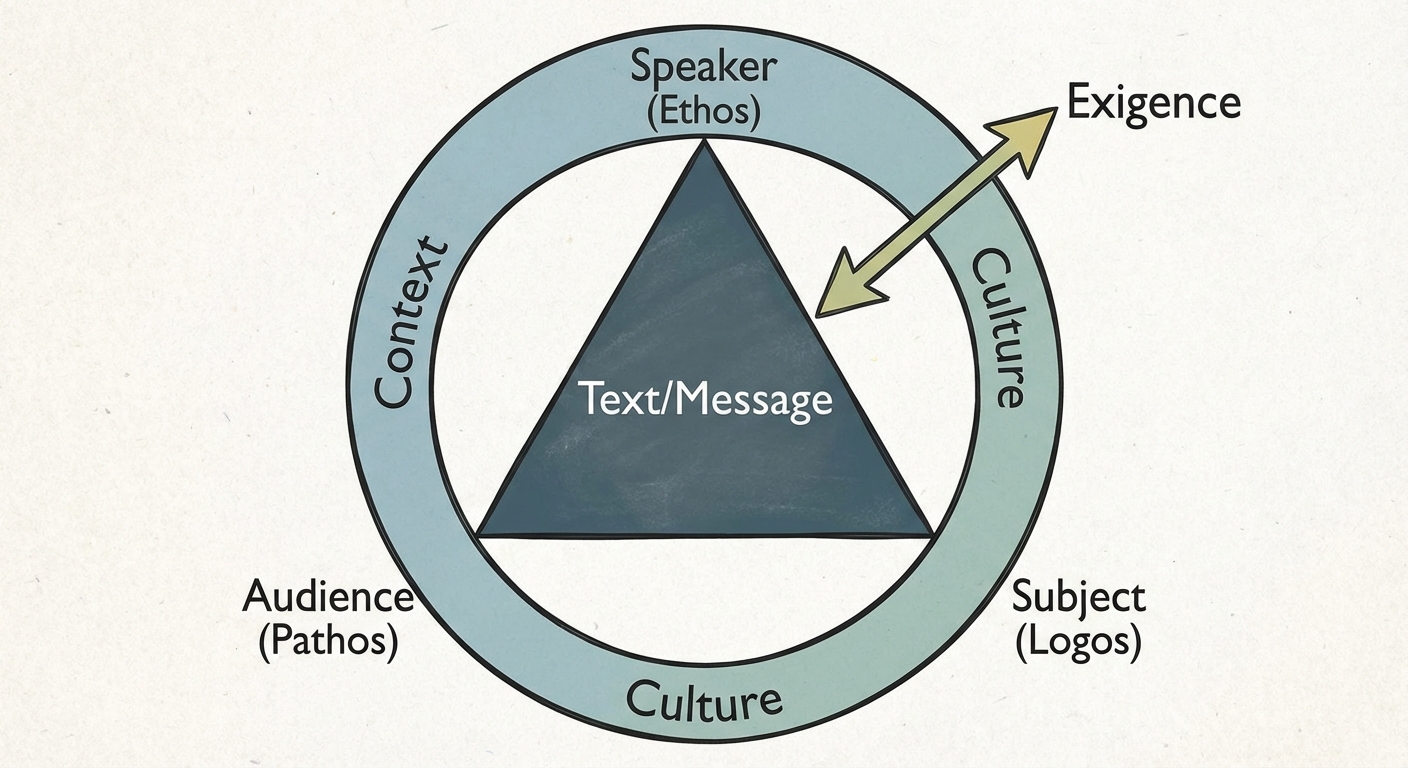
1. Exigence
Exigence is the "spark" or the immediate need that motivated the writer to write. It is not just the topic; it is the catalyst.
- Ask yourself: Why write this now? What problem or event just happened that demands a response?
- Example: The topic might be "school safety." The exigence is a school board meeting scheduled for tomorrow night regarding new security measures.
2. Audience
Using the generic term "the general public" is usually incorrect in AP Lang. Writers tailor their arguments to specific demographics with specific values, beliefs, and needs.
- Primary Audience: The direct intended recipients.
- Secondary Audience: Others who might read or hear the text later.
- Analysis Tip: Consider what the audience fears or desires. How does the speaker manipulate those feelings?
3. Purpose
What does the speaker want the audience to do, think, or feel by the end of the text?
- The purpose is rarely just "to inform." It is usually to persuade, to criticize, to defend, or to inspire action.
4. Context
Context refers to the broader historical, cultural, and social movements surrounding the text. While exigence is the immediate spark, context is the background atmosphere.
- Example: MLK's "I Have a Dream" speech has the exigence of the March on Washington, but the context includes the 100-year history of the Emancipation Proclamation and the ongoing Civil Rights Movement.
Memory Aid: SPACE CAT
A popular mnemonic for the Rhetorical Situation and analysis is SPACE CAT:
- Speaker
- Purpose
- Audience
- Context
- Exigence
- Choices (Rhetorical strategies)
- Appeals (Ethos, Pathos, Logos)
- Tone
Claims and Evidence
At the core of every argument is a claim supported by evidence. In Unit 1, your goal is to identify these elements and evaluate their relationship.
Defining the Claim
A Claim is an assertion that requires proof. It is not a statement of fact.
- Fact: The legal driving age in Texas is 16. (Cannot be argued)
- Claim: The legal driving age should be raised to 18 to reduce accident rates. (Arguable/Defensible)
Types of Claims
- Claims of Fact: Assert that something is true or not true (e.g., "Standardized testing does not accurately measure student intelligence").
- Claims of Value: Assert that something is good/bad, right/wrong, or desirable/undesirable (e.g., "It is immoral to ban books in public libraries").
- Claims of Policy: Assert that a change should be made (e.g., "Schools must adopt a four-day work week").
Selecting Evidence
Writers choose evidence strategically to persuade their specific audience. The College Board categorization of evidence typically falls into these buckets:
| Evidence Type | Definition | Best Used For |
|---|---|---|
| Anecdotal | Short personal stories or narratives. | Building narrative interest; appealing to emotion (pathos). |
| Facts & Statistics | Quantifiable data and objective truths. | Establishing logic (logos) and irrefutable proof. |
| Expert Testimony | Citations from authorities in a specific field. | Building credibility (ethos) or supporting complex claims. |
| Analogies | Comparisons to unlike things to explain a concept. | Making abstract ideas concrete for the audience. |
Reasoning and Organization
Evidence alone does not make an argument. Reasoning is the connective tissue—the commentary that explains how the evidence supports the claim.
Methods of Development
Authors organize their reasoning using specific patterns, often called Modes of Development. Recognizing these helps you understand the structure of the argument.
- Narration: Telling a story to illustrate a point.
- Cause-Effect: Explaining why something happened or what will happen.
- Comparison-Contrast: highlighting similarities or differences to evaluate two things.
- Definition: Establishing the boundaries of a concept (often used in Claims of Value).
- Exemplification: Providing a series of specific examples to turn a general idea into a concrete one.
Inductive vs. Deductive Reasoning
While you rarely need to diagram formal logic, understanding the flow is essential:
- Inductive Reasoning: Moves from specific examples to a general conclusion. (Pattern: Example A + Example B + Example C → General Claim).
- Deductive Reasoning: Moves from a general truth (major premise) to a specific application (minor premise) to a conclusion. (Pattern: All men are mortal → Socrates is a man → Socrates is mortal).
Line of Reasoning
This is the most critical concept for the AP exam. The Line of Reasoning is the logical arrangement of claims and evidence that leads to a conclusion. It is the "spine" of the essay.
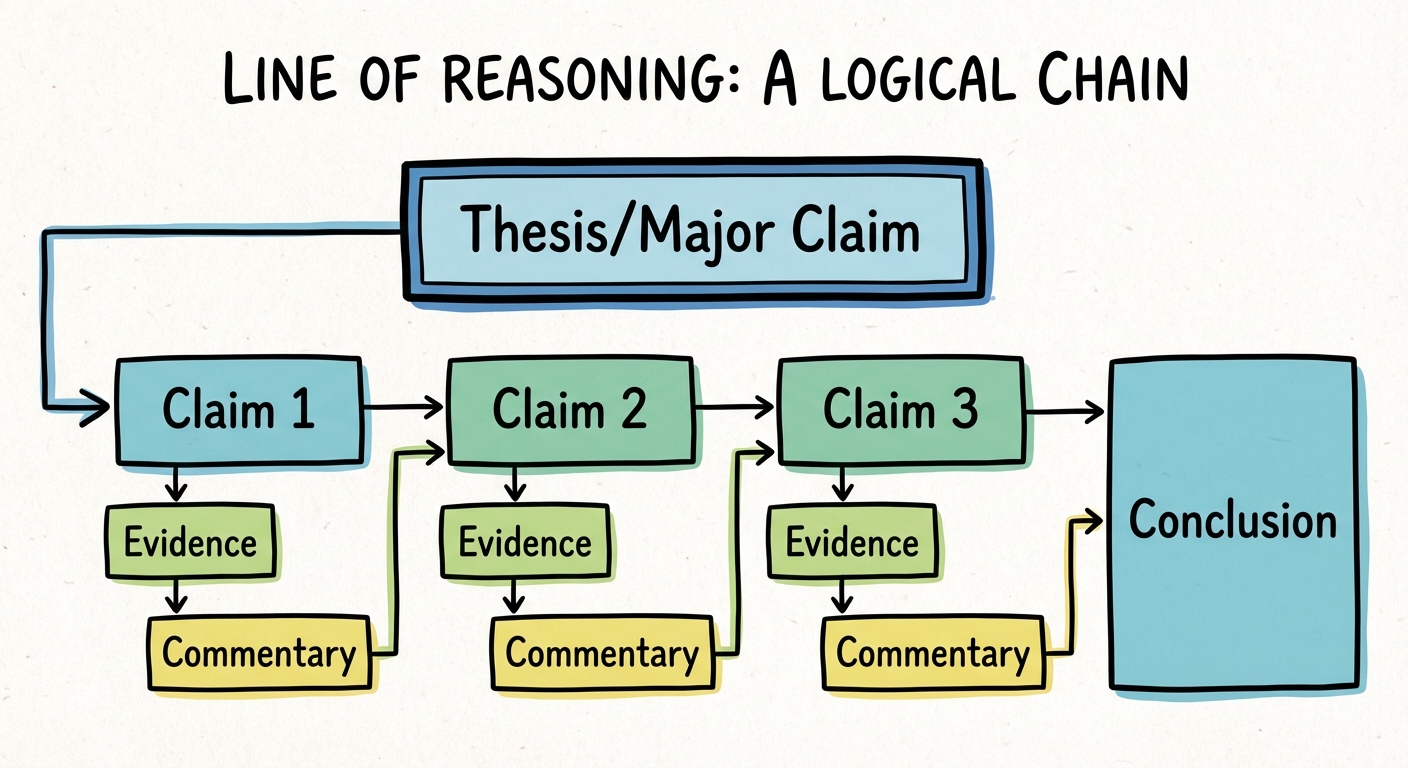
Analyzing the Line of Reasoning
When reading, ask yourself providing questions to find the thread:
- cohesion: Do the paragraphs stick together? Does paragraph 2 build on paragraph 1, or does it shift direction?
- Transitions: Look for signal words like "however," "consequently," "furthermore," or "conversely." These flag shifts in the line of reasoning.
- Structure: Why is the emotional anecdote at the end rather than the beginning? (Perhaps to leave a lasting impact after the logic is established).
Example Analysis:
"The author begins by establishing a claim of value regarding the ethics of space travel, supporting it with financial statistics (evidence). However, the line of reasoning shifts in the third paragraph when she introduces a personal anecdote, moving the argument from a logical cost-benefit analysis to an emotional appeal regarding human curiosity."
Common Mistakes & Pitfalls
Confusing Topic with Claim
- Mistake: "The author talks about global warming."
- Correction: "The author argues that global warming is an immediate economic threat."
- Why: A topic is what the text is about; a claim is the specific stance taken.
The "Laundry List" Analysis
- Mistake: Listing rhetorical devices (metaphor, simile, diction) without connecting them to the argument.
- Correction: Always connect the choice to the function. "The author uses a metaphor to contrast the rigidity of the law with the fluidity of justice."
Ignoring the Context
- Mistake: Analyzing a speech from 1850 as if it were written today.
- Correction: Always factor in the historical attitudes and events (Exigence and Context) influential at the time of writing.
Vague Audience Identification
- Mistake: Stating the audience is "the readers" or "everyone."
- Correction: Be specific. "The audience consists of skeptical voters who are concerned about tax increases."