Comprehensive Guide to ACT Algebra
Linear Equations and Inequalities
Linear algebra forms the backbone of the ACT Math section. Success here depends on mastering the relationship between algebraic adjustments and graphical representations.
Slope and Forms of Linear Equations
The slope ($m$) represents the rate of change or standard steepness of a line. It is calculated as "rise over run":
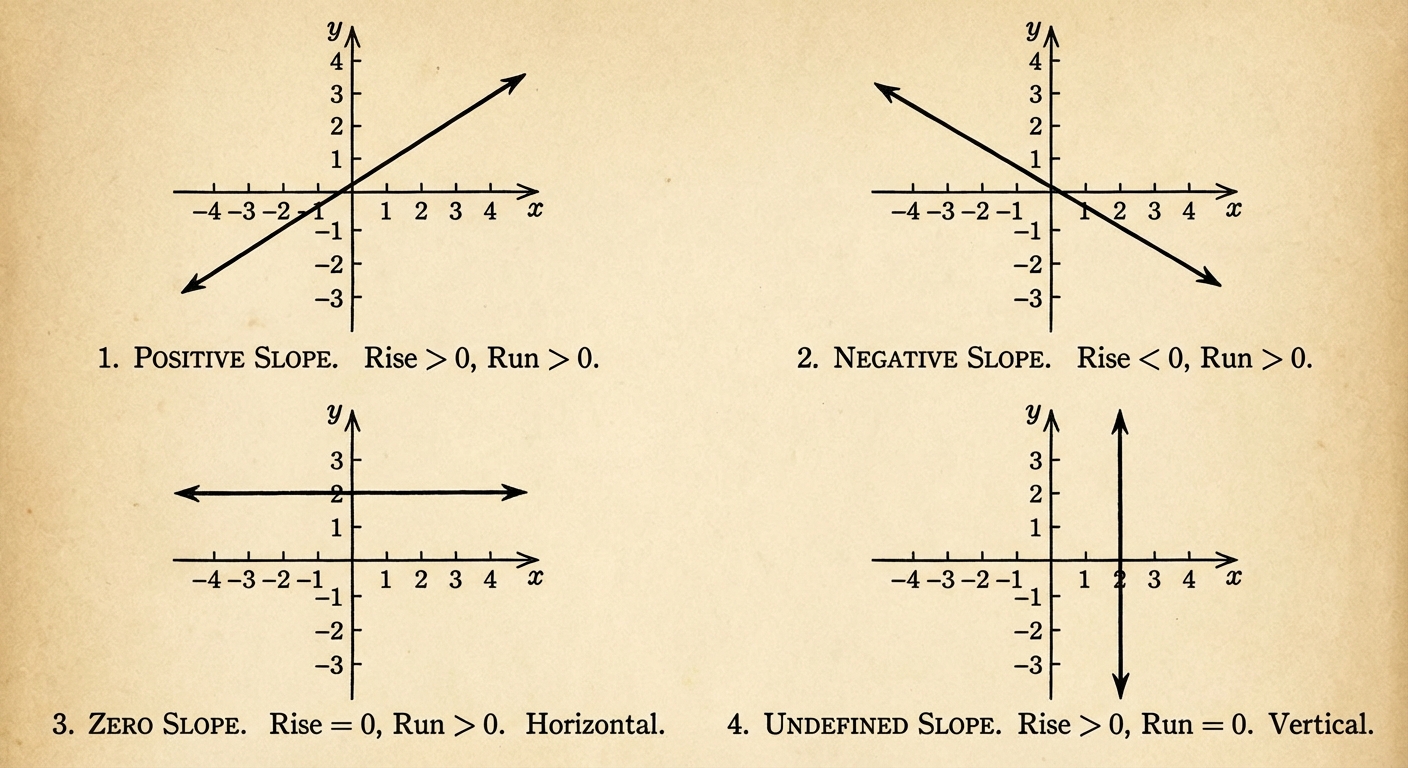
You must be fluent in converting between the three major linear forms:
- Slope-Intercept Form: $y = mx + b$
- Best for identifying the slope ($m$) and y-intercept ($b$) quickly.
- Point-Slope Form: $y - y1 = m(x - x1)$
- Best when you know a specific point $(x1, y1)$ and the slope.
- Standard Form: $Ax + By = C$
- Often used in systems of equations. To find the slope here, use $m = -\frac{A}{B}$.
Linear Inequalities
Solving inequalities follows the same rules as solving equations, with one crucial exception—the Direction Flip Rule.
- Rule: When you multiply or divide both sides of an inequality by a negative number, you MUST flip the direction of the inequality sign.
- Example: $-2x > 10 \rightarrow x < -5$
When graphing inequalities on a number line:
- Solid circle: $\leq$ or $\geq$ (value included)
- Open circle: $
Systems of Equations
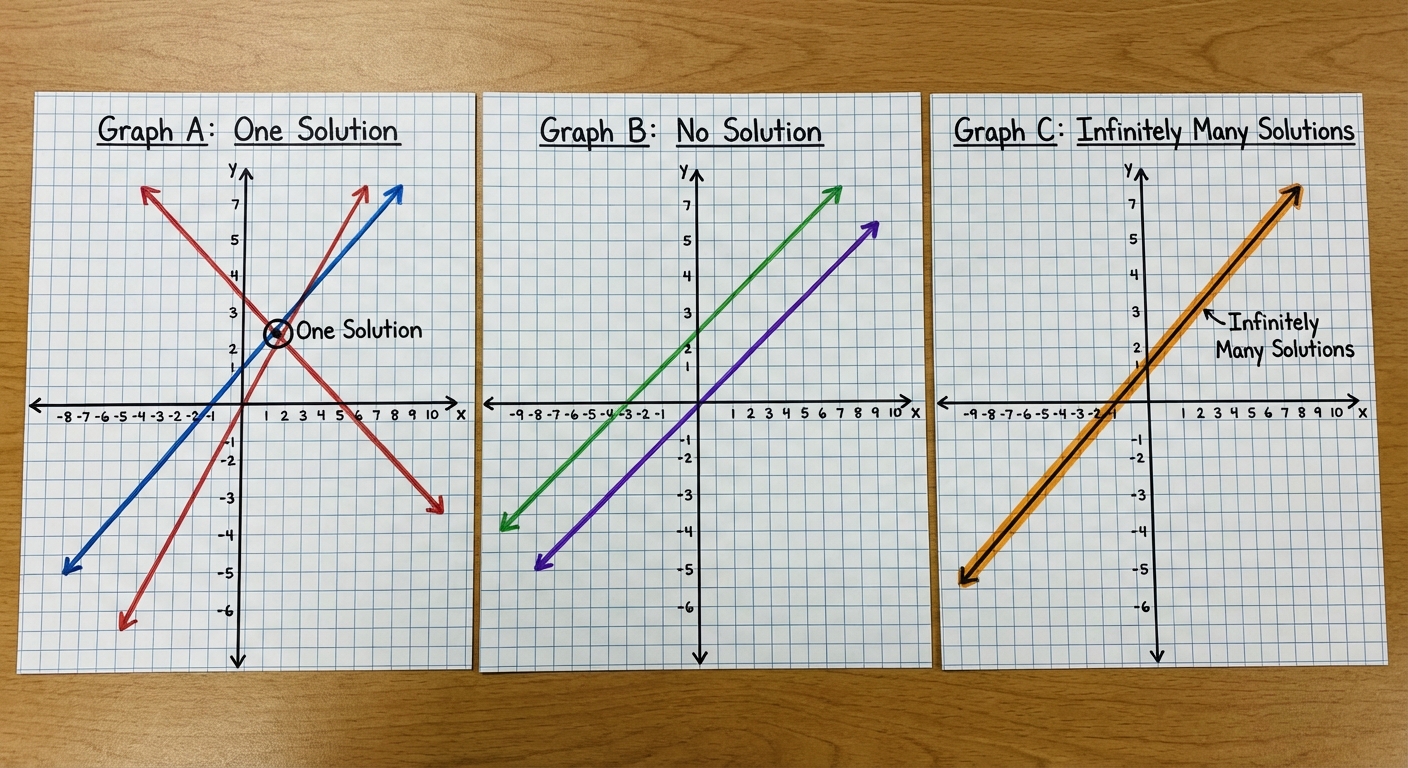
A system of equations is a set of two or more equations with the same variables. The solution is the point $(x, y)$ where the lines intersect.
Methods of Solving
- Substitution: Isolate a variable in one equation and plug it into the other.
- Elimination: Add or subtract entire equations to cancel out one variable.
Example: Solving via Elimination
Subtract the bottom equation from the top: $(2x-2x) + (3y - (-y)) = 12 - 4$
Plug $y=2$ back in to find $x$: $2x - 2 = 4 \rightarrow 2x = 6 \rightarrow x = 3$. Solution: $(3, 2)$.
Number of Solutions
The ACT often asks how many solutions a system has without asking you to solve it.
| Relationship | Slopes ($m$) | Y-Intercepts ($b$) | Solutions | Visual |
|---|---|---|---|---|
| Intersecting Lines | Different | Irrelevant | One Solution | Cross at one point |
| Parallel Lines | Same | Different | No Solution | Never touch |
| Coincident Lines | Same | Same | Infinitely Many | Same line |
Polynomial Expressions and Equations
Polynomials are expressions involving variables raised to whole-number powers.
Operations on Polynomials
- Addition/Subtraction: Combine like terms (terms with the same variable and exponent).
- $3x^2 + 2x^2 = 5x^2$
- Multiplication: Use the Distributive Property. For binomials, use the mnemonic FOIL.
- First, Outer, Inner, Last.
- $(x+3)(x-2) = x^2 - 2x + 3x - 6 = x^2 + x - 6$
Factoring Strategies
Reversing multiplication is essential for simplifying fractions or solving equations.
- GCF (Greatest Common Factor): Always check this first. $4x^3 - 8x^2 = 4x^2(x - 2)$.
- Difference of Squares: A very common ACT pattern.
- Example: $x^2 - 49 = (x+7)(x-7)$
- Perfect Square Trinomials:
Quadratic Equations and Factoring
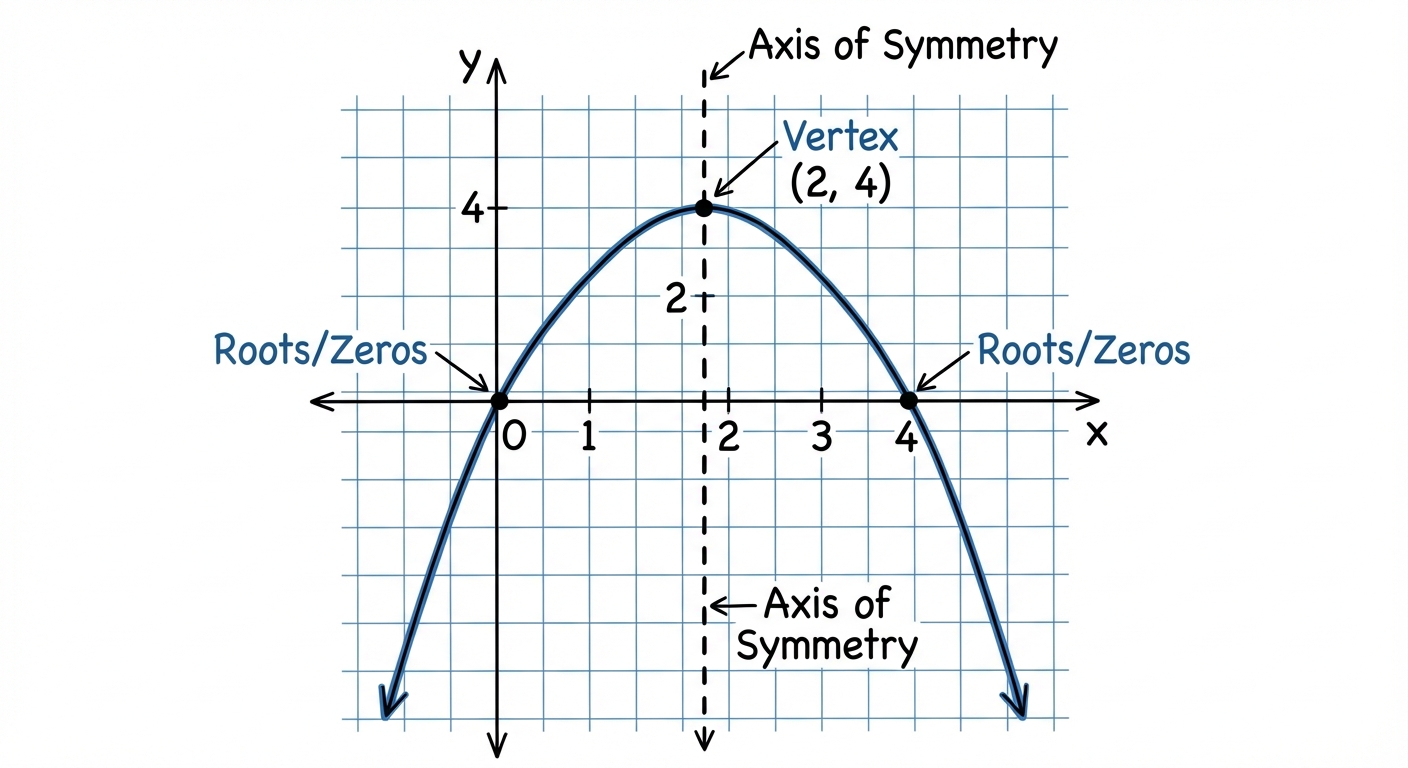
Quadratic equations generally appear in the form $ax^2 + bx + c = 0$. Their graphs are parabolas.
Methods to Solve for $x$ (Roots/Zeros)
- Factoring: Set the equation to 0, factor, and set each factor to 0.
- Quadratic Formula: Use this when factoring is difficult or impossible.
The Discriminant
The expression inside the square root, $b^2 - 4ac$, is called the discriminant. It tells you the nature of the roots:
- Positive: 2 real solutions (2 x-intercepts)
- Zero: 1 real double root (vertex touches x-axis)
- Negative: 2 imaginary/complex solutions (no x-intercepts)
Parabola Anatomy
- Vertex: The peak or valley of the graph. The x-coordinate of the vertex is found at $x = -\frac{b}{2a}$.
- Axis of Symmetry: The vertical line passing through the vertex.
Radical Expressions and Equations
Simplifying Radicals
To simplify $\sqrt{n}$, factor $n$ into a perfect square and a remainder.
- Example: $\sqrt{72} = \sqrt{36 \times 2} = \sqrt{36} \times \sqrt{2} = 6\sqrt{2}$
Rational Exponents
You answer many radical questions by converting them to fraction exponents:
- Example: $\sqrt[3]{x^2} = x^{\frac{2}{3}}$
Exponential Equations and Growth/Decay
Unlike linear functions which add a constant amount, exponential functions multiply by a constant rate.
Laws of Exponents
Memorize these rules to simplify expressions quickly:
- Product Rule: $x^a \cdot x^b = x^{a+b}$
- Quotient Rule: $\frac{x^a}{x^b} = x^{a-b}$
- Power Rule: $(x^a)^b = x^{ab}$
- Negative Exponents: $x^{-a} = \frac{1}{x^a}$
- Zero Exponent: $x^0 = 1$ (for any $x \neq 0$)
Growth and Decay Formula
- $A$: Final amount
- $P$: Principal (starting amount)
- $r$: Rate (as a decimal)
- $t$: Time
Note: If a population doubles every 3 hours, the formula changes base: $A = P(2)^{t/3}$.
Graphing and Modeling Expressions
Usually, these questions ask you to match a word problem to an equation or a graph.
Function Transformations
If you know what $f(x)$ looks like, you can predict:
- $f(x) + k$: Shift Up $k$ units
- $f(x) - k$: Shift Down $k$ units
- $f(x - h)$: Shift Right $h$ units (Note the sign reversal!)
- $f(x + h)$: Shift Left $h$ units
Modeling Translation Guide
- "Per," "each," "rate": usually indicates the slope ($m$).
- "Initial fee," "starting amount," "flat rate": usually indicates the y-intercept ($b$).
- "Product of," "area": usually indicates a quadratic or polynomial.
Common Mistakes & Pitfalls
- Distributing the Negative:
- Mistake: $-(3x - 5) \rightarrow -3x - 5$
- Correction: Distribute to both terms: $-3x + 5$.
- The "Freshman Dream":
- Mistake: $(x + y)^2 = x^2 + y^2$
- Correction: You must FOIL: $(x+y)(x+y) = x^2 + 2xy + y^2$.
- Variable in Denominator:
- Mistake: Multiplying by $x$ in an inequality without knowing if $x$ is positive or negative.
- Correction: If you don't know the sign of $x$, you cannot multiply across an inequality (because you don't know whether to flip the sign).
- Radical Illusions:
- Mistake: $\sqrt{x^2 + 9} = x + 3$
- Correction: Roots do not distribute over addition. $\sqrt{x^2+9}$ cannot be simplified further.