Comprehensive Guide to AP Gov Unit 3: Civil Rights
The Fourteenth Amendment and Equal Protection
Civil Rights differ fundamentally from Civil Liberties. While Civil Liberties are protections from government intrusion (like free speech or privacy), Civil Rights are protections provided by the government against discrimination. The cornerstone of Civil Rights in the United States is the Fourteenth Amendment.
The Equal Protection Clause
Ratified in 1868 during Reconstruction, the Fourteenth Amendment contains several vital clauses. For Civil Rights, the most critical is the Equal Protection Clause.
“No State shall… deny to any person within its jurisdiction the equal protection of the laws.”
This clause provides the legal basis for challenging discrimination based on race, gender, and other characteristics. It forces states to govern impartially and prevents them from drawing unreasonable distinctions between groups of people.
Standards of Judicial Review (Scrutiny)
Not all discrimination is illegal (e.g., the government can discriminate against 10-year-olds by not letting them drive). To determine if a law violates the Equal Protection Clause, the Supreme Court uses three main tests, also known as standards of review.
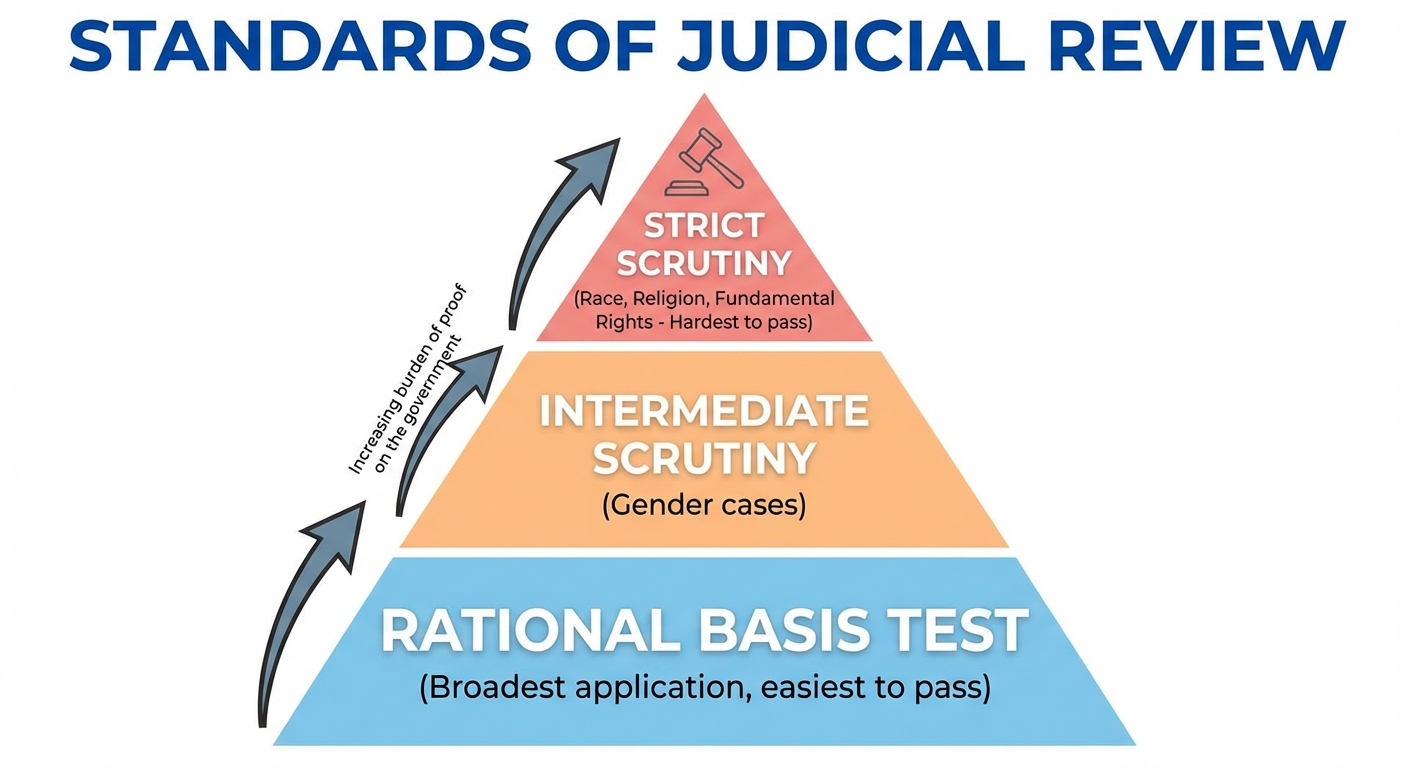
| Level of Scrutiny | Used For | The Standard (The Test) | Burden of Proof |
|---|---|---|---|
| Strict Scrutiny | Race, Ethnicity, Religion, Fundamental Rights | The law must serve a compelling state interest and be narrowly tailored (least restrictive means). | Government |
| Intermediate Scrutiny | Gender (Sex) | The law must serve an important government objective and be substantially related to achieving it. | Government |
| Rational Basis | Age, Income, Wealth, etc. | The law must have a reasonable relationship to a legitimate state interest. | Challenger |
Social Movements and Equal Protection
Constitutional amendments often lie dormant until social movements pressure the government to enforce them. The 20th century featured diverse groups utilizing the Equal Protection Clause to demand equality.
The African American Civil Rights Movement
This movement sought to end de jure segregation (segregation by law/Jim Crow) and disenfranchisement.
Key Document: Letter from a Birmingham Jail (Martin Luther King Jr.)
This is a required foundational document for the AP Gov exam. Written in 1963, King argues against the concept of "waiting" for rights.
- Key Argument: Nonviolent direct action (sit-ins, marches) is necessary to create "constructive tension" that forces a community to negotiate.
- Just vs. Unjust Laws: Drawing on natural rights, King argues that an unjust law (one that degrades human personality or is inflicted on a minority that had no vote in enacting it) is no law at all.
- The “White Moderate”: King expresses disappointment with white moderates who prefer "order" over "justice,” arguing that they are the biggest stumbling block to freedom.
The Women’s Rights Movement
Sparked by the "second wave" of feminism in the 1960s and the National Organization for Women (NOW).
- Goals: Equal pay, ending employment discrimination, and reproductive rights.
- Strategy: Utilized the Equal Protection Clause to argue that laws distinguishing citizens by sex were unconstitutional (pushing the courts toward Intermediate Scrutiny).
LGBTQ+ and Disability Rights
- Pro-Life and Pro-Choice Movements: Both sides of the abortion debate utilize political action committees, mass protests, and litigation to influence policy regarding the rights of the unborn versus the rights of the mother, often invoking differing interpretations of liberty and equality.
- Disability Rights: Culminated in the Americans with Disabilities Act (ADA) of 1990, mandating public accommodations for those with disabilities.
Government Responses to Social Movements
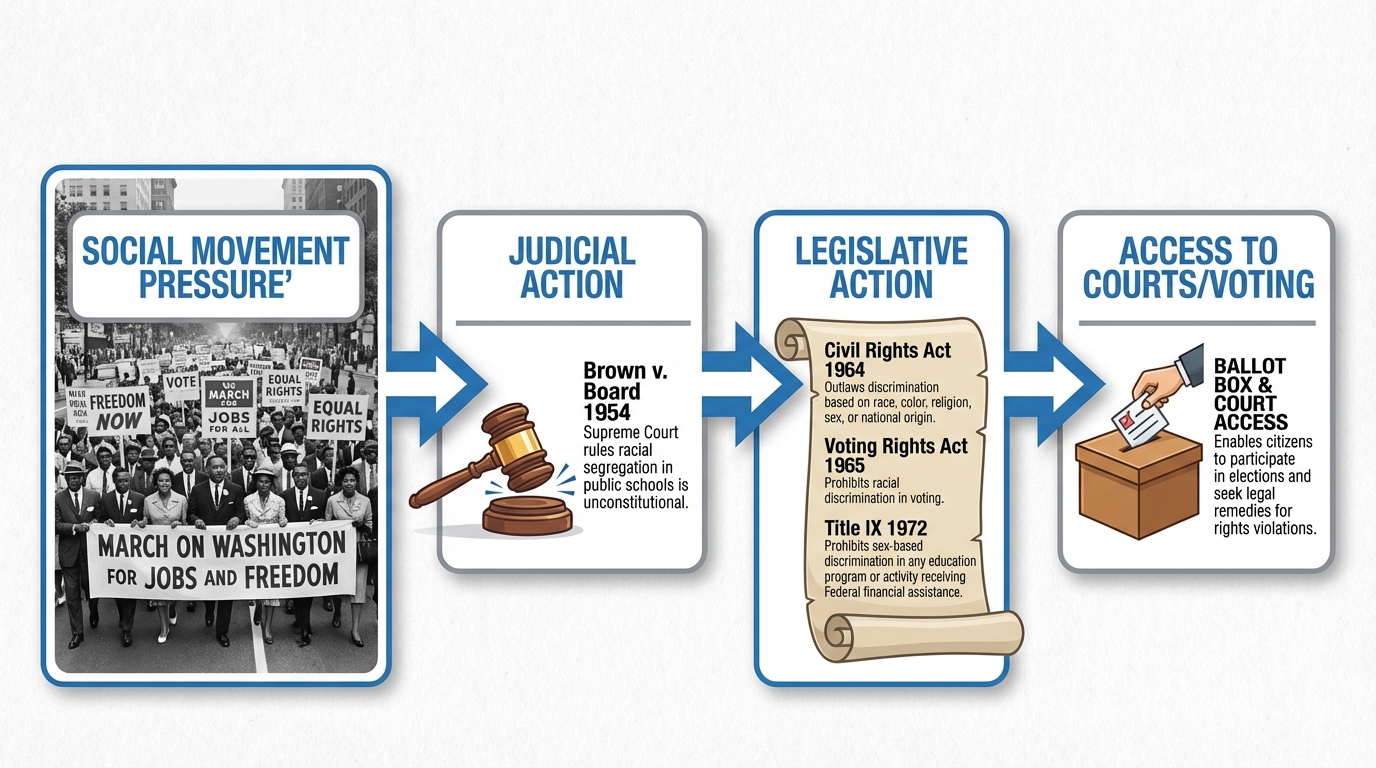
Social movements generate the political will necessary for the Legislative, Executive, and Judicial branches to act.
Judicial Response: Brown v. Board of Education (1954)
This required Supreme Court case is the turning point for Civil Rights application.
- Background: African American students were denied admittance to certain public schools based on laws allowing public education to be segregated by race.
- Constitutional Issue: Does the segregation of public education based solely on race violate the Equal Protection Clause of the 14th Amendment?
- Holding: Yes. The Court unanimously overturned Plessy v. Ferguson (1896).
- Reasoning: Chief Justice Earl Warren wrote that "separate educational facilities are inherently unequal." Segregation generates a feeling of inferiority in minority children that affects their hearts and minds, which cannot be undone.
Legislative Responses
When the Courts (Judiciary) declare a right, Congress (Legislature) often passes laws to enforce it.
1. The Civil Rights Act of 1964
- Purpose: To enforce the 14th Amendment and end Jim Crow.
- Key Provisions:
- Barred discrimination in public accommodations (hotels, restaurants) based on race, color, religion, or national origin.
- Created the Equal Employment Opportunity Commission (EEOC) to enforce bans on employment discrimination.
- Constitutional Basis: Congress engaged its power under the Commerce Clause to regulate public accommodations (since hotels/restaurants affect interstate commerce).
2. The Voting Rights Act of 1965
- Purpose: To enforce the 15th Amendment and eliminate barriers to voting.
- Key Provisions:
- Banned literacy tests.
- Established federal oversight (preclearance) of elections in states with a history of discrimination.
- Significantly increased African American voter registration and the number of minority elected officials.
3. Title IX of the Education Amendments Act of 1972
- Definition: “No person in the United States shall, on the basis of sex, be excluded from participation in… any education program or activity receiving Federal financial assistance.”
- Impact: Most famously applied to high school and college athletics, requiring schools to offer equal opportunities for women in sports. It also addresses sexual harassment and violence on campus.
Affirmative Action and Policy
Affirmative Action refers to policies designed to address the effects of past discrimination by giving special consideration to members of historically disadvantaged groups in areas like employment and education.
The Constitutional Debate
This is a clash between competing interpretations of the Equal Protection Clause:
- The "Colorblind" Constitution: The Constitution prohibits any classification based on race, even if intended to help minorities.
- Substantive Equality: The Constitution permits race-conscious policies if they remedy past state-sponsored discrimination and promote diversity.
Evolution of Case Law
- Regents of the Univ. of California v. Bakke (1978): The Court ruled that while strict quotas were unconstitutional (violating the 14th Amendment), race could be used as one factor among many in admissions.
- Grutter v. Bollinger (2003): Upheld the use of race as a "plus factor" to achieve a "critical mass" of diversity, which the Court deemed a compelling state interest.
- Students for Fair Admissions v. Harvard / UNC (2023):
- Current Precedent: The Supreme Court effectively struck down affirmative action in college admissions.
- Reasoning: The Court held that admissions programs generally cannot use race as a negative or positive factor, arguing that doing so violates the Equal Protection Clause. The "benefits of diversity" were deemed too vague to justify strict scrutiny violations.
- Note for Students: Be aware that while discussing one's personal experience with race in an essay is permitted, institutional selection based on race is currently unconstitutional.
Common Mistakes & Pitfalls
Civil Liberties vs. Civil Rights:
- Mistake: Using the terms interchangeably.
- Correction: Liberties = Restrictions on government (e.g., "Congress shall make no law…"). Rights = Government stepping in to protect groups from discrimination (e.g., Civil Rights Act).
Due Process vs. Equal Protection:
- Mistake: Citing the Due Process Clause (14th Amendment) for discrimination cases.
- Correction: Use Due Process for issues involving the deprivation of life, liberty, or property (privacy, fair trial). Use Equal Protection for issues involving discrimination or treating groups differently.
Martin Luther King Jr.'s Focus:
- Mistake: Thinking Letter from a Birmingham Jail is just a plea for peace.
- Correction: It is a strategic defense of nonviolent tension. King argues that without creating tension/crisis, the majority will never voluntarily give up power.
Brown v. Board Scope:
- Mistake: Thinking Brown ended all segregation immediately.
- Correction: Brown only ended de jure (legal) segregation in schools. It took the Civil Rights Act of 1964 and years of enforcement to end segregation in other public areas, and de facto (by custom/housing patterns) segregation persists today.