ACT Math: Foundation Concepts and Complexity Management
Rates, Ratios, and Proportional Relationships
The Integrating Essential Skills category often tests your ability to handle relationships between quantities. While the math itself (multiplication/division) is often simple, the phrasing of the questions can be complex.
Ratio and Proportion Basics
A ratio compares two quantities, usually written as $a:b$ or $\frac{a}{b}$. A proportion states that two ratios are equal.
Properties to remember:
- Part-to-Part vs. Part-to-Whole: If a class has boys and girls in a ratio of $2:3$, the ratio of boys to the total class is $2:5$. Always identify the "whole" denominator.
- Direct Variation: Many ACT problems use value scaling. If $y$ varies directly as $x$, then $y = kx$, where $k$ is the constant of proportionality.
Key Formula:
Unit Rates and Density
A unit rate describes how many units of the first quantity correspond to one unit of the second quantity (e.g., miles per hour, dollars per ounce). This often extends to density, defined generally as:
Example Scenario:
A city has a population of 50,000 and an area of 20 square miles. The population density is $ \frac{50,000}{20} = 2,500 $ people per square mile. If the city annexes 5 more square miles containing 2,000 people, the new density requires adding the totals first: $ \frac{52,000}{25} = 2,080 $ people/sq mi.
Percentages and Percent Change
Percentages are ubiquitous in the Essential Skills section, often appearing in multi-step financial contexts (discounts, taxes, interest).
The Golden Formulas
Basic Percent:
Percent Change (Increase/Decrease):
Note: If the result is negative, it is a percent decrease.
Multi-Step Percentages
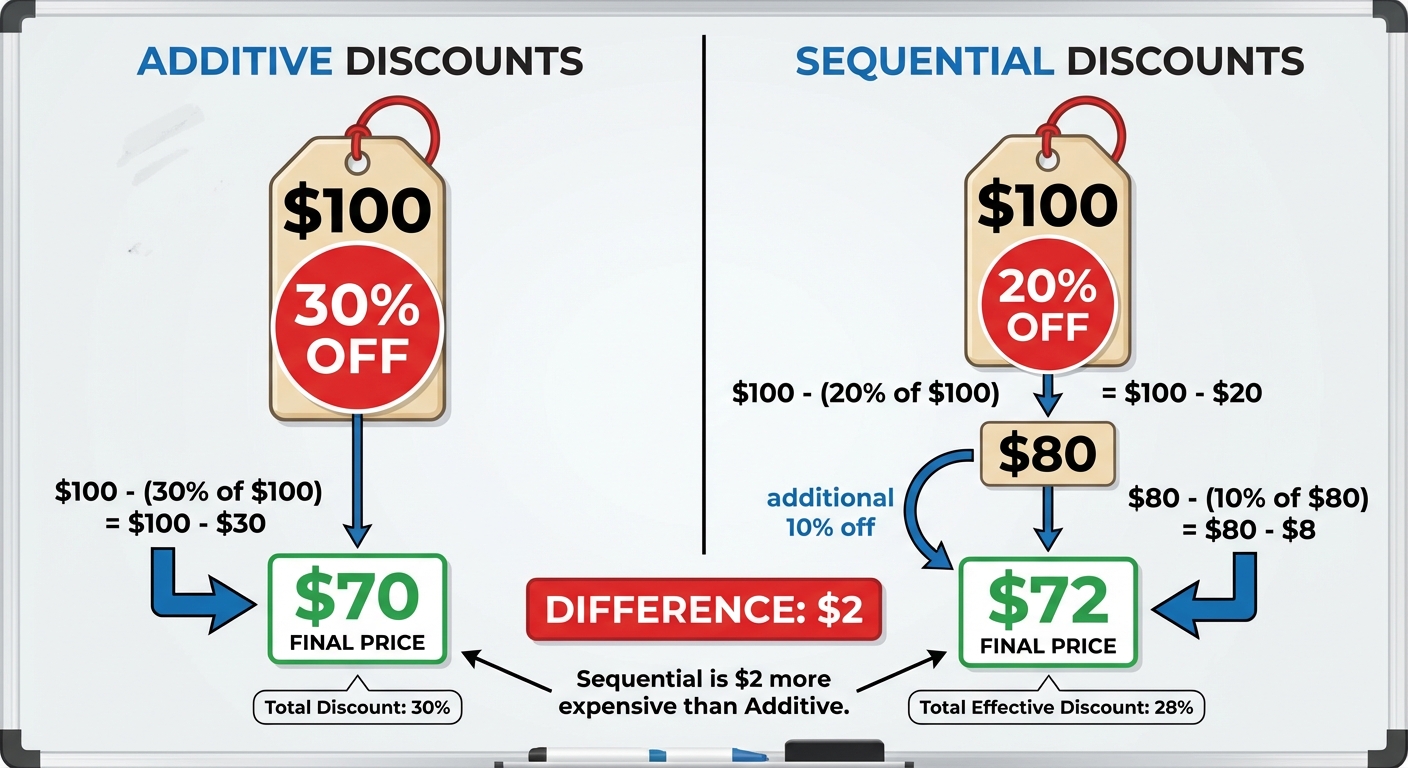
Sequential Change: A common trap is assuming percentages add up linearly.
- Scenario: A shirt is discounted by 20%, then an additional 10% is taken off the discounted price.
- Calculation: Start with price $x$. After first discount: $0.80x$. After second discount: $0.90(0.80x) = 0.72x$.
- Result: The total discount is $28\%$, not $30\%$.
Unit Conversions (Dimensional Analysis)
The ACT tests your ability to convert units, specifically when units are squared or cubed.
The Chain Method
To convert units, multiply by conversion factors equal to 1 so that unwanted units cancel out.
Squared and Cubed Units Trap
When converting area or volume, you must square or cube the linear conversion factor.
Example: Convert 10 square yards ($yd^2$) to square feet ($ft^2$).
- Wrong: $10 \times 3 = 30 ft^2$
- Right: Since $1 yd = 3 ft$, then $(1 yd)^2 = (3 ft)^2$, so $1 yd^2 = 9 ft^2$.
Mean, Median, and Measures of Center
Statistics in this section focus on missing data problems and weighted averages.
Definitions
- Mean (Average): sum of terms / number of terms.
- Median: The middle value when values are ordered least to greatest. If there is an even number of items, average the two middle numbers.
- Mode: The most frequent value.
- Range: Max value - Min value.
The "Sum" Trick
Most harder problems don't ask you to find the average; they give you the average and ask for a missing value. Always rewrite the average formula as:
Worked Problem:
A student averages 85 on 4 tests. What must they score on the 5th test to raise the average to 87?
- Calculate current sum: $85 \times 4 = 340$.
- Calculate desired sum: $87 \times 5 = 435$.
- Find the difference: $435 - 340 = 95$.
The student must score a 95.
Weighted Averages
When groups are of different sizes, a simple average of the averages will not work.
Area, Surface Area, and Volume
While geometry has its own section, "Integrating Essential Skills" uses geometry in practical applications (e.g., "how much paint is needed for this wall?").
Essential Formulas
| Shape | Area / Volume |
|---|---|
| Rectangle | $A = lw$, $P = 2l + 2w$ |
| Triangle | $A = \frac{1}{2}bh$ |
| Circle | $A = \pi r^2$, $C = 2\pi r$ |
| Rectangular Prism | $V = lwh$, $SA = 2(lw + lh + wh)$ |
| Cylinder | $V = \pi r^2 h$ |
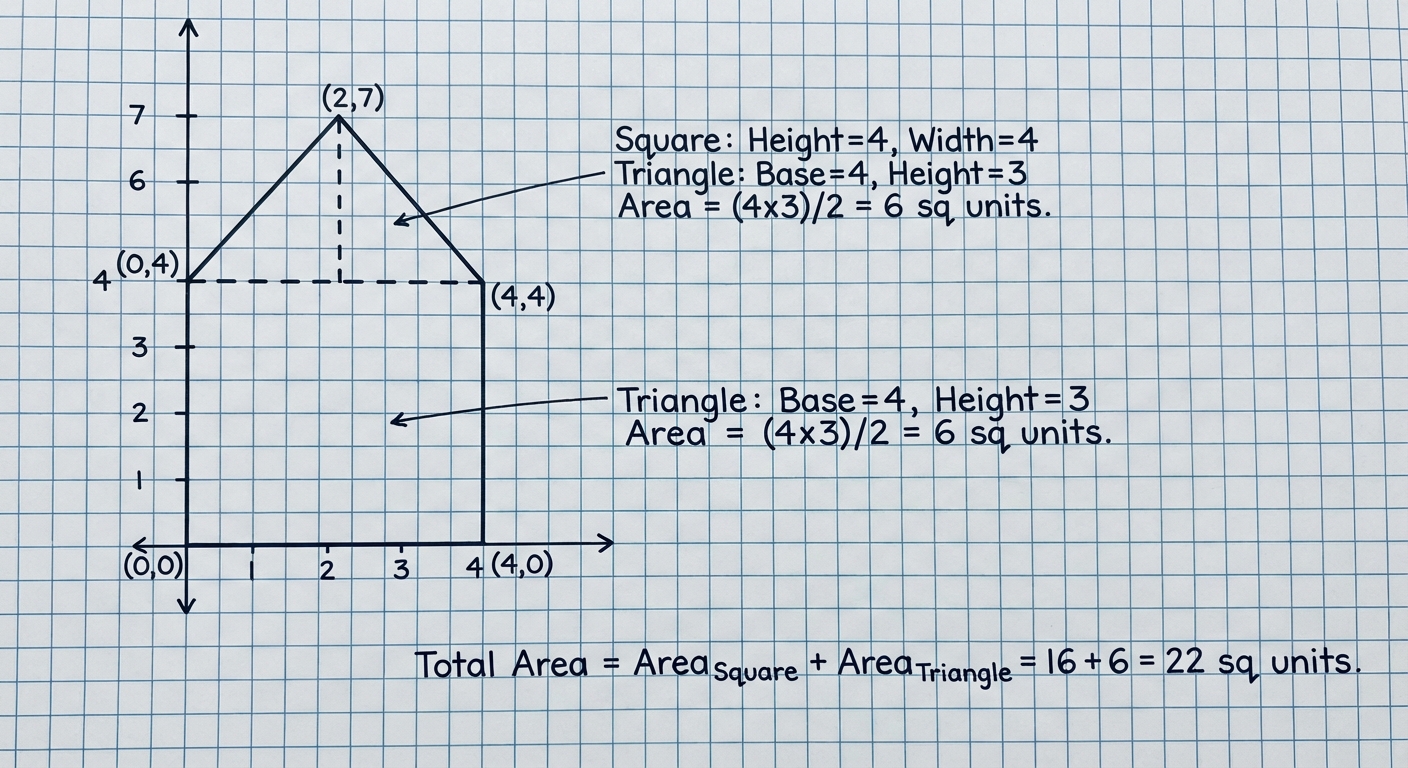
Composite Figures
Advanced problems involve composite shapes (shapes made of two or more standard shapes). Strategy:
- Break the shape into simpler parts (rectangles, triangles).
- Add areas together (or subtract "holes" or empty space).
Mathematical Modeling & Multi-Step Solving
This is the core of "Integrating" essential skills. These questions are often word-heavy.
Translating English to Math
- "is": $=$
- "of": $\times$ (multiplication)
- "per" / "for every": $\div$ (division or ratio)
- "less than": usually indicates subtraction order reversal (e.g., "5 less than x" is $x - 5$, not $5 - x$).
Best Practices for Word Problems
- Define Variables: Write down explicitly what $x$ represents (e.g., $x =$ number of adult tickets).
- Identify Constraints: Look for limits (e.g., "budget cannot exceed $500").
- Check Logic: Does a negative answer make sense for time or distance? (No).
Expressing Numbers in Different Ways
Scientific Notation
Used for very large or very small numbers.
Format: $a \times 10^n$, where $1 \le |a| < 10$.
- Small numbers ($0 < x < 1$): Negative exponent.
- Large numbers ($x > 10$): Positive exponent.
Factors and Multiples
- Greatest Common Factor (GCF): The largest number that divides evenly into two or more numbers.
- Least Common Multiple (LCM): The smallest number that is a multiple of two or more numbers.
- Tip: These concepts are often tested in scheduling problems (e.g., "Bus A leaves every 12 mins, Bus B every 18 mins. When do they leave together?"). Use LCM.
Common Mistakes & Pitfalls
- Unit Blindness: Solving for minutes when the rate is in hours. Always highlight units.
- Radius vs. Diameter: The prompt gives the diameter, but the formula requires radius. Default action: Divide diameter by 2 immediately.
- Percent Increase vs. "Percent Of": "150% of X" is $1.5x$. "150% more than X" is $x + 1.5x = 2.5x$. Read carefully.
- Average Rate Trap: If you drive 60mph there and 40mph back, your average speed is NOT 50mph. You spend more time driving slower. (Harmonic mean applies, or calculating Total Distance / Total Time).
- Distribution of Negatives: In expressions like $3x - (2y + 5)$, students often forget to distribute the negative to the 5. Correct: $3x - 2y - 5$.