Mastering AP Calculus AB: Unit 1 Limits Guide
Defining Limits and Using Limit Notation
Calculus is built upon the concept of the Limit. Unlike Algebra, where we calculate exactly what a function equals at a specific point, Calculus asks: "What value does the function approach as we get closer and closer to a specific point?"
The Intuitive Definition
The limit of a function $f(x)$ as $x$ approaches a value $c$ is the number $L$ if all values of $f(x)$ get arbitrarily close to $L$ as $x$ gets sufficiently close to $c$ (but not approximately equal to $c$).
Notation:
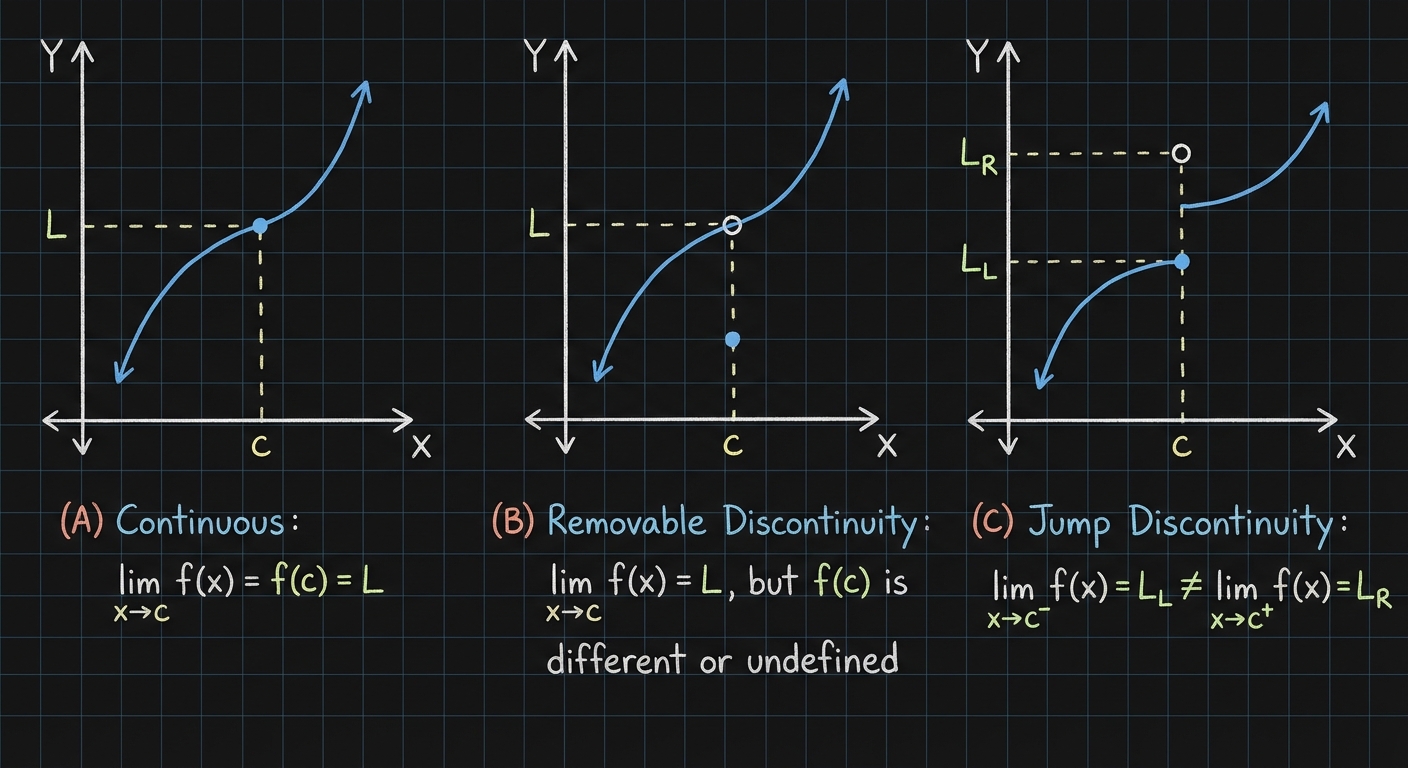
It is crucial to understand that $f(c)$ (the value of the function at $c$) does not impact the limit. The point $(c, f(c))$ might be undefined, a hole, or defined elsewhere; the limit only cares about the journey approaching $c$, not the destination.
One-Sided vs. Two-Sided Limits
For a general (two-sided) limit to exist, the function must approach the same height from both the left and the right.
- Left-Hand Limit: Approaching $c$ from values smaller than $c$.
Notation: $\lim_{x \to c^-} f(x)$ - Right-Hand Limit: Approaching $c$ from values larger than $c$.
Notation: $\lim_{x \to c^+} f(x)$
The Existence Theorem:
$\lim{x \to c} f(x) = L$ if and only if:
If the left and right sides approach different values, the limit Does Not Exist (DNE).
Estimating Limit Values from Graphs and Tables
Before using algebra, you must be able to visually and numerically estimate limits.
Graphical Approach
When looking at a graph, trace the curve with your fingers from both the left and right sides toward the target $x$-value.
- Continuous Path: If your fingers meet, the limit is the $y$-value where they meet.
- Holes (Removable Discontinuity): If your fingers meet at an open circle (a hole), the limit exists and is the $y$-value of the hole.
- Jumps: If your fingers are at different heights, the limit DNE.
- Vertical Asymptotes: If the graph shoots up to $\infty$ or down to $-\infty$, the limit technically DNE (because infinity is not a real number), though we often specify the behavior as $\pm \infty$.
Numerical Approach (Tables)
To estimate $\lim_{x \to 2} f(x)$, plug in $x$-values getting incrementally closer to 2 from both sides.
| $x$ (Left) | $1.9$ | $1.99$ | $1.999$ | 2 | $2.001$ | $2.01$ | $2.1$ | $x$ (Right) |
|---|---|---|---|---|---|---|---|---|
| $f(x)$ | $4.7$ | $4.97$ | $4.997$ | ? | $5.003$ | $5.03$ | $5.3$ | $f(x)$ |
Observation: In this table, as $x \to 2$, $f(x)$ approaches 5. Therefore, we estimate $\lim_{x \to 2} f(x) = 5$.
Determining Limits Using Algebraic Properties
Once we move past estimation, we use algebraic laws to solve limits exactly. Assuming $\lim{x \to c} f(x)$ and $\lim{x \to c} g(x)$ exist:
- Sum/Difference Rule: $\lim [f(x) \pm g(x)] = \lim f(x) \pm \lim g(x)$
- Product Rule: $\lim [f(x) \cdot g(x)] = \lim f(x) \cdot \lim g(x)$
- Quotient Rule: $\lim \frac{f(x)}{g(x)} = \frac{\lim f(x)}{\lim g(x)}$ (provided denominator $\neq 0$)
- Composite Function: $\lim{x \to c} f(g(x)) = f(\lim{x \to c} g(x))$ (requires continuity)
Procedure 1: Direct Substitution
Always try this first. To find $\lim_{x \to c} f(x)$, simply evaluate $f(c)$.
- Example: $\lim_{x \to 3} (x^2 + 2x) = (3)^2 + 2(3) = 9 + 6 = 15$.
If the function is continuous at $c$ (like polynomials, sin, cos, $e^x$), this works immediately.
Selecting Procedures for Determining Limits
If Direct Substitution fails, you usually encounter one of two scenarios. It is vital to distinguish between them.
Scenario A: The Non-Zero Denominator (Vertical Asymptote)
If you get a form like $\frac{5}{0}$ or $\frac{-1}{0}$ (Non-zero / Zero):
- The limit Does Not Exist.
- There is a Vertical Asymptote at $x=c$.
- The behavior is either $\infty$, $-\infty$, or approaching different infinities from each side.
Scenario B: The Indeterminate Form
If you get the form $\frac{0}{0}$:
- STOP! This does NOT mean the limit is undefined or zero.
- It means "we don't know yet/more work is required."
- There is usually a hole at this point.
Strategies to fix $\frac{0}{0}$:
1. Factoring and Canceling
Used for rational functions (polynomials).
Example: Limit of Rational Function
- Direct sub yields $\frac{0}{0}$.
- Factor numerator: $(x-2)(x+2)$.
- Cancel common term: $\lim_{x \to 2} (x+2)$.
- Retry Direct Sub: $2+2 = 4$.
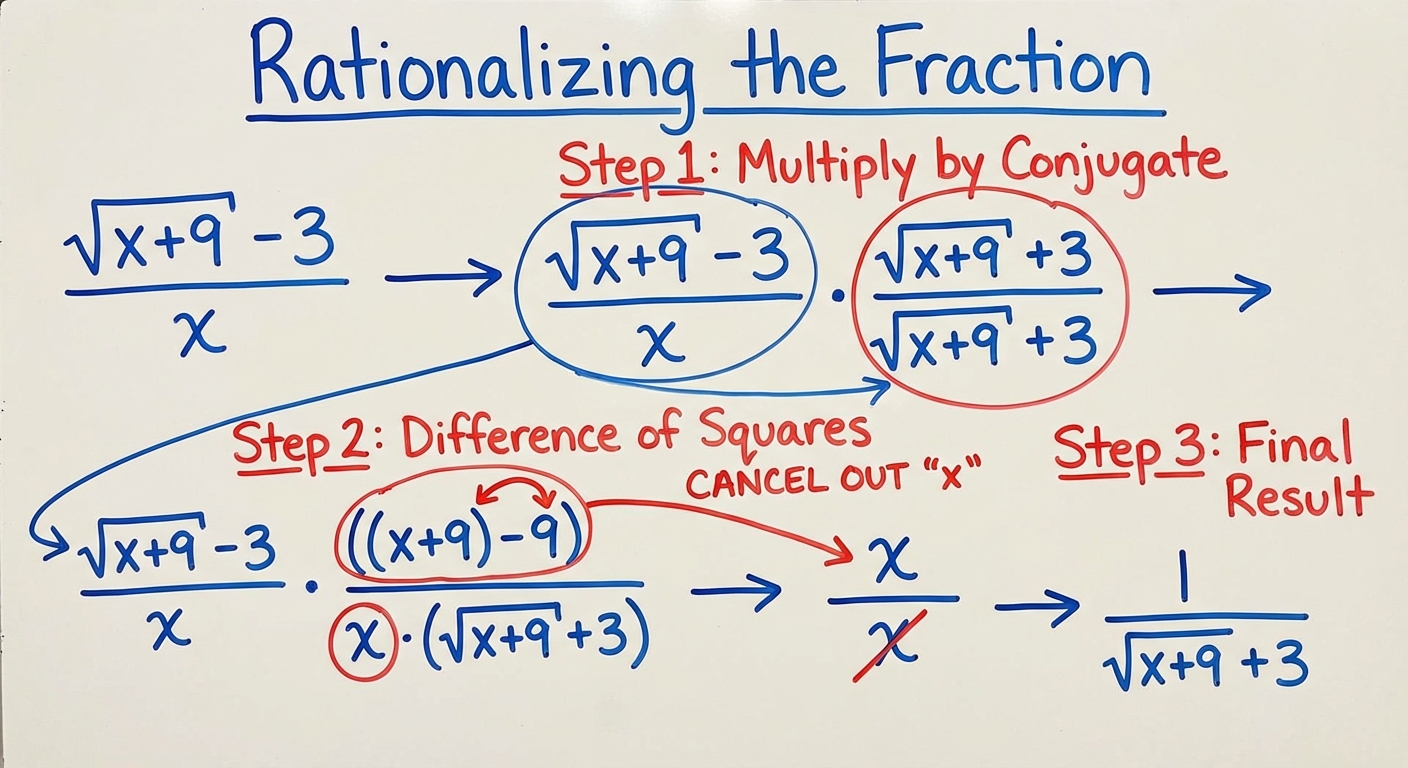
2. Rationalization (Conjugates)
Used when you see square roots.
Example:
Multiply numerator and denominator by the conjugate $(\sqrt{x+9} + 3)$. This usually clears the root and allows you to cancel the $x$ causing the zero.
3. Special Trigonometric Limits
Memorize these two special limits for $x \to 0$. They appear frequently.
The Squeeze Theorem
The Squeeze Theorem (or Sandwich Theorem) is used for complicated functions that oscillate wildly (like sine or cosine of high frequencies) so that algebraic manipulation doesn't work.
The Theorem:
If $g(x) \le f(x) \le h(x)$ for all $x$ near $c$ (except possibly at $c$), and:
Then:
Visual: Think of $f(x)$ as a car