Unit 4: Modern Black Politics, Feminism, and Social Justice
Black Feminism and Intersectionality
The post-Civil Rights era paved the way for a more nuanced understanding of how race and gender interact. While the Civil Rights Movement focused largely on race and the Feminist Movement on gender, Black women often found themselves marginalized in both. This section explores the theoretical frameworks developed to address this double burden.
The Roots of Black Feminism
Black Feminism differs from mainstream (often criticized as "white") feminism by centering the specific historical and social experiences of Black African American women. It asserts that the liberation of Black women entails the liberation of all people, as it requires the destruction of racism, sexism, and class oppression.
The Combahee River Collective
In 1974, a group of Black feminists formed the Combahee River Collective. Their 1977 statement is a foundational text in Black feminist thought.
- Key Concept: Interlocking Oppressions: They argued that race, class, and gender oppression are not separate issues but work together (interlock) to create the condition of Black women's lives.
- Identity Politics: This group is credited with coining the term "identity politics"—the idea that the most profound and potentially radical politics come directly out of one's own identity, as opposed to working to end someone else's oppression.
Intersectionality
Coined by legal scholar Kimberlé Crenshaw in 1989, Intersectionality is a framework for understanding how various forms of inequality (such as racism, sexism, and classism) operate together and exacerbate each other.
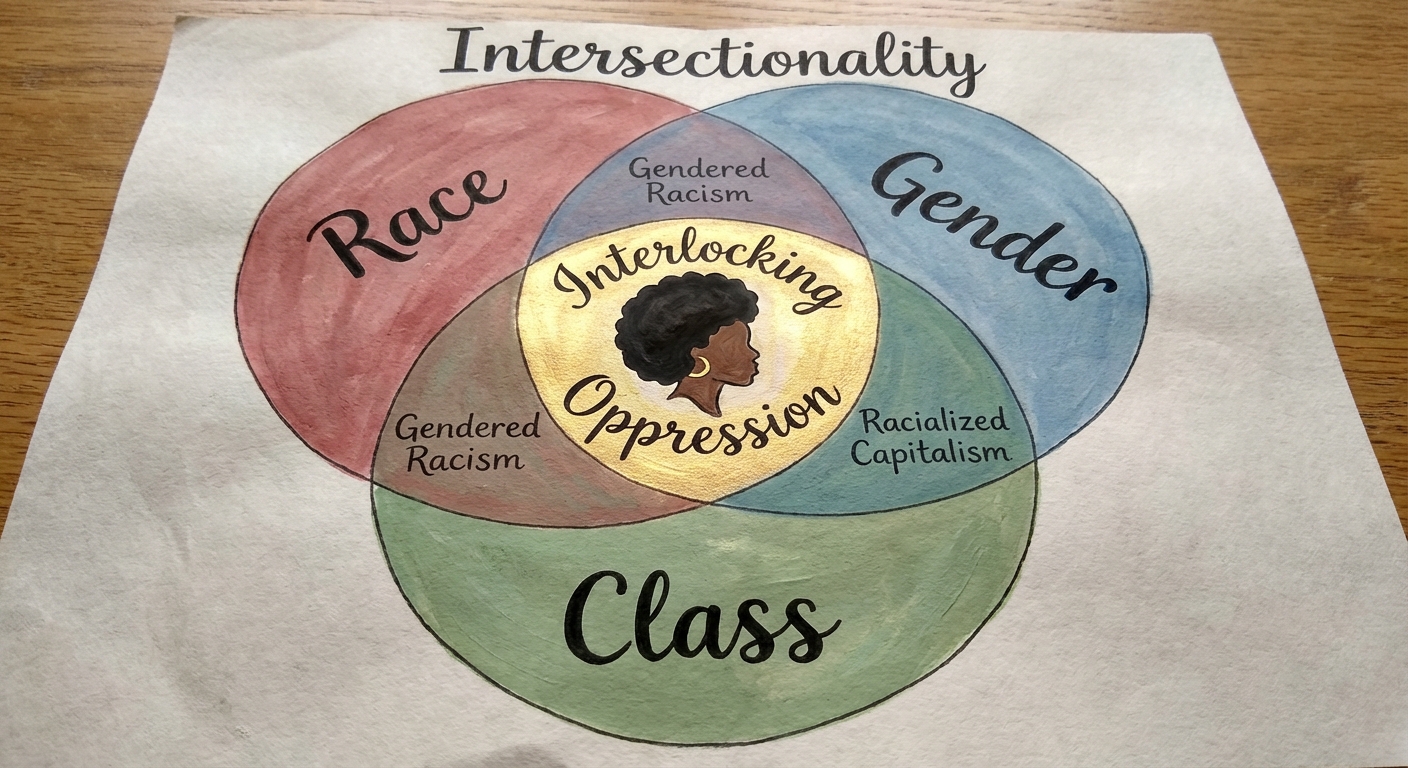
The "Traffic Intersection" Analogy:
Crenshaw famously described discrimination like traffic at an intersection. If a Black woman is harmed at an intersection, the injury could result from cars traveling from any number of directions (race, gender, etc.). Sometimes, the injury is caused by the collision of both.
"When Black women were excluded from the feminist movement, it was because they were Black; when they were excluded from the anti-racist movement, it was because they were women."
Womanism vs. Feminism
In 1983, author Alice Walker introduced the term Womanism to distinguish Black women's activism from white feminism.
| Feature | Feminism (Mainstream/Second Wave) | Womanism |
|---|---|---|
| Primary Focus | Gender equality; often centered middle-class white women's concerns (e.g., workforce entry). | The survival and wholeness of the entire Black community (men, women, and children). |
| Approach | Often viewed separation from men as necessary for liberation. | Often committed to the "survival and wholeness of entire people," male and female. |
| Famous Quote | "The personal is political." | "Womanist is to feminist as purple is to lavender." (Walker) |
African American Political Participation
Following the passage of the Voting Rights Act of 1965 (VRA), African American strategies shifted from "protest to politics"—focusing on electing Black representatives and influencing policy from within the system.
The Rise of Black Elected Officials
The late 20th century saw a dramatic increase in Black representation at the local, state, and federal levels.
- Shirley Chisholm: In 1968, she became the first Black woman elected to the U.S. Congress. In 1972, she became the first Black candidate for a major party's nomination for President of the United States. Her slogan, "Unbought and Unbossed," remains iconic.
- The Congressional Black Caucus (CBC): Founded in 1971, the CBC was established to empower Black members of Congress to advocate for legislative priorities affecting African Americans.
- Jesse Jackson: His 1984 and 1988 presidential campaigns registered millions of new voters and built a "Rainbow Coalition" across racial lines.
The Obama Era
The election of Barack Obama in 2008 as the 44th President marked a monumental milestone in U.S. history.
- Significance: It dismantled the idea that a Black person could not hold the highest office.
- The "Post-Racial" Myth: His election led some to prematurely declare America "post-racial," assuming systemic racism had been eradicated. However, his presidency also saw a rise in polarized racial rhetoric and opposition movements.
Contemporary Challenges to Voting Rights
Despite the gains of the 1960s, African American political participation faces renewed threats.
Shelby County v. Holder (2013)
This Supreme Court decision struck down Section 4(b) of the Voting Rights Act. This section determined which states (mostly in the South with histories of discrimination) required federal approval ("preclearance") before changing voting laws.
- Impact: Immediately following the ruling, many states implemented strict Voter ID laws, moved polling places, and purged voter rolls, disproportionately affecting Black voters.
- Gerrymandering: The drawing of district boundaries to dilute Black voting power remains a major point of legal contention.
Contemporary Social Justice Movements
The 21st century has seen the rise of new decentralized movements addressing systemic issues that persist despite legislative gains.
The Black Lives Matter (BLM) Movement
Founded in 2013 by Alicia Garza, Patrisse Cullors, and Opal Tometi in response to the acquittal of George Zimmerman (who killed Trayvon Martin), BLM grew into a global movement following the 2014 death of Michael Brown in Ferguson, Missouri.
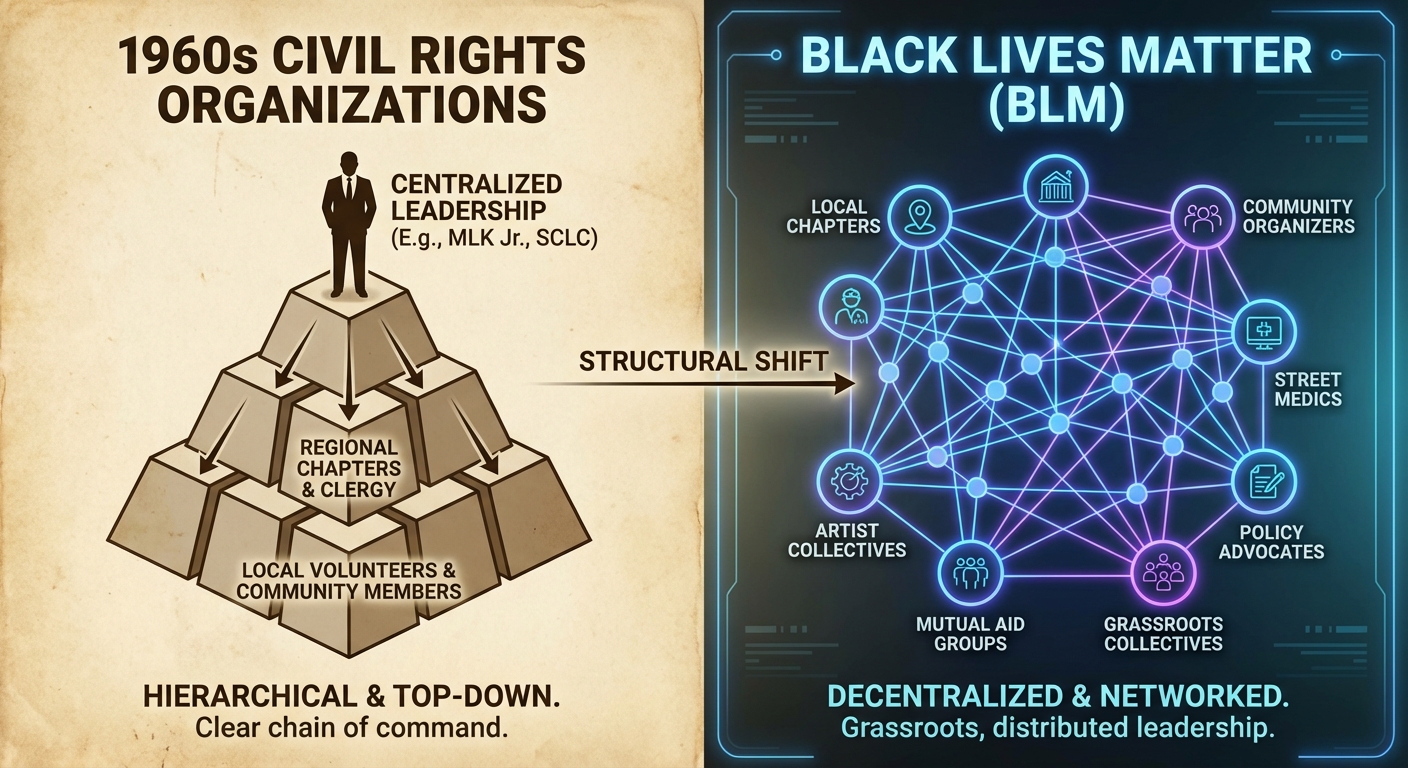
Differences from the Civil Rights Movement (CRM):
- Leadership Structure: While the CRM had centralized, hierarchical leadership (e.g., MLK Jr., SCLC), BLM is decentralized and "leader-full," operating through local chapters and social media organization.
- Scope: BLM explicitly centers the voices of queer and trans Black people, who were often sidelined in 1960s movements.
- Tactics: Heavy reliance on digital activism (social media hashtags, viral video documentation of police brutality) alongside traditional street protests.
Say Her Name
launched by the African American Policy Forum (led by Kimberlé Crenshaw), the #SayHerName campaign brings awareness to the often-invisible names and stories of Black women and girls who have been victims of police violence (e.g., Breonna Taylor, Sandra Bland).
The Debate on Mass Incarceration
Scholars and activists argue that the criminal justice system functions as a new system of racial control.
- Michelle Alexander: In her book The New Jim Crow, she argues that the "War on Drugs" disproportionately targeted Black men, leading to mass incarceration that strips millions of voting rights and economic opportunities, effectively recreating the caste system of Jim Crow.
- Prison Abolition vs. Reform: A major debate within the movement is whether to reform the police and prisons (better training, body cams) or work toward abolition (defunding police and investing in community services).
The Reparations Debate
The discussion regarding financial compensation for the descendants of enslaved people has moved from the fringe to mainstream politics.
- H.R. 40: A long-standing bill in Congress proposing a commission to study and develop reparation proposals.
- Arguments: Proponents argue reparations are necessary to address the racial wealth gap created by centuries of unpaid labor and discriminatory housing policies (redlining).
Common Mistakes & Pitfalls
Confusing "Intersectionality" with "Diversity":
- Mistake: Thinking intersectionality just means "having a diverse group of people."
- Correction: Intersectionality is a tool to analyze how systems of power (laws, policies) hurt people who hold multiple marginalized identities (e.g., a Black woman faces unique hurdles that a white woman or a Black man might not).
Oversimplifying the Post-Obama Era:
- Mistake: Believing racism ended or drastically declined simply because Obama was elected.
- Correction: While a symbolic victory, the era saw the rise of the "Birther" movement and increased legislative barriers to voting (voter suppression).
Misunderstanding BLM Leadership:
- Mistake: Criticizing BLM for having "no leaders" like MLK.
- Correction: Understand the strategy of decentralized leadership. This is an intentional design to prevent the movement from collapsing if a single leader is assassinated or jailed.
Conflating Womanism and Black Feminism:
- Mistake: Using the terms interchangeably.
- Correction: While related, Womanism (Alice Walker) specifically emphasizes the wholeness of the entire Black community (men and women) and often has a spiritual component, whereas Black Feminism is rooted more in political analysis of power structures.