Unit 5: Ideological Shifts and Material Changes (1750–1900)
Unit 5 Overview
In the period 1750–1900, the world underwent massive transformations driven by two distinct but related forces: ideas (The Enlightenment) and machines (The Industrial Revolution). This note set covers the intellectual roots of political change, the resulting Atlantic Revolutions, and the geographic and economic origins of industrialization.
The Enlightenment (Topic 5.1)
The Enlightenment was an intellectual movement in the 17th and 18th centuries emphasizing reason, individualism, and skepticism of traditional authority (monarchy and the church).
Core Philosophy and New Ideas
Before the Enlightenment, the "Clash of Ideas" was dominated by religious dogma. The shift began with the Scientific Revolution and the application of Empiricism.
- Empiricism: The belief that knowledge comes from sensed experience (observation and experiments) rather than tradition or religion (pioneered by Francis Bacon).
- Rationalism: Utilizing logic to solve social and political problems.
Key Philosophers (The Philosophes)
These thinkers challenged the Divine Right of Kings (the idea that God appointed monarchs).
| Philosopher | Key Work | Major Concept | Details |
|---|---|---|---|
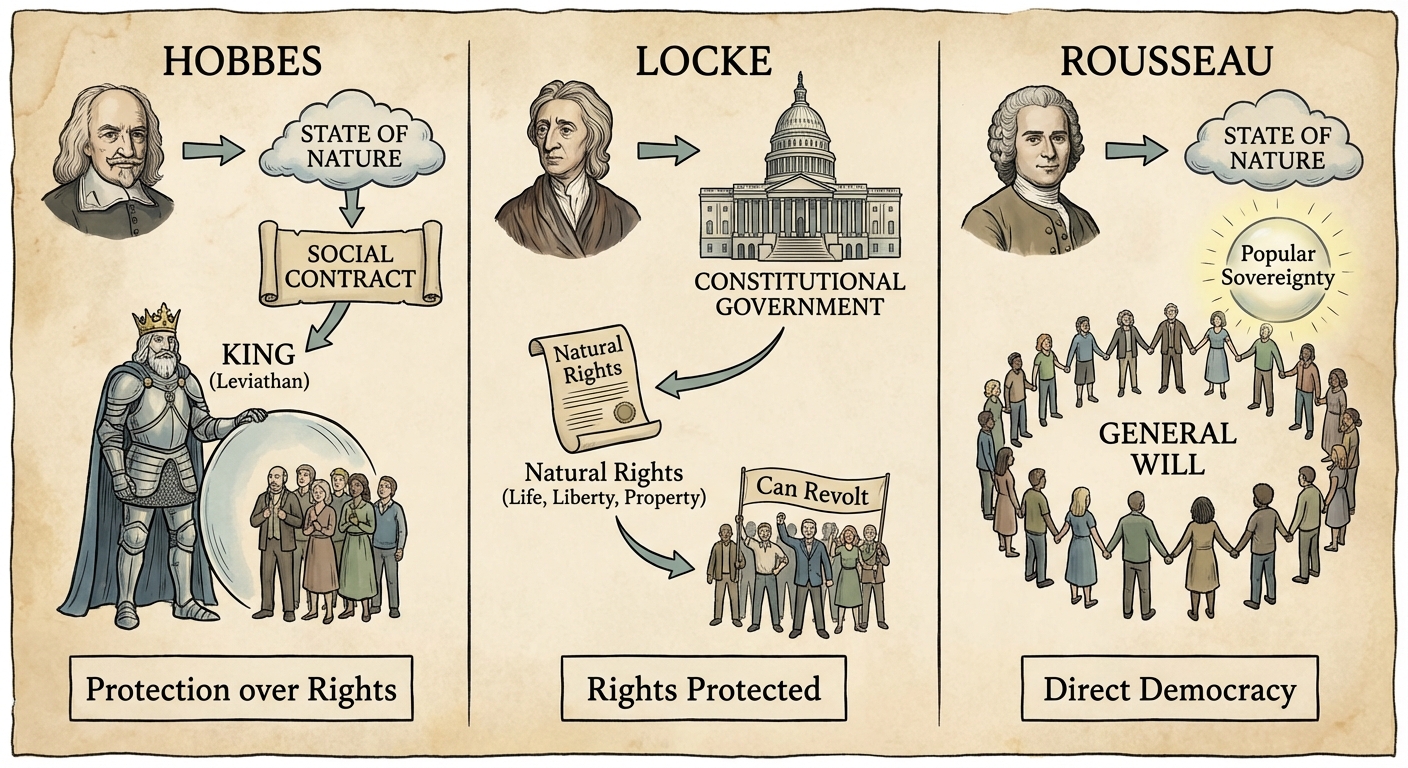
| Thomas Hobbes | Leviathan | Social Contract (Authoritarian) | Believed human life was "nasty, brutish, and short." People give up rights to a strong monarch for protection. |
| John Locke | Two Treatises of Government | Natural Rights | Life, Liberty, and Property. If a govt takes these away, the people have the Right to Revolt. |
| Baron de Montesquieu | The Spirit of Laws | Separation of Powers | Checks and balances (Legislative, Executive, Judicial) to prevent tyranny. |
| Voltaire | Candide | Civil Liberties | Advocated for religious liberty and freedom of speech. Famous for wit and satire against the Church. |
| Jean-Jacques Rousseau | The Social Contract | The General Will | Government should enact the will of the people. More emphasis on emotion/collective than pure reason. |
Impact on Society and Reform Movements
Enlightenment ideas didn't just stay in books; they sparked social movements:
- Suffrage: The movement for voting rights (extended slowly from land-owning males to all males, and eventually women).
- Abolition of Slavery: Slave trade banned in early 1800s (UK: 1807, US: 1808); total abolition followed later. The Enlightenment idea of "natural rights" made slavery philosophically indefensible.
- End of Serfdom: Russia emancipated serfs in 1861 (Alexander II), though their economic situation remained poor.
- Feminism:
- Mary Wollstonecraft (England): Wrote A Vindication of the Rights of Woman, arguing for equal education.
- Olympe de Gouges (France): Wrote Declaration of the Rights of Woman and of the Female Citizen, challenging the male-centric French Revolution documents.
Nationalism and Revolutions (Topic 5.2)
The Enlightenment provided the ideology, but Nationalism provided the identity.
Definition: Nationalism is the intense loyalty to others who share one's language and culture, creating the idea of a Nation-State (a state ruled by people of a specific nationality rather than a distant monarch).
The Atlantic Revolutions
These revolutions are connected by a "domino effect" of democratic ideals.
1. The American Revolution (1776)
- Cause: "No taxation without representation" and admiration of Locke's ideals.
- Key Doc: Declaration of Independence (heavily plagiarized Locke's natural rights).
- Outcome: Established a constitutional republic; inspired the French.
2. The French Revolution (1789)
- Cause: Financial crisis, weak monarchy (Louis XVI), and the unequal Three Estates system (Clergy, Nobility, Commoners).
- Key Doc: Declaration of the Rights of Man and of the Citizen.
- Phase: Radical phase used the guillotine (Reign of Terror via Robespierre). Ended with the rise of Napoleon Bonaparte, who spread nationalist ideas across Europe through conquest.
3. The Haitian Revolution (1791)
- Uniqueness: The only successful slave revolt in history that established a nation.
- Leader: Toussaint L'Ouverture (educated former slave, inspired by Enlightenment).
- Context: Haiti (Saint-Domingue) was a French sugar colony. Enslaved people outnumbered free people 10 to 1.
- Outcome: Independent Haiti (1804). Terrified slave owners globally.
4. Latin American Revolutions (1810s–1820s)
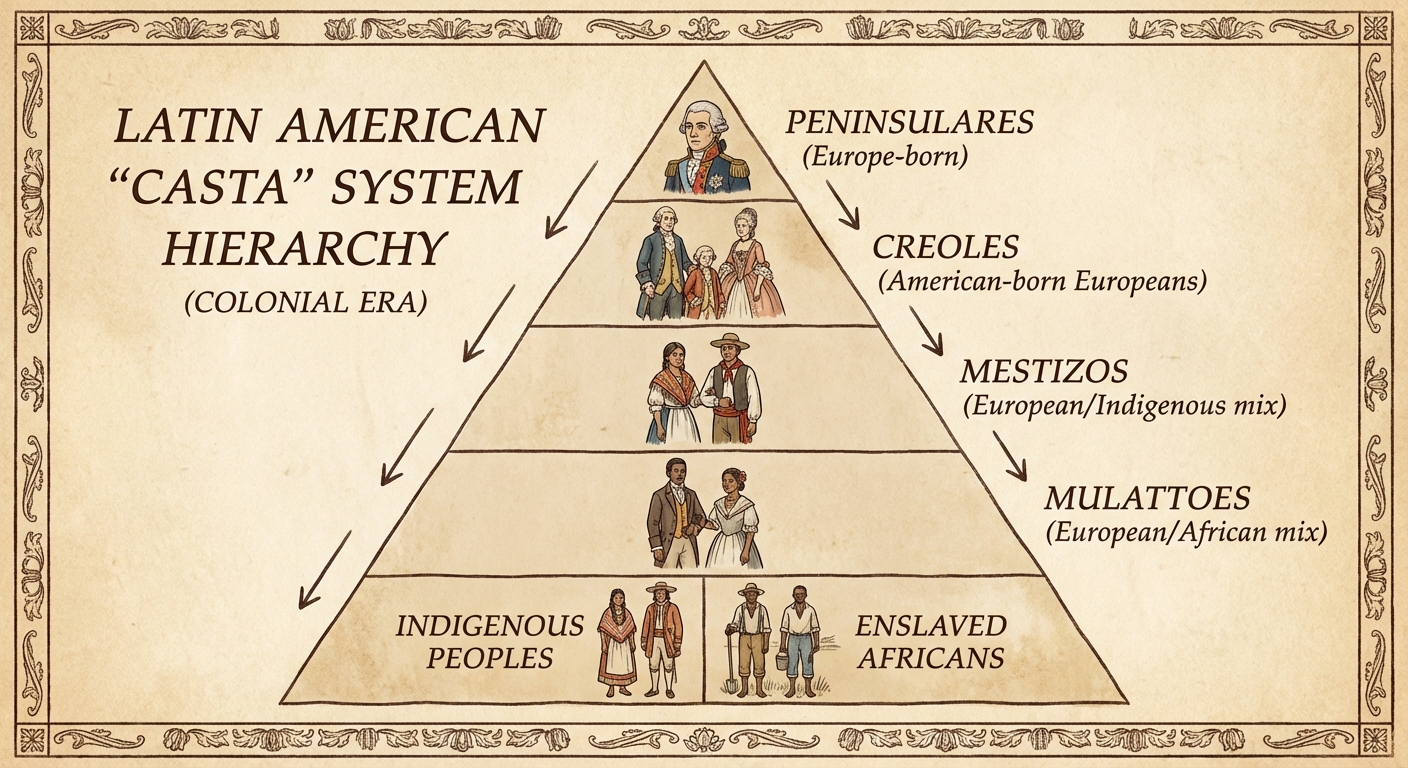
- Social Tension: Creoles (Europeans born in Americas) resented the Peninsulares (born in Spain/Portugal) who held top government jobs.
- Key Figure: Simón Bolívar ("The Liberator").
- The Jamaica Letter: Bolívar's document outlining his desire for Latin American independence and unity (Gran Colombia) based on Enlightenment values.
- Outcome: Independence from Spain, but "Gran Colombia" failed to unify. Social hierarchy largely remained intact (Creoles replaced Peninsulares at the top).
Unification of Europe
Nationalism didn't just break empires; it also built them.
- Italian Unification: Led by Count Cavour (diplomacy) and Giuseppe Garibaldi (military). Unified varied states into the Kingdom of Italy.
- German Unification (1871): Led by Otto von Bismarck (Prussia). He used Realpolitik (politics of reality/practicality) and three wars to unite German states against common enemies.
- Mnemonic: Bismarck used "Blood and Iron" (War and Industry) to unite Germany.
Industrial Revolution Begins (Topic 5.3)
While revolutions changed who ruled, the Industrial Revolution changed how people lived. It marked the shift from agrarian/hand-crafted economies to machine-manufactured economies.
Agricultural Roots
Before efficient factories, you needed efficient farms to feed the workers.
- Agricultural Revolution: Increased food production $\rightarrow$ Population Spike.
- Crop Rotation: Rotating crops to restore soil nutrients.
- Seed Drill: Efficient planting technology.
- Enclosure Movement: Public lands were closed off (privatized), forcing small farmers to move to cities (Urbanization) to find work.
Why Britain First?
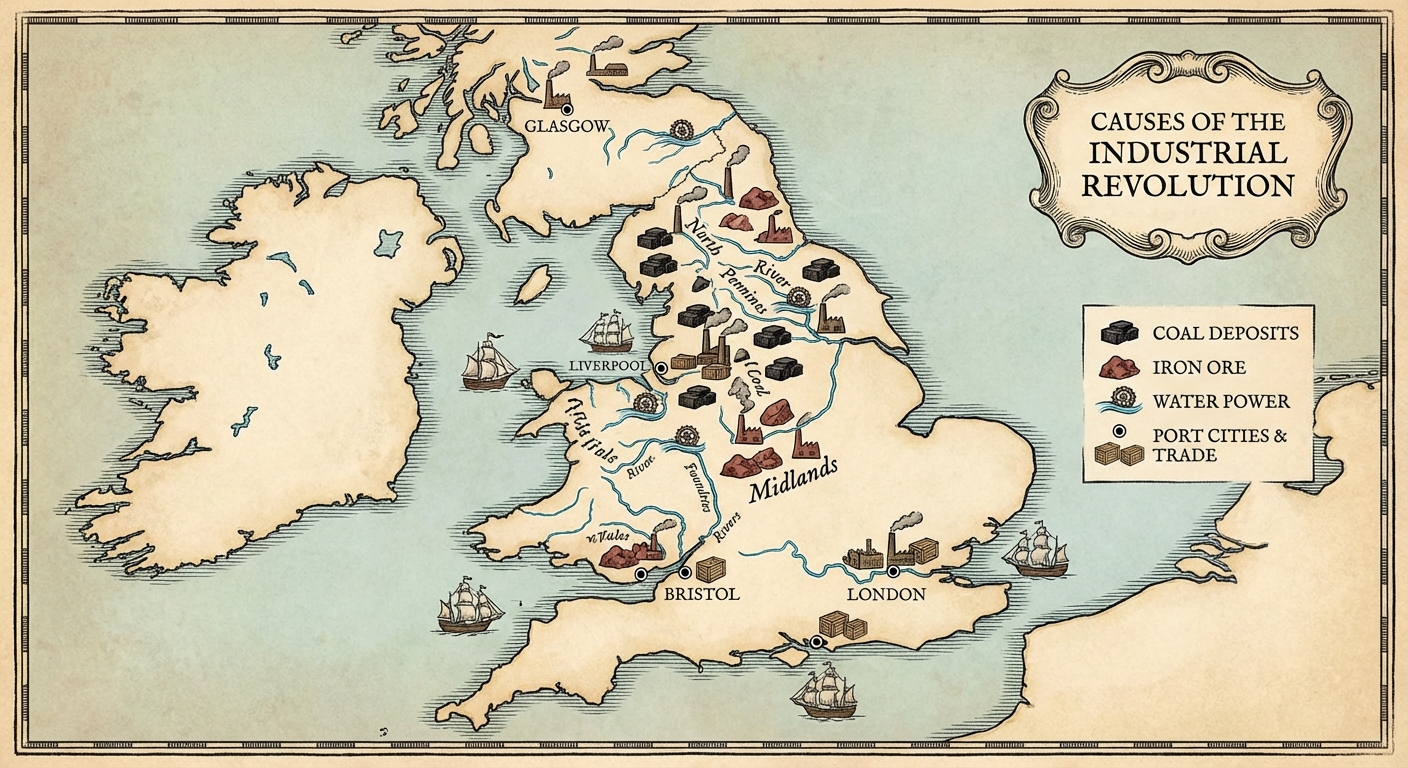
Great Britain was the birthplace of industrialization due to a "Perfect Storm" of factors:
- Geography: Abundance of Coal and Iron ore; island location meant many navigable rivers and harbors.
- Colonies: Access to raw materials (timber, cotton) and markets to sell finished goods.
- Capital: Wealth from the Atlantic slave trade and colonization was available for investment.
- Legal Protections: Protection of Private Property encouraged investment.
Technological Shifts
- Cottage Industry (The "Putting-Out" System): Before factories, women spun cotton at home. It was slow and low-volume.
- The Factory System: Large machines required a central location. This concentrated labor in specific locations.
- Spinning Jenny: James Hargreaves (Spins multiple threads).
- Water Frame: Richard Arkwright (Water power drives the wheel). This is considered the doom of the cottage industry.
- Interchangeable Parts: Eli Whitney. Allowed distinct parts to be replaced rather than replacing the whole tool. Led to mass production.
Common Mistakes & Pitfalls
- Chronology Confusion: Students often think the Industrial Revolution happened after all political revolutions. In reality, they overlapped. The American Revolution (1776) happened right as the Steam Engine was being refined.
- "Liberalism" vs. Modern Politics: In the 19th Century, Classical Liberalism meant limited government, free markets (Adam Smith), and civil rights. Do not confuse this with the modern American definition of reform-heavy "liberalism."
- Haitian vs. Latin American Leadership:
- Haiti = Led by Slaves (Bottom-up).
- Latin America (Bolívar) = Led by Creoles (Elite-driven).
- Mistake: Assuming Bolívar was fighting for the rights of indigenous or enslaved people; he was primarily fighting for Creole political power.
- Nation-State Confusion: A "Nation" is a cultural group; a "State" is a government. A "Nation-State" is when the cultural group is the government. (e.g., The Austrian Empire was a State, but not a Nation-State because it ruled over Hungarians, Czechs, etc. Germany became a Nation-State in 1871).