Comprehensive Guide to Applications of Integration (Unit 8)
Average Value of a Function
Concept Definition
In differential calculus, the Average Rate of Change is the slope of the secant line. In integral calculus, we are interested in the Average Value of a continuously varying function over an interval. Geometrically, the average value of $f(x)$ on $[a, b]$ is the height of a rectangle whose base is $(b-a)$ and whose area equals the area under the curve $f(x)$.
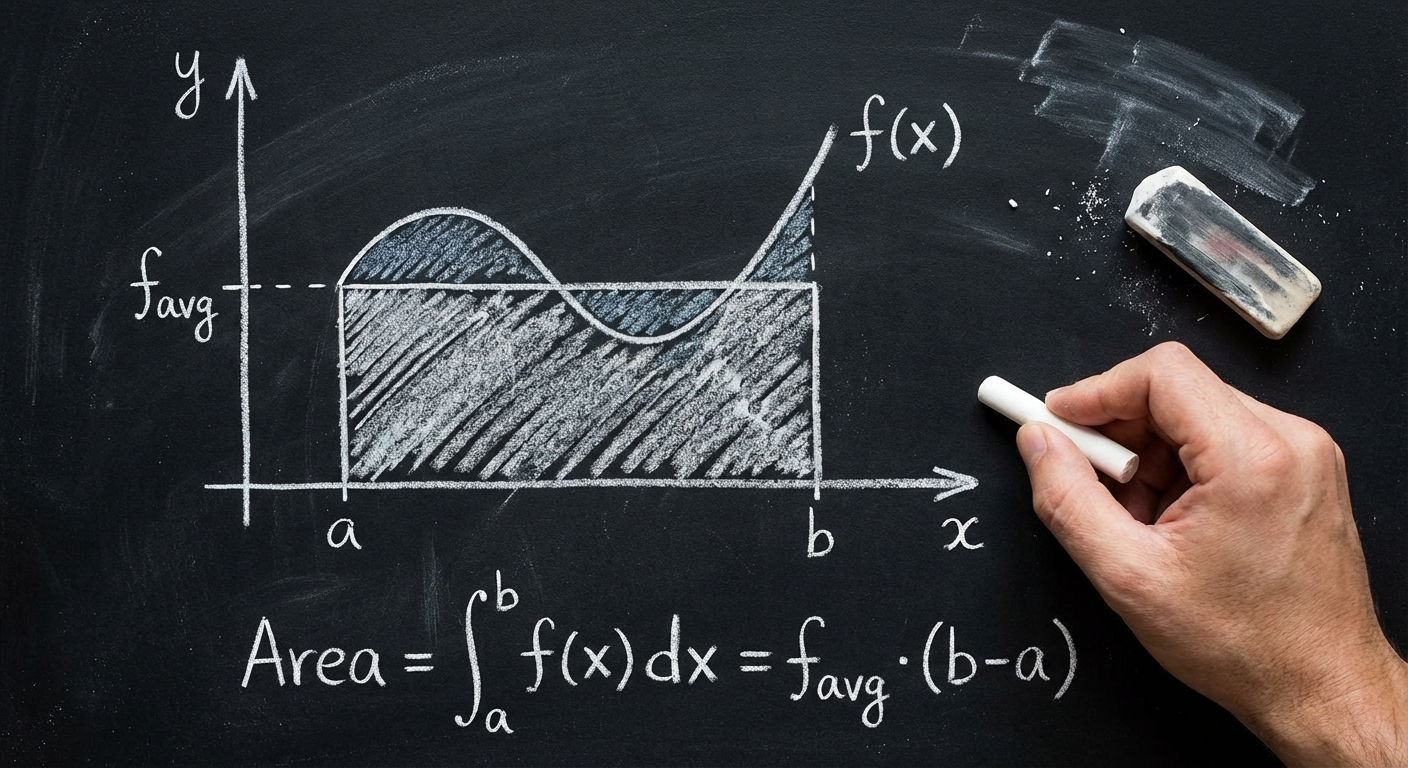
Formula
If $f$ is integrable on the closed interval $[a, b]$, then the average value of $f$ on the interval is:
The Mean Value Theorem (MVT) for Integrals
The MVT for Integrals states that if $f$ is continuous on $[a, b]$, there exists at least one number $c$ in $[a, b]$ such that:
Or equivalently:
Key Takeaway: At some point, the function usually equals the average value.
Connect Motion: Position, Velocity, and Acceleration
Motion along a line (rectilinear motion) is a fundamental application of integration. While differentiation takes you from Position $\to$ Velocity $\to$ Acceleration, integration reverses this process.
Fundamental Relationships
Let $s(t)$ be position, $v(t)$ be velocity, and $a(t)$ be acceleration.
Velocity from Acceleration:
Use an initial condition $v(0)$ to find $C$.Position from Velocity (Net Change):
Current Position = Initial Position + Displacement.
Displacement vs. Total Distance Traveled
This is the most common area for student errors. You must distinguish between "how far you ended up from the start" and "how much ground you covered."
| Concept | Formula | Meaning |
|---|---|---|
| Displacement | $\int_{a}^{b} v(t) \, dt$ | Net change in position. Can be positive, negative, or zero. |
| Total Distance | $\int_{a}^{b} | v(t) |
Example:
A particle moves with velocity $v(t) = t^2 - 4$. Find the displacement and total distance on $[0, 3]$.
- Displacement: $\int0^3 (t^2 - 4) \, dt = [\frac{t^3}{3} - 4t]0^3 = (9 - 12) - 0 = -3$.
- Total Distance: The particle changes direction at $v(t)=0 \Rightarrow t=2$.
We must split the integral or integrate the absolute value:
Area Between Two Curves
We can extend the concept of "area under a curve" to find the area bounded by two different functions. The principle is Accumulation.
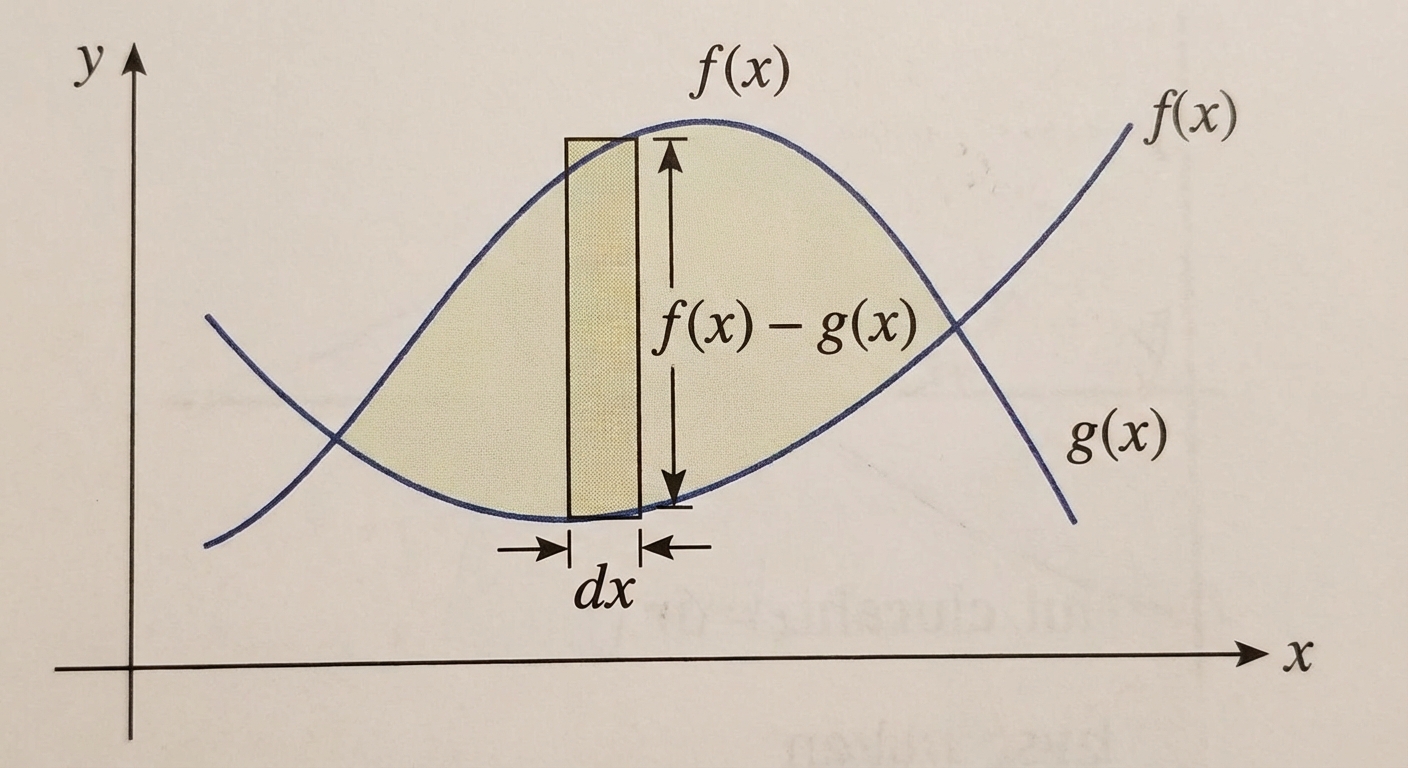
Vertical Slicing (With respect to $x$)
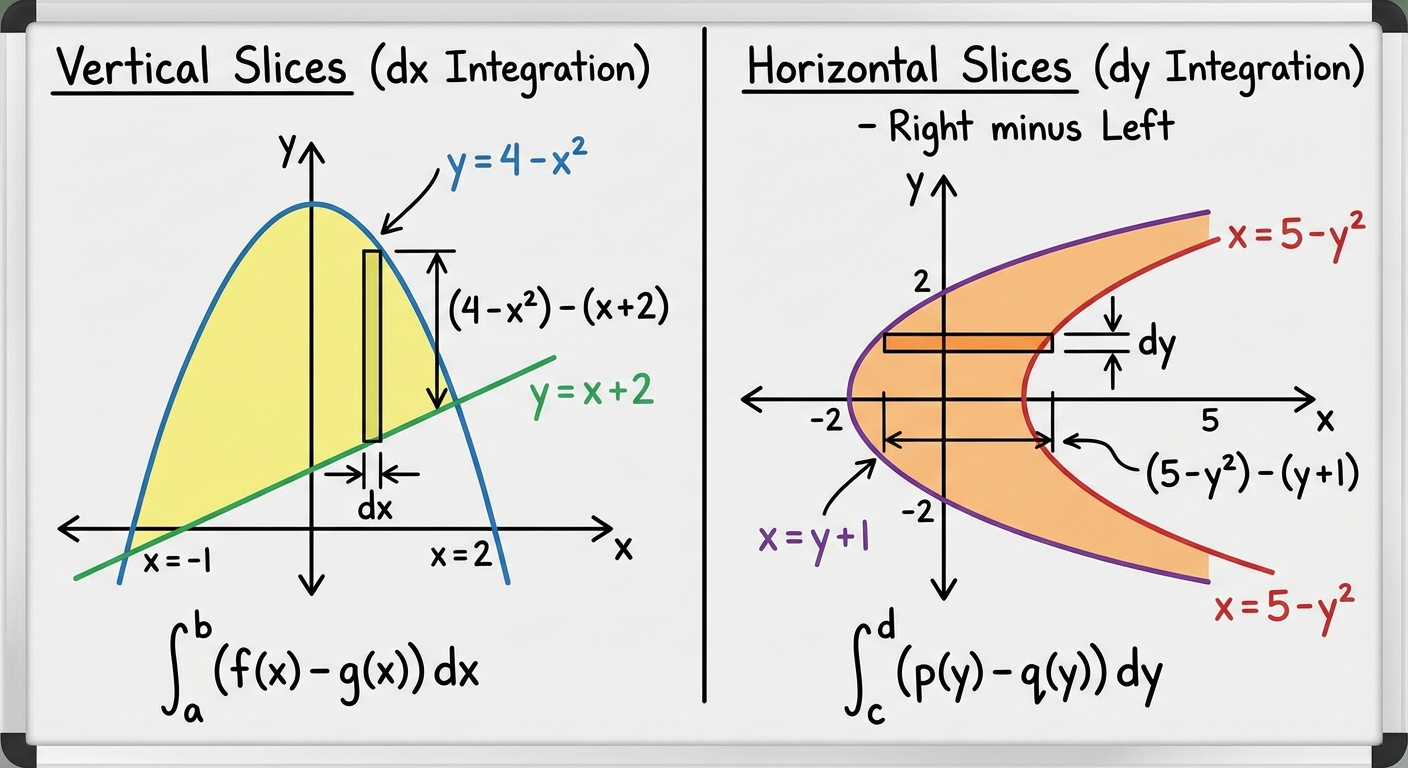
When functions are defined as $y=f(x)$ and $y=g(x)$, and $f(x) \ge g(x)$ on $[a, b]$, use vertical rectangles.
Mnemonic: Top Curve $-$ Bottom Curve.
Horizontal Slicing (With respect to $y$)
When functions are defined as $x=f(y)$ and $x=g(y)$, or considering the geometry is easier sideways, use horizontal rectangles.
Mnemonic: Right Curve $-$ Left Curve.
Helpful Tip for Intersections
If the limits of integration are not given, set the two functions equal to each other ($f(x) = g(x)$) to solve for the intersection points $x=a$ and $x=b$. These will be your limits.
Volumes: Cross Sections
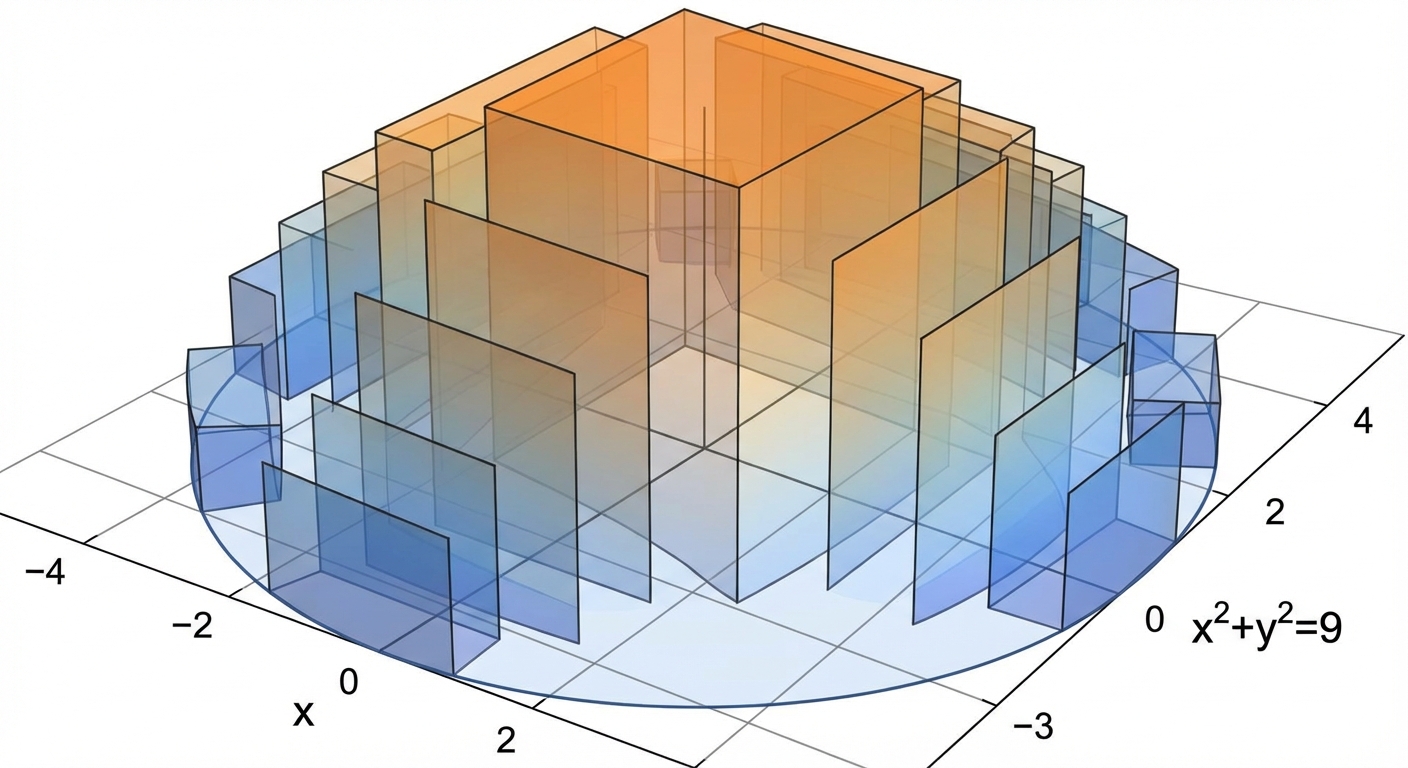
Imagine a 3D solid where the base is a region in the $xy$-plane (bounded by curves), and every cross-section taken perpendicular to an axis is a known geometric shape (Square, Triangle, Semicircle).
The General Formula
Volume is the accumulation of Area.
Where $A(x)$ is the Area Formula for the 2D cross-sectional shape in terms of $x$.
Common Cross-Section Areas
Let $s = \text{top curve} - \text{bottom curve}$ (the length of the slice).
- Square: $A = s^2$
- Rectangle: $A = s \cdot \text{height}$ (Height usually given as a constant or function)
- Semicircle: $A = \frac{\pi}{8} s^2$ (Derived from $\frac{1}{2}\pi r^2$ where $r = s/2$)
- Equilateral Triangle: $A = \frac{\sqrt{3}}{4} s^2$
- Isosceles Right Triangle (Leg on base): $A = \frac{1}{2} s^2$
Volumes of Revolution
These solids are formed by taking a 2D region and rotating it around an axis (like the $x$-axis, $y$-axis, or lines like $y=2$).
1. The Disc Method
Used when the region being moved is flush against the axis of rotation (no gap).
- $R(x)$ is the distance from the axis of rotation to the outer edge of the curve.
2. The Washer Method
Used when there is a gap between the region and the axis of rotation (the solid has a hole).
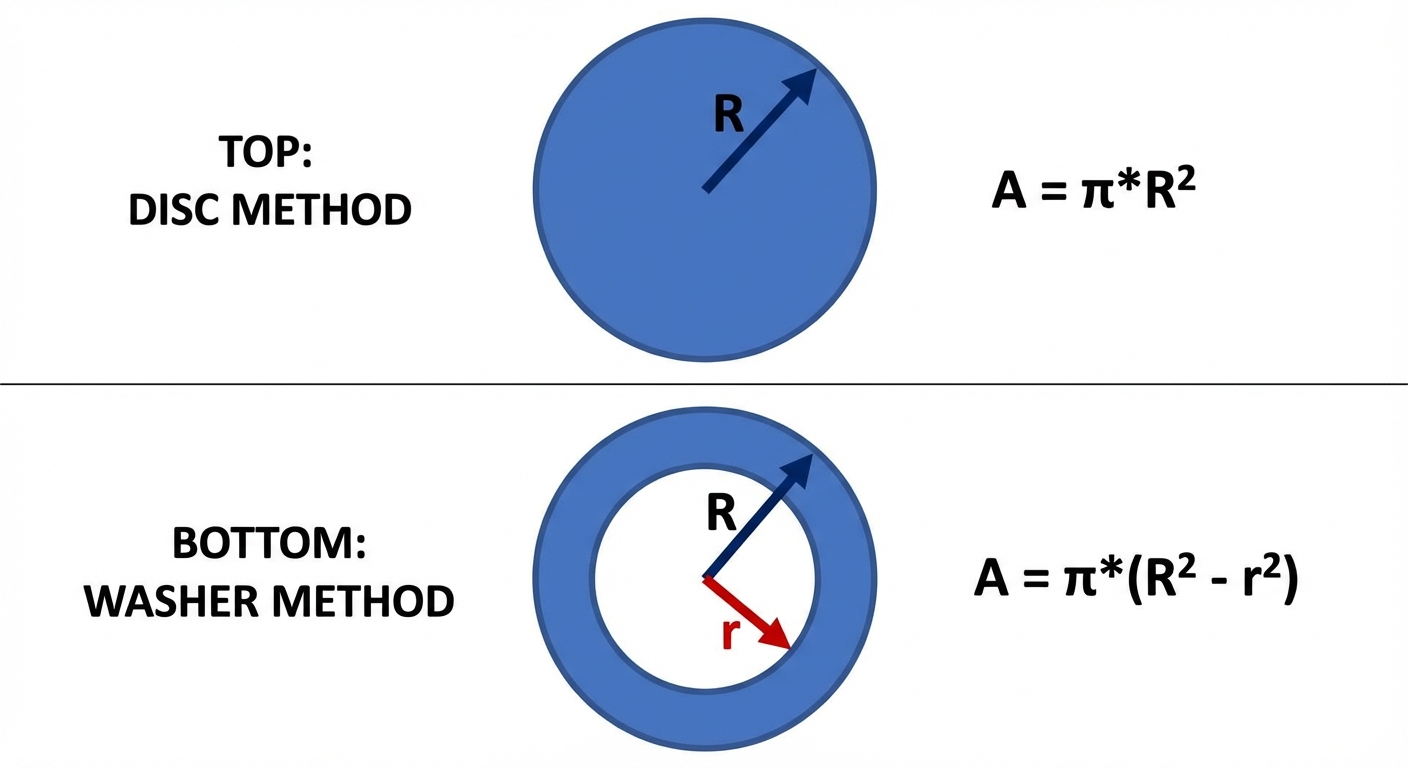
- $R(x) = $ Outer Radius (Distance from axis to far curve).
- $r(x) = $ Inner Radius (Distance from axis to near curve).
Crucial Note: It is Difference of Squares $(R^2 - r^2)$, NOT the Square of the Difference $(R-r)^2$.
Rotating Around Other Lines
If rotating around $y = k$ or $x = h$, the radii change:
- Rotation around $y = -2$: The radius is usually $(f(x) - (-2)) = f(x) + 2$.
- Rotation around $y = 5$: The radius is usually $(5 - f(x))$.
- Always draw a line from the axis of rotation to the curve to determine the length.
Arc Length (BC Topic)
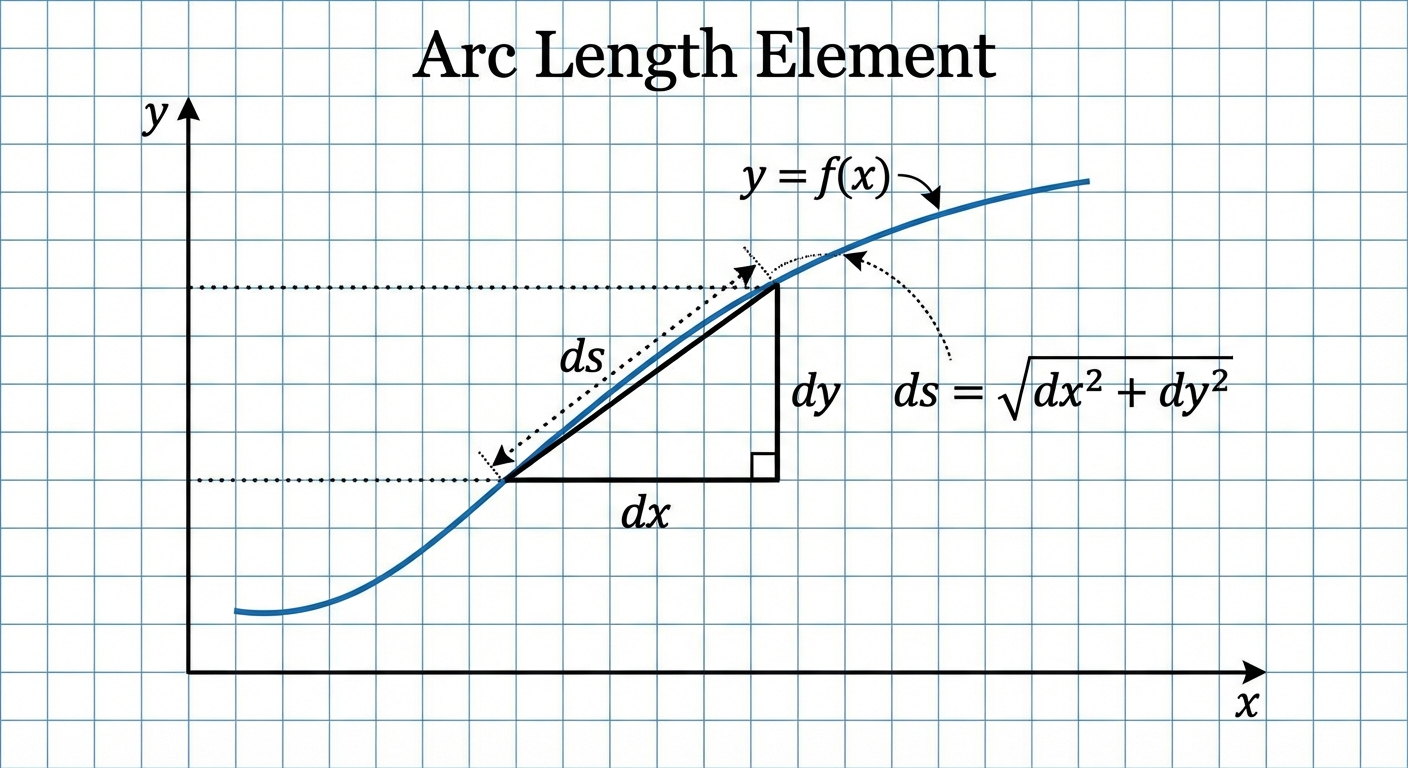
This topic is specific to AP Calculus BC. It calculates the actual length of the curve $f(x)$ if you were to straighten it out.
The Formula
Calculated by integrating the hypotenuse of infinitely small triangles along the curve ($dl = \sqrt{dx^2 + dy^2}$).
For a function $y=f(x)$ on $[a, b]$:
For a function $x=g(y)$ on $[c, d]$:
Example Setup:
Find the length of $y = \ln(\sec x)$ from $x=0$ to $x=\pi/4$.
- Find derivative: $y' = \frac{1}{\sec x} \cdot \sec x \tan x = \tan x$.
- Plug into formula: $L = \int_0^{\pi/4} \sqrt{1 + \tan^2 x} \, dx$.
- Simplify using identity: $1 + \tan^2 x = \sec^2 x$.
- Integral becomes: $\int_0^{\pi/4} \sec x \, dx$.
Common Mistakes & Pitfalls
Confusing Total Distance and Displacement:
- Make sure: Check if the problem asks for "how far it is from the start" (Displacement, $\int v$) or "total distance traveled" (Distance, $\int |v|$).
The Washer Method Algebra Error:
- Wrong: $\pi \int (R - r)^2 dx$
- Right: $\pi \int (R^2 - r^2) dx$
- Why: You are subtracting one volume from another volume, which means subtracting two squared terms, not squaring the subtraction.
Forgetting $\pi$:
- When calculating Volumes of Revolution, students frequently forget to put the $\pi$ outside the integral.
Mismatched Variables:
- If revolving around the $y$-axis (or a vertical line $x=k$), effective limits and functions must usually be in terms of $y$ (unless using Shell Method, which is rarely required in standard BC curriculums now compared to Washer/Disc).
- Ensure your limits ($a$ to $b$) match the variable of integration ($dx$ uses $x$-values, $dy$ uses $y$-values).