APES Unit 8: Nutrient Pollution and Toxin Dynamics
Eutrophication Mechanisms
Eutrophication refers to the accumulation of excess nutrients—specifically Nitrogen (N) and Phosphorus (P)—in water bodies, leading to rapid algal growth and subsequent ecosystem degradation. While this can occur naturally over centuries, Cultural Eutrophication is the accelerated process caused by human activities.
The Step-by-Step Cycle
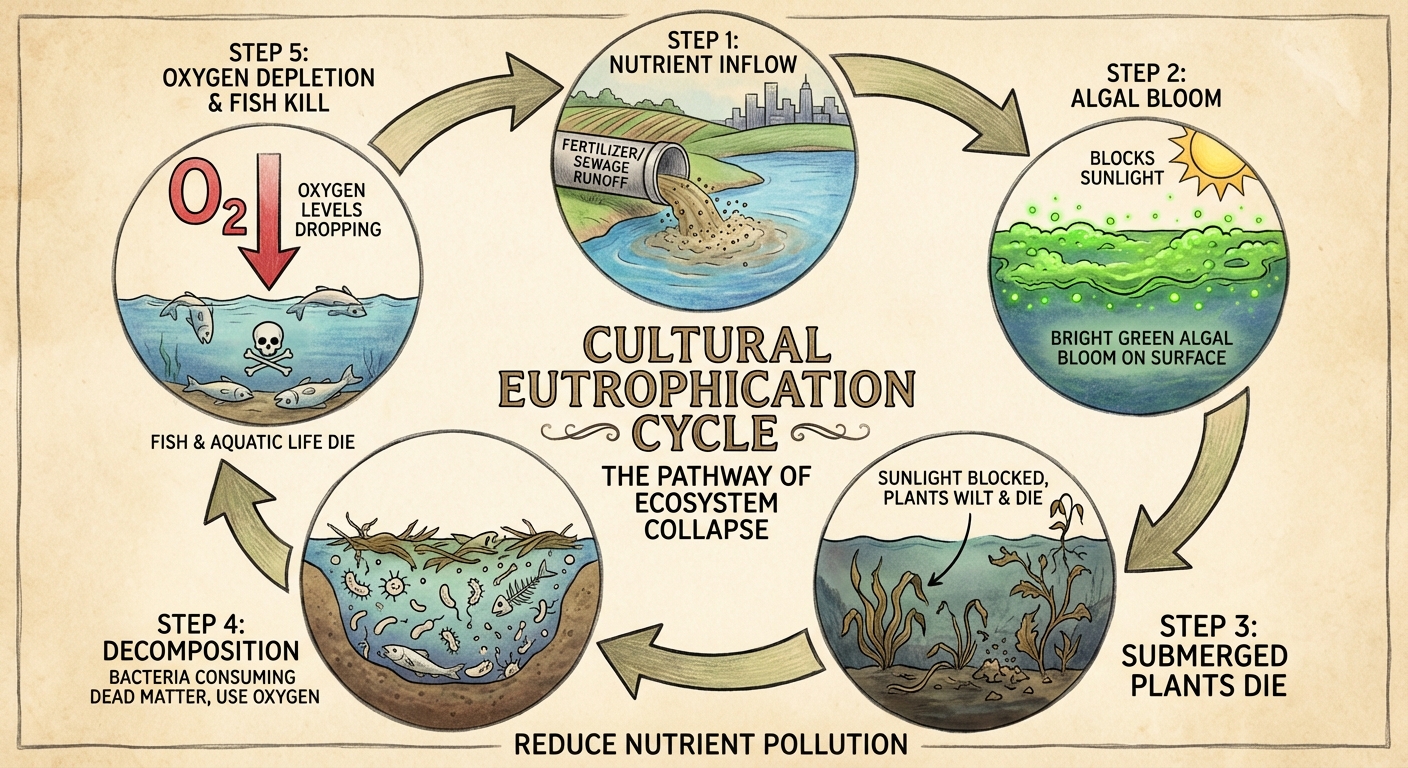
Understanding the sequence of events is critical for the AP exam. It is not the algae itself that directly suffocates fish, but the decomposition process that follows.
- Nutrient Load: Runoff containing nitrates ($NO3^-$) and phosphates ($PO4^{3-}$) from agricultural fertilizer, animal manure, or wastewater treatment plants enters a waterway.
- Algal Bloom: The excess nutrients act as fertilizer for aquatic plants, causing a rapid population explosion of algae on the water's surface.
- Shading: Thick algal mats block sunlight from reaching submerged aquatic vegetation below. Without light, these bottom-dwelling plants die because they cannot perform photosynthesis.
- Die-off: Eventually, the algae consume all available nutrients and die, sinking to the bottom along with the dead submerged plants.
- Decomposition: Aerobic (oxygen-requiring) bacteria decompose the massive amount of dead organic matter.
- Oxygen Depletion: As the bacteria population exponentially grows to eat the waste, they consume the dissolved oxygen (DO) in the water. This increases the Biological Oxygen Demand (BOD).
- Hypoxia/Dead Zone: The DO levels drop below the threshold required to support aquatic life (typically < 2 mg/L), creating a hypoxic zone. Organisms that cannot swim away (benthos) die; mobile organisms flee.
Primary Sources of Nutrients
- Nitrates: Chemical fertilizers, concentrated animal feeding operations (CAFO/feedlot) manure, septic tank leaks.
- Phosphates: Detergents (though often regulated now), fertilizers, industrial waste. Note: Phosphorus is usually the limiting factor in freshwater ecosystems.
Dissolved Oxygen (DO) and Biological Oxygen Demand (BOD)
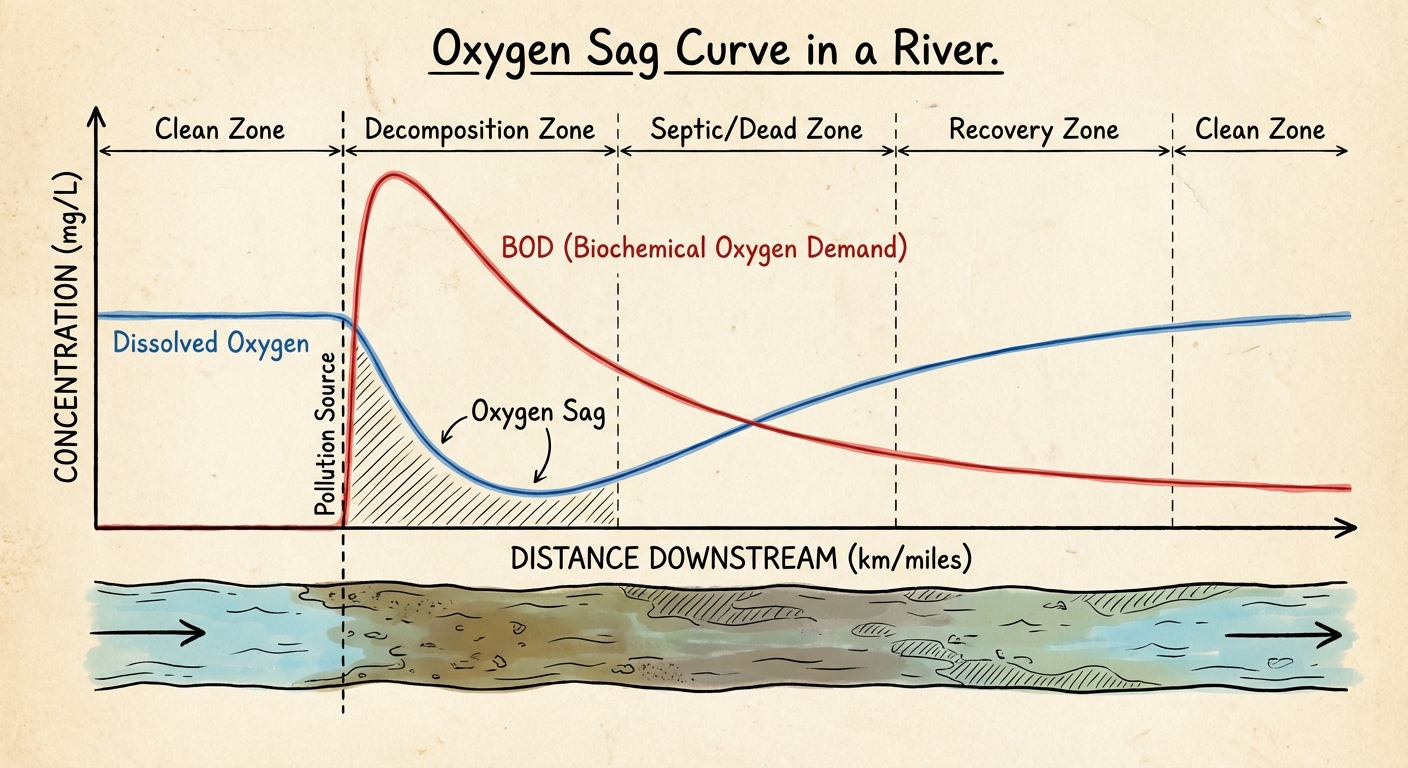
These two variables have an inverse relationship during a pollution event:
- Dissolved Oxygen (DO): The amount of oxygen gas available in the water for fish and other organisms.
- Biological Oxygen Demand (BOD): The amount of oxygen bacteria consume to break down organic waste.
Rule of Thumb: High Organic Waste $\rightarrow$ High BOD $\rightarrow$ Low DO.
Trophic States of Waterways
Water bodies are classified by their nutrient richness.
| Feature | Oligotrophic | Eutrophic |
|---|---|---|
| Nutrient Levels | Low (N and P scarce) | High (N and P abundant) |
| Water Clarity | High (Clear) | Low (Turbid/Murky) |
| Dissolved Oxygen | High | Low (prone to hypoxic events) |
| Biodiversity | High specialized species | Lower, dominated by tolerant species |
| Bottom Substrate | Rocky/Sandy | Silty/Muck (organic buildup) |
Bioaccumulation and Biomagnification
While eutrophication deals with nutrients, this section deals with Persistent Organic Pollutants (POPs) and heavy metals. These toxins do not easily break down in the environment.
Key Definitions
Bioaccumulation
- Scope: Occurs within a single organism over its lifespan.
- Mechanism: An organism absorbs a toxin at a rate faster than it can excrete it (through urine or feces).
- Solubility: Most of these toxins are fat-soluble (lipophilic), meaning they are stored in fatty tissues and liver rather than dissolved in water and flushed out.
- Example: A single old tuna fish has higher mercury levels than a young tuna fish because it has been absorbing mercury for more years.
Biomagnification
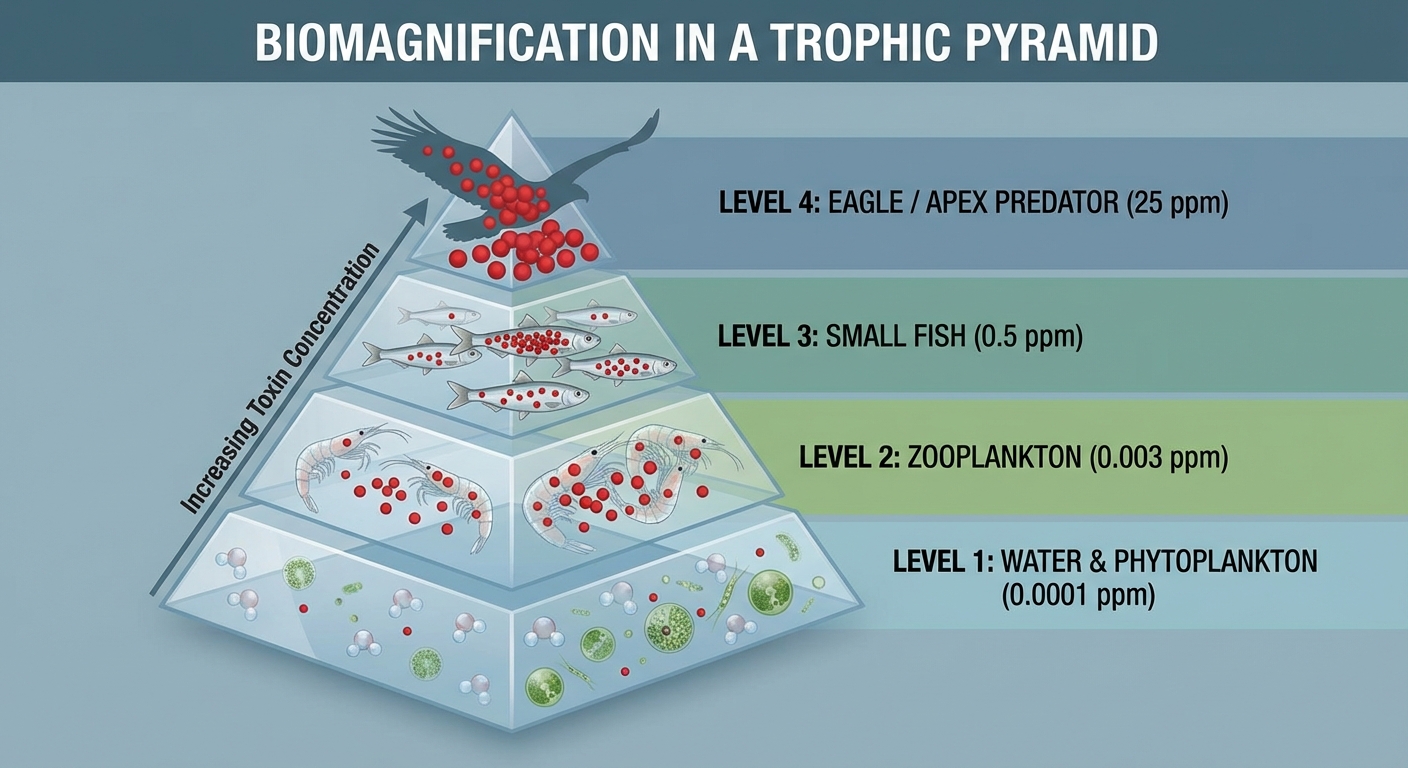
- Scope: Occurs across a food chain/food web.
- Mechanism: Consumers eat many organisms from lower trophic levels. As they consume the biomass, the toxins contained in that biomass move up but are not metabolized. Because of the 10% Rule of energy transfer, a predator must eat a massive amount of prey to survive, thereby ingesting the total toxin load of all that prey.
- Result: Apex predators (top of the food chain) have exponentially higher concentrations of toxins than organisms at the bottom.
Notable Toxins and Effects
| Toxin | Source | Health/Environmental Impact |
|---|---|---|
| DDT | Synthetic pesticide (used for mosquitoes) | Endocrine disruptor. Caused thinning of eggshells in birds of prey (Bald Eagles, Ospreys), leading to population collapse. |
| Mercury (Hg) | Coal combustion, trash incineration | Neurotoxin. Converts to Methylmercury in water. Causes Minamata disease (neurological damage) in humans; reproductive failure in fish. |
| PCBs | Industrial coolants/lubricants | Carcinogen and endocrine disruptor. Persists in sediments for decades. |
| Microplastics | Breakdown of plastics, synthetic fibers | Absorbs other POPs (like sponges); physically blocks digestive tracts of aquatic life. |
Endocrine Disruptors
Many bioaccumulative chemicals (like DDT, PCBs, and Atrazine) mimic hormones in animals.
- They can bind to cellular receptors and either block biological signals or mimic estrogen/testosterone.
- Effects: Gender imbalances in amphibian populations (feminization of male frogs), low sperm count in mammals, and reproductive cancers.
Common Mistakes & Pitfalls
Misconception 1: Algae suffocate the fish directly.
- Correction: Algae actually produce oxygen when alive. The suffocation happens after the algae die, when aerobic decomposers (bacteria) use up the oxygen to break down the dead algae.
Misconception 2: Bioaccumulation and Biomagnification are synonyms.
- Correction: Remember the scope. Bioaccumulation = One organism getting more toxic as it ages. Biomagnification = Moving up the food chain (Predator > Prey).
Misconception 3: Eutrophication is caused by toxic chemicals.
- Correction: Eutrophication is caused by excess nutrients (good things in too high a quantity), not direct poisons like arsenic or cyanide.
Misconception 4: Nitrogen is the limiting factor in freshwater.
- Correction: Phosphorus is usually the limiting nutrient in freshwater lakes. Nitrogen is usually the limiting factor in saltwater ecosystems.