Unit 4: Linear Approximations and Indeterminate Forms
Local Linearity and Linearization
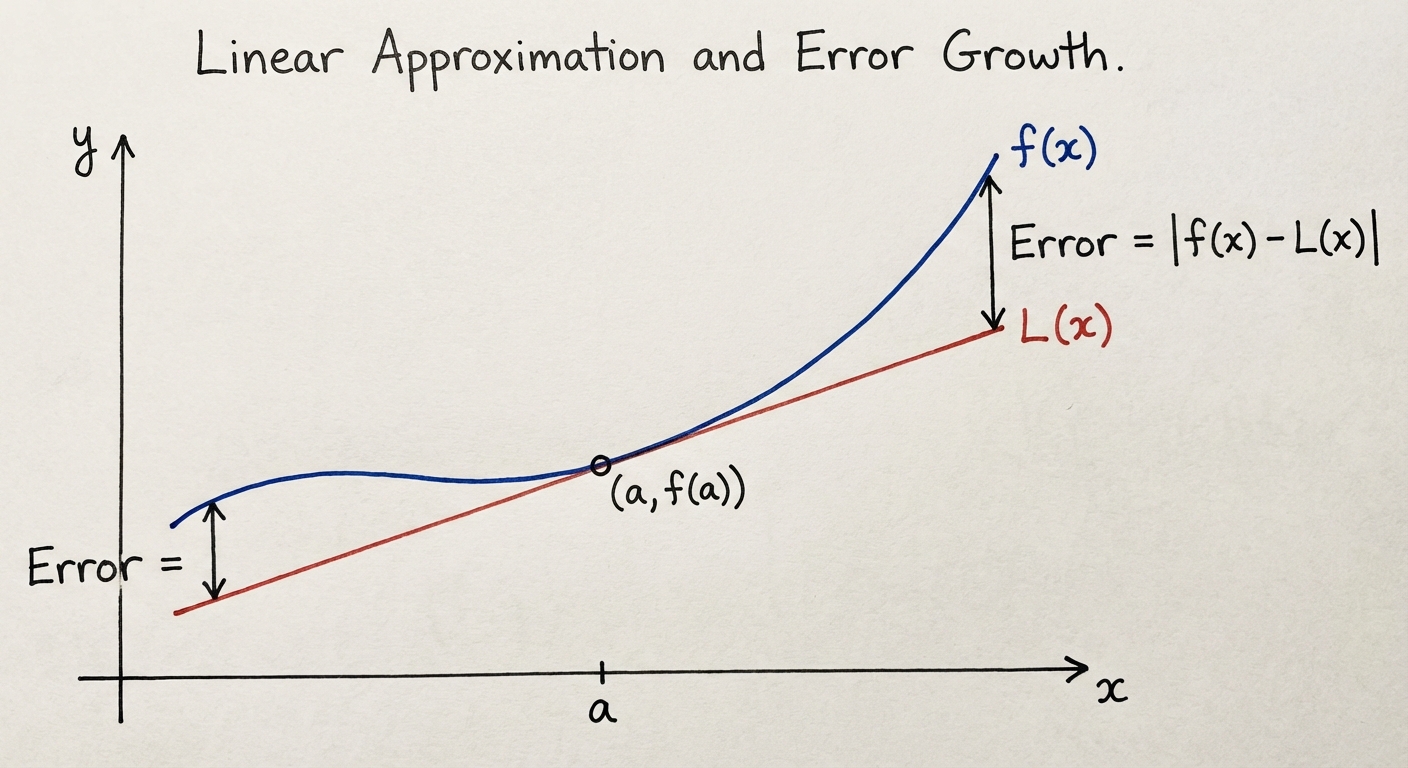
In calculus, one of the most powerful applications of the derivative is the ability to approximate complex functions using simpler linear functions. This concept relies on Local Linearity: the idea that if you zoom in close enough on any differentiable curve at a specific point, the curve looks like a straight line.
That "straight line" is the tangent line. Linearization is simply the process of finding the equation of that tangent line and using it to estimate values of the function near the point of tangency.
The Linearization Formula
To derive the linearization formula, we start with the point-slope form of a line:
If we are approximating a function $f(x)$ at a specific value $x = a$, we know:
- The point on the curve is $(a, f(a))$. Thus, $x1 = a$ and $y1 = f(a)$.
- The slope $m$ is the derivative evaluated at $a$, so $m = f'(a)$.
Substituting these into the point-slope equation yields:
Solving for $y$ gives us the standard formula for the Standard Linear Approximation (often denoted as $L(x)$):
Here, $L(x)$ represents the approximate value on the tangent line, while $f(x)$ represents the actual value on the curve.
Worked Example: Approximating a Root
Problem: Use linearization to approximate $\sqrt{4.1}$.
Solution:
- Choose a convenient center point ($a$): We need a number close to 4.1 that produces an easy exact value. Let $a = 4$ because $\sqrt{4} = 2$.
- Identify the function: $f(x) = \sqrt{x} = x^{1/2}$.
- Find the derivative:
- Evaluate function and slope at $x=4$:
- $f(4) = \sqrt{4} = 2$
- $f'(4) = \frac{1}{2\sqrt{4}} = \frac{1}{4} = 0.25$
- Write the Linearization Equation:
- Approximate the value: Plug in $x = 4.1$.
(Note: The actual value of $\sqrt{4.1}$ is approximately 2.02485. Our approximation is accurate to three decimal places!)
Overestimates and Underestimates
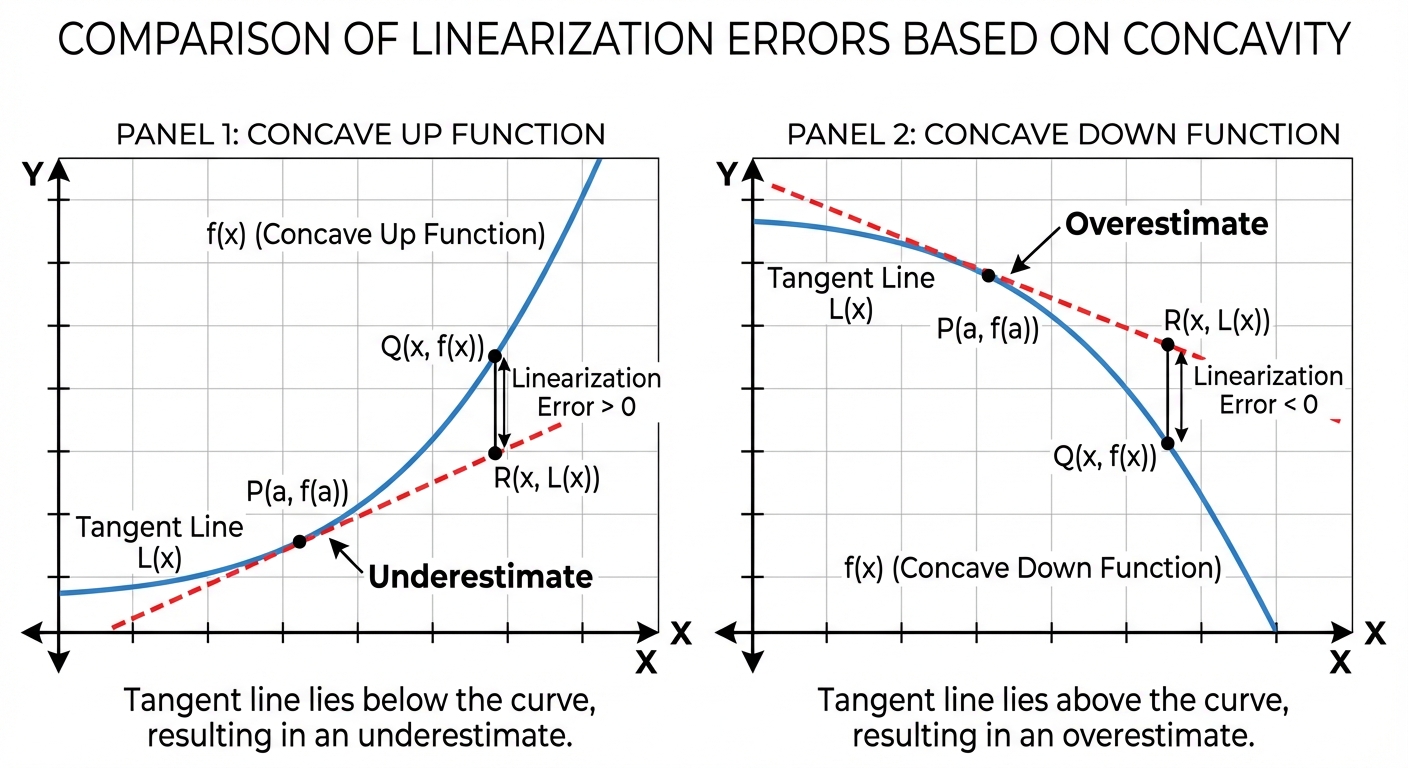
A critical concept in AP Calculus is determining whether your linear approximation is an overestimate or an underestimate of the true value. This depends on the concavity of the function, which is determined by the second derivative, $f''(x)$.
| Concavity | Significance ($f''$) | Tangent Line Position | Result |
|---|---|---|---|
| Concave Up | $f''(x) > 0$ | Below the curve | Underestimate ($L(x) < f(x)$) |
| Concave Down | $f''(x) < 0$ | Above the curve | Overestimate ($L(x) > f(x)$) |
Mnemic: think of a cup (Concave Up). If you lay a ruler (tangent line) under the cup, it sits below it.
L'Hôpital's Rule
Evaluating limits is a foundational skill in calculus. However, direct substitution often leads to ambiguous results known as Indeterminate Forms. L'Hôpital's Rule is a method using derivatives to evaluate these specific limits.
Indeterminate Forms
L'Hôpital's Rule can ONLY be applied if direct substitution results in one of the following two forms:
The Theorem
Suppose $f$ and $g$ are differentiable functions and $g'(x) \neq 0$ near $c$ (except possibly at $c$).
If the limit $\lim_{x \to c} \frac{f(x)}{g(x)}$ produces the indeterminate form $\frac{0}{0}$ or $\frac{\infty}{\infty}$, then:
…provided the limit on the right side exists (or is $\pm \infty$).
Important Exam Procedure
On the AP Exam free-response section, you must show your work rigorously to receive credit. You cannot simply write equals $0/0$. You must explicitly calculate the limit of the numerator and denominator separately.
Correct Formatting:
Since $\lim{x \to c} f(x) = 0$ and $\lim{x \to c} g(x) = 0$, by L'Hôpital's Rule:
Worked Example 1: The Standard Case
Evaluate: $\lim_{x \to 0} \frac{\sin(3x)}{x}$
- Check Conditions (Direct Substitution):
- Numerator: $\sin(3(0)) = 0$
- Denominator: $0$
- Form is $\frac{0}{0}$. L'Hôpital's Rule applies.
- Differentiate Top and Bottom separately:
- $\frac{d}{dx}(\sin(3x)) = 3\cos(3x)$ (Chain Rule)
- $\frac{d}{dx}(x) = 1$
- Apply Rule:
- Evaluate new limit:
Worked Example 2: The Infinity Case
Evaluate: $\lim_{x \to \infty} \frac{2x^2}{e^x}$
- Check Conditions:
- As $x \to \infty$, $2x^2 \to \infty$ and $e^x \to \infty$. Form is $\frac{\infty}{\infty}$.
- Apply L'Hôpital's Rule:
- Check Again:
- We still have $\frac{\infty}{\infty}$. Apply the rule a second time.
- Apply Rule Again:
- Evaluate:
- Numerator approaches 4.
- Denominator approaches $\infty$.
- Limit $= 0$.
Summary of Common Mistakes
The Quotient Rule Trap (L'Hôpital's Rule):
- Mistake: Evaluating the derivative of the fraction $\frac{f(x)}{g(x)}$ using the Quotient Rule $\frac{g f' - f g'}{g^2}$.
- Correction: L'Hôpital's Rule requires deriving the numerator and denominator independently: $\frac{f'(x)}{g'(x)}$.
Forgetting to Check Conditions:
- Mistake: Blindly applying L'Hôpital's Rule to a limit like $\lim_{x \to 1} \frac{x+1}{x}$.
- Correction: Direct substitution here gives $\frac{2}{1} = 2$. If you applied the rule, you would get $\frac{1}{1}=1$, which is wrong. You must verify $0/0$ or $\infty/\infty$ first.
Concavity Confusion (Linearization):
- Mistake: Thinking that if a function is increasing, the approximation is an underestimate.
- Correction: Over/underestimation is determined by concavity ($f''$), not increasing/decreasing behavior ($f'$).
Notation Errors:
- Mistake: Writing $\lim_{x \to c} \frac{f(x)}{g(x)} = \frac{0}{0}$ on an FRQ.
- Correction: Never equate a limit to the undefined symbol $0/0$. State that the limits of the top and bottom are individually 0.