Comprehensive Guide to Indigenous Americas: Mesoamerica and the Andes
Cultural Context and Geography
Defining the Regions
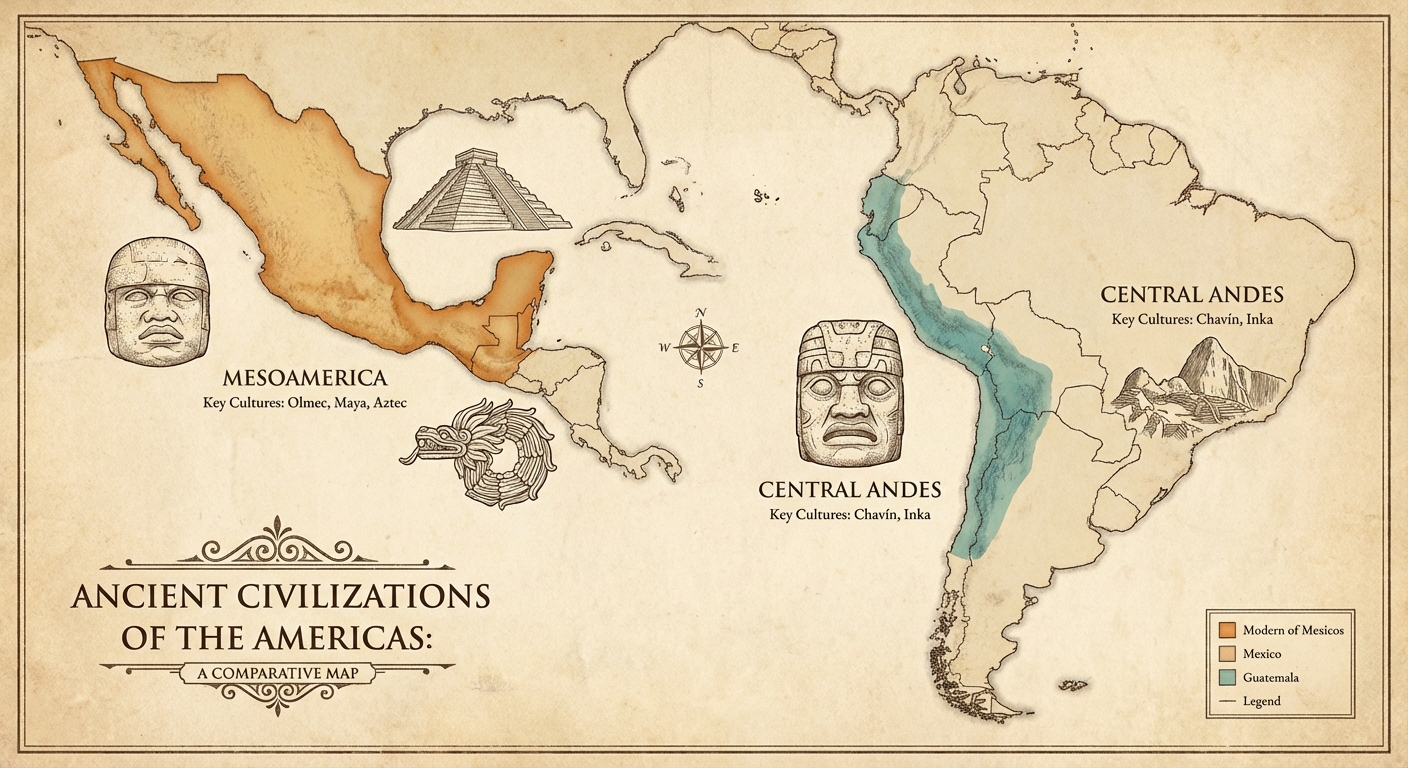
Before analyzing specific works, you must distinguish between the two primary geographical zones in Unit 5. Mixing these up is the most common error on the AP exam.
- Mesoamerica ("Middle America"): Covers modern-day Central Mexico, Guatemala, Belize, and parts of Honduras and El Salvador. Home to the Olmec, Teotihuacan, Maya, and Aztec (Mexica).
- The Central Andes: Covers modern-day Peru and Bolivia (the mountainous spine of South America). Home to the Chavín and Inka.
Core Themes
- Shamanism: The belief that religious specialists can transform into animals (specifically jaguars) and traverse the spiritual realms.
- Axis Mundi: The center of the world connecting the earth, the heavens, and the underworld.
- Sacred Landscape: Architecture is often designed to mimic mountains or align with celestial events.
- Reciprocity: Humans owe debts to the gods (blood, sacrifice) in exchange for rain, sun, and prosperity.
Mesoamerican Art: Olmec, Maya, and Aztec
The Mesoamerican tradition involves a succession of cultures that inherited and modified the beliefs of their predecessors.
The Olmec (1200–400 BCE)
Often called the "Mother Culture" of Mesoamerica. While specific AP required works focus on later cultures, Olmec influence is foundational.
- Key Contribution: The Colossal Heads carved from basalt. They established the tradition of monumental stone sculpture glorifying rulers.
- Legacy: They introduced the obsession with jade (greenstone), the jaguar motif, and the ballgame.
The Maya (300–1100 CE)
The Maya were not a unified empire but a collection of rival city-states (like massive, jungle versions of ancient Greek city-states).
Case Study: Yaxchilán (Chapas, Mexico)
This site is famous for its high-relief lintels (stone beams above doorways).
- Lintel 25, Structure 23:
- Subject: Depicts Lady Xook (the Queen) performing a bloodletting ritual. She passes a rope with thorns through her tongue.
- Vision Serpent: The blood loss induces a hallucination (vision) of a warrior emerging from the jaws of a serpent.
- Significance: This proves the queen's moral and political power. In Maya art, text and image are integrated; the hieroglyphs date the event exactly.
- Architectural Context: Roof Combs—large, vertical structures atop temples to increase their height and visible impression.
The Aztec / Mexica (1325–1521 CE)
The Aztecs were the dominant empire in Central Mexico when the Spanish arrived. They viewed themselves as the heirs to the ancient city of Teotihuacan (which they found abandoned and revered).
1. Templo Mayor (Main Temple)
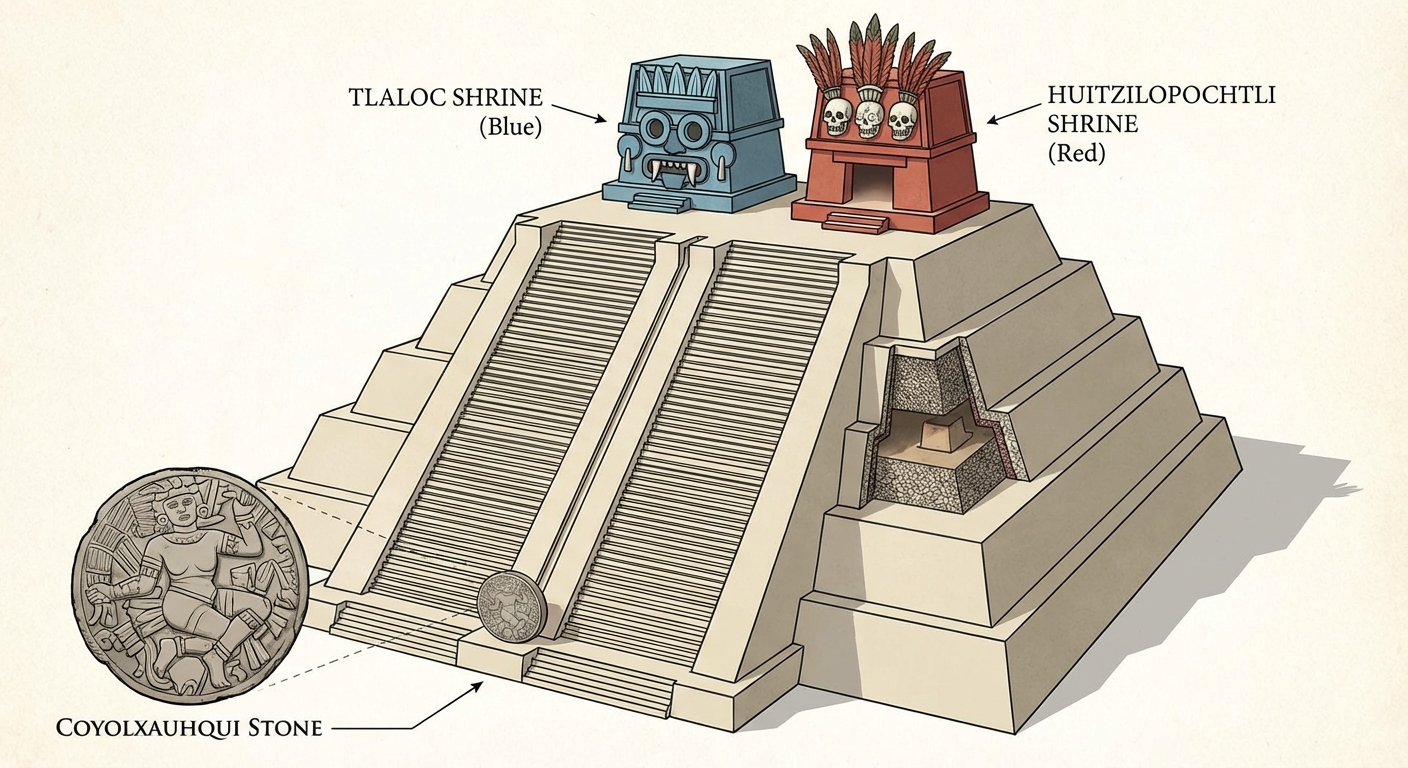
Located in the capital, Tenochtitlan (modern Mexico City). A massive double pyramid signifying duality.
- North Side (Blue): Dedicated to Tlaloc (God of Rain/Agriculture). Associated with the wet season.
- South Side (Red): Dedicated to Huitzilopochtli (God of Sun/War). Associated with the dry season.
- The Coyolxauhqui Stone: A circular relief stone found at the base of the Huitzilopochtli side. It depicts the moon goddess, dismembered and naked.
- Function: Sacrificial victims were thrown down the stairs to land on this stone, reenacting the myth where Huitzilopochtli killed his sister Coyolxauhqui.
2. Ruler’s Feather Headdress
- Materials: Quetzal tail feathers (green) and Cotinga feathers (blue), gold, and precious stones.
- Concept: Amanteca were the specialized feather workers. In Mesoamerica, feathers and jade were viewed as more valuable than gold because they represented fertility and the greenery of life.
- Context: Likely belonged to Motecuhzoma II; demonstrates the vast trade networks of the Aztec empire (quetzal birds are from the tropical lowlands, far from the Aztec capital).
Andean Art: Chavín and Inka
South American art emphasizes textiles as the primary art form and centers on the difficult geography of the Andes mountains.
Chavín (900–200 BCE)
Like the Olmec in the north, Chavín is the "Mother Culture" of the Andes. It was a pilgrimage center.
Case Study: Chavín de Huántar
- Geography: Located at the convergence of two rivers (tinku) and midway between the coast and the jungle.
- The Lanzón Stela: A blade-shaped stone in a dark maze under the temple.
- Iconography: A "fanged god" mixing human and animal features (jaguar/caiman). One hand unites heaven, the other earth (Axis Mundi).
- Key Term: Contour Rivalry—Two images share the same lines. If you look at the image upside down, it transforms (e.g., a fanged mouth becomes a forehead). This created a barrier to understanding; only the initiated priests could "read" the god.
- Nose Ornament: Gold jewelry worn by elites to physically transform the wearer into a supernatural being.
The Inka (1438–1540 CE)
The Inka mastered organization, bureaucracy, and masonry.
1. City of Cusco
- Planning: The city was shaped like a puma (symbol of royal power). The head was the fortress Saqsa Waman.
- Qorikancha (Golden House): The main temple of the Sun God (Inti).
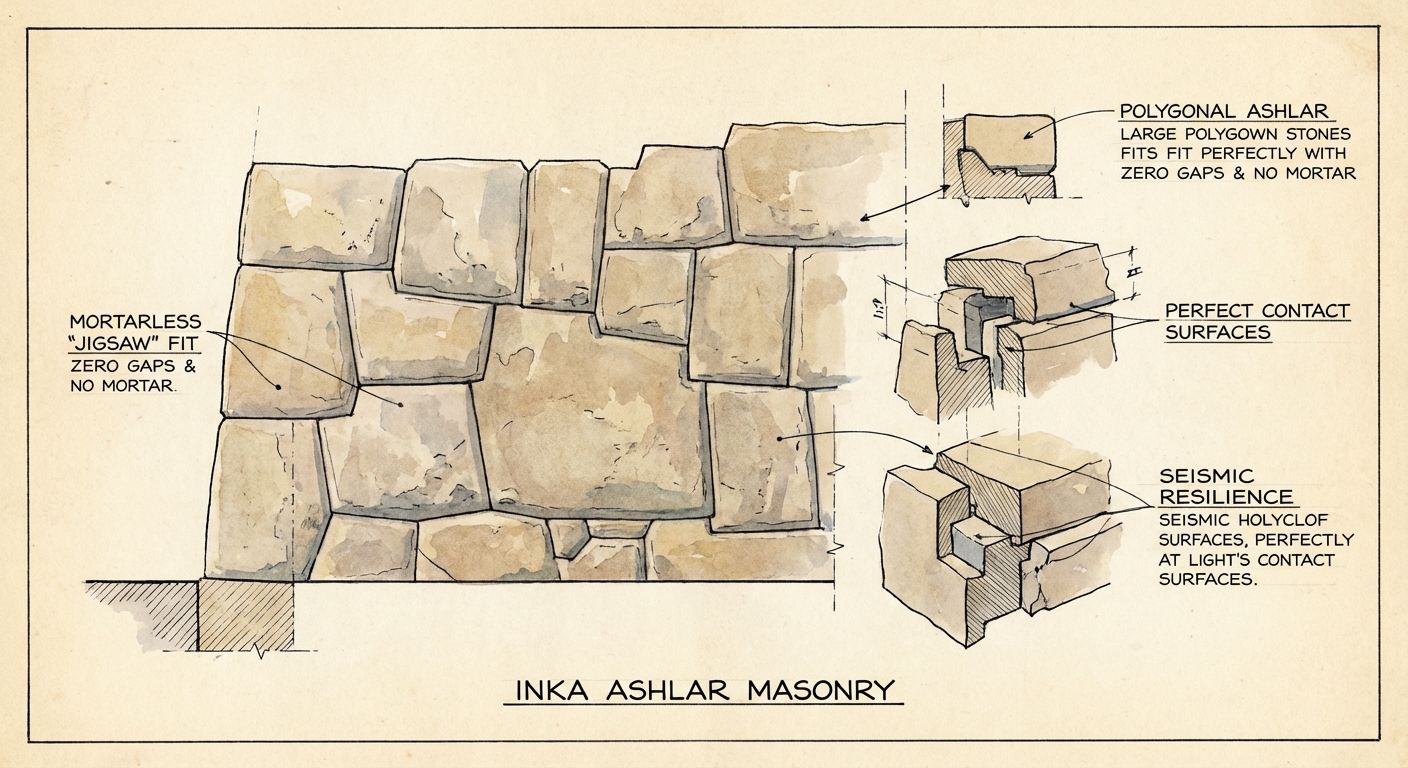
- Technique: Ashlar Masonry. Stones are shaped to fit together perfectly like a puzzle without mortar. This allowed walls to shift slightly during earthquakes without collapsing.
2. Maize Cobs
- Material: Sheet metal/repoussé (Gold and Silver).
- Function: Realism used for ritual. A garden of artificial plants placed in the Qorikancha to ensure a successful harvest. It shows the Inka focused on miniature versions of the cosmos to control the real cosmos.
3. Machu Picchu
- Function: A royal estate for the first Inka emperor, Pachacuti (not a fortress).
- Intihuatana Stone: "Hitching post of the sun." A carved boulder aligning with the sun during solstices.
4. All-T’oqapu Tunic
- Material: Camelid fiber (alpaca/vicuña) and cotton.
- Significance: Textiles were the Inka's most valuable asset.
- T'oqapu: The square geometric designs. Wearing a tunic with all the designs (All-T’oqapu) commanded that the king ruled over all peoples and lands.
Summary Comparisons
| Feature | Mesoamerica (Aztec/Maya) | Andes (Inka/Chavín) |
|---|---|---|
| Precious Material | Jade (Greenstone), Quetzal Feathers | Textiles (Alpaca), Gold/Silver |
| Writing | Advanced Hieroglyphs (Maya) | No written words; used Quipu (knotted strings) |
| Masonry | Mortar, Stucco, Painted Facades | Ashlar (fitting stones without mortar) |
| Deities | Quetzalcoatl, Tlaloc (Rain/War focus) | Inti (Sun), Staff God, Jaguar cults |
Common Mistakes & Pitfalls
- Geography Mix-up: DO NOT say the Aztecs lived in Peru or that Machu Picchu is in Mexico. This is an automatic point deduction in essays.
- Mnemonic: Mesoamerica = Mexico (+ Maya). Inca = In the mountains (Andes).
- "Primitive" Misconception: Avoid describing these works as "primitive" or "tribal." Use terms like complex, highly stratified, technologically advanced (specifically in masonry and hydraulics), and stylized.
- Bloodletting vs. Sacrifice:
- Bloodletting: Self-injury (piercing tongue/ears) done by elites to contact ancestors (Maya: Lady Xook).
- Human Sacrifice: Killing a captive/victim to feed the gods (Aztec: Templo Mayor).
- Material Confusion: Students often forget that textiles were more valuable than gold to the Inka. If analyzing the All-T’oqapu Tunic, emphasize that the sheer labor and fine thread count made it a currency of power.
Critical Vocabulary List
- Repoussé: Metalworking technique where the design is hammered from the back (Inka Maize Cobs).
- Roof Comb: Analyzing Maya architecture (Yaxchilán); the decorative top of the temple.
- Chacmool: A reclining figure with a bowl on its stomach, often used for sacrificial offerings (found at Templo Mayor).
- Ashlar Masonry: Stone construction without mortar (Inka).