Study Notes: Unit 2 - Resistance, Abolition, and Community Building
Forms of Resistance to Enslavement
Resistance to enslavement was not a single event but a continuous spectrum of actions ranging from day-to-day sabotage to organized armed rebellion. In AP African American Studies, it is crucial to understand resistance as an assertion of agency—the capacity of individuals to act independently and make their own free choices, even within a system designed to strip them of humanity.
Overt Resistance: Flight and Rebellion
Overt resistance refers to visible, direct, and often forceful opposition to the institution of slavery.
Fugitivity (Running Away):
- Truancy: Leaving the plantation for a short period to visit family members on other estates or to negotiate better working conditions upon return.
- Permanent Escape: Attempting to reach free states in the North, Canada, or Mexico. This often involved the Underground Railroad, a clandestine network of secret routes and safe houses (it was neither underground nor a literal railroad).
Marronage:
- Derived from the Spanish cimarrón (wild/untamed). Maroons were enslaved people who escaped and established independent communities in remote areas like swamps, mountains, or forests.
- The Great Dismal Swamp: Located on the Virginia/North Carolina border, this was a major site where maroons lived on islands within the swamp, often trading with free people and raiding plantations.
Armed Rebellions:
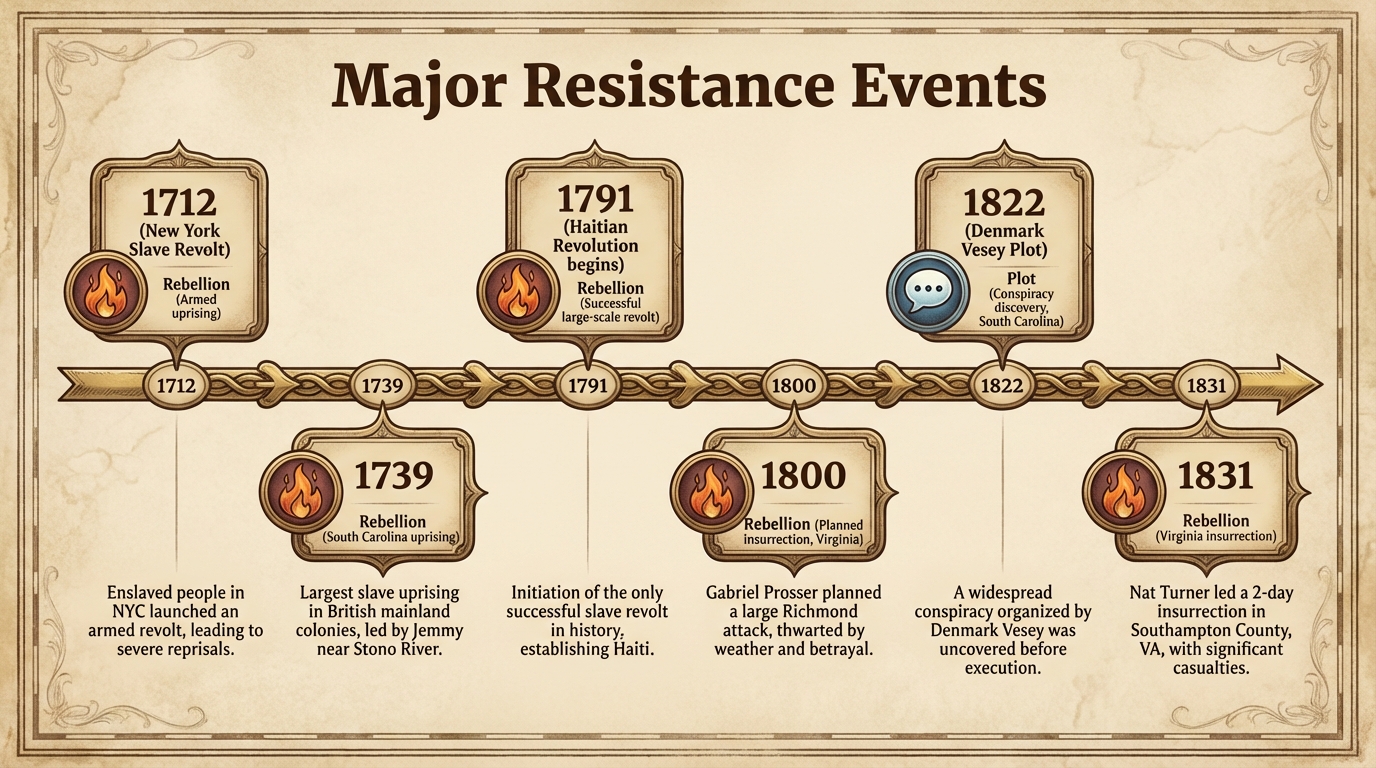
- Stono Rebellion (1739): One of the earliest major uprisings in South Carolina. Enslaved people marched toward Spanish Florida (where freedom was promised), beating drums and burning plantations. Limitations imposed afterwards: The Negro Act of 1740 restricted movement and education.
- The Haitian Revolution (1791–1804): The only successful slave revolt leading to a founding of a state free from slavery and ruled by non-whites and former captives. This event terrified U.S. enslavers and inspired Black resistance in America.
- Nat Turner’s Rebellion (1831): A visionary preacher in Virginia led a revolt killing nearly 60 white people. Impact: It shattered the myth of the "contented slave" and led to harsher laws (slave codes) forbidding Black literacy and gathering.
Covert Resistance: Everyday Acts
Most resistance was subtle and designed to survive the system while undermining it. This is often called "day-to-day resistance."
- Cultural Resistance: Maintaining African religious practices, drumming (until banned), basket weaving, and foodways. Preserving cultural identity was an act of defiance against a system trying to enforce social death.
- Workplace Sabotage: Breaking tools, feigning illness, working slowly (often stereotyped by enslavers as laziness/stupidity), and mishandling livestock.
- Poisoning: Enslaved cooks occasionally poisoned the food of enslavers.
The Abolitionist Movement
The movement to end slavery evolved significantly from the late 1700s to the Civil War, shifting from gradual approaches to demands for immediate emancipation.
Early Abolition and Colonization
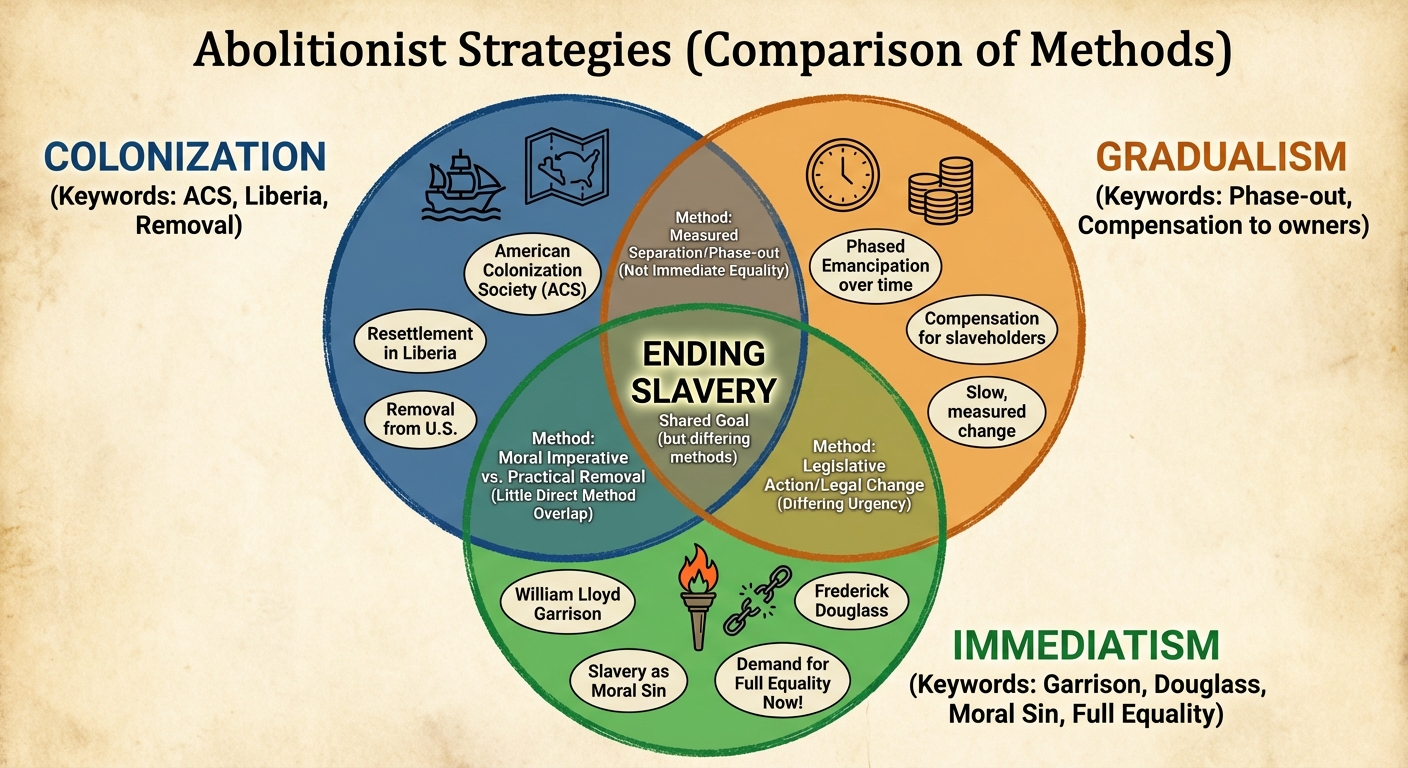
- Gradualism: Early efforts (like those by Quakers) focused on gradually phasing out slavery.
- American Colonization Society (ACS, 1817): Founded by white elites (including Henry Clay) with the goal of sending free African Americans to Africa (creating Liberia).
- Critique: Most African Americans opposed this, viewing themselves as Americans with a right to remaining in the land they built.
Immediatism and Black Leadership
By the 1830s, the movement radicalized, demanding immediate abolition without compensation to enslavers.
David Walker’s Appeal (1829):
- A radical pamphlet by free Black abolitionist David Walker. He called for enslaved people to rise up against their masters, using religious language to condemn slavery as a sin. It was banned in the South.
- Significance: It shifted the tone of abolition from polite petitioning to militant demand.
Key Figures:
- Frederick Douglass: Escaped enslavement to become the movement's most famous orator and writer; published the newspaper The North Star.
- Sojourner Truth: Combined abolition with women's rights (intersectionality). Famous for her "Ain't I a Woman?" speech logic.
- Harriet Tubman: The most famous "conductor" of the Underground Railroad; she made 13 missions to rescue approximately 70 enslaved people.
The Black Press:
- Newspapers like Freedom’s Journal (founded 1827) provided a counter-narrative to racist white media, organizing the Black community and coordinating political action.
Free Black Communities
Despite the name, "Free Black" status was precarious. Scholars often refer to this as quasi-freedom because they were still denied citizenship rights (like voting or testifying in court) in many places.
Building Institutions
Excluded from white society, free African Americans built their own structures for survival and advancement.
The Black Church:
- Richard Allen and Absalom Jones founded the Free African Society (1787) in Philadelphia, the first Black mutual aid society.
- African Methodist Episcopal (AME) Church: Established by Allen after Black worshippers were pulled off their knees while praying in white churches. It became the educational, political, and spiritual hub of the community.
Mutual Aid Societies:
- These organizations functioned as early insurance companies, providing financial support for burial costs, backing widely for widows, and support for the sick.
- Examples: The Prince Hall Masons.
Education:
- Since many Southern states had anti-literacy laws, Free Black communities formed clandestine schools. In the North, they fought (often unsuccessfully) to integrate public schools or founded their own African Free Schools.
Regional Differences
- The North (e.g., Philadelphia, Boston): Larger communities, more organized abolitionist activity, but faced segregation and race riots.
- The South (e.g., Charleston, New Orleans): A distinct "three-caste" system existed in places like New Orleans (White, Free People of Color, Enslaved). Free people of color here were often wealthier and sometimes even owned slaves themselves to protect family members or for economic integration.
Common Mistakes & Pitfalls
Misunderstanding the Underground Railroad:
- Mistake: Thinking it was a train or a subway.
- Correction: It was a network of people (conductors) and safe houses (stations). It relied on trust and secrecy, not technology.
Overlooking Black Women's Resistance:
- Mistake: focusing only on violent male-led rebellions (Nat Turner).
- Correction: Women resisted through truancy, reproductive resistance (herbal abortions), and maintaining cultural lineage. They were the backbone of cultural preservation.
Confusing "Abolition" with "Anti-Slavery":
- Mistake: Using the terms interchangeably.
- Correction: "Anti-slavery" could mean stopping the spread of slavery (Free Soil movement) while allowing it to exist in the South. "Abolition" meant ending the institution entirely everywhere.
The "Passive Slave" Myth:
- Mistake: Believing enslaved people accepted their fate until Lincoln freed them.
- Correction: Resistance began the moment capture occurred in Africa and continued daily through the Civil War.