Unit 4: Shattering Tradition — The Evolution of Modern Art (1900–1980 CE)
The Fracture of Form: Cubism, Futurism, and Expressionism
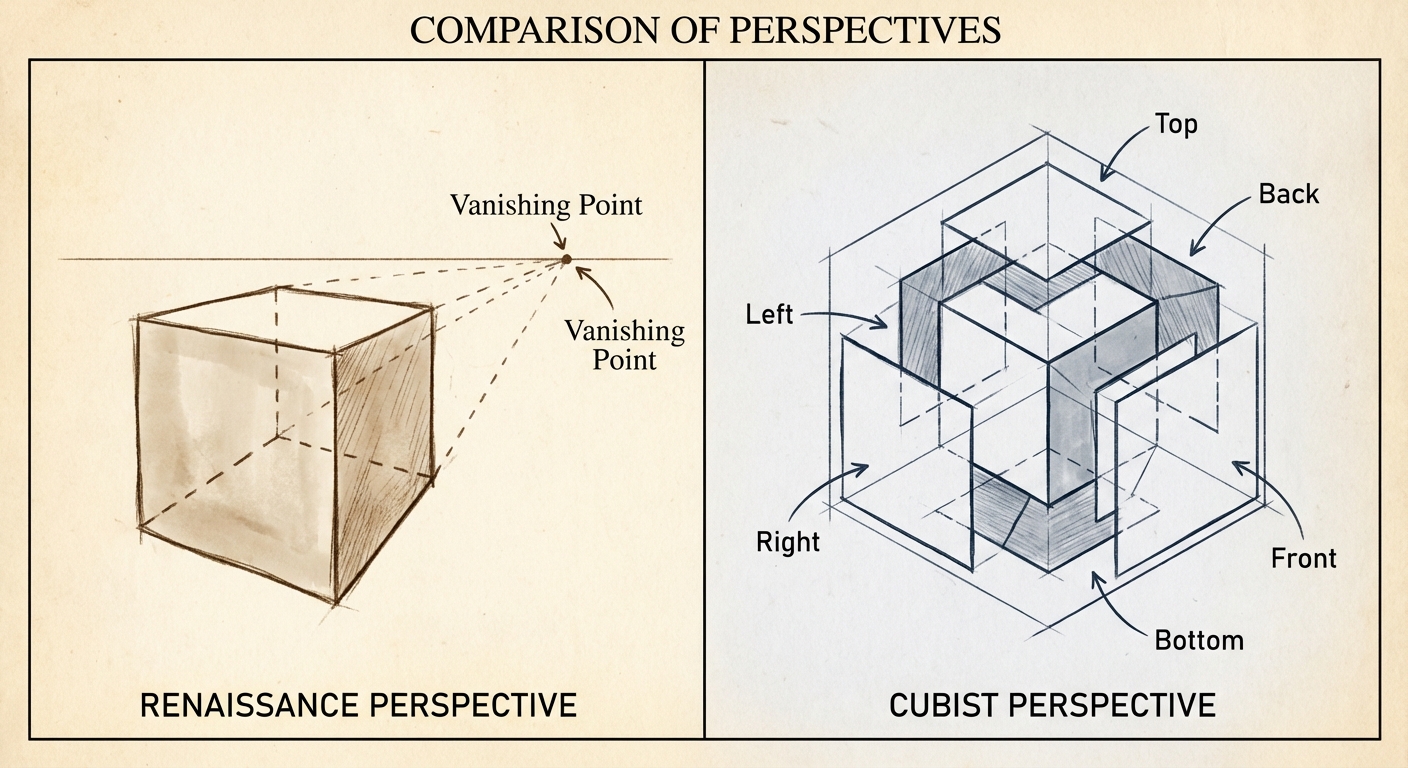
The early 20th century marked a violent break from the Renaissance tradition of linear perspective and naturalistic representation. Influenced by rapid industrialization, political unrest, and new psychological theories, the Avant-garde sought to depict the modern experience.
Cubism: Deconstructing Reality
Cubism challenged the singular viewpoint that had dominated Western art since the 1400s. Instead of looking at an object from one angle, Cubists analyzed, broke up, and reassembled objects in an abstracted form.
- Concept: Forms are depicted from multiple viewpoints simultaneously to represent the subject in a greater context.
- Key Artists: Pablo Picasso, Georges Braque.
- Phases:
- Analytic Cubism (c. 1907–1912): Monochromatic (browns/grays), complex, highly fragmented. Focused on structure (e.g., Braque’s The Portuguese).
- Synthetic Cubism (c. 1912–1914): Brighter colors, simpler shapes, introduction of collage using found materials like newspaper or rope.
German Expressionism: The Inner World
While Cubism focused on formal structure, Expressionism prioritized emotional experience over physical reality. This movement emerged largely in Germany prior to WWI.
- Philosophy: Art should express the artist's inner angst, spiritual yearning, or reaction to the hypocrisies of modern society.
- Two Key Groups:
- Die Brücke (The Bridge): Led by Ernst Ludwig Kirchner. They viewed themselves as a "bridge" to a better future but often depicted the alienation of modern urban life using harsh colors and jagged lines (e.g., Self-Portrait as a Soldier).
- Der Blaue Reiter (The Blue Rider): Led by Vassily Kandinsky. More focused on spiritual abstraction. Kandinsky believed color and line could evoke emotion like music, without needing representation (e.g., Improvisation 28).
Futurism: The Worship of Speed
Based in Italy, Futurism began as a literary movement with Marinetti’s Manifesto of Futurism (1909). It celebrated technology, urban modernity, speed, and violence (war as a "cleansing agent").
- Visual Style: Adopted Cubist fragmentation but added "lines of force" to show dynamism and motion.
- Goal: To destroy the cult of the past (museums, libraries) and celebrate the industrial future.
The Absurd and the Unconscious: Dada and Surrealism
World War I shattered the belief in logic and progress. If logic led to trench warfare and mustard gas, artists decided the only rational response was irrationality.
Dada: Anti-Art
Dada arose in Zurich, Berlin, and New York as a reaction to the slaughter of WWI. It claimed to be "anti-art."
- Characteristics: Mockery of materialistic and nationalistic values; use of chance, nonsense, and absurdity.
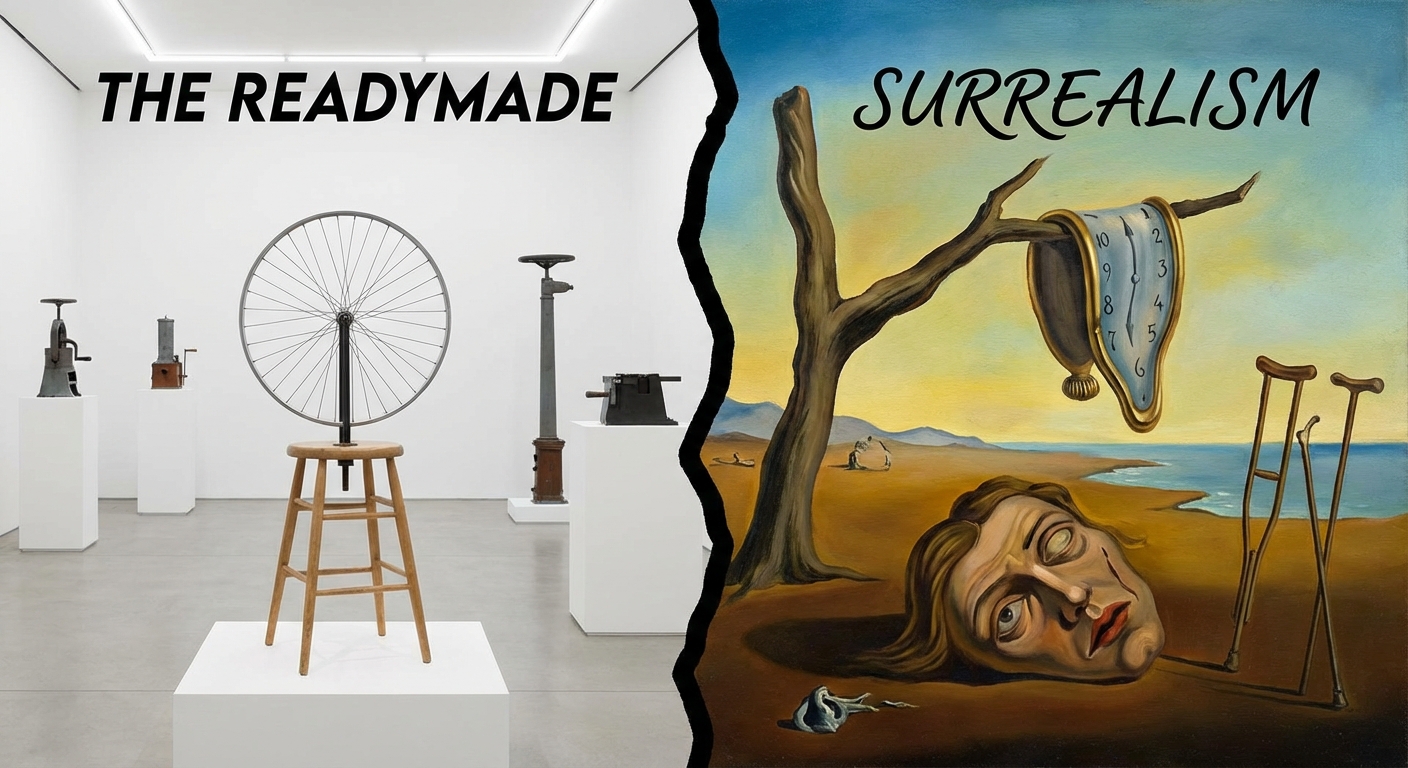
- The Readymade: Introduced by Marcel Duchamp. An ordinary manufactured object designated by the artist as a work of art (e.g., Fountain—a urinal turned upside down). This shifted art from "craft" (skill of the hand) to "concept" (choice of the mind).
Surrealism: Resolving Dream and Reality
Growing out of Dada in the 1920s, Surrealism was heavily influenced by Sigmund Freud’s theories of the unconscious mind and dreams.
- Aim: To reveal the "super-reality" (sur-reality) by unlocking the unconscious.
- Two Main Styles:
- Biomorphic/Abstract: Automatism (drawing without conscious control) to allow the subconscious to flow (e.g., Joan Miró).
- Veristic/Naturalistic: Hyper-realistic painting techniques applied to impossible, dreamlike scenes (e.g., Meret Oppenheim’s Object—the fur-covered teacup).
The New Center of Art: Abstract Expressionism
Post-WWII, the center of the art world shifted from Paris to New York. The trauma of the war and the atomic bomb led artists to seek a universal visual language rooted in existentialism.
The New York School
Abstract Expressionism was the first specifically American movement to achieve international influence.
- Action Painting (Gestural): Focuses on the physical act of painting. The canvas is an arena in which to act. The "drip paintings" of Jackson Pollock or the aggressive brushwork of Willem de Kooning (Woman, I) record the artist's physical energy.
- Color Field Painting: Focuses on large expanses of color to evoke a spiritual or meditative response. Mark Rothko and Helen Frankenthaler (The Bay) minimized the artist’s gesture to emphasize the transcendence of color itself.
Concept Note: These works are often non-objective. There is no figure or narrative; the paint and the canvas are the subject.
Mass Culture and Reduction: Pop Art and Minimalism
By the late 1950s and 60s, artists reacted against the serious, emotional intensity of Abstract Expressionism.
Pop Art: The Mirror of Society
Pop Art embraced the post-war consumer boom, blurring the line between "High Art" (museums) and "Low Culture" (advertising, comic books).
- Characteristics: Bright, flat colors; mechanical reproduction techniques (silkscreen); imagery from mass media (celebrities, soup cans).
- Key Artists:
- Andy Warhol: Used repetition (e.g., Marilyn Diptych) to desensitize the viewer to the image, mimicking mass production and the commodification of fame.
- Claes Oldenburg: Created monumental sculptures of mundane objects (e.g., Lipstick (Ascending) on Caterpillar Tracks) to critique consumerism and gender roles.
Minimalism: The Essence of the Object
While Pop Art looked to culture, Minimalism looked to the object itself. It removed the artist's metaphor, emotion, and biography entirely.
- Mantra: "What see is what you see." (Frank Stella)
- Visuals: Geometric shapes, industrial materials (steel, neon, plexiglass), and repetition. No hidden meaning or symbolism.
Summary Comparisons
| Movement | Primary Focus | Reaction Against… |
|---|---|---|
| Cubism | Structure & Multiple Viewpoints | Renaissance Perspective |
| Dada | Absurdity & Chance | Logic/Rationality (that caused WWI) |
| Surrealism | The Unconscious/Dreams | Conscious Reality |
| Abstract Expressionism | Emotion & Action | Social Realism / Geometric Abstraction |
| Pop Art | Mass Culture/Consumerism | Elitism of Abstract Expressionism |
| Minimalism | Pure Form/Materiality | Emotion & Illusionism |
Common Mistakes & Pitfalls
- Analytic vs. Synthetic Cubism: Students often swap these. Remember: Analytic analyzes (breaks down, monochromatic); Synthetic synthesizes (builds up, collage, brighter colors).
- Dada vs. Surrealism: While both are weird, Dada is about nonsense and anarchy (political reaction), while Surrealism is about psychology and dreams (Freudian reaction).
- "My Kid Could Do That": Avoid dismissing Abstract Expressionism or Minimalism as requiring no skill. In AP Art History, you must analyze the intellectual intent and the historical context. Pollock wasn't just splashing paint; he was challenging the definition of painting itself.
- Duchamp's Intent: Fountain is not about the beauty of the urinal. It is an intellectual question: "Does the artist's choice define art, or does the artist's hand define art?"