Differentiation Rules for Products and Quotients
In previous sections, you likely mastered the Power Rule and the Sum and Difference Rules. Those rules make derivatives feel intuitive—almost linear. However, when functions multiply or divide, intuition can be misleading.
This section covers the Product Rule and the Quotient Rule, two fundamental pillars of differential calculus essential for AP Calculus AB. These rules allow you to differentiate complex combinations of functions, such as $x^2 \sin(x)$ or $\frac{e^x}{x^2 + 1}$, where simpler rules fail.
The Product Rule
The most common error students make when first encountering products is assuming the derivative of a product is simply the product of the derivatives. This is false.
If $y = f(x)g(x)$, then $y' \neq f'(x)g'(x)$. Instead, the rate of change depends on the interplay between the changing value of one function and the current value of the other.
Definition and Formula
If $f$ and $g$ are both differentiable functions, then their product $fg$ is also differentiable. The rule is formally stated as:
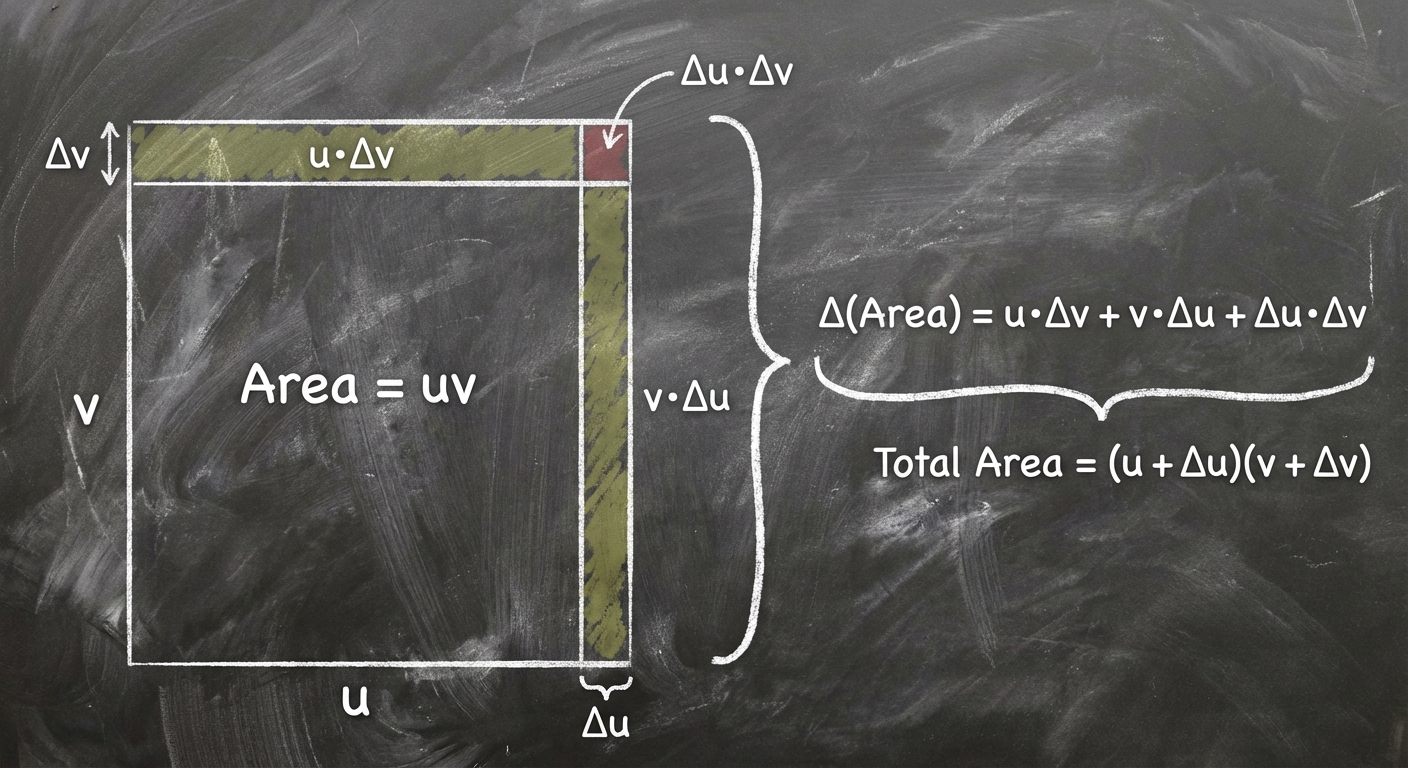
In shorthand notation using $u$ and $v$:
Conceptual Interpretation:
Imagine $f(x)$ and $g(x)$ are the lengths of the sides of a rectangle that are changing over time. The total area is $A = f(x)g(x)$. The change in area isn't just the tiny corner piece (product of changes); it includes the strips added to both sides.
Worked Example: Polynomials
Problem: Find $f'(x)$ for $f(x) = (3x^2 - 1)(x^2 + 5x)$.
Method:
- Identify the two parts:
Let $u = 3x^2 - 1$ and $v = x^2 + 5x$. - Differentiate each part separately:
$u' = 6x$
$v' = 2x + 5$ - Apply the formula $(uv)' = uv' + vu'$:
- Simplify (optional on Free Response Questions, but useful for Multiple Choice):
Worked Example: Mixing Function Types
Problem: Differentiate $y = x^2 \sin(x)$.
Solution:
- Let $f(x) = x^2$ therefore $f'(x) = 2x$
- Let $g(x) = \sin(x)$ therefore $g'(x) = \cos(x)$
The Quotient Rule
Just as with products, you cannot simply divide the derivatives. The Quotient Rule is necessary whenever you have a fraction where both the numerator and the denominator contain variables.
Definition and Formula
If $f$ and $g$ are differentiable functions and $g(x) \neq 0$, then the quotient $f/g$ is differentiable. The formula is:
Using $u$ (numerator) and $v$ (denominator):
Mnemonic Device: "Lo d-Hi"
Because the operation in the numerator is subtraction, the order matters immensely. A classic rhyme to remember this is:
"Lo d-Hi minus Hi d-Lo, all over Lo Lo."
- Lo: The denominator (Low)
- d-Hi: Derivative of the numerator (High)
- Hi: The numerator
- d-Lo: Derivative of the denominator
- Lo Lo: The denominator squared
Worked Example: Rational Function
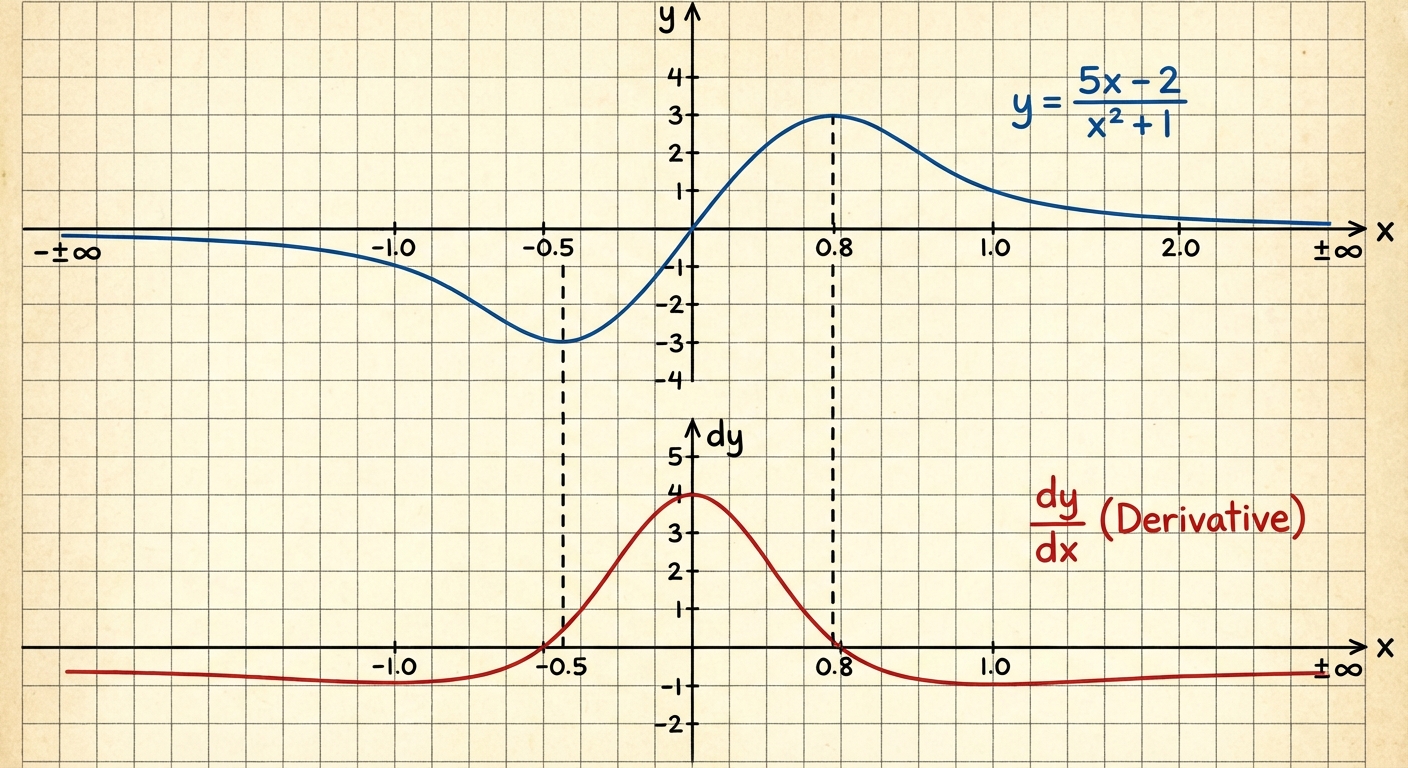
Problem: Find $dy/dx$ for $y = \frac{5x - 2}{x^2 + 1}$.
Method:
- Identify Lo and Hi:
- $Hi = 5x - 2 \rightarrow dHi = 5$
- $Lo = x^2 + 1 \rightarrow dLo = 2x$
- Apply Mnemonic: (Lo $\cdot$ dHi) - (Hi $\cdot$ dLo)
- Place over "Lo Lo":
- Simplify the numerator:
Note: It is standard practice to leave the denominator in factored form $(x^2+1)^2$ rather than expanding it. This makes finding critical points (where the denominator is zero) much easier later in the course.
Higher-Order Derivatives & Notation
Occasionally, you will be asked to find the second derivative, denoted as $f''(x)$ or $\frac{d^2y}{dx^2}$, involving these rules. This often requires nesting rules.
If calculating $f''(x)$ for a product $f(x) = uv$, you apply the product rule once to get $f'(x) = uv' + vu'$, and then apply the product rule again to each term ($uv'$ and $vu'$) to find the second derivative. This expands rapidly, so organization is key.
Notation Reference
| Notation Type | Derivative of Product | Derivative of Quotient |
|---|---|---|
| Prime ($'$ ) | $(fg)' = f'g + fg'$ | $(f/g)' = \frac{g f' - f g'}{g^2}$ |
| Leibniz ($d/dx$) | $\frac{d}{dx}(uv) = u\frac{dv}{dx} + v\frac{du}{dx}$ | $\frac{d}{dx}(\frac{u}{v}) = \frac{v\frac{du}{dx} - u\frac{dv}{dx}}{v^2}$ |
Common Mistakes & Pitfalls
Even advanced students stumble on these specific issues. Watch out for:
"The Freshman's Dream": Believing that $(fg)' = f'g'$.
- Correction: Always verify if two functions are being multiplied. If they are, use the Product Rule.
Quotient Rule Order: Swapping terms in the numerator.
- Why it occurs: Since subtraction is not commutative ($a-b \neq b-a$), getting the order wrong flips the sign of your answer.
- Correction: Always start with the bottom function ($v$ or "Lo"). Remember "Lo d-Hi" comes first.
Failure to Distribute the Negative: In the Quotient Rule numerator $vu' - (uv')$, the negative sign applies to the entire product $uv'$.
- Correction: Use parentheses liberally around the second part of the numerator.
Avoiding the Rule when not needed: You don't need the Quotient Rule for $y = \frac{x^3 + 5}{6}$.
- Why: The denominator is a constant. Rewrite as $y = \frac{1}{6}(x^3 + 5)$ and use the Power/Sum rules. It is much faster.