Unit 4: Momentum Conservation and Collision Dynamics
Introduction to Collision Mechanics
In AP Physics C: Mechanics, a collision is defined as an isolated event in which two or more bodies exert relatively strong forces on each other for a relatively short time. The central principle governing all collisions is the Law of Conservation of Linear Momentum.
This law holds true because the forces during the collision are internal forces (Newton’s Third Law pairs). Consequently, the net external force on the system is zero during the impact (or negligible compared to the impact forces), meaning the impulse applied to the system is zero.
While momentum is conserved in all isolated collisions, Kinetic Energy (K) is not. The classification of a collision depends entirely on what happens to the system's kinetic energy.
Types of Collisions
| Collision Type | Conservation of Momentum | Conservation of Kinetic Energy | Characteristics |
|---|---|---|---|
| Elastic | Yes | Yes | Objects bounce perfectly; no deformation/heat generation. |
| Inelastic | Yes | No | Objects bounce but lose K to heat/sound/deformation. |
| Perfectly Inelastic | Yes | No (Max Loss) | Objects stick together and move with a common velocity. |
Elastic Collisions
In an elastic collision, the total kinetic energy of the system is the same before and after the collision. While truly perfectly elastic collisions are rare in the macroscopic world (billiard balls come close), they are common at the atomic and subatomic levels.
1D Elastic Collisions
For two objects moving along a single axis (e.g., the x-axis), we have two governing equations:
Conservation of Momentum:
Conservation of Kinetic Energy:
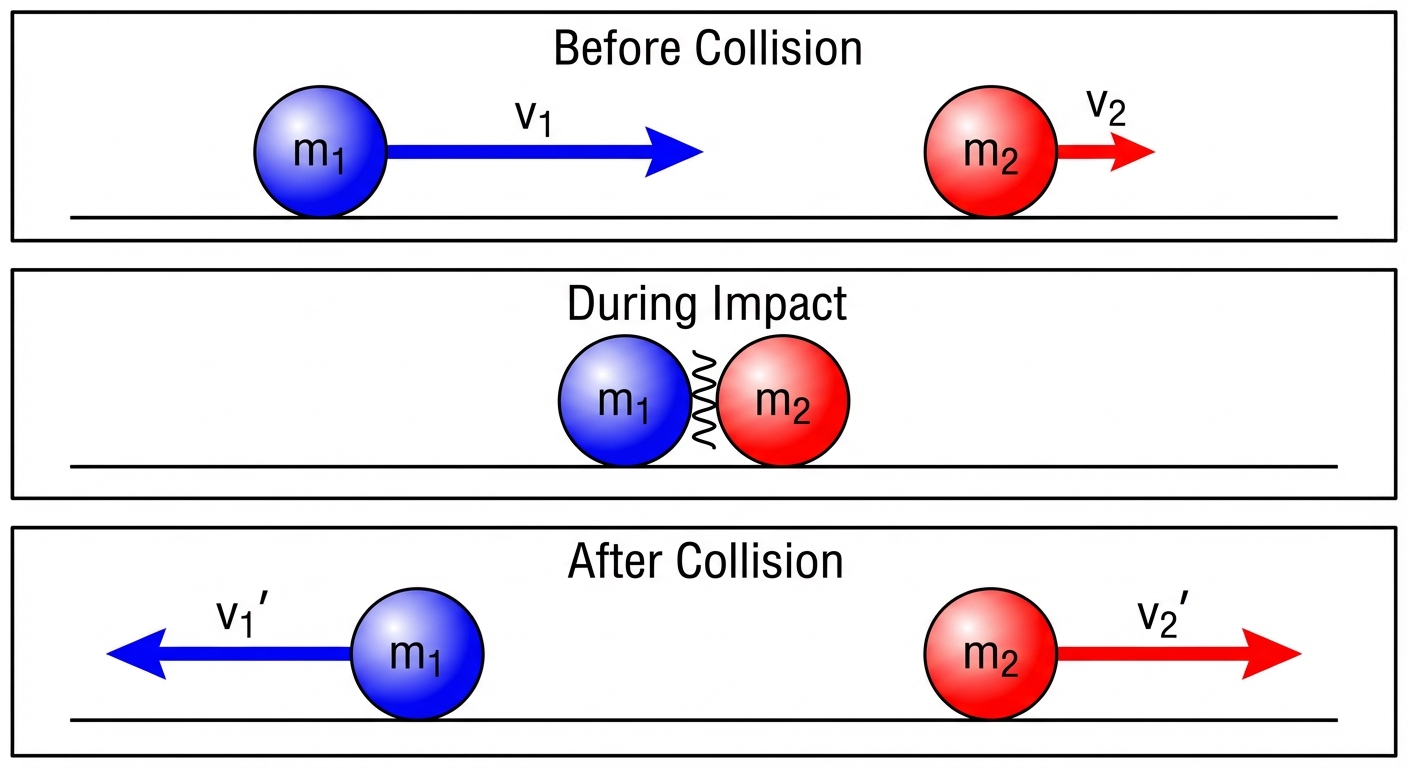
The Relative Velocity Shortcut
Solving the quadratic energy equation during an exam is time-consuming. By combining the momentum and energy equations, we derive a simpler relationship for 1D elastic collisions:
Or reduced to:
This states that the relative velocity of approach equals the negative relative velocity of separation. If object 1 approaches object 2 at $5\ m/s$, they must separate at $5\ m/s$ after the collision.
Special Cases
- Equal Masses ($m1 = m2$): The particles exchange velocities. If $m2$ was at rest, $m1$ stops dead, and $m2$ shoots off with $v{1i}$.
- Massive Hits Light ($m1 \gg m2$): If $m1$ hits stationary $m2$, $m1$ continues essentially unchanged, and $m2$ shoots off at nearly $2v_{1i}$.
- Light Hits Massive ($m1 \ll m2$): If $m1$ hits stationary $m2$, $m1$ bounces back with almost $-v{1i}$, and $m_2$ barely moves.
2D Elastic Collisions
In two dimensions, momentum must be conserved in both the x-direction and the y-direction independently. Kinetic energy is a scalar, so it is just summed generally.
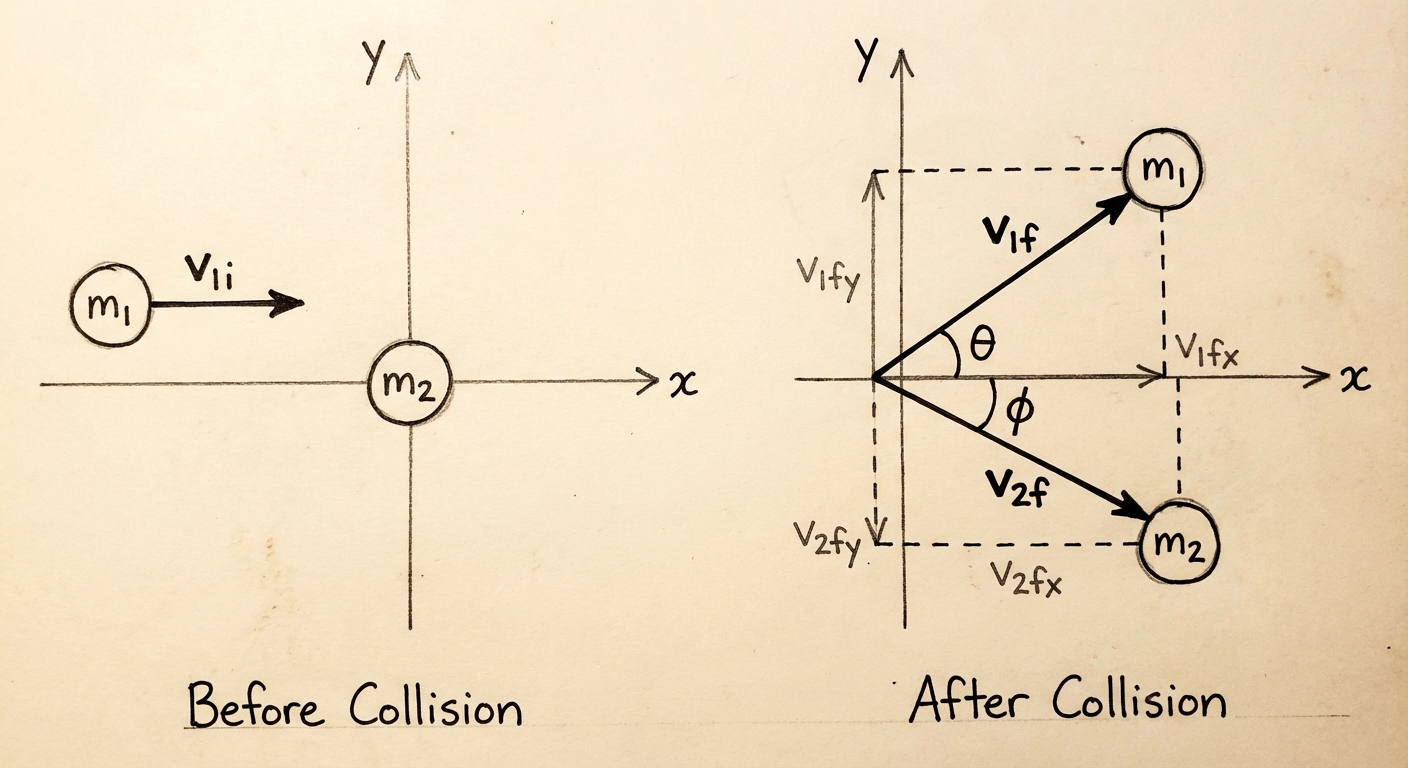
Equations to set up:
Note: If two objects of equal mass collide elastically and one is initially at rest, the angle between their final velocity vectors will always be 90 degrees.
Inelastic Collisions
In standard inelastic collisions, deformation occurs. Some kinetic energy is transformed into internal energy (elastic potential energy that doesn't rebound, heat, or sound).
- Governing Rule: Conservation of Momentum ONLY.
- Energy Check: $Kf < Ki$.
Perfectly Inelastic Collisions
This occurs when the colliding objects stick together after impact and move as a single combined mass. This results in the maximum possible loss of kinetic energy consistent with the conservation of momentum.
Equation:
From here, the final common velocity $vf$ is:
Worked Example: The Ballistic Pendulum
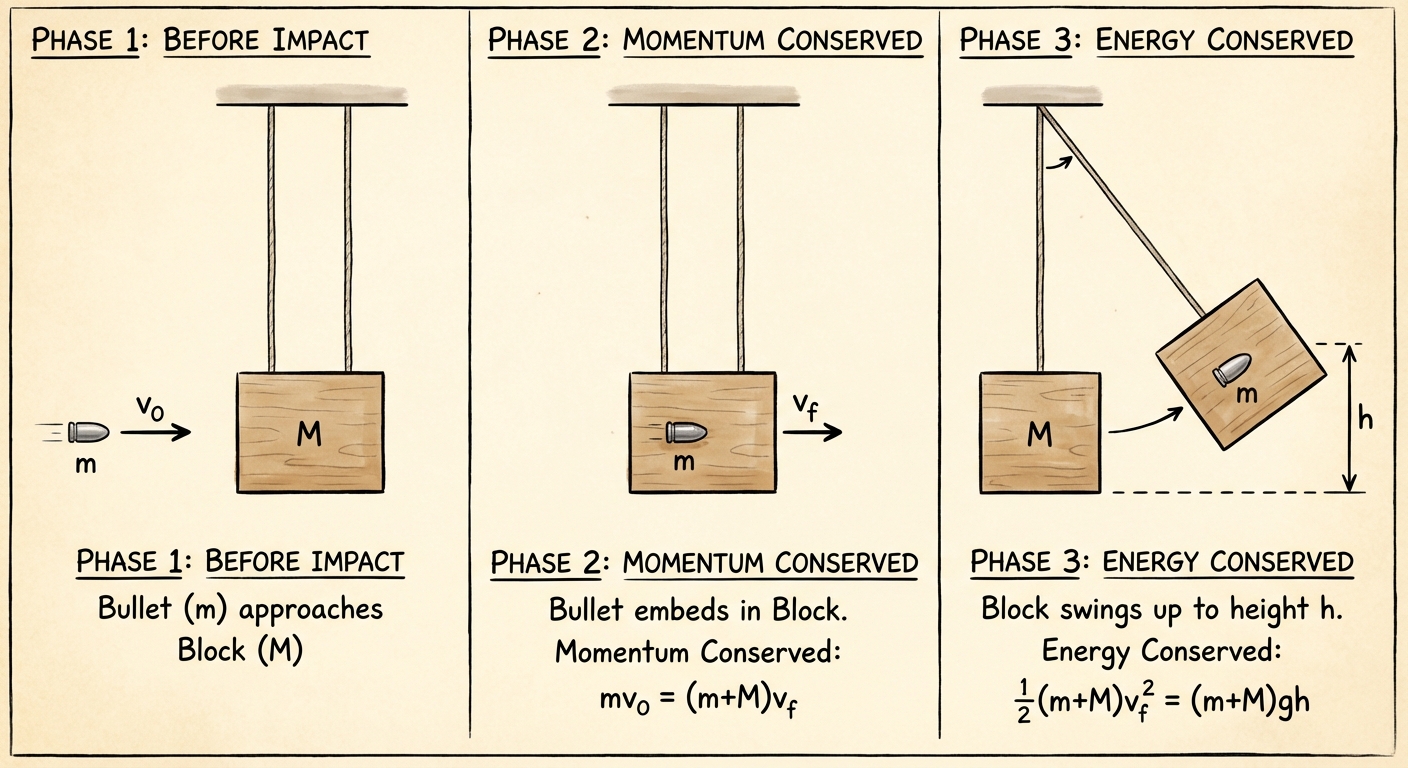
A classic AP Physics C problem involves a bullet (mass $m$) fired into a hanging block of wood (mass $M$). The bullet embeds itself in the wood (perfectly inelastic), and the block swings upward.
This problem requires a two-step analysis:
The Collision (Conservation of Momentum):
- Just before and just after impact, external forces (gravity/tension) don't have time to do work or provide significant impulse.
The Swing (Conservation of Mechanical Energy):
- After the collision, the block swings up. Momentum is not conserved here (gravity acts), but mechanical energy is.
Substituting $V{sys}$ allows you to solve for the initial bullet speed $v0$ or the height $h$.
Solving 2D Collision Problems
When dealing with collisions in 2 dimensions (glancing blows), structure your work systematically.
- Define Axes: usually align the x-axis with the initial velocity vector of one of the particles.
- Resolve Vectors: Break all velocities into i (x) and j (y) components.
- Write Conservation Equations:
- $P{ix} = P{fx}$
- $P{iy} = P{fy}$
- Count Unknowns: You normally need as many equations as unknowns. If the collision is elastic, you get a third equation ($Ki = Kf$).
Memory Aid: "Momentum is a vector, Energy is a scalar." Never start a problem by breaking Energy into x and y components. Energy is just a number (Joules) associated with the total speed.
In-Depth Analysis: Center of Mass Frame
While not strictly required for every problem, analyzing collisions in the Center of Mass (CM) reference frame can simplify difficult problems, especially elastic ones.
- In the CM frame, the total momentum of the system is zero.
- In a 1D elastic collision viewed from the CM frame, the particles simply approach the center of mass, hit, and rebound with the same speed but opposite direction. Their velocity vectors essentially just flip signs.
Common Mistakes & Pitfalls
Assuming Energy Conservation indiscriminately:
- Mistake: Students often apply $\frac{1}{2}mv^2$ conservation to non-elastic collisions.
- Correction: Check the problem text. Does it say "Elastic"? If not, assume energy is lost. Only momentum is safe.
Confusing Vector vs. Scalar Addition:
- Mistake: Adding magnitudes like $5 m/s + 3 m/s = 8 m/s$ in a 2D collision.
- Correction: You must add vectors components: $\vec{p}{resultant} = \sqrt{px^2 + p_y^2}$.
Ballistic Pendulum Error:
- Mistake: Trying to use Conservation of Energy for the entire process (Bullet fired $\to$ top of swing).
- Correction: Energy is lost during the impact. You cannot equate the initial KE of the bullet to the potential energy of the block. You must bridge the gap with momentum conservation during the crash.
Signs in 1D Problems:
- Mistake: Forgetting that velocity is a vector. If object A moves right and object B moves left, one must have a negative velocity.
- Correction: Define your positive direction explicitly at the start (e.g., "Right is +xt").