AP Calculus AB Unit 4 Study Guide: Contextual Applications of Differentiation (Rates, Motion, Related Rates, Linearization, and L’Hospital’s Rule)
Interpreting derivatives as rates of change (meaning, units, and context)
When you first learn derivatives, it’s easy to think of them as a purely algebraic skill: take a function and “differentiate it.” In real applications, though, a derivative is mainly an interpretation tool. It tells you how one quantity is changing right now compared to another quantity.
A derivative has two interconnected interpretations. Geometrically, it is the slope of the line tangent to the graph at a particular point. In applications, it is the instantaneous rate of change, meaning “change in output per unit of input,” at a specific input value.
What a derivative is (in plain language)
If a function %%LATEX0%% connects an input %%LATEX1%% to an output %%LATEX2%%, then the derivative %%LATEX3%% measures the instantaneous rate of change of %%LATEX4%% with respect to %%LATEX5%%.
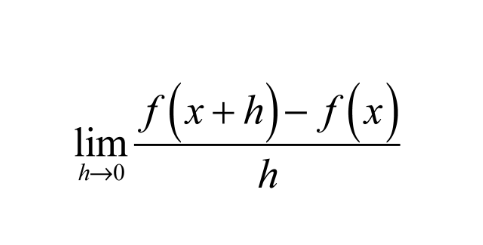
Formally, the derivative is defined by a limit of average rates of change (secant slopes):
Even if you don’t compute derivatives by the limit definition most of the time, that formula explains what you are measuring: as gets tiny, the average rate of change becomes an instantaneous one.
Why this matters in applications
Many real-world quantities aren’t constant. A car’s speed changes as you accelerate or brake. A tank may fill faster at some times than others. Revenue changes as price changes. Temperature changes as time passes. In these situations, you rarely only care about “how much changed over an hour.” You often care about “how fast is it changing at this moment?” That is exactly what derivatives provide.
Derivative as slope vs derivative as rate
Because slope is “rise over run,” it matches the idea of “change in output over change in input.” So the tangent slope interpretation and the rate interpretation are the same concept in two languages.
Units: your built-in error checker
In contextual problems, units are essential. If %%LATEX8%% has units of meters and %%LATEX9%% has units of seconds, then has units of meters per second.
In general:
- Units of = (units of output) per (units of input)
This is one of the best ways to catch mistakes. If a problem asks for “gallons per minute” and your work gives “minutes per gallon,” something is wrong.
Average rate of change vs instantaneous rate of change
Over an interval , the average rate of change is:
That’s the slope of a secant line. At a single point %%LATEX14%%, the instantaneous rate is %%LATEX15%%, the slope of the tangent line. A key conceptual leap is to think of as what the average rate of change becomes when the interval shrinks down to a point.
Interpreting statements like
To interpret %%LATEX18%% correctly, you need the meaning of %%LATEX19%% and the units.
A reliable sentence template is: when %%LATEX20%%, the output %%LATEX21%% is increasing at a rate of 5 output-units per input-unit.
If %%LATEX22%% is the position of a runner in meters at time %%LATEX23%% seconds, then %%LATEX24%% means: at %%LATEX25%% seconds, the runner’s instantaneous velocity is 5 meters per second (in the positive direction).
Estimating derivatives from tables and graphs
AP problems often give you data instead of a formula. Then you estimate.
From a table near , use a symmetric difference quotient when possible:
If you only have one-sided data, use a one-sided estimate:
From a graph, sketch or visualize the tangent line at the point and estimate its slope using two clear points on the tangent line (not necessarily points on the curve).
Notation you must recognize (and translate)
In applications, derivative notation changes depending on the variables.
| Meaning | Common notations | Typical use |
|---|---|---|
| Derivative of %%LATEX29%% with respect to %%LATEX30%% | %%LATEX31%%, %%LATEX32%% | Function notation, general math |
| Derivative of %%LATEX33%% with respect to %%LATEX34%% | Emphasizes “rate per unit x” | |
| Derivative with respect to time | %%LATEX36%%, %%LATEX37%% | Related rates, motion |
| Value at a point | %%LATEX38%%, %%LATEX39%% | Specific instantaneous rate |
A key skill is being able to read as “the rate at which volume changes with respect to time.”
Worked example 1: interpreting units and meaning
Suppose %%LATEX41%% is the population of a town (people) at time %%LATEX42%% (years). You are told .
Interpretation: at years, the population is increasing at 250 people per year.
Worked example 2: estimating a derivative from a table
A temperature sensor records %%LATEX45%% in degrees Celsius at time %%LATEX46%% in minutes.
| 4 | 5 | 6 | |
|---|---|---|---|
| 18.2 | 19.0 | 20.3 |
Estimate .
Because we have values on both sides of 5, use the symmetric difference quotient with :
So the temperature is increasing at about 1.05 degrees Celsius per minute at .
Exam Focus
- Typical question patterns:
- Interpret in a sentence with correct units.
- Estimate from a table or graph (often using nearby values).
- Compare average rate of change on an interval to instantaneous rate at a point.
- Common mistakes:
- Forgetting units (or giving mismatched units like “minutes per gallon” instead of “gallons per minute”).
- Using a forward difference when a centered estimate is possible.
- Interpreting %%LATEX56%% as the value of the function %%LATEX57%% (rate vs amount confusion).
Motion along a line: position, velocity, acceleration, speed, and direction
Motion problems are one of the cleanest places to see derivatives in action because the vocabulary already includes rates.
The three core functions of one-dimensional motion
For an object moving along a line:
- Position: %%LATEX58%% or %%LATEX59%% (units: meters or other length) tells where the object is at time .
- Velocity: %%LATEX61%% or %%LATEX62%% (units: meters per second) tells how fast and in what direction position is changing.
- Acceleration: %%LATEX63%% or %%LATEX64%% or (units: meters per second squared) tells how velocity is changing.
The derivative relationships are:
A compact summary (matching common AP notation) is:
| Quantity | Common notation | Typical units |
|---|---|---|
| Position | %%LATEX68%% or %%LATEX69%% | meters |
| Velocity | %%LATEX70%% or %%LATEX71%% | meters/second |
| Acceleration | %%LATEX72%% or %%LATEX73%% or | meters/second |
Why sign matters: direction and “negative velocity”
In one-dimensional motion, the sign tells direction.
- If , position is increasing: the object moves in the positive direction.
- If , position is decreasing: the object moves in the negative direction.
- If , the object is momentarily at rest.
A very common confusion is treating velocity as “speed.” Speed is the magnitude of velocity:
Speed is never negative.
When does a particle speed up?
A particle speeds up when velocity and acceleration have the same sign (both positive or both negative). Intuitively, acceleration is pushing in the same direction as the motion, increasing the magnitude of velocity.
Displacement vs distance traveled
- Displacement from %%LATEX80%% to %%LATEX81%% is the net change in position:
- Distance traveled is how much ground you covered total, regardless of direction.
Distance traveled requires tracking when velocity changes sign. If the object reverses direction, distance traveled is larger than the absolute value of displacement.
Connecting graphs of %%LATEX83%%, %%LATEX84%%, and
From position %%LATEX86%% to velocity %%LATEX87%%: velocity is the slope of the position graph. Increasing %%LATEX88%% means positive %%LATEX89%%, decreasing %%LATEX90%% means negative %%LATEX91%%, and a horizontal tangent on %%LATEX92%% means %%LATEX93%%.
From velocity %%LATEX94%% to acceleration %%LATEX95%%: acceleration is the slope of the velocity graph. If %%LATEX96%% is increasing, %%LATEX97%% is positive; if %%LATEX98%% is decreasing, %%LATEX99%% is negative.
A useful check: if a position graph is concave up, its slope is increasing, so velocity is increasing, which means acceleration is positive.
When does an object change direction?
An object changes direction when its velocity changes sign, typically at times when %%LATEX100%% and crosses from positive to negative or vice versa. It is not enough to find where %%LATEX101%%; you must check the sign on each side.
Worked example 1: from position to velocity and acceleration
A particle’s position is given by:
where %%LATEX103%% is in meters and %%LATEX104%% is in seconds.
1) Find velocity and acceleration.
2) Interpret %%LATEX107%% and %%LATEX108%%.
At seconds, the velocity is negative 3 meters per second, so the particle is moving in the negative direction.
At seconds, the acceleration is 0 meters per second squared, meaning velocity is not changing at that instant.
Worked example 2: at rest and direction change (check signs)
Using the same velocity:
Solve :
So the object is at rest at %%LATEX118%% and %%LATEX119%%.
To check direction change, test intervals:
So the particle moves positive, then negative, then positive again, changing direction at both %%LATEX123%% and %%LATEX124%%.
Worked example 3: acceleration from a velocity function
A particle moves along a straight line with velocity:
Find the acceleration at time .
Acceleration is the derivative of velocity:
Evaluate at :
So the acceleration at is 8 (in units of meters per second squared if velocity was in meters per second).
Exam Focus
- Typical question patterns:
- Given %%LATEX131%%, find %%LATEX132%% and and interpret values with units.
- Determine when an object is moving forward/backward or at rest using the sign of .
- Identify direction changes by checking sign changes around zeros of .
- Decide when a particle speeds up using the sign agreement of %%LATEX136%% and %%LATEX137%%.
- Common mistakes:
- Treating velocity as speed and ignoring negative values.
- Assuming always means a direction change (it might just touch and keep the same sign).
- Mixing up what is given: slope of %%LATEX139%% is %%LATEX140%%, slope of %%LATEX141%% is %%LATEX142%% (not the other way around).
Rates of change in applied models (beyond motion): interpreting, converting, and combining rates
Derivatives show up in many contexts besides motion. The unifying idea is the same: a derivative measures how one quantity responds to changes in another.
Derivatives as “sensitivity”
In applied settings, you can think of %%LATEX143%% as a sensitivity measure. If %%LATEX144%% is large in magnitude, small changes in the input cause large changes in the output near %%LATEX145%%. If %%LATEX146%% is near 0, the output is relatively insensitive to the input near .
In economics, for example, if %%LATEX148%% is cost to produce %%LATEX149%% items, then %%LATEX150%% is marginal cost: approximately how much additional cost you incur by producing one more item when you’re already producing %%LATEX151%% items.
Marginal interpretation (the derivative approximates a small increment)
If %%LATEX152%% is differentiable, then for a small change %%LATEX153%%:
If , then:
That is why is interpreted as “cost of producing one more item,” even though calculus is continuous and items are discrete.
Rates with respect to time vs rates with respect to something else
Not every derivative is “per second.” You must read what the independent variable represents.
- If %%LATEX158%% is temperature as a function of height %%LATEX159%%, then is degrees per meter.
- If %%LATEX161%% is pressure as a function of depth %%LATEX162%%, then is pressure-units per meter.
AP questions often test whether you can interpret the derivative using the right “per.”
Combining rates through dependency (chain rule in context)
Sometimes you know how a variable changes in time, but the function is written in terms of another variable. If %%LATEX164%% and %%LATEX165%%, then:
This is the same chain rule logic used in related rates.
Worked example 1: marginal cost interpretation
A company’s cost (in dollars) to produce units is:
Find and interpret .
Interpretation: when producing 100 units, the cost is increasing at about 22 dollars per additional unit, so the cost of producing the 101st unit is approximately 22 dollars.
Worked example 2: rate of change of volume in a pool
Let the volume of water in a pool be:
where %%LATEX173%% is in gallons and %%LATEX174%% is time in hours. To find the rate that volume is changing, differentiate:
The units are gallons per hour. At :
So at hours, the volume is not changing instantaneously.
Worked example 3: rate of change of coffee temperature at a specific time
Suppose the temperature of a cup of coffee is:
where is minutes since the coffee was poured. Differentiate to get the rate of change with respect to time:
Evaluate at :
Interpretation: at 5 minutes, the coffee’s temperature is decreasing at about 2.27 degrees per minute.
Interpreting the sign of a derivative in context
The sign is not just a math detail.
- If %%LATEX184%%, the quantity is increasing at %%LATEX185%%.
- If %%LATEX186%%, the quantity is decreasing at %%LATEX187%%.
- If %%LATEX188%%, the quantity is not changing instantaneously at %%LATEX189%%.
A frequent mistake is assuming means the function is “at its maximum” or “stopped forever.” It only means the instantaneous rate is zero at that moment.
Working with verbal descriptions
AP often presents scenarios in words and asks you to set up derivative meaning. Even if you don’t have an explicit formula, you should identify:
- the dependent variable,
- the independent variable,
- what the derivative represents in words and units.
If you can write a sentence like “ is the rate the height changes in feet per second,” you’re already doing a major part of the problem.
Exam Focus
- Typical question patterns:
- Interpret derivatives like %%LATEX192%%, %%LATEX193%%, as marginal quantities or rates with correct units.
- Use chain rule logic to connect a rate of one variable to a rate of another through a known model.
- Explain the meaning of a sign (increasing vs decreasing) in the real situation.
- Common mistakes:
- Confusing the function value with the derivative value (amount vs rate).
- Giving units that match the original function rather than the derivative.
- Ignoring negative signs that indicate decrease or opposite direction.
Related rates: linking quantities that change together
In many real situations, you don’t have just one changing quantity. You have several, tied together by a geometric or physical relationship. Related rates problems are about using derivatives (especially the chain rule) to connect those rates.
What a related rates problem is
A related rates problem involves:
- two or more variables (like radius and volume) that depend on time,
- a relationship among those variables (often a geometry formula),
- one rate given (like ),
- another rate asked for (like ).
Even if you don’t know how the variables depend on time explicitly, you can still relate their rates by differentiating the relationship with respect to time.
Why differentiating with respect to time works (chain rule engine)
If %%LATEX197%% depends on %%LATEX198%%, and %%LATEX199%% depends on %%LATEX200%%, then:
Usually you’ll do this by differentiating an equation containing %%LATEX202%% and %%LATEX203%% with respect to .
A reliable step-by-step process
To solve related rates problems in calculus, follow these steps:
- Read the problem carefully and identify all given information.
- Draw a diagram if possible.
- Determine what needs to be found and assign a variable to it.
- Write an equation that relates the variables involved.
- Differentiate both sides of the equation with respect to time.
- Substitute in the given values and solve for the unknown rate.
- Always include units in your final answer and check that your answer makes sense in context.
A common mistake is substituting numbers too early, before differentiating. If you replace a variable with a constant too soon, you can accidentally make its derivative zero and destroy the relationship.
Typical derivative patterns you must recognize
If %%LATEX205%% depends on %%LATEX206%%, then:
If %%LATEX208%% and %%LATEX209%% changes with time, then:
That extra is the chain rule in action.
Worked example 1: expanding circle (radius given)
A circle’s radius increases at a constant rate of 3 centimeters per second. How fast is its area increasing when the radius is 10 centimeters?
Relationship:
Differentiate with respect to time:
Substitute %%LATEX214%% and %%LATEX215%%:
Interpretation: when the radius is 10 cm, the area is increasing at square centimeters per second.
Worked example 2: sliding ladder (classic related rates)
A 13-foot ladder leans against a wall. The bottom slides away from the wall at 2 feet per second. How fast is the top sliding down the wall when the bottom is 5 feet from the wall?
Let %%LATEX218%% be the distance from the wall to the bottom of the ladder (feet) and %%LATEX219%% be the height of the top on the wall (feet). The ladder length is constant.
Relationship:
Differentiate with respect to time:
Simplify:
Given %%LATEX223%% and %%LATEX224%%. Find :
Solve for :
Interpretation: the top is moving down at feet per second when the bottom is 5 feet from the wall.
Worked example 3: area increasing given, solve for radius rate
A pool of water (modeled as a circle) is expanding at a rate of square inches per second. Find the rate the radius is expanding when the radius is 4 inches.
Start with:
Differentiate with respect to time:
Substitute %%LATEX236%% and %%LATEX237%%:
So the radius is changing at 2 inches per second.
Worked example 4: spherical balloon volume rate given
A spherical balloon is being inflated at a rate of 10 cubic inches per second. How fast is the radius increasing when the radius is 4 inches?
Volume of a sphere:
Differentiate with respect to time:
Substitute %%LATEX242%% and %%LATEX243%%:
So the radius is increasing at a rate of %%LATEX246%% inches per second when %%LATEX247%%.
Common conceptual pitfalls in related rates
- Forgetting that the question asks “at the instant when…” so you often need a snapshot value (like %%LATEX248%%) to compute another variable (like %%LATEX249%%).
- Losing the chain rule factor, for example differentiating %%LATEX250%% as %%LATEX251%% instead of .
- Sign confusion: decide whether a quantity is increasing or decreasing. If a height is going down, its rate should be negative.
Exam Focus
- Typical question patterns:
- Geometry-based: circles, spheres, cones, ladders, triangles with moving points.
- “Find %%LATEX253%% when %%LATEX254%%” after giving .
- Problems that require using a relationship to compute a missing value before solving for the rate.
- Common mistakes:
- Plugging in numerical values before differentiating (turning variables into constants too early).
- Not using the chain rule (missing factors like ).
- Solving for the wrong rate or mixing up which rate is given.
Linearization and differentials: approximating change with the tangent line
Derivatives don’t just measure change. They also help you approximate complicated functions using simpler ones. Near a point, a smooth curve behaves almost like its tangent line.
What linearization means
The tangent line at %%LATEX257%% is the best linear (straight-line) approximation to the function near that point. The linearization of %%LATEX258%% at is:
Differentials and “small change” notation
A closely related idea is the differential, which packages “small changes” into a convenient format.
- Let %%LATEX261%% be a small change in %%LATEX262%%.
- Then the corresponding approximate change in is:
At a specific point , you often write:
Important nuance: %%LATEX267%% is the actual change, while %%LATEX268%% is the linear (tangent-line) approximation to that change.
Some notes and teachers also describe this approximation by saying “replace the limit-definition step size %%LATEX269%% with a small change %%LATEX270%% and remove the limit,” leading to:
Even though %%LATEX272%% is technically a finite change (not the differential %%LATEX273%%), in linear approximation problems you usually treat as “small,” so the formula works as a practical approximation.
Visual reminder resource
The following images were included in the original notes as visual reminders of linearization and L’Hospital’s Rule:
When linear approximation is trustworthy
Linearization works best when %%LATEX275%% is close to the base point %%LATEX276%% and the function is smooth and not rapidly curving near %%LATEX277%%. If %%LATEX278%% is far from , the curve may bend away from the tangent line and the approximation error can become large.
Worked example 1: approximating a function value
Approximate using linearization.
Let:
Choose .
Linearization:
Evaluate:
So:
Worked example 2: using differentials to estimate error
Suppose the radius of a sphere is measured as 10 cm, but the measurement may be off by up to 0.1 cm. Estimate the possible error in the calculated volume.
Using differentials with %%LATEX291%% at %%LATEX292%%:
So the volume could be off by about cubic centimeters.
Worked example 3: using a differential to approximate a power
Approximate:
Let:
Choose %%LATEX297%% and %%LATEX298%% so that .
Use:
Compute:
Approximation:
You can verify this on a calculator.
Common misconceptions with linearization
- Using linearization too far from the base point (linearization is local).
- Forgetting to pick a convenient base point where %%LATEX305%% and %%LATEX306%% are easy.
- Confusing actual change and differential: %%LATEX307%% is exact; %%LATEX308%% is approximate.
Exam Focus
- Typical question patterns:
- Construct a linearization at a specified point and use it to approximate a value.
- Use to estimate change given a small input change.
- Error propagation: estimate how measurement error in one variable affects an output.
- Common mistakes:
- Plugging into %%LATEX311%% without first computing %%LATEX312%% and correctly.
- Using but forgetting to evaluate at the specified point.
- Treating the approximation as exact, especially when the change is not small.
Solving contextual problems with derivatives: modeling, interpreting, and communicating results
Unit 4 isn’t only about computing derivatives. It’s also about using them as part of a solution process that includes setting up a model, computing a derivative, and interpreting the result clearly.
A general problem-solving framework
Many AP Free Response questions in this unit can be approached with the following structure:
- Define variables clearly (what depends on what, and in what units).
- Write the function or relationship that models the situation.
- Differentiate to find the relevant rate.
- Evaluate at the correct input (the specified time, quantity, or location).
- Interpret your answer in a complete sentence with units.
Steps 1 and 5 are the communication part. On AP problems, those steps often matter as much as the calculus.
Building a function before differentiating (a core setup skill)
Sometimes you’re not given directly. You have to build it.
Example pattern: a circular puddle has radius . Express the area as a function of time.
You combine geometry and time dependence:
Then differentiate with respect to time:
Distinguishing “rate at a moment” from “rate over an interval”
- “Average rate from %%LATEX319%% to %%LATEX320%%” means use a difference quotient.
- “Instantaneous rate at ” means use a derivative value.
Self-check: “at ” or “at the instant” signals a derivative; “from…to…” signals average rate.
Worked example 1: interpreting a derivative from a contextual graph
Suppose a graph of %%LATEX323%% (height of water in a tank in centimeters) vs time %%LATEX324%% (minutes) is provided. At , the tangent line appears to rise 6 cm over a run of 2 minutes.
Interpretation: at 8 minutes, the water height is increasing at about 3 centimeters per minute.
When “the derivative exists” is an assumption you should notice
Real-world data can be noisy, and graphs can have corners.
- If a graph has a sharp corner at a time, the derivative at that time does not exist (no unique tangent slope).
- If a model is piecewise, you may need one-sided derivatives.
AP questions sometimes test whether you recognize when a derivative is not defined from a graph (for example, a pointed cusp or jump).
Communication: writing interpretations that earn full credit
A strong interpretation sentence contains the input value, the quantity changing, the rate, and the units.
Template:
- At %%LATEX327%%, %%LATEX328%% is increasing or decreasing at a rate of [number] [output units] per [input unit].
Motion template:
- At seconds, the object’s velocity is [number] meters per second, meaning it is moving in the [direction] direction.
Worked example 2: full modeling-to-interpretation chain (exponential cooling)
A hot drink cools according to the model:
where %%LATEX331%% is in degrees Celsius and %%LATEX332%% is in minutes.
Differentiate:
Evaluate at :
Interpretation: at time 0 minutes, the drink’s temperature is decreasing at 2 degrees Celsius per minute.
Exam Focus
- Typical question patterns:
- Build a model (often geometric or exponential) and then differentiate to find a rate.
- Interpret derivative values from formulas, tables, or graphs in complete sentences.
- Decide whether the question asks for average rate of change or instantaneous rate.
- Common mistakes:
- Giving a numerical answer without interpretation and units (often costs points on free response).
- Using average rate when instantaneous rate is requested (or vice versa).
- Evaluating at the wrong input because you missed “when ” language.
L’Hospital’s Rule (interpreting indeterminate limits using derivatives)
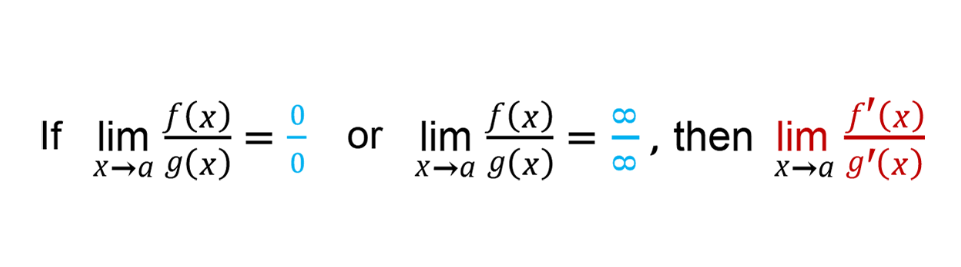
Sometimes derivatives appear inside limit problems. If a limit produces an indeterminate form like “zero over zero” or “infinity over infinity,” you can often use L’Hospital’s Rule to interpret it by differentiating.
When you can use it
If a limit gives you an indeterminate form
then L’Hospital’s Rule says you can take the derivative of the numerator and denominator and try the limit again.
Visual reminder resource
Worked example: repeated L’Hospital’s Rule for a rational function
Evaluate:
As %%LATEX340%%, this is an %%LATEX341%% indeterminate form, so apply L’Hospital’s Rule.
Differentiate numerator and denominator once:
This is still , so differentiate again:
This is still , so differentiate a third time:
So the limit is:
Exam Focus
- Typical question patterns:
- Recognize when a limit is indeterminate of type %%LATEX348%% or %%LATEX349%% and apply L’Hospital’s Rule.
- Apply L’Hospital’s Rule repeatedly when the indeterminate form persists.
- Common mistakes:
- Using L’Hospital’s Rule when the limit is not actually indeterminate.
- Differentiating only the numerator or only the denominator.
- Forgetting to re-check the form after each application to see whether you should stop or apply it again.