Model Comparison: Linear Equations & Inequalities
═══════════════════════════════════════
Gemini 3 Pro
═══════════════════════════════════════
What You Need to Know
- Slope is king: Mastery of slope () as a rate of change and the y-intercept () as a starting value is the most tested concept in this unit.
- Solution types define the graph: You must instantly recognize whether a linear system has one solution (intersecting), no solution (parallel), or infinite solutions (identical lines) based on their equations.
- Inequalities represent regions: Unlike equations which represent lines, linear inequalities represent half-planes. The solution is a set of points, not just lines.
Solving Linear Equations
Linear equations in one variable form the foundation of the SAT Math section. Your goal is to isolate the variable (usually ) to find the value that makes the equation true.
Basics of Isolation
To solve an equation like , use inverse operations to isolate .
- Distribution: Clear parentheses first. .
- Combining Like Terms: Group terms on one side and constants on the other.
- Fractions: If an equation contains fractions, multiply the entire equation by the least common denominator to clear them. For example, in , multiply every term by 6.
The Three Solution Types
Not all equations result in a single value for . You must recognize these special cases immediately:
- One Solution: The standard case. The variable remains after simplification.
- Example: 2x = 6
ightarrow x = 3.
- Example: 2x = 6
- No Solution (Contradiction): The variables cancel out, leaving a false statement. The lines would be parallel on a graph.
- Example: 3x + 5 = 3x + 10
ightarrow 5 = 10 (False).
- Example: 3x + 5 = 3x + 10
- Infinite Solutions (Identity): The variables cancel out, leaving a true statement. The lines are identical.
- Example: 2(x + 1) = 2x + 2
ightarrow 2x + 2 = 2x + 2
ightarrow 2 = 2 (True).
- Example: 2(x + 1) = 2x + 2
Exam Focus
- Why it matters: Approximately 30% of SAT Math comes from Heart of Algebra. These questions often test your ability to model real-world situations abstractly.
- Typical question patterns:
- "Find for no solution": You are given an equation like and asked to find the value of that results in no solution. (Answer: must equal the coefficient of on the other side, so ).
- Modeling: "A painter charges dollars per hour plus a dollar flat fee." You must write .
- Common mistakes:
- Forgetting to distribute the negative sign to both terms in parentheses: becomes , not .
- Misidentifying "no solution" vs. "infinite solutions." Remember: False statement = None; True statement = Infinite.
Graphing Linear Equations
Visualizing linear relationships is essential. You should be able to switch fluently between algebraic equations and their graphs.
Key Forms of Linear Equations
| Form | Equation | When to use |
|---|---|---|
| Slope-Intercept | Best for graphing. is slope, is y-intercept. | |
| Standard | Common in word problems involving two different items (e.g., tickets for adults and children). | |
| Point-Slope | Best when writing an equation given a slope and a single point . |
Understanding Slope ()
Slope represents the Rate of Change.
- Positive slope: Line rises from left to right.
- Negative slope: Line falls from left to right.
- Zero slope: Horizontal line ().
- Undefined slope: Vertical line ().
Parallel and Perpendicular Lines:
- Parallel: Slopes are equal ().
- Perpendicular: Slopes are negative reciprocals (). Example: If , the perpendicular slope is .
Exam Focus
- Why it matters: The SAT emphasizes interpreting the meaning of the graph in context, not just drawing it.
- Typical question patterns:
- Interpret and : "In the equation , what does represent?" (Answer: The initial flat fee or starting cost).
- Rate of change: "Identify the rate at which the temperature decreases." (Answer: Look for the absolute value of the slope).
- Common mistakes:
- Confusing and intercepts. To find the -intercept, set . To find the -intercept, set .
- Flipping the slope formula: It is , never .
Linear Inequalities
Linear inequalities work just like equations, but they represent a range of values rather than specific numbers.
Solving Inequalities
Follow the same rules as equations, with one crucial exception:
- The Golden Rule: When you multiply or divide both sides of an inequality by a negative number, you MUST flip the direction of the inequality symbol.
- -2x > 10 \rightarrow x < -5
Graphing Inequalities
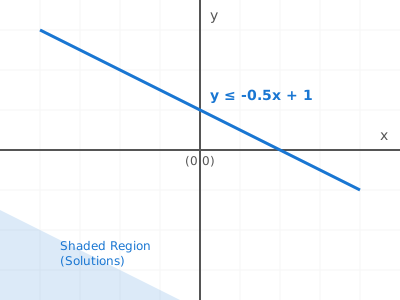
Inequalities on the coordinate plane define a region (a half-plane).
- Boundary Line:
- Use a solid line for or (the boundary is included).
- Use a dashed line for or (the boundary is excluded).
- Shading:
- For y > or , shade the region above the line.
- For y < or , shade the region below the line.
- Test Point Method: Pick a point like . If it makes the inequality true, shade that side. If false, shade the other side.
Exam Focus
- Why it matters: Inequality questions often ask you to determine if a specific data point fits a set of constraints.
- Typical question patterns:
- Testing points: "Which ordered pair satisfies the inequality 2x - 3y < 12?" Plug in the values to check.
- System of inequalities: You are given two inequalities and asked to identify the graph with the correct overlapping shaded region.
- Common mistakes:
- Forgetting to flip the sign when dividing by a negative.
- Shading the wrong side of vertical lines (x > 3 means shade to the right).
Systems of Linear Equations
A system of equations is a set of two or more linear equations containing the same variables. The solution is the point where the lines intersect.
Solving Methods
- Substitution: Isolate one variable in one equation and plug it into the other.
- Best when one variable is already isolated ().
- Elimination: Add or subtract the equations to cancel out one variable.
- Best when equations are in standard form ( and ).
Analyzing Solutions by Sight
The SAT frequently asks for the number of solutions without requiring you to solve for or . Convert both equations to slope-intercept form () to compare them:
- One Solution: Different slopes (). The lines intersect at exactly one point.
- No Solution: Same slope, different y-intercept ( and ). The lines are parallel.
- Infinite Solutions: Same slope, same y-intercept ( and ). The lines are identical (coincident).
Exam Focus
- Why it matters: This is the highest-difficulty conceptual topic in Heart of Algebra.
- Typical question patterns:
- Word Problems: "A mixture of raisins and nuts weighs 10 lbs… raisins cost dollars/lb, nuts cost dollars/lb… total cost is dollars." You write: and .
- Constant or : "For what value of does the system have infinitely many solutions?" You must set the ratios of the x-coefficients, y-coefficients, and constants equal to each other.
- Common mistakes:
- Stopping after finding and forgetting to solve for .
- In elimination, subtracting the equations incorrectly (e.g., should be , not ).
Quick Review Checklist
- Can you rewrite into slope-intercept form ()?
- Do you remember to flip the inequality sign when dividing by a negative number?
- Can you identify the slope and y-intercept from a real-world word problem?
- Do you know the relationship between the slopes of perpendicular lines?
- Can you look at a system of equations and instantly tell if it has zero, one, or infinite solutions based on the coefficients?
- Do you know which line style (dashed vs. solid) corresponds to strict inequalities ()?
Final Exam Pitfalls
- The "No Solution" Trap: Students often solve fully when they only need to check slopes. Fix: If the question asks "for what value of is there no solution," immediately set the slopes equal to each other ().
- Coordinate Confusion: Students mix up as . Fix: Always label your coordinates. Remember: is horizontal (left/right), is vertical (up/down).
- The Negative Slope Sign: When converting to , students often drop the negative sign. Fix: Remember the shortcut , or carefully subtract to the other side.
- Inequality Shading: Students guess the shading area. Fix: Always use the test point . If 0 < 5 is the result, shade the side containing .
═══════════════════════════════════════
GPT 5.2 Pro
═══════════════════════════════════════
Generation failed: 400 Invalid schema for responseformat 'studynotes': In context=(), 'additionalProperties' is required to be supplied and to be false.
═══════════════════════════════════════
Claude Opus 4.6
═══════════════════════════════════════
Generation failed: 400 {"type":"error","error":{"type":"invalidrequesterror","message":"Your credit balance is too low to access the Anthropic API. Please go to Plans & Billing to upgrade or purchase credits."},"requestid":"req011CYmMdZiatRKqrLbpG5qUX"}