Unit 5: Dynamics of Regime Transition and Political Evolution
Political Change: Mechanisms, Causes, and Consequences
Political change is a constant force in comparative government. It refers to the shifting of power, policy, or regime type within a state. While some systems evolve gradually through established legal mechanisms, others experience abrupt, violent shifts that redefine the fundamental structure of the state.
Democratization and Democratic Backsliding
Democratization is the transformation under which a regime transitions from authoritarianism to a democratic regime. This process is rarely linear; it involves establishing competitive elections, expanding civil liberties, and ensuring the rule of law.
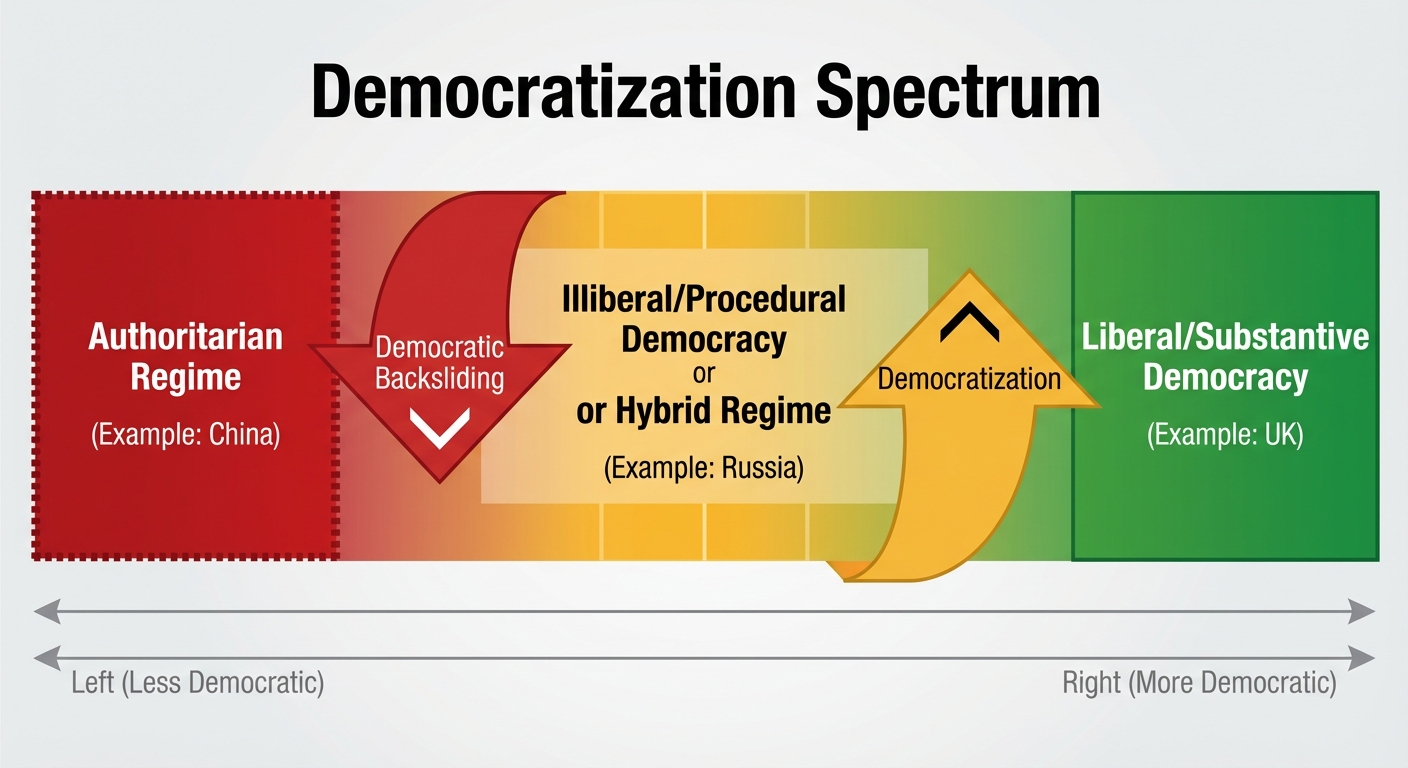
The Spectrum of Democracy
To understand democratization, you must distinguish between the appearance of democracy and the substance of it.
Substantive (Liberal) Democracy: A system that not only holds elections but also ensures constitutional protection of civil liberties, rule of law, and neutrality of the judiciary. There is a healthy civil society and media freedom.
- Properties: Free/fair elections + Civil Liberties + Rule of Law.
- Example: The United Kingdom acts as a consolidated liberal democracy.
Procedural (Illiberal) Democracy / Hybrid Regime: A system that holds elections (procedures) but restricts civil rights and liberties. The elections may not be entirely fair, media is often state-controlled, and the opposition is harassed.
- Properties: Elections exist, but civil liberties are curtailed.
- Example: Russia maintains the procedural appearance of elections, but restricts genuine competition and press freedom.
Democratic Consolidation
Democratization is considered successful when Democratic Consolidation occurs. This is the point where a new democratic order becomes institutionalized and is considered "the only game in town"—meaning no major political group advocates for overthrowing the democratic system.
- The Two-Turnover Test: A common heuristic for consolidation. It occurs when a government is voted out of power peacefully, and the subsequent government is also voted out peacefully.
- AP Tip: Nigeria passed a significant milestone in 2015 when Goodluck Jonathan conceded power to Muhammadu Buhari, marking the first peaceful transfer of power via election in the country's history.
Democratic Backsliding
Conversely, Democratic Backsliding is the gradual decline in the quality of democracy. This often happens legally, through the manipulation of existing laws to weaken checks and balances, control the media, and harass the opposition.
- Key Indicators: Centralization of power in the executive, politicization of the judiciary, and restrictions on NGOs.
Revolution, Coups, and Reform
Political change occurs at different speeds and intensities. You must distinguish between changing the government (the people in charge) and changing the regime (the fundamental rules and institutions).
Reform
Reform involves changes that do not advocate the overthrow of basic institutions. Reforms are gradual and work within the existing system to improve political and economic conditions.
- Example: Mexico's transition during the 1990s, where electoral laws were reformed to create the IFE (now INE), allowing opposition parties to compete fairly against the PRI.
- Example: The UK's gradual expansion of voting rights and devolution of power to Scotland and Wales.
Revolution
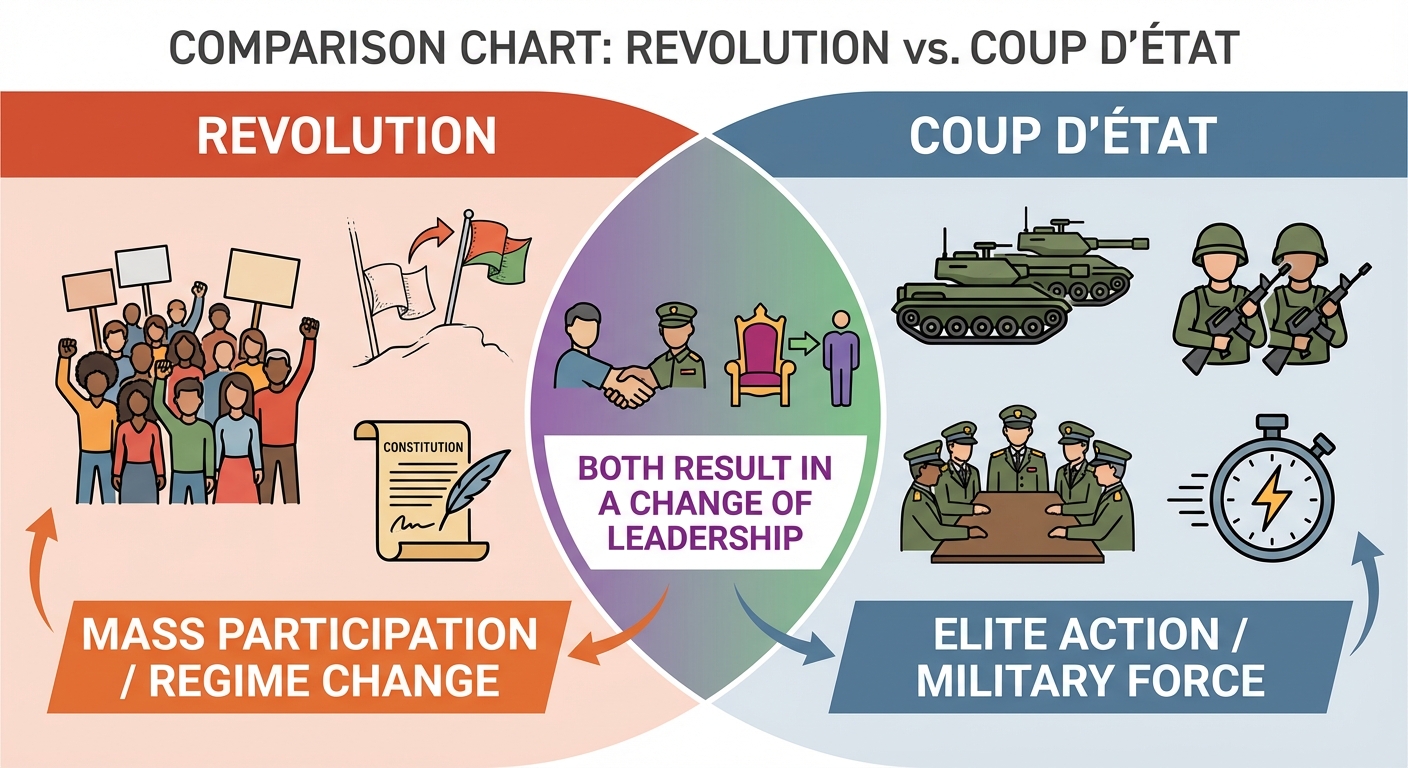
A Revolution is a fundamental change in the political and social institutions of a society, often accompanied by violence, cultural upheaval, and civil war. Revolutions change the Regime, not just the Government.
- Key Characteristics:
- Involves mass participation.
- Results in a total overhaul of the constitution and ideology.
- Example: The Chinese Revolution (1949) replaced the Republic of China with the Communist People’s Republic of China.
- Example: The Iranian Revolution (1979) replaced the secular Monarchy (Shah) with a Theocracy led by the Ayatollah.
Coup d'état
A Coup d'état (blow to the state) is the seizure of power, usually by the military. Unlike revolutions, coups often lack mass popular support and seek to replace the leadership rather than the entire social order (though regime chances can follow).
| Feature | Revolution | Coup d'état |
|---|---|---|
| Actors | Mass public / Social Movements | Military / Elites |
| Scope | Total Regime & Social Change | Leadership Change (sometimes Regime) |
| Speed | Often prolonged struggle | Sudden, rapid takeover |
| Example | Iran (1979) | Nigeria (1966, 1983, 1993, etc.) |
Fragmentation and National Identity
Political change is heavily influenced by how citizens identify themselves. Tensions often arise between the state (the government apparatus) and nations (groups of people with shared identity).
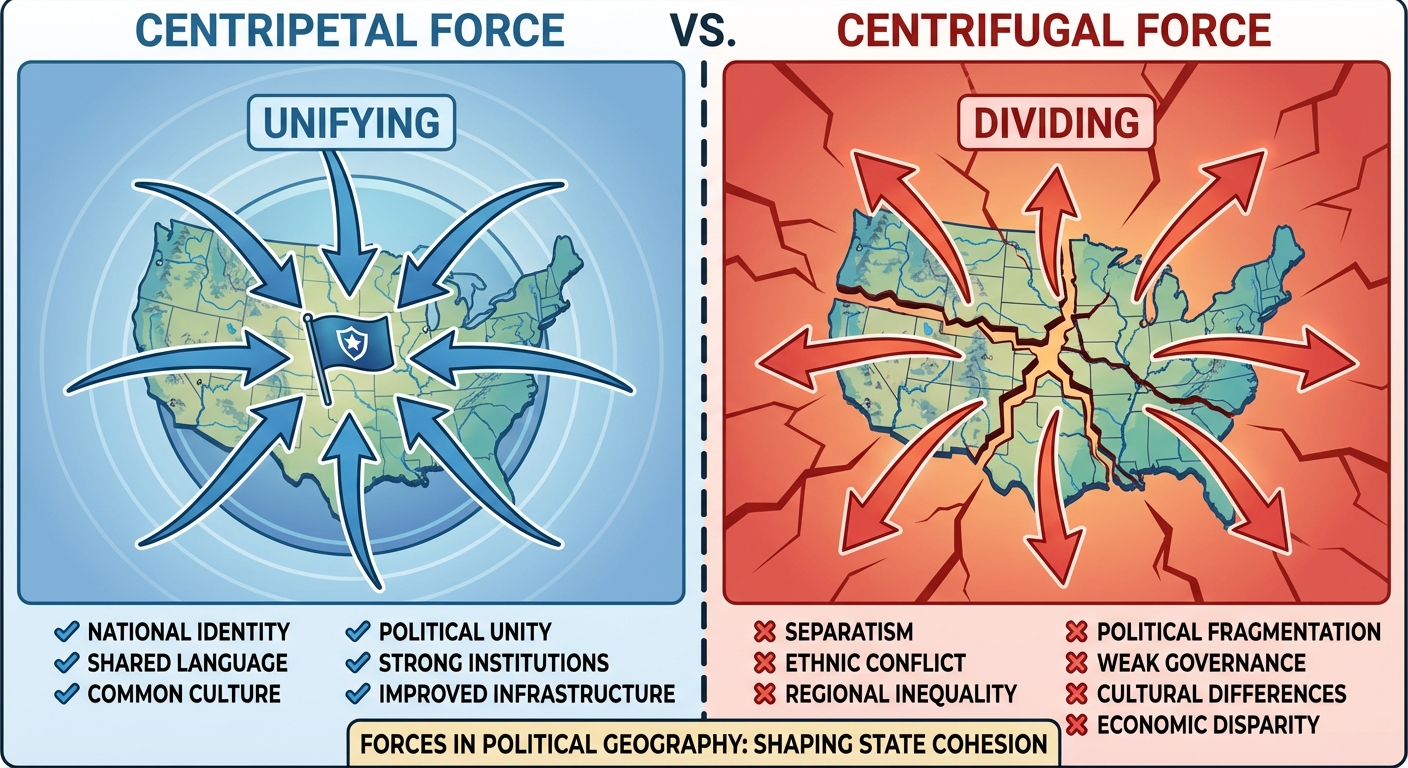
Centripetal and Centrifugal Forces
Understanding stability requires analyzing the forces pushing a country together or pulling it apart.
Centripetal Forces: Factors that bind the people of a state together (Unifying).
- Examples: A strong national language (Mandarin in China), a shared religion (Shi'ism in Iran), external threats, or a charismatic leader.
Centrifugal Forces: Factors that divide the people of a state (Destabilizing). These lead to Fragmentation.
- Examples: Religious cleavages (Christians vs. Muslims in Nigeria), ethnic differences (Chechens in Russia, Uighurs in China), or regional economic disparities (North vs. South in Mexico).
Globalization and Sovereignty
Global forces complicate national sovereignty, causing internal political change.
Supranational Organizations: Groups like the European Union (EU) or ECOWAS (West Africa).
- Benefit: Economic integration and growth.
- Cost: Loss of Sovereign decision-making power.
- Example: The UK's Brexit vote was a reaction against supranational control, reasserting national sovereignty over EU integration.
Economic Liberalization: Many AP countries (China, Mexico, Nigeria) have moved toward free markets. This often reduces the government's control over the economy, leading to social fragmentation as wealth gaps widen.
Common Mistakes & Pitfalls
Confusing Government vs. Regime:
- Mistake: Saying "The regime changed when Boris Johnson resigned."
- Correction: That was a government change. The democratic regime remained the same. A regime change happens when the constitution or type of system (e.g., authoritarian to democratic) changes.
Rule BY Law vs. Rule OF Law:
- Mistake: Thinking authoritarian states have no laws.
- Correction: Authoritarian states use Rule BY Law (using law as a weapon to control subjects). Democracies use Rule OF Law (the state and leaders are subject to the law).
Equating Elections with Democracy:
- Mistake: Assuming Iran or Russia are democracies because they vote.
- Correction: Always look for the "Liberal" aspects—civil society, independent media, and fair competition. Without those, it is merely procedural or authoritarian.
Misunderstanding Coups:
- Mistake: Assuming all coups result in military dictatorships forever.
- Correction: While they start that way, some military leaders eventually oversee a transition back to democracy (e.g., Nigeria's transition to the Fourth Republic in 1999).