Unit 8: Comprehensive Guide to Musical Architecture and Formal Analysis
Fundamentals of Phrase Structure
Before diving into larger forms, it is essential to understand the building blocks of musical form. AP Music Theory requires you to identify how small units combine to create larger structures.
The Hierarchy of Form
- Motive: The smallest identifiable musical idea (can be rhythmic or melodic).
- Phrase: A musical thought that ends with a cadence. Imagine this as a sentence in language.
- Period: A structure usually consisting of two phrases in an Antecedent-Consequent (Question-Answer) relationship.
Analyzing the Period
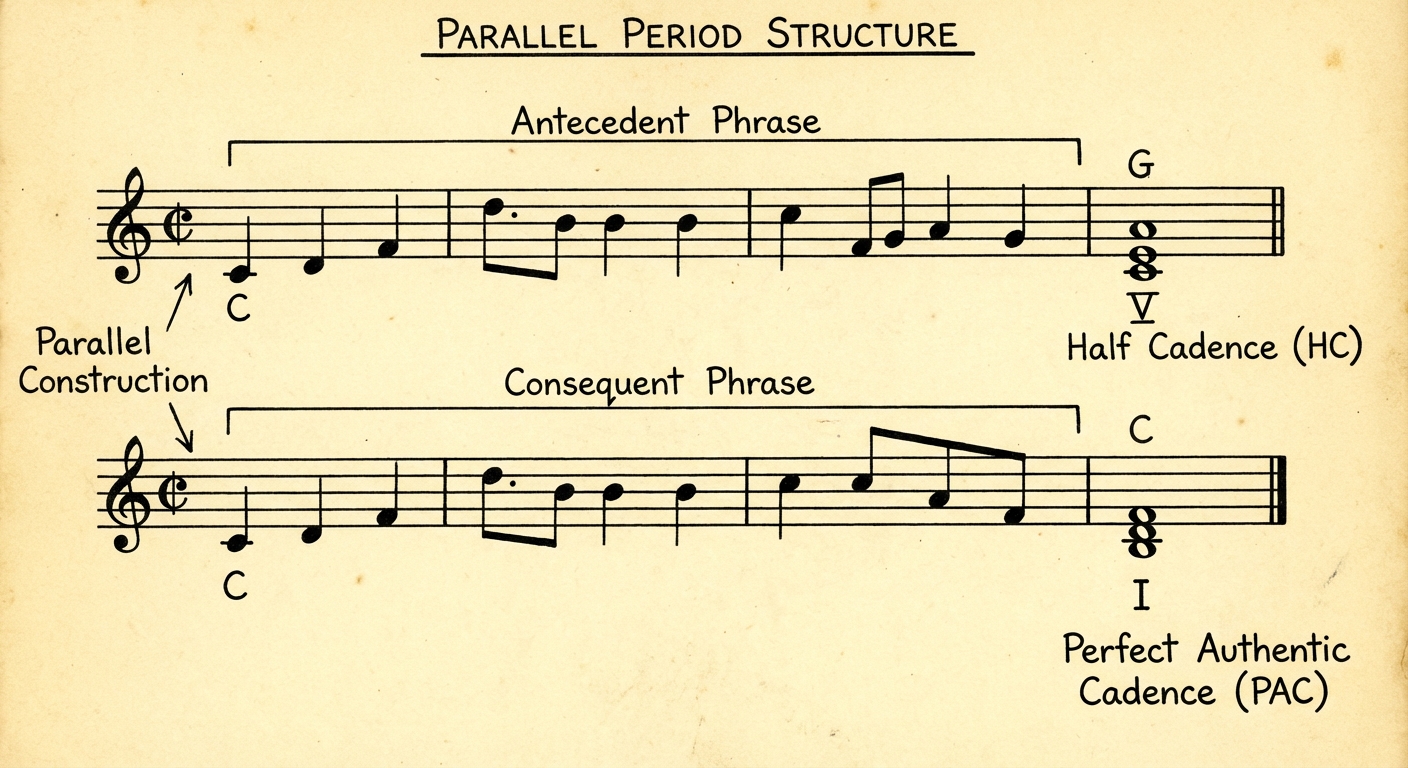
A Period generally consists of two phrases. The first is the Antecedent (weak cadence, usually Half Cadence) and the second is the Consequent (strong cadence, usually Perfect Authentic Cadence).
| Term | Relationship | Definition |
|---|---|---|
| Parallel Period | AA' | Both phrases begin with similar melodic material. |
| Contrasting Period | AB | The two phrases are melodically distinct. |
| Double Period | 4 Phrases | Consists of four phrases (two pairs), where the only strong cadence is at the very end of the fourth phrase. |
Binary and Ternary Forms
These are the most common formal structures found in Baroque dances, classical movements, and short vocal pieces.
1. Binary Form ($AB$)
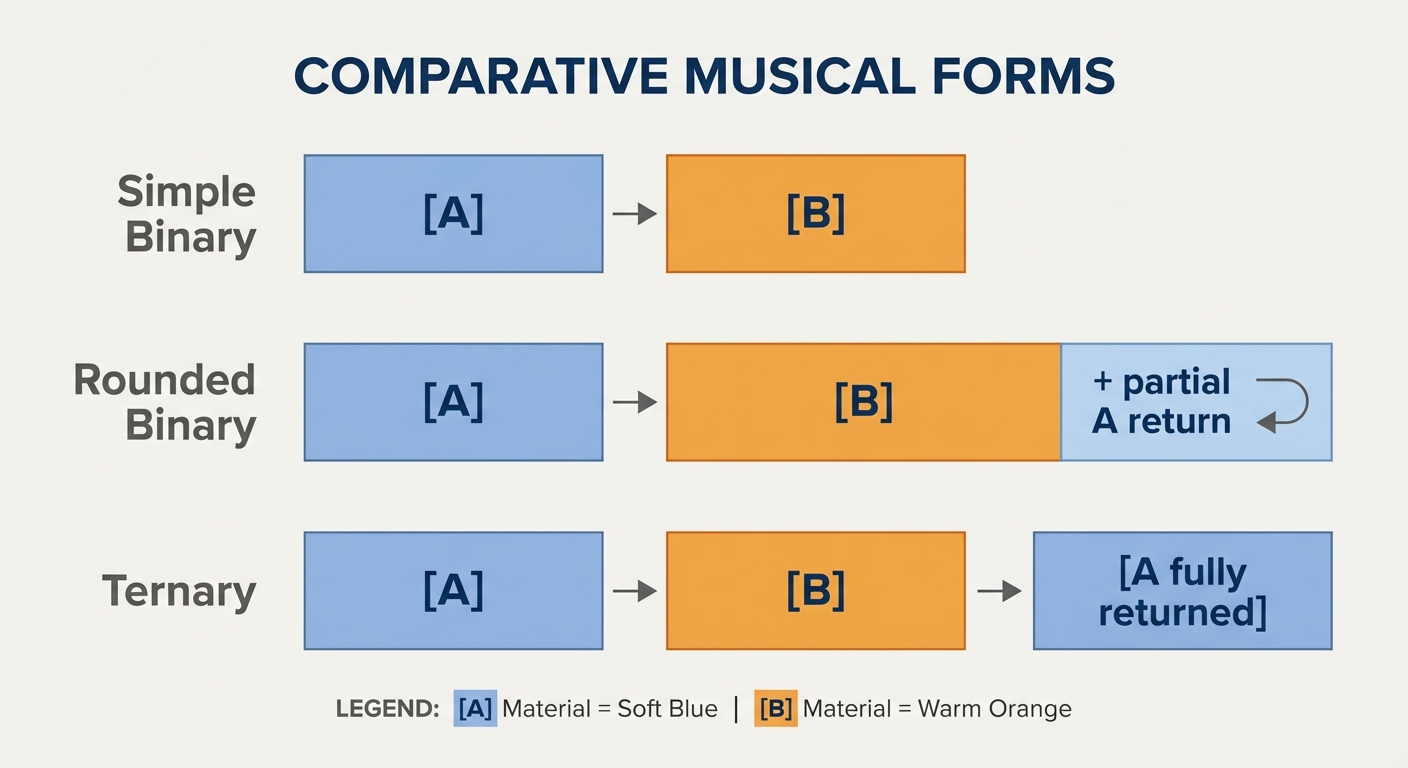
Binary Form consists of two distinct sections, labeled A and B. It is intimately tied to harmony.
- Structure: $||: A :||: B :||$
- Characteristics:
- The A section often moves from the Tonic (I) to the Dominant (V) or Relative Major (III).
- The B section is usually longer and less harmonically stable, eventually returning to the Tonic.
- There is no substantial return of the opening thematic material in the B section.
2. Ternary Form ($ABA$)
Ternary form is a three-part structure emphasizing contrast and return. It is often described as "Statement - Contrast - Return."
- Structure: $A - B - A$
- Characteristics:
- Section A: Starts and ends in the Tonic (closed).
- Section B: Distinctively different material. Usually in a contrasting key (Dominant, Relative Minor/Major, or Parallel Minor/Major). It typically ends with a strong Half Cadence or a re-transition.
- Return of A: The first section returns, sometimes ornamented ($A'$).
3. The Trap: Rounded Binary Form
This is the most common point of confusion for students. Rounded Binary is halfway between Binary and Ternary.
- Structure: $||: A :||: B \ A' :||$
- Key Distinction: It has two main repeated sections (like Binary), but the end of the second section brings back a shortened version of the A theme (like Ternary).
Quick Check: Rounded Binary vs. Ternary
- If the B section is structurally independent and the A section returns completely structurally separate, it is usually Ternary.
- If the B section feels like a harmonic digression and the return of A is partial (only the second half of the theme returns), it is Rounded Binary.
Larger Forms: Rondo and Theme & Variations
Rondo Form ($ABACA$)
Commonly found in the final movements of sonatas and symphonies, the Rondo is defined by the recurrent use of a main theme (Refrain) separated by contrasting sections (Episodes).
- The Refrain (A): Always in the Tonic key. It is catchy and easily recognizable.
- The Episodes (B, C): These are in contrasting keys and have different moods or tempos.
Common Patterns:
- 5-Part Rondo: $A - B - A - C - A$
- 7-Part Rondo: $A - B - A - C - A - B - A$ (Symmetrical/Arch)
Theme and Variations
In this form, a composer presents a clear, simple theme and then repeats it multiple times, altering distinct musical elements each time.
Ways to Vary a Theme:
- Melodic: Adding ornaments, passing tones, or changing the contour.
- Rhythmic: Changing rhythmic density (e.g., changing quarter notes to sixteenth notes) or changing the meter.
- Harmonic: Changing the chord accompanying the melody or changing the mode (Major to Minor).
- Texture: Changing from homophonic to polyphonic, or moving the melody to the bass line.
Sonata-Allegro Form
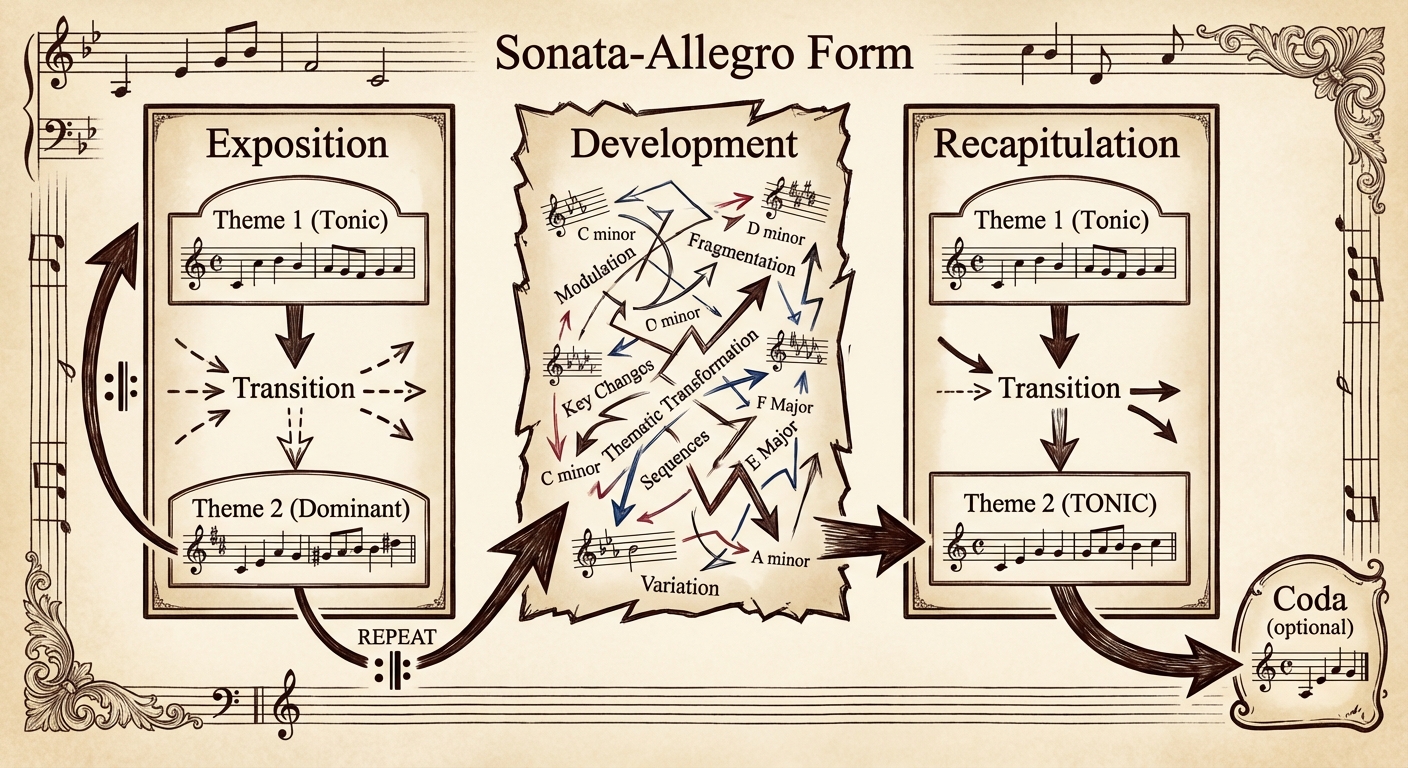
Sonata form is the most complex structure you will analyze in AP Music Theory. It is an intellectual drama based on the conflict between tonal centers. It has three main "acts."
1. Exposition (The Setup)
This section exposes the musical materials and establishes the harmonic conflict.
- First Theme: Presented in the Tonic key.
- Transition (Bridge): Modulates (changes key) and destabilizes the music.
- Second Theme: Presented in a New Key (usually the Dominant V in major keys, or Relative Major III in minor keys).
- Closing Theme: Confirms the new key.
2. Development (The Conflict)
This is the most unstable section. The composer takes fragments of the themes and manipulates them.
- Tonal Instability: Rapid modulation through distant keys.
- Sequencing: Creating tension through sequential repetition.
3. Recapitulation (The Resolution)
The themes from the Exposition return, but the harmonic conflict is resolved.
- First Theme: Refurns in the Tonic.
- Transition: It might be altered so it does not modulate.
- Second Theme: Crucial Rule—It returns in the Tonic Key (not the Dominant).
Definition: Sonata-Rondo
A hybrid form often used in finales. It generally follows the alternating pattern of a Rondo ($ABA…$) but imposes the key relationships of a Sonata (Exposition/Recap tension). Pattern: $A - B - A - C - A - B - A$ (where the C section acts as a Development).
Common Pitfalls and Concept Checks
1. Parallel vs. Contrasting Periods
- Mistake: Thinking phrases are contrasting just because the notes aren't identical.
- Correction: Look at the beginning of the phrases. If they start with the same melodic contour or motive, they are Parallel ($aa'$ or $aa$ ). If they are totally different, they are Contrasting ($ab$).
2. Modulating vs. Non-Modulating Transitions
- Mistake: Assuming a transition always changes keys.
- Correction: In the Recapitulation of a Sonata, the transition is often "fake"—it creates motion but keeps the Second Theme in the Tonic key.
3. Double Period vs. Phrase Group
- Mistake: Confusing a Double Period with a repeated Period.
- Correction: Check the cadence at the end of the second phrase. If phrase 2 ends with a PAC (Perfect Authentic Cadence), the period is done. If phrase 2 ends with a Half Cadence (weak), forcing the music to continue to phrase 4 for the PAC, it is a Double Period.
4. Strophic Form
- Note: While less complex, remember Strophic Form ($A A A…$ - same music, different text) is common in hymns and folk songs. Do not confuse this with Variations.
Summary Table: Key Relationships
| Form Section | Major Key Trajectory | Minor Key Trajectory |
|---|---|---|
| Binary (A) | I $\rightarrow$ V | i $\rightarrow$ III (Relative Major) |
| Sonata (Exp T2) | V (Dominant) | III (Relative Major) or v (Minor Dom) |
| Sonata (Recap T2) | I (Tonic) | i (Tonic) |