Mastering the Definition of the Derivative
Average and Instantaneous Rates of Change
Calculus is fundamentally the study of change. Before defining the derivative formally, it is crucial to understand the geometric and physical intuition behind rates of change.
The Secant Line and Average Rate of Change
The Average Rate of Change (AROC) measures how much a function changes over a specific interval $[a, b]$. Geometrically, this corresponds to the slope of the secant line connecting two points on a curve.
Given a function $f(x)$ and an interval $[x1, x2]$, the AROC is calculated as:
This formula is simply the slope formula ($m = \frac{y2-y1}{x2-x1}$) applied to a function. In physics, if $f(t)$ represents position, the AROC represents average velocity.
The Tangent Line and Instantaneous Rate of Change
The Instantaneous Rate of Change (IROC) measures the rate of change at a specific moment or single point. Geometrically, this corresponds to the slope of the tangent line at that point.
To find the instantaneous rate, we imagine letting the interval for the average rate shrink to zero. As $x2$ approaches $x1$, the secant line pivots and approaches the tangent line. This limiting process is the foundation of the derivative.
Defining the Derivative of a Function
The derivative is the mathematical tool used to calculate the instantaneous rate of change. It is defined formally using limits.
The Limit Definition (The Difference Quotient)
The derivative of $f(x)$ with respect to $x$ is the function $f'(x)$ defined by:
Key Components:
- $f(x+h) - f(x)$: The change in $y$ (often denoted $\Delta y$).
- $h$: The change in $x$ (often denoted $\Delta x$).
- $\lim_{h \to 0}$: The process of shrinking the interval to a single point.
Note: If this limit exists, we say that $f$ is differentiable at $x$.
Alternative Definition at a Point
When calculating the derivative at a specific constant value $x = c$, an alternative but equivalent limit definition is often used:
Students must recognize both forms, as AP exams frequently present multiple choice questions asking to identify which specific limit represents a derivative.
Notation Reference
In Calculus, several notations are used interchangeably. Being comfortable with all of them is essential.
| Notation Type | Symbol(s) | Usage |
|---|---|---|
| Lagrange | $f'(x)$, $y'$ | Common for general functions (read "f prime of x"). |
| Leibniz | $\frac{dy}{dx}$, $\frac{d}{dx}[f(x)]$ | Emphasizes the ratio of differentials (change in y over change in x). |
| Function | $\frac{dy}{dx}\big | _{x=c}$ |
Worked Example: Using the Definition
Problem: Use the limit definition to find $f'(x)$ for $f(x) = x^2 - 3x$.
Solution:
Set up the difference quotient:
Expand and simplify the numerator:
Factor out $h$ and cancel:
Evaluate the limit (set $h=0$):
Estimating Derivatives at a Point
Sometimes you do not have an analytic function (equation) but instead have a table of data or a graph. You must be able to estimate the derivative.
Estimating from Tables
To estimate $f'(c)$ given a table of values, calculate the average rate of change over a small interval surrounding $c$. The best approximation is usually the symmetric difference quotient using the points immediately to the left and right of $c$.
Example:
Given the table below, estimate $f'(3)$.
| $x$ | 2.9 | 3.0 | 3.1 |
|---|---|---|---|
| $f(x)$ | 5.2 | 5.8 | 6.5 |
Estimating from Graphs
To estimate a derivative from a graph:
- Locate the point on the graph.
- Sketch a tangent line at that point using a ruler.
- Pick two points on your sketched line and calculate the slope (rise over run).
Differentiability and Continuity
Understanding the relationship between continuity and differentiability is a high-frequency topic on the AP exam.
The Fundamental Theorem of Differentiability
Theorem: If a function $f$ is differentiable at $x = c$, then $f$ is continuous at $x = c$.
From a logical standpoint:
- Differentiability $\implies$ Continuity
- Discontinuity $\implies$ Non-differentiability (Contrapositive)
Critically Important: The converse is FALSE. Continuity does NOT imply differentiability. A function can be continuous but not have a derivative at a specific point.
How Differentiability Fails
A function fails to be differentiable at $x=c$ in three main scenarios:
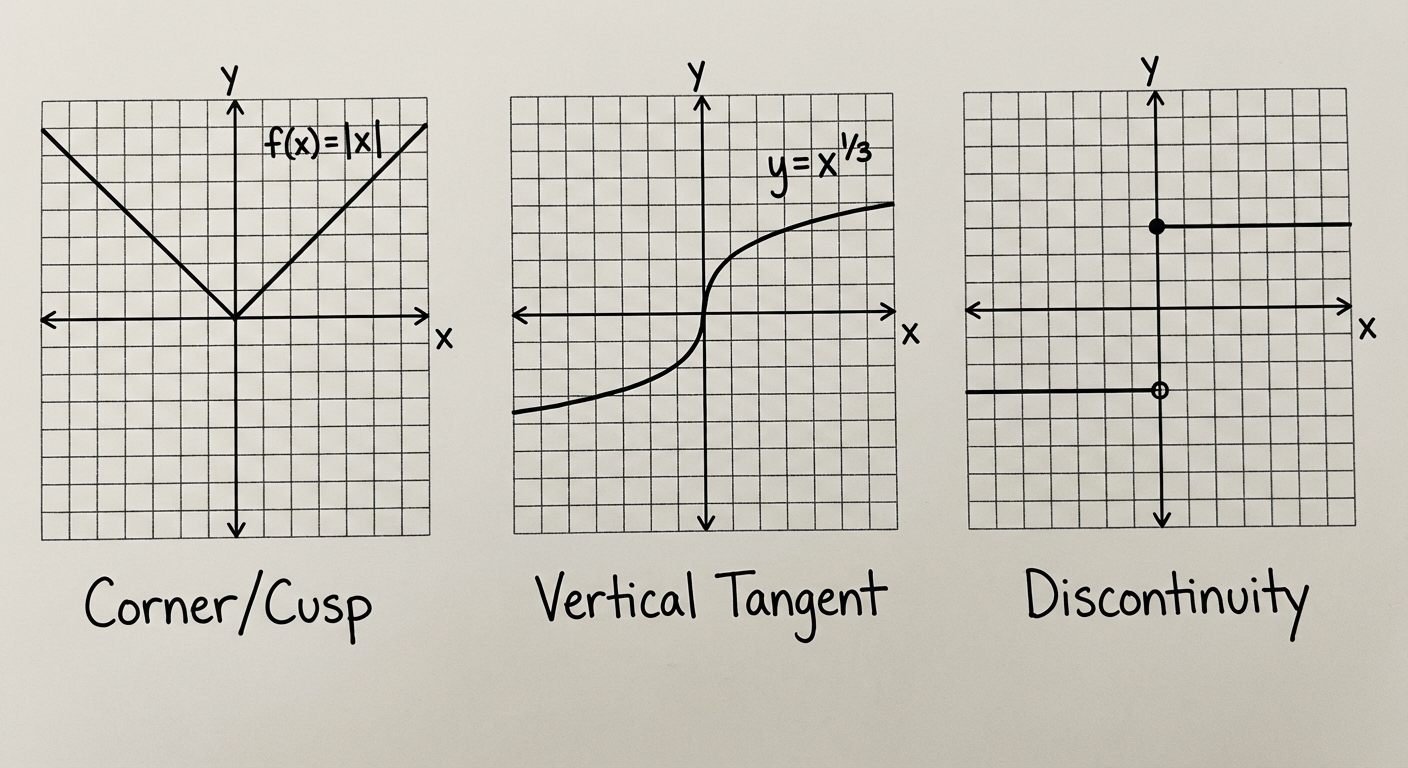
- Corners or Cusps: The graph has a sharp turn. At these points, the slope approaching from the left is different from the slope approaching from the right.
- Example: $f(x) = |x|$ at $x=0$. The Left Hand Derivative is $-1$, but the Right Hand Derivative is $+1$.
- Vertical Tangents: The graph is smooth, but the tangent line becomes vertical.
- Example: $f(x) = \sqrt[3]{x}$ at $x=0$. The slope represents an undefined value (infinity).
- Discontinuities: If the graph has a hole, jump, or break, a tangent line cannot be clearly defined.
One-Sided Derivatives
For a function to be differentiable at a point, the derivatives from the left and right must exist and be equal:
Common Mistakes & Pitfalls
- Confusing Limit Variable with $x$: In the definition $\lim_{h \to 0}$, remember you are replacing $h$ with 0, not $x$. Your answer should usually start with an $x$ variable remaining.
- Assuming Continuity Equals Differentiability: Just because you can draw the line without lifting your pencil (continuity) does not mean it has a slope (derivative). Always check for sharp "corners."
- Algebra Errors in the Quotient: When expanding expressions like $(x+h)^2$, students often forget the middle term ($2xh$). Remember: $(x+h)^2 = x^2 + 2xh + h^2$.
- Notation Laziness: Dropping the $\lim_{h \to 0}$ notation while doing the algebra steps. You must write "lim" in front of every step until you actually evaluate the limit (plug in 0).
- Estimating Derivatives: When asked to estimate $f'(3)$ from a table, do NOT find $\frac{f(3)}{3}$. That is the slope of the line from the origin, not the tangent slope. Always use the change in $y$ over the change in $x$.