AP Environmental Science - Unit 1: Ecosystems & Energy Flow
Unit 1: The Living World: Ecosystems
1.1 Introduction to Ecosystems & Species Interactions
Ecosystems are the result of biotic and abiotic interactions. To understand how the living world functions, we must look at how organisms interact with one another and their physical environment.
Key Definitions
- Ecosystem: A community of living (biotic) organisms interacting with the non-living (abiotic) components of their environment (soil, temperature, sunlight) as a system.
- Community: All the different populations of species living in a specific area.
- Population: A group of individuals of the same species living in the same area at the same time.
- Symbiosis: A close, long-term biological interaction between two different biological organisms.
Symbiotic Relationships
Organisms interact in three primary ways that are frequently tested:
- Mutualism (+/+): Both species benefit.
- Example: Coral and Zooxanthellae (algae). The coral provides a home and CO$_2$; algae provide sugar via photosynthesis.
- Example: Bees and flowers (pollination).
- Commensalism (+/0): One species benefits, the other is unaffected.
- Example: Epiphytes (air plants) growing on large trees to reach sunlight. The tree is neither protected nor harmed.
- Parasitism (+/-): One organism (parasite) benefits at the expense of the other (host).
- Example: Ticks on a deer; intestinal tapeworms.
Competition & Resource Partitioning
Competition arises when resources (food, water, territory, light) are limited.
- Intraspecific Competition: Between members of the same species (e.g., two male deer fighting for a mate).
- Interspecific Competition: Between members of different species (e.g., hyenas and lions fighting for a gazelle).
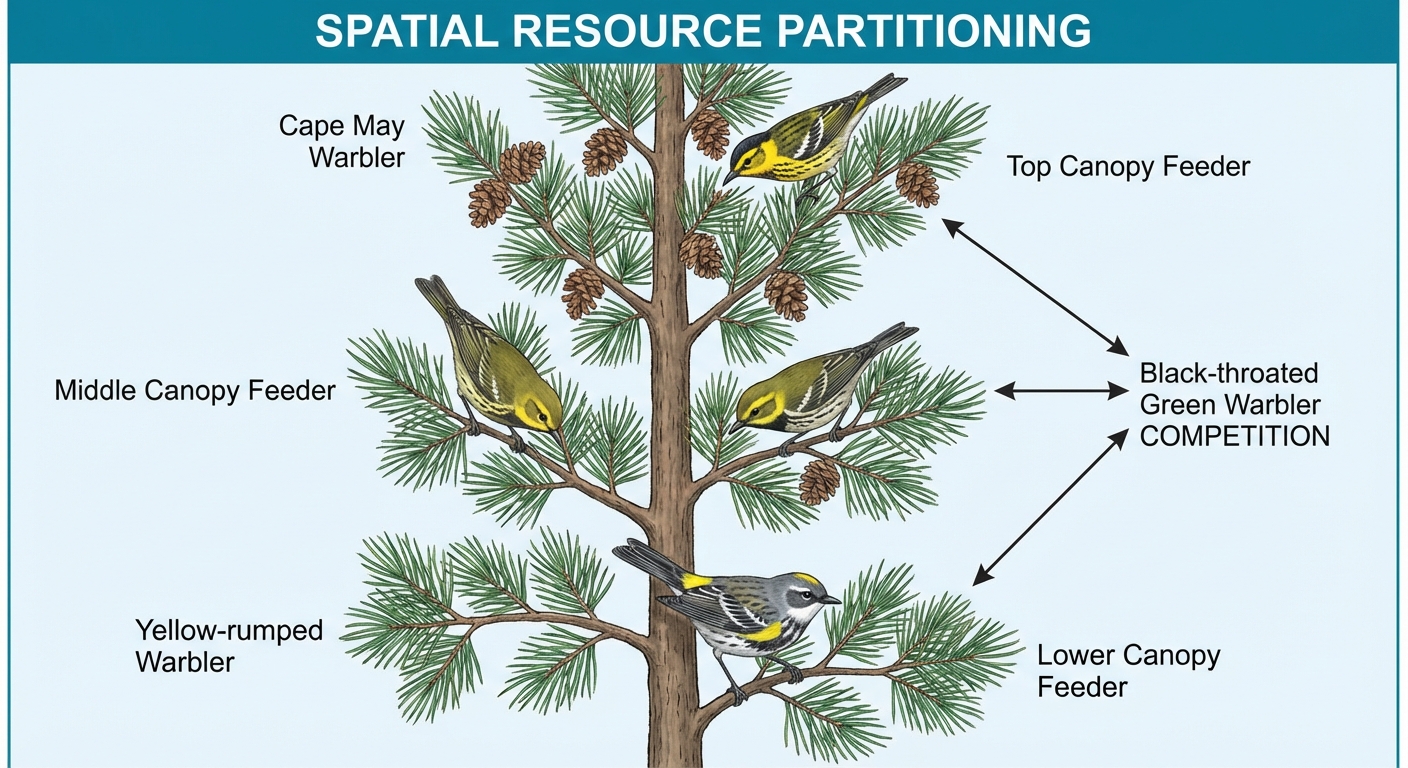
When two species compete for the exact same resource, one typically outcompetes the other (Competitive Exclusion Principle). To avoid this and coexist, species evolve to use resources differently.
Resource Partitioning: Using the same resource in many different ways, places, or at different times to reduce direct competition.
- Temporal Partitioning: Using resources at different times (e.g., wolves hunt by day, coyotes by night).
- Spatial Partitioning: Using different areas of a shared habitat (e.g., different species of root systems accessing water at different soil depths).
- Morphological Partitioning: Evolving different body shapes/sizes to use different parts of a resource (e.g., Darwin's finches evolving different beak shapes for different seeds).
1.2 Terrestrial Biomes
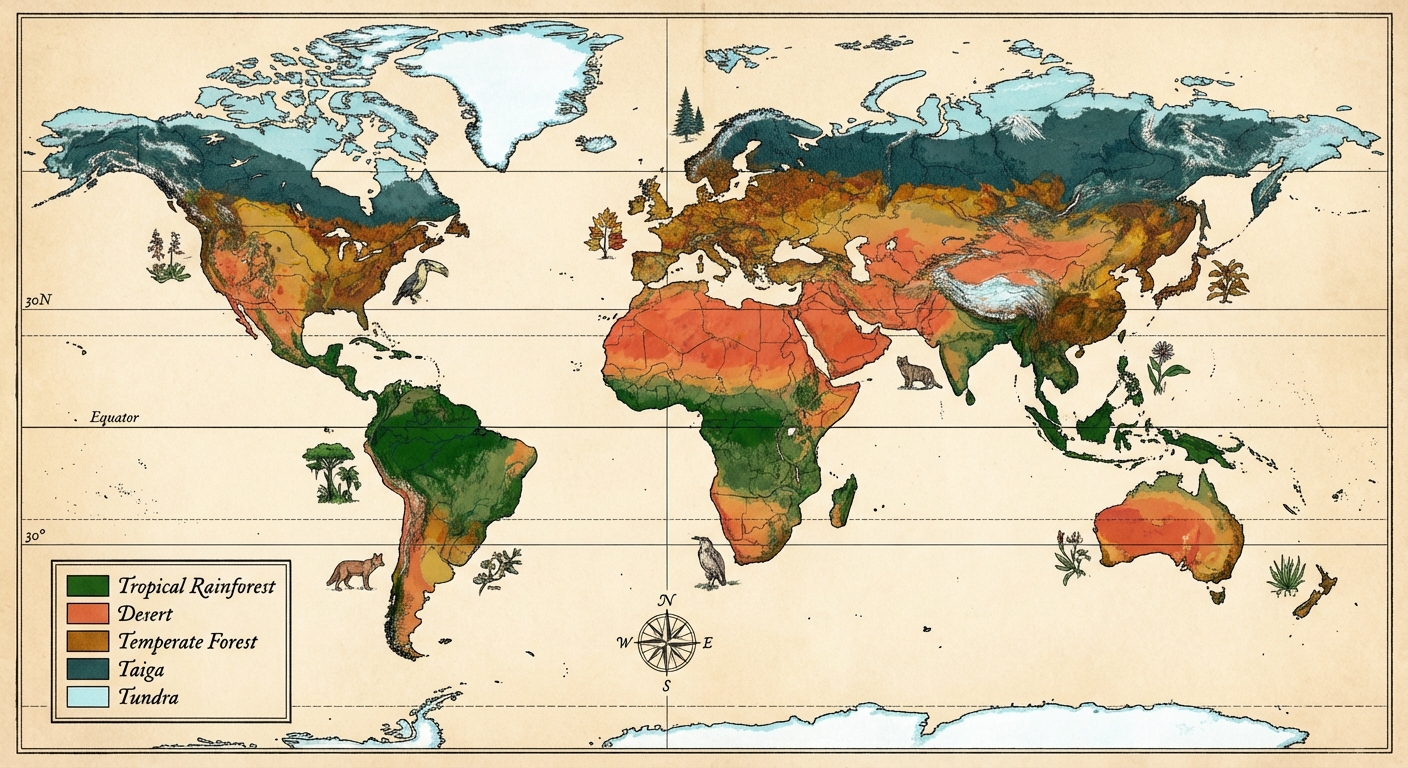
Biomes are large distinct terrestrial regions having similar climate, soil, plants, and animals, regardless of where they occur in the world. The distribution of biomes is determined primarily by:
- Temperature (Average and seasonal range)
- Precipitation (Total annual and seasonal distribution)
- Latitude/Altitude (Distance from equator or height above sea level)
Global Distribution Pattern
- Equator (0°): Warm, wet, high productivity (Tropical Rainforests).
- 30° N/S: Dry air descends, creating deserts.
- 60° N/S: Seasonal variation, sufficient moisture (Taiga/Temperate forests).
Major Biomes Cheat Sheet
| Biome | Key Characteristics | Climate | Soil Quality |
|---|---|---|---|
| Tropical Rainforest | High biodiversity, rapid decomposition, layers (canopy). | Hot/Wet year-round. | Nutrient-Poor (nutrients are in the biological vegetation, not soil). |
| Temperate Deciduous Forest | Broadleaf trees that lose leaves (oak, maple). | Seasonal temps, moderate rain. | Nutrient-Rich (leaf litter decomposes slowly creating humus). |
| Taiga (Boreal Forest) | Coniferous (cone-bearing) evergreen trees. | Long cold winters, short summers. | Acidic, rocky, slow decomposition due to cold. |
| Temperate Grassland | Grasses dominate, few trees. Adapted to fire and grazing. | Hot summers, cold winters. | Very Rich (thick topsoil from potential deep root decay). |
| Oligotrophic Tundra | Permafrost (frozen subsoil), lichen, moss, no trees. | Freezing cold, very dry. | Nutrient-poor, waterlogged when thawed. |
| Desert | Succulents (cactus), nocturnal animals. | Variable temp, <25cm rain/yr. | Sandy, low organic matter, fragile. |
| Savanna | Tropical grassland with scattered trees. | Warm year-round, distinct wet/dry seasons. | Porous, rapid drainage. |
| Chaparral (Shrubland) | Spiny shrubs, adapted to fire. | Hot dry summers, mild wet winters. | Thin, rocky, nutrient-poor. |
Climatograms
A Climatogram maps average monthly temperature and precipitation.
- Bars = Precipitation (Rain).
- Line = Temperature.
- Interpretation Tip: If the line is flat/high, it's tropical. If it curves like a hill, it is Northern Hemisphere (summer in June/July). If it dips like a valley, it is Southern Hemisphere (winter in June/July).
1.3 Aquatic Biomes
Aquatic biomes are categorized by salinity, depth, and water flow.
Freshwater Biomes
- Streams and Rivers: Flowing water (lotic). High O$2$ at the source (headwaters), lower O$2$ and higher nutrient load at the mouth.
- Lakes and Ponds: Standing water (lentic). Zones are defined by light penetration.
- Littoral Zone: Shallow, near shore, rooted plants. High activity.
- Limnetic Zone: Open water, sunlit. Phytoplankton dominate.
- Profundal Zone: Deep, too dark for photosynthesis. Low O$_2$.
- Benthic Zone: Muddy bottom, decomposers.
Marine Biomes
- Intertidal Zone: Band of coast between high and low tide. Organisms must handle crashing waves and desiccation (drying out) during low tide.
- Coral Reefs: Found in warm, shallow waters. Biome with the highest aquatic biodiversity. Extremely sensitive to temperature (coral bleaching) and acidity.
- Open Ocean (Pelagic): Covers most of Earth, but low productivity per unit area due to lack of nutrients. However, due to its size, it produces the most total O$_2$.
Wetland Services
Wetlands (marshes, swamps, bogs) and Estuaries (where rivers meet oceans) are critical.
- Ecological Services:
- Water filtration (removing pollutants/sediment).
- Flood protection (absorbing excess water).
- Habitat/Nursery for fish and birds.
1.4 The Carbon Cycle
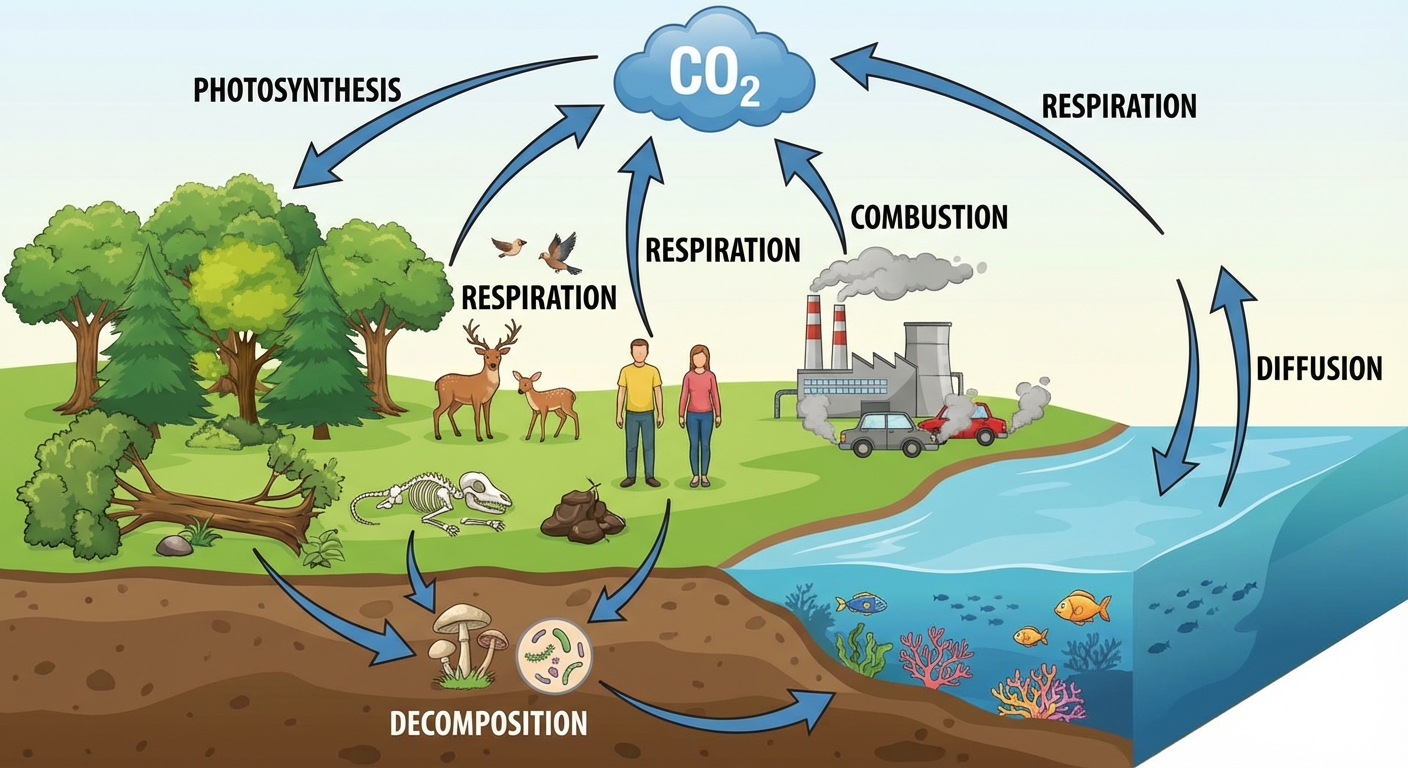
Life is carbon-based. The cycle moves carbon between sources and sinks.
- Key Processes:
- Photosynthesis: Plants take CO$_2$ from the atmosphere $\rightarrow$ Glucose.
- Formula: $6CO2 + 6H2O + light \rightarrow C6H{12}O6 + 6O2$
- Cellular Respiration: Organisms release CO$_2$ back to the atmosphere.
- Decomposition: Decomposers break down dead biomass, returning Carbon to soil or atmosphere.
- Combustion: Burning fossil fuels or biomass releases stored Carbon as CO$_2$.
- Photosynthesis: Plants take CO$_2$ from the atmosphere $\rightarrow$ Glucose.
- Major Reservoirs (Sinks):
- Sedimentary Rock (Limestone/Calcium Carbonate): Largest long-term storage.
- Ocean: Absorbs CO$_2$ directly (solubility) and via phytoplankton.
- Fossil Fuels: Buried carbon from millions of years ago.
- Forests: Old-growth forests store carbon in biomass.
Human Impact
Extracting and burning fossil fuels moves carbon from the slow cycle (underground) to the fast cycle (atmosphere) faster than it can be sequestered, causing global warming.
1.5 The Nitrogen Cycle
Nitrogen is essential for Proteins (Amino Acids) and DNA/RNA. It is often a limiting factor for plant growth.
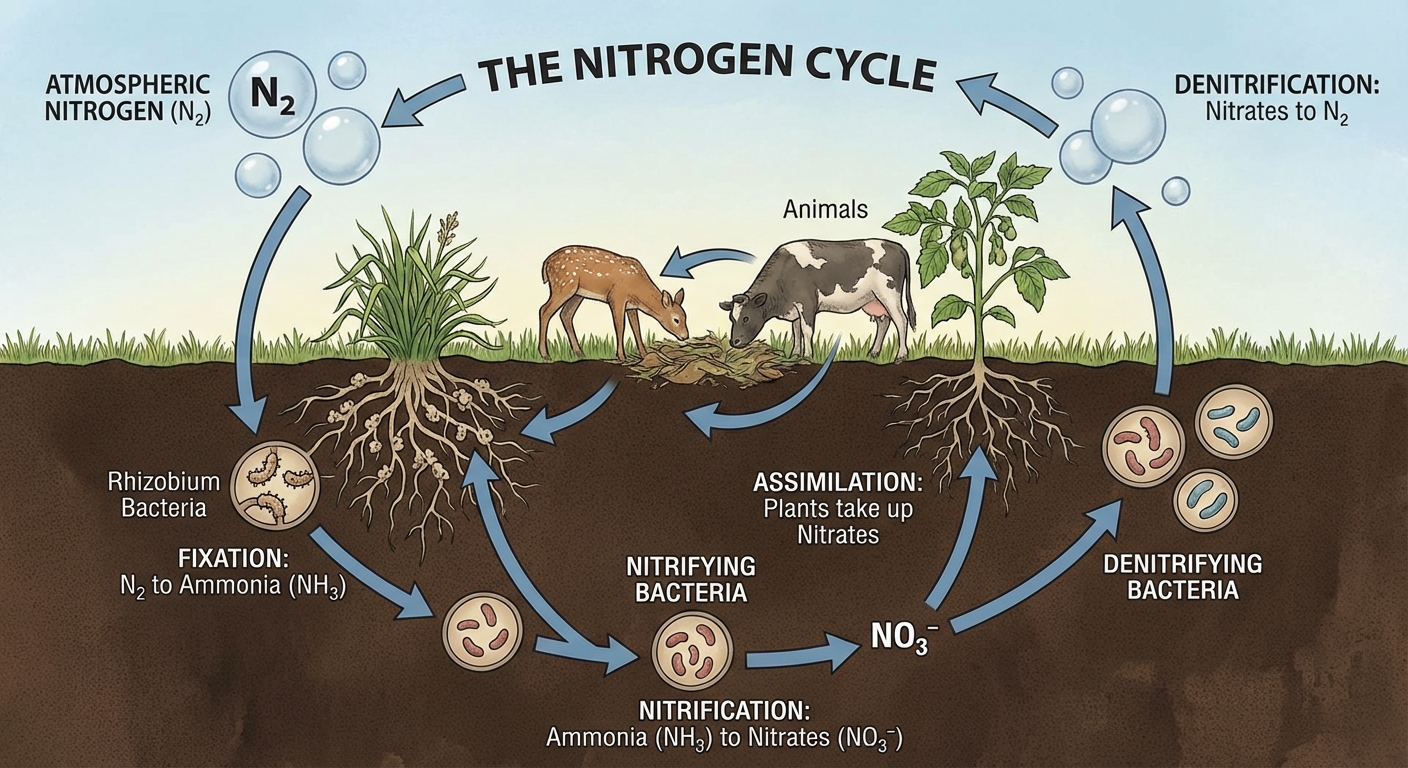
The "Big Challenge": The atmosphere is 78% Nitrogen ($N_2$), but plants/animals cannot use nitrogen gas. It has a triple bond that is hard to break. It must be "fixed."
Key Steps (Acronym: FixNAAD)
- Nitrogen Fixation:
- Biotic: Bacteria on legume roots (Rhizobium) turn $N2 \rightarrow$ Ammonia ($NH3$).
- Abiotic: Lightning turns $N_2 \rightarrow$ Nitrate.
- Nitrification: Soil bacteria convert Ammonia $\rightarrow$ Nitrites ($NO2^-$) $\rightarrow$ Nitrates ($NO3^-$). Plants love Nitrates.
- Assimilation: Plants take up Nitrates/Ammonia through roots to make protein/DNA. Animals eat plants.
- Ammonification: Decomposers break down dead matter/waste back into Ammonia ($NH_3$).
- Denitrification: Anaerobic soil bacteria convert Nitrates back into Nitrogen Gas ($N_2$), returning it to the atmosphere.
Human Impact
- Fertilizers: Adding synthetic N causes runoff $\rightarrow$ Algae blooms.
- Combustion: Burning fuels releases Nitrogen Oxides ($NO_x$), causing smog and acid rain.
1.6 The Phosphorus Cycle
- Distinct Feature: There is NO ATMOSPHERIC COMPONENT. Phosphorus never enters the air as a gas.
- Primary Sink: Sedimentary rocks.
- Cycle Speed: Very slow.
- Function: Needed for ATP (energy), DNA, and cell membranes (phospholipids).
- Process: Weathering/Erosion of rocks releases phosphate ions $\rightarrow$ Soil/Water $\rightarrow$ Plants $\rightarrow$ Consumers $\rightarrow$ Decomposers $\rightarrow$ Sedimentation.
Limiting Factor
Because the process is slow and P sinks to the ocean floor, phosphorus is usually the main limiting nutrient in nature. Excess P from fertilizer leads to massive algae blooms (Eutrophication).
1.7 The Hydrologic (Water) Cycle
Powered by the Sun.
- Reservoirs: Oceans (97%), Glaciers/Ice caps (2% - largest freshwater reservoir), Groundwater (<1%).
- Evaporation: Liquid to gas (ocean to atm).
- Transpiration: Water loss from plant leaves to atmosphere.
- Infiltration (Percolation): Water soaking into the soil to recharge aquifers (groundwater).
- Runoff: Water flowing over land into rivers/oceans (carries pollutants).
1.8 Primary Productivity
Primary Productivity is the rate at which solar energy (sunlight) is converted into organic compounds (sugars) via photosynthesis over a unit of time.
The Formula
- Gross Primary Productivity (GPP): The total amount of sun energy captured/sugar made by plants.
- Respiration (R): The amount of energy plants use up themselves to stay alive (metabolism, growth).
- Net Primary Productivity (NPP): The amount of energy remaining that is available to be eaten by consumers (biomass growth).
Ranking Productivity
- Highest NPP: Swamps/Marshes, Tropical Rainforests, Coral Reefs. (Warm, wet, lots of sun).
- Lowest NPP: Deserts, Tundra, Open Ocean. (Limited by water, temperature, or nutrients).
1.9 & 1.10 Trophic Levels and Energy Flow
Ecosystems obey the Laws of Thermodynamics.
- 1st Law: Energy cannot be created or destroyed, only transformed.
- 2nd Law: As energy is transferred, entropy increases. In ecosystems, this means energy quality decreases (lost as heat).
Trophic Levels
- Producers (Autotrophs): Convert sun flow to chemical energy (Plants/Algae).
- Primary Consumers: Herbivores (eat producers).
- Secondary Consumers: Carnivores/Omnivores (eat herbivores).
- Tertiary Consumers: Apex predators.
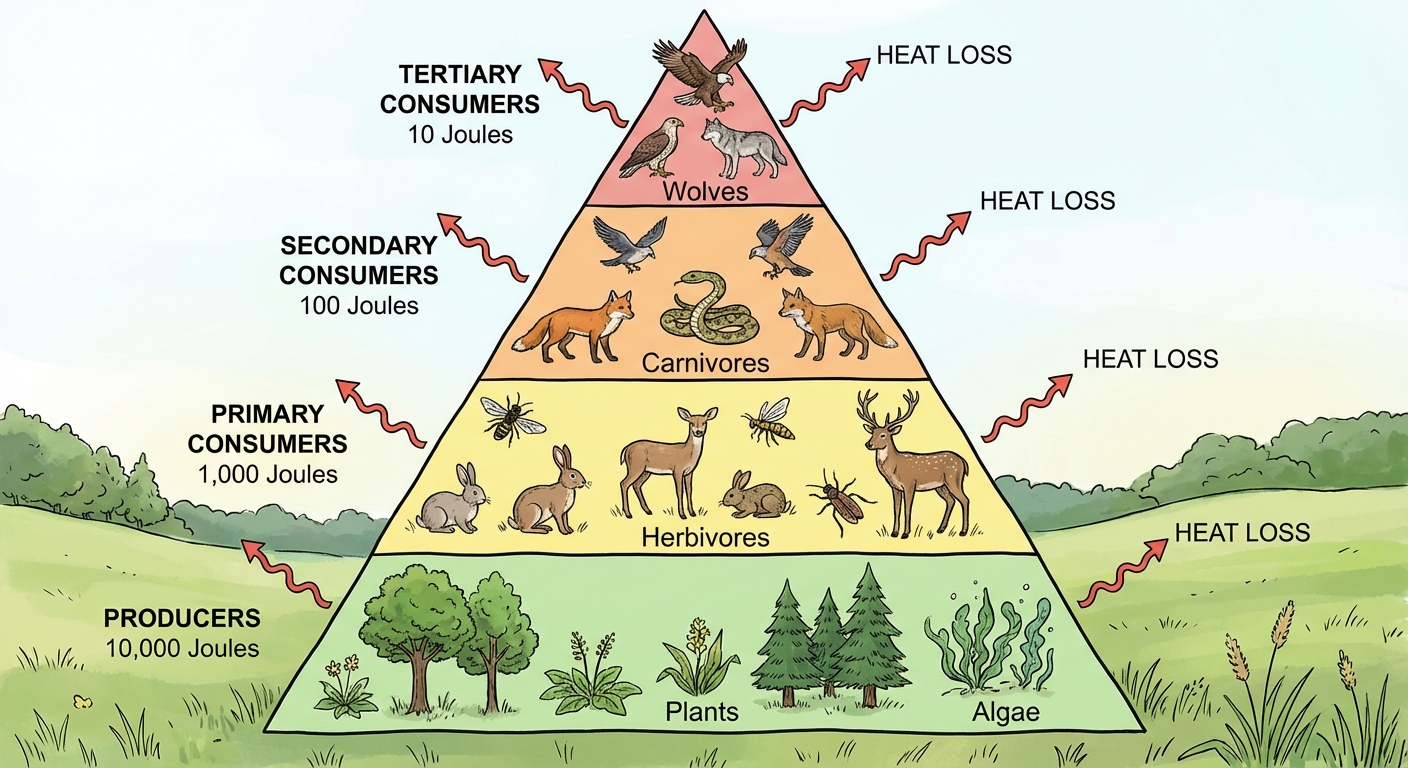
The 10% Rule
When moving from one trophic level to the next, only about 10% of the energy is passed on and stored as biomass. The remaining 90% is lost as metabolic heat, kinetic energy, or waste.
- Application: If Producers have 10,000 J of energy, Primary Consumers get 1,000 J, Secondary get 100 J, Tertiary get 10 J.
- Consequence: This explains why food chains rarely have more than 4-5 levels; there isn't enough energy left to support large populations of apex predators.
Food Chains vs. Food Webs
- Food Chain: A single linear path of energy flow (Sun $\rightarrow$ Grass $\rightarrow$ Zebra $\rightarrow$ Lion).
- Food Web: A complex network of interconnected food chains. Webs are more resilient; if one organism is removed, others may adapt.
- Trophic Cascade: Removing a keystone species (like a wolf) causes ripple effects down the trophic levels (e.g., deer population explodes $\rightarrow$ vegetation is destroyed).
Common Mistakes & Pitfalls
- Matter vs. Energy: Matter CYCLES (circles back); Energy FLOWS (enters as light, leaves as heat). Energy never recycles.
- Nitrification vs. Denitrification: Students flip these. Remember Nitro (Nitrification) sounds cool/active (making usable Nitrate), while De (Denitrification) means removing/undoing (turning back to unusable gas).
- Eutrophication: It isn't the chemicals killing the fish directly. It is the decomposition of the dead algae after the bloom that sucks oxygen out of the water (Hypoxia), suffocating the fish.
- Mixing up Biomes: Confusing the Tropical Rainforest (hot/wet) with Temperate Rainforest (coastal, mild, redwoods/Pacific NW).