Study Notes: Essential Differentiation Rules
Unit 2: Differentiation — Basic Differentiation Rules
Moving beyond the cumbersome limit definition of the derivative, Basic Differentiation Rules provide efficient algebraic shortcuts to calculate the instantaneous rate of change. Proficiency in these rules is critical for success in AP Calculus AB, as they form the foundation for the Chain Rule and Implicit Differentiation later in the course.
Algebraic Derivatives: The Power Rule & Linearity
Before applying calculus, it is often necessary to use algebra to rewrite functions into a differentiable form. The systematic approach is: Rewrite $\rightarrow$ Differentiate $\rightarrow$ Simplify.
The Constant Rule
Let $c$ be a real number. The derivative of a constant function is 0. This makes intuitive sense because a horizontal line ($y=c$) has a slope of 0 everywhere.
The Power Rule
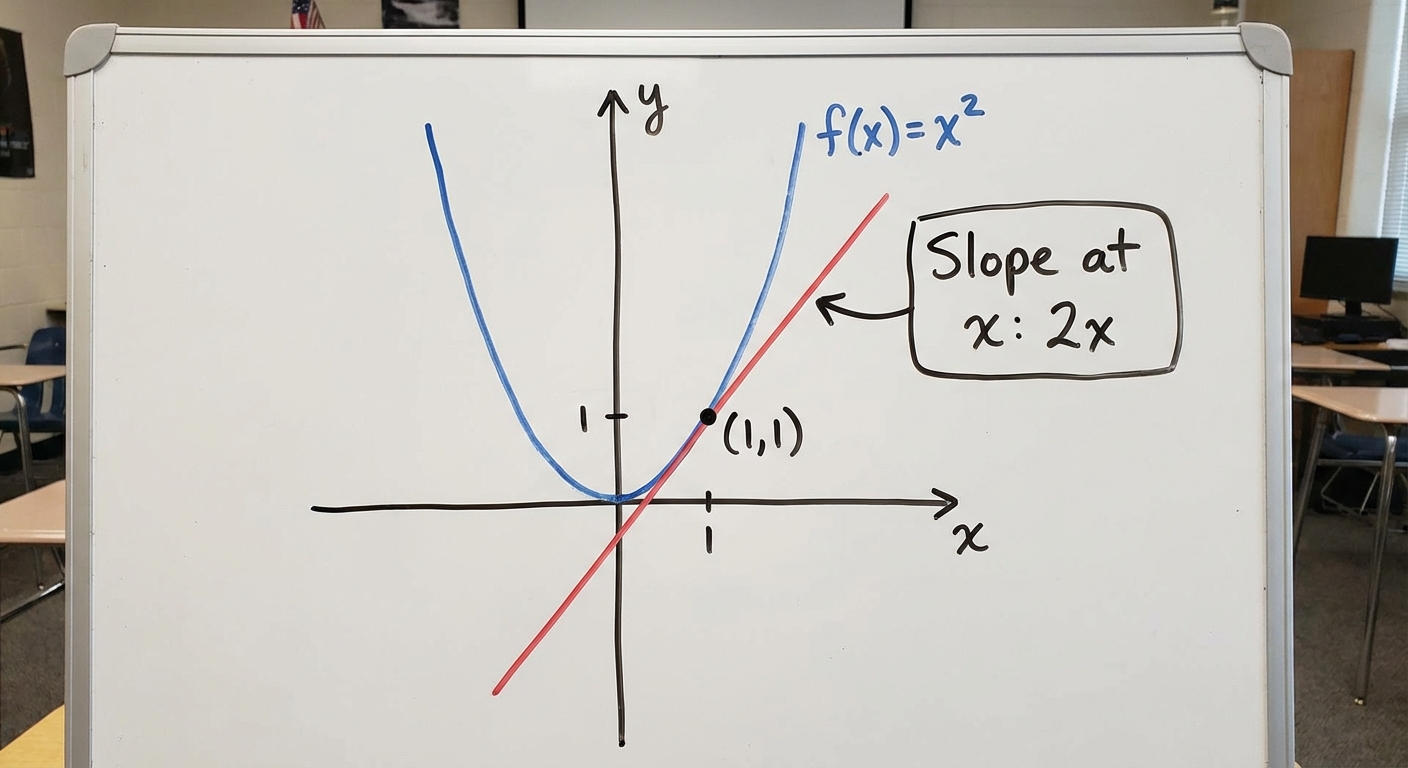
This is the most frequently used rule in differential calculus. If $n$ is a rational number, then the function $f(x) = x^n$ is differentiable.
Key Strategy: Use the Power Rule for radicals and rational expressions by rewriting them as exponents first.
| Original Function | Rewrite as Power | Differentiate ($nx^{n-1}$) | Simplify |
|---|---|---|---|
| $y = \sqrt{x}$ | $y = x^{1/2}$ | $y' = \frac{1}{2}x^{-1/2}$ | $y' = \frac{1}{2\sqrt{x}}$ |
| $y = \frac{1}{x^3}$ | $y = x^{-3}$ | $y' = -3x^{-4}$ | $y' = -\frac{3}{x^4}$ |
Linearity Properties: Constant Multiple, Sum, and Difference
Differentiation is a linear operator. You can pull constant multipliers out of the derivative and split sums/differences into individual parts.
Constant Multiple Rule: If $c$ is a constant and $f$ is a differentiable function:
Sum and Difference Rule:
Worked Example: Polynomial Differentiation
Find $\frac{dy}{dx}$ for $y = 3x^4 - 5\sqrt{x} + \frac{2}{x} + 7$.
Step 1: Rewrite
Step 2: Differentiate (Apply Rules)
Step 3: Simplify
Derivatives of Transcendental Functions
Transcendental functions (exponentials, logarithms, and trigonometry) cannot be differentiated using the Power Rule. You must memorize these specific forms.
Exponential and Logarithmic Functions
The Natural Base ($e$)
The function $f(x) = e^x$ is unique in calculus because it is its own derivative. It represents the rate of change directly proportional to the current value.
For the natural logarithm:
\frac{d}{dx}[\ln x] = \frac{1}{x}, \quad x > 0
General Bases ($a^x$ and $\log_a x$)
When the base is a constant $a$ ($a > 0, a \neq 1$) rather than $e$, a scaling factor of $\ln(a)$ is required.
- Exponential: $\frac{d}{dx}[a^x] = a^x \ln(a)$
- Logarithmic: $\frac{d}{dx}[\log_a x] = \frac{1}{x \ln(a)}$
Visual Tip: Since $e \approx 2.718$, $\ln(e) = 1$. If you forget the scaling factor rules, just remember that the formulas for base $a$ must work for base $e$.
Derivatives of Trigonometric Functions
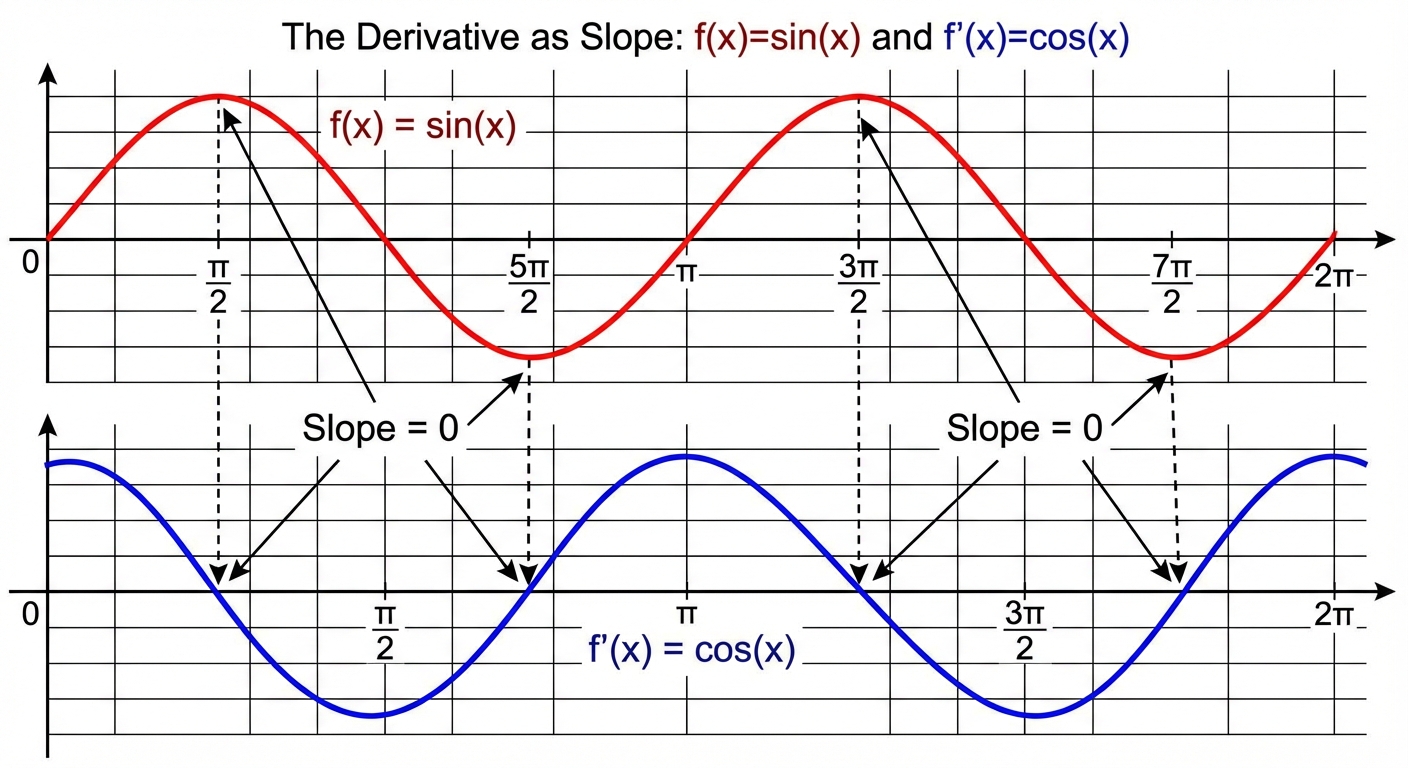
The AP Calculus AB exam stresses the derivatives of sine and cosine heavily, but you are required to know the derivatives of all six trigonometric functions.
Sine and Cosine
These derivatives form a cycle.
The Other Four (Tangent, Cotangent, Secant, Cosecant)
These are often derived using the Quotient Rule (covered in a later section), but for now, they are standard forms to memorize.
| Function $f(x)$ | Derivative $f'(x)$ |
|---|---|
| $\tan x$ | $\sec^2 x$ |
| $\cot x$ | $-\csc^2 x$ |
| $\sec x$ | $\sec x \tan x$ |
| $\csc x$ | $-\csc x \cot x$ |
Memory Aids
- The "PSST" Mnemonic:
- Tangent goes with Secant
- Cotangent goes with Cosecant
- The Negative "Co" Rule:
- All trigonometric functions starting with "c" ($\cos, \cot, \csc$) have negative derivatives.
Common Mistakes & Pitfalls
1. Confusing Power Rule with Exponential Rules
Students often try to apply the Power Rule to exponentials.
- WRONG: $\frac{d}{dx}[2^x] = x \cdot 2^{x-1}$
- RIGHT: $\frac{d}{dx}[2^x] = 2^x \ln(2)$
- Why? The Power Rule ($x^n$) applies when the base is variable and the exponent is constant. Exponential rules ($a^x$) apply when the base is constant and the exponent is variable.
2. Failing to Rewrite Radicals Before Differentiating
Trying to differentiate $\sqrt[3]{x}$ in your head often leads to errors.
- Correction: Always write $\sqrt[3]{x}$ as $x^{1/3}$ explicitly on paper before applying the rule $nx^{n-1}$.
3. Sign Errors with Trig Functions
Forgetting the negative sign for $\cos x$, $\csc x$, or $\cot x$ is the most common notation error.
- Check: Did you differentiate a "Co" function? The answer must be negative.
4. Notation Sloppiness
Do not write: $y = x^2 = 2x$.
- This implies the function equals its derivative, which is false.
- Use proper notation: $y=x^2 \implies y' = 2x$.
5. Evaluating Before Differentiating
If a question asks for $f'(2)$, you must find the general derivative $f'(x)$ first, and only then plug in $x=2$. If you plug in 2 first, you get a constant, and the derivative of a constant is always 0 (which is usually incorrect for the problem).