Revolution and Evolution: European and American Art (1750–1900)
Revolution and Evolution: European and American Art (1750–1900)
This era, covering the mid-18th through the 19th century, is defined by rapid shifts in political power, technology, and philosophy. The art moves from the intellectual rigidity of the Enlightenment to the emotional turmoil of Romanticism, the gritty truth of Realism, and finally, the optical experiments of Impressionism and Post-Impressionism.
Neoclassicism (c. 1750–1830)
Definition & Context
Neoclassicism is the visual embodiment of the Enlightenment. It represents a return to the classical ideals of Ancient Greece and Rome, emphasizing reason, order, skepticism, and civic duty over the frivolity of the previous Rococo style.
- Historical Context: The Grand Tour (aristocratic education trips to Italy/Greece), the excavations of Pompeii, and political revolutions in America and France.
- Philosophy: Art should be intellectual, moral, and teach a lesson.
Key Stylistic Traits
- Linearity: Sharp outlines, invisible brushstrokes, and a polished finish.
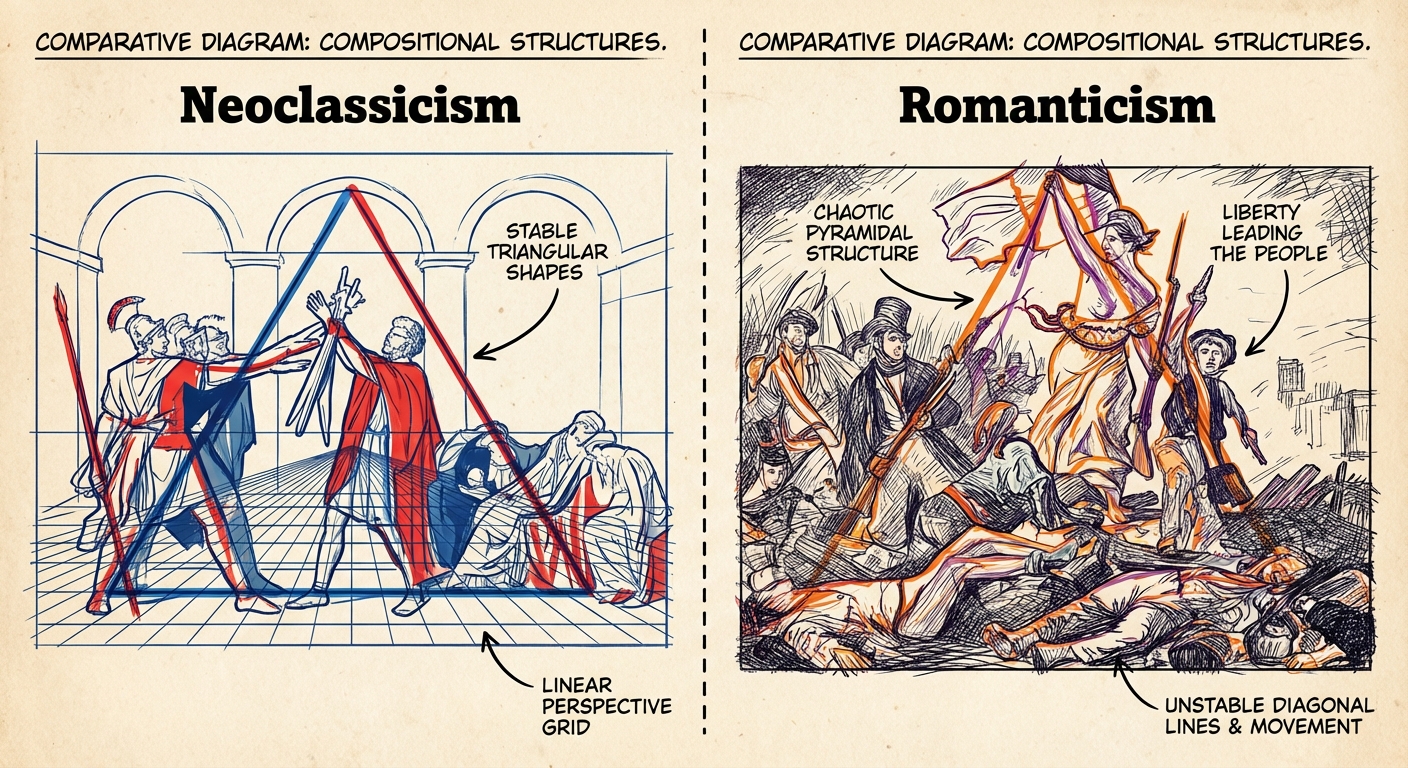
- Composition: Balanced, symmetrical, often using shallow depth of field (like a stage setting).
- Subject Matter: History paintings, mythological allegories, and portraits.
- Exemplum Virtutis: Artwork that functions as a "model of virtue" or moral lesson.
Major Works & Examples
1. The Oath of the Horatii - Jacques-Louis David (1784)
- Concept: A call to arms for the state above the family. Three brothers swear allegiance to Rome before battle, while women weep nearby.
- Visuals: The men form a rigid, angular structure (masculine strength), while the women are curved and slumped (feminine emotion). The clear light and Roman architecture emphasize the rationality of the sacrifice.
2. Monticello - Thomas Jefferson (1768–1809)
- Context: Jefferson believed art could validate the American Republic. He detested the British Georgian style and looked to Rome.
- Design: Based on the Roman Pantheon and French Neoclassical architecture (Hotel de Salm). It features a dome, octagonal drum, and Doric columns, symbolizing democracy and education.
Memory Aid
"Neo-Clean-sisicm": The lines are clean, the morals are clean, and the surfaces are polished.
Romanticism (c. 1790–1850)
Definition & Context
Romanticism was a reactionary movement against the industrialization of society and the scientific rationalization of nature (Neoclassicism). It prioritized P.O.W. (Passion, Opinion, Wonder).
- The Sublime: A key Romantic concept referring to feelings of awe mixed with terror (e.g., a massive storm, a jagged mountain). It reminds viewers of nature's dominance over humanity.
- Political Commentary: Artists used emotion to critique current events (French Revolution turmoil, slavery, corruption).
Key Stylistic Traits
- Brushwork: Loose, expressive, visible strokes.
- Color: Intense, dramatic, often clashing to evoke emotion rather than reality.
- Composition: Diagonal lines (creating movement and instability) rather than stable triangles.
Major Works & Examples
1. Y no hai remedio (And There’s Nothing to Be Done) - Francisco de Goya (1810–1823)
- Series: The Disasters of War. Use of drypoint etching.
- Analysis: Depicts the brutal consequences of the Peninsular War between Spain and France. It strips war of glory, showing only anonymous, gruesome death. The firing squad is faceless; the victim is central and illuminated (Christ-like).
2. The Slave Ship - Joseph Mallord William Turner (1840)
- Styles: An early drift toward abstraction. The subject is the Slaver Throwing Overboard the Dead and Dying.
- Technique: A chaotic sunset of blood-red and gold vs. the dark blue ocean. The "sublime" nature is indifferent to the human brutality occurring in the waves (shackled hands reaching up).
Realism & Early Photography (c. 1840–1870)
Definition & Context
Realism emerged in the wake of the 1848 revolutions. It rejected both the intellectualism of Neoclassicism and the emotionalism of Romanticism. Realists claimed to paint only what they could see with their own eyes—emphasizing the mundane, the working class, and the unvarnished truth.
"Show me an angel and I will paint one." — Gustave Courbet
Focus: The Revolution of Photography
Photography appeared in the late 1830s, changing art forever. Painters no longer needed to record reality perfectly; they were free to interpret it.
- Daguerreotype: One-of-a-kind image on a metal plate. Incredible detail, but fragile and not reproducible.
- Calotype: Paper negative. Allowed for multiple prints but had a grainier texture.
- Key Work: Eadweard Muybridge’s The Horse in Motion bridged science and art, proving that a galloping horse lifts all four legs off the ground.
Major Works & Examples
1. The Stone Breakers - Gustave Courbet (1849)
- Why it was radical: It painted two anonymous laborers on a massive scale usually reserved for kings or gods. It showed the cycle of poverty (an old man and a young boy) without romanticizing their struggle.
2. Olympia - Édouard Manet (1863)
- Significance: Manet bridges Realism and Impressionism. He painted a high-class prostitute (sex worker) staring aggressively at the viewer.
- Technique: Stark lighting (reducing figures to flat shapes), harsh black outlines, and a rejection of the "male gaze" fantasy. It caused a massive scandal.
Impressionism (c. 1872–1890)
Definition & Context
Impressionism sought to capture a fleeting moment in time—the "impression" of a scene rather than a fixed narrative. It was heavily influenced by the modernization of Paris (Haussmannization), new theories of color, and tubes of paint which allowed artists to work outdoors (en plein air).
Stylistic Traits
- Broken Color: Placing dabs of complementary colors side-by-side so they mix in the viewer's eye (optical mixing).
- Light: The true subject of most Impressionist paintings is light itself, not the objects.
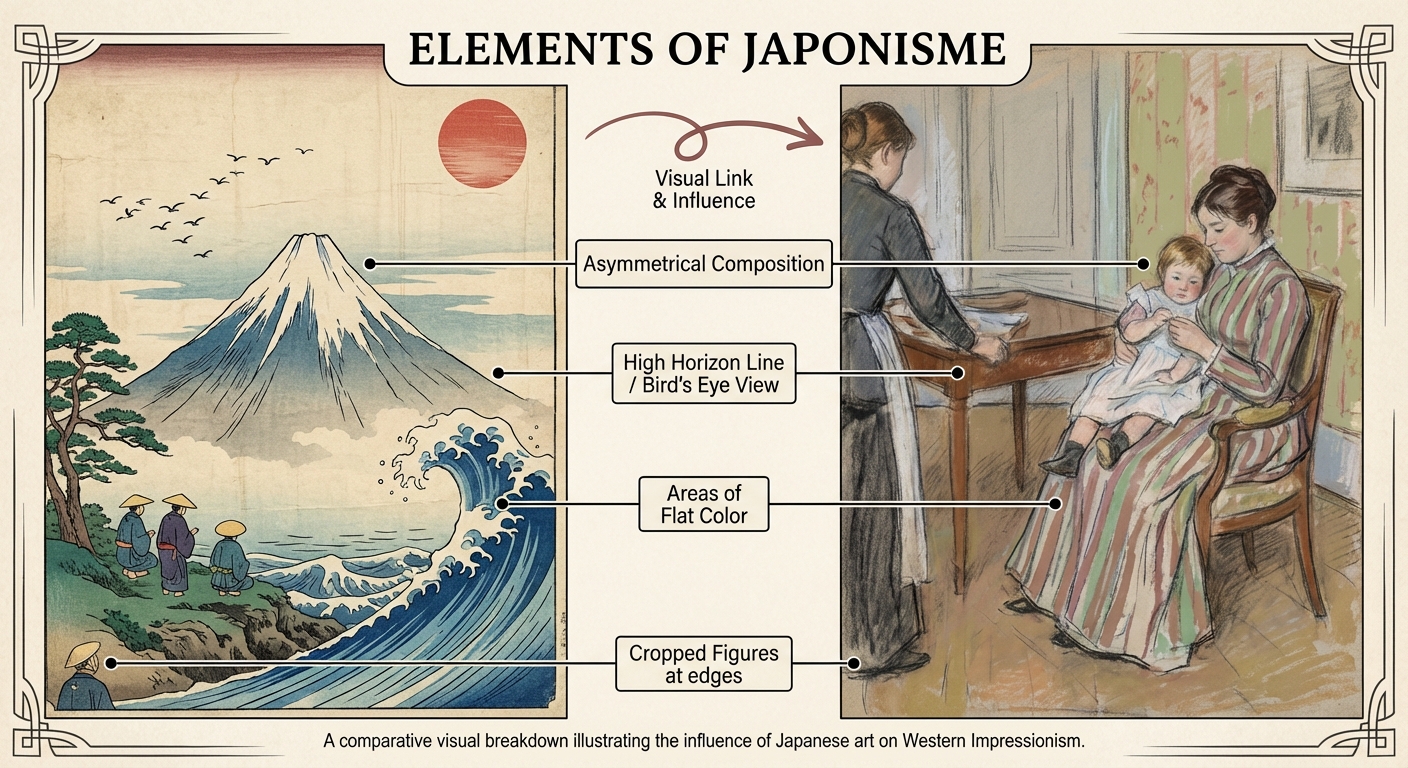
- Influence of Japan (Japonisme): After Japan opened trade in 1853, Ukiyo-e woodblock prints flooded Europe. Artists adopted their diagonal angles, cropping, flattened space, and patterning.
Major Works & Examples
1. The Saint-Lazare Station - Claude Monet (1877)
- Subject: Modern urban life—trains, steam, and industrial architecture.
- Analysis: Monet focuses on the interplay of light through the steam and the glass roof. The train is just a vehicle for color.
2. The Coiffure - Mary Cassatt (1890-1891)
- Technique: Drypoint and aquatint. Use of pastel colors.
- Japonisme: The figure is seen from a high angle, the composition dominates over the face, and the patterns are flat. It depicts a private, non-sexualized moment of a woman grooming.
Post-Impressionism (c. 1880–1905)
Definition & Concepts
Post-Impressionism is not a unified style but a collective term for artists who felt Impressionism was too fleeting and lacked structure or emotional depth. They moved in two distinct directions:
- Structure & Geometry: Focus on the underlying shapes of nature (Cézanne).
- Emotion & Symbolism: Focus on expressive color and psychological depth (Van Gogh, Gauguin, Munch).
Major Works & Examples
1. The Starry Night - Vincent van Gogh (1889)
- Context: Painted in an asylum. It is a composite of observation and imagination.
- Technique: Heavy impasto (thick application of paint). The swirling cyprus tree (symbol of death/mourning) connects earth and sky. Color is used to express feeling, not to describe reality.
2. Mont Sainte-Victoire - Paul Cézanne (1902–1904)
- Philosophy: "Treat nature by the cylinder, the sphere, the cone."
- Technique: He broke the landscape into patches of color (warm colors advance, cool colors recede). This deconstruction of space paved the way for Cubism.
3. The Scream - Edvard Munch (1893)
- Movement: Symbolism (a subset of Post-Impressionism).
- Analysis: A representation of internal anxiety projected onto the external world. The figure is skeletal, the landscape swirls like a sound wave, and the colors are jarring.
Common Mistakes & Pitfalls
| Mistake | Correction |
|---|---|
| Confusing Manet and Monet | Manet came first (Realism/Transition); he painted people, social commentary, and used black. Monet came later (Impressionism); he painted light, landscapes, and rarely used black. |
| Misunderstanding "Realism" | Realism does not mean "photorealistic" (looking like a photo). It refers to realistic subject matter (poverty, labor) rather than idealized gods or heroes. |
| Romanticism = Romance | Romanticism is not about love/romance. It is about intense emotion, including terror, madness, and the sublime power of nature. |
| Ignoring Photography | Don't forget that the invention of the camera forced painters to stop merely documenting reality and start interpreting it (Impressionism). |