Mastering Curve Analysis and Real-World Optimization
Connecting f, f', and f'' Graphs
In AP Calculus BC, one of the most frequently tested skills is the ability to interpret the behavior of a function ($f$) based on the graphs of its first ($f'$) and second ($f''$) derivatives. Understanding these relationships is the key to solving curve sketching problems without a calculator.
The Hierarchy of Function Analysis
To analyze curves effectively, you must understand what each "level" of the derivative tells you about the original function.
- $f(x)$ — The Position/Value Functions: Tells you the location (height, y-value) of the graph.
- $f'(x)$ — The Slope/Velocity: Tells you the direction and steepness of the graph.
- $f''(x)$ — The Concavity/Acceleration: Tells you how the slope is changing (curvature).
The Translation Table
The following table is essential for translating between a graph and its derivatives. Memorize these relationships:
| If $f(x)$ is… | Then $f'(x)$ is… | And $f''(x)$ is… |
|---|---|---|
| Increasing | Positive (+) | (Indeterminate) |
| Decreasing | Negative (-) | (Indeterminate) |
| Concave Up | Increasing (slope is rising) | Positive (+) |
| Concave Down | Decreasing (slope is falling) | Negative (-) |
| At a Relative Extrema (Max/Min) | Zero or Undefined (changes sign) | (Use 2nd Derivative test) |
| At a Point of Inflection | At a relative Max or Min | Zero or Undefined (changes sign) |
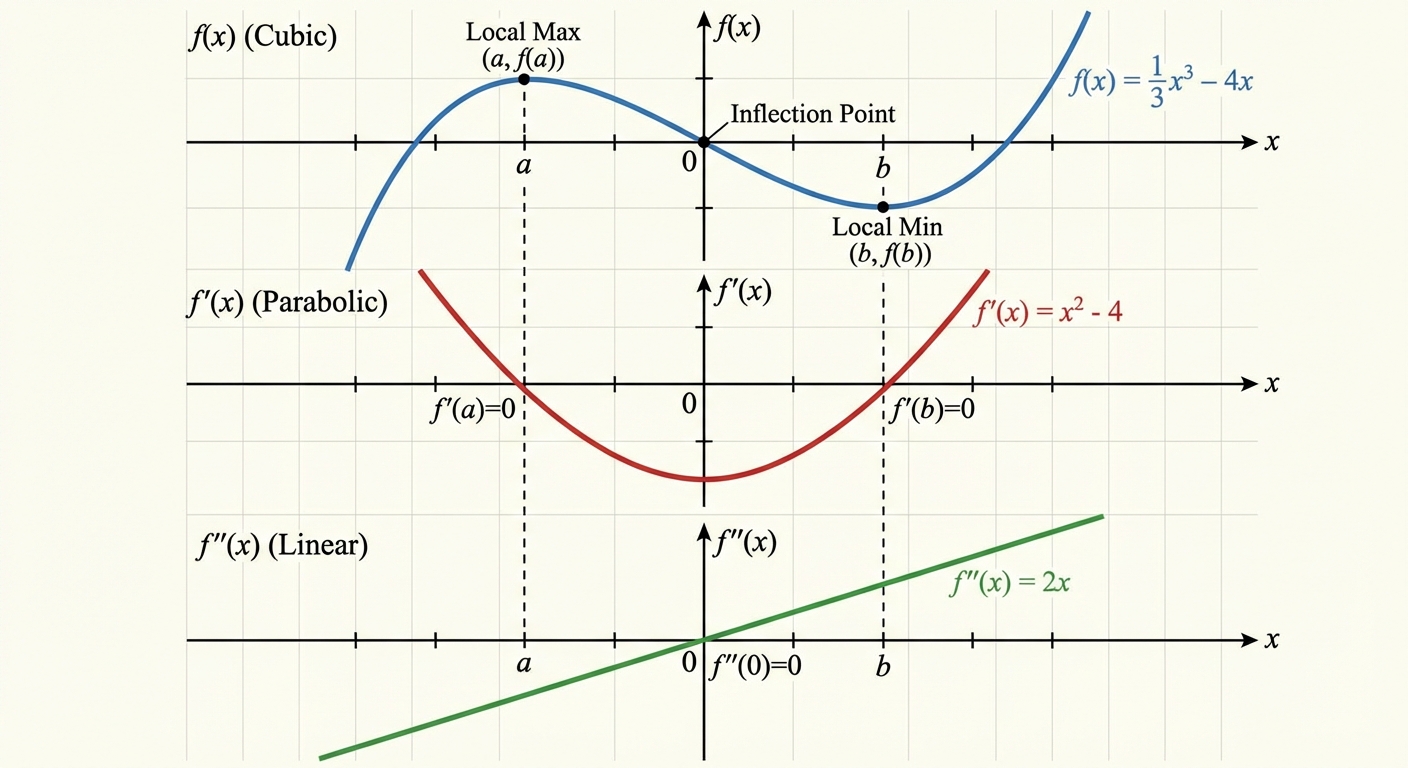
Analyzing the Graph of $f'$
A common AP Exam question presents the graph of the derivative, $f'$, and asks questions about $f$. Do not confuse the height of the $f'$ graph with the height of $f$.
Key Analysis Checkpoints:
- Where is $f$ increasing? Look for where the graph of $f'$ is above the x-axis ($f' > 0$).
- Where is $f$ decreasing? Look for where the graph of $f'$ is below the x-axis ($f' < 0$).
- Local Maxima of $f$: Look for x-intercepts on $f'$ where the graph crosses from positive to negative.
- Local Minima of $f$: Look for x-intercepts on $f'$ where the graph crosses from negative to positive.
- Concavity of $f$: Look at the slope of $f'$. If $f'$ is going up (increasing), $f$ is concave up. If $f'$ is going down (decreasing), $f$ is concave down.
- Points of Inflection of $f$: Look for the peaks and valleys (relative extrema) on the graph of $f'$. These represent where $f''$ changes sign.
Optimization Problems
Optimization is the application of differentiation to find the "best" possible value—maximum profit, minimum cost, minimum distance, or maximum volume. These problems translate real-world constraints into mathematical functions.
General Strategy for Optimization
- Identify the Quantities: Determine what is being maximized or minimized (the Objective Function) and what is restricting the situation (the Constraint).
- Sketch a Diagram: Visualize variables.
- Write the Primary Equation: Express the quantity to be optimized as a function (e.g., $A = xy$).
- Reduce to One Variable: Use the constraint equation (secondary equation) to substitute variables so the primary equation is in terms of a single variable (e.g., substitute $y = 100-x$ into Area).
- Determine the Domain: Identify the feasible interval $[a, b]$ for the variable. Do not skip this step. Context often implies constraints (e.g., length cannot be negative).
- Find Critical Points: Calculate the derivative, set it to zero ($f'(x)=0$) or undefined.
- Justify the Extrema: Use the First Derivative Test or the Candidates Test (for closed intervals).
The Candidates Test (Absolute Extrema)
Most AP optimization problems ask for an Absolute Max or Min on a closed interval. The most rigorous justification is the Candidates Test.
Steps:
- Find critical numbers $c$ inside the interval $(a, b)$.
- Evaluate the function $f(x)$ at the endpoints ($a$ and $b$) and the critical numbers ($c$).
- Compare the values. The highest is the Absolute Max; the lowest is the Absolute Min.
Example 1: The Open-Top Box
Problem: You have a rectangular sheet of cardboard with dimensions $20 \text{ in} \times 30 \text{ in}$. You cut equal squares of side length $x$ from each corner and fold up the sides to create an open-top box. What value of $x$ maximizes the volume?
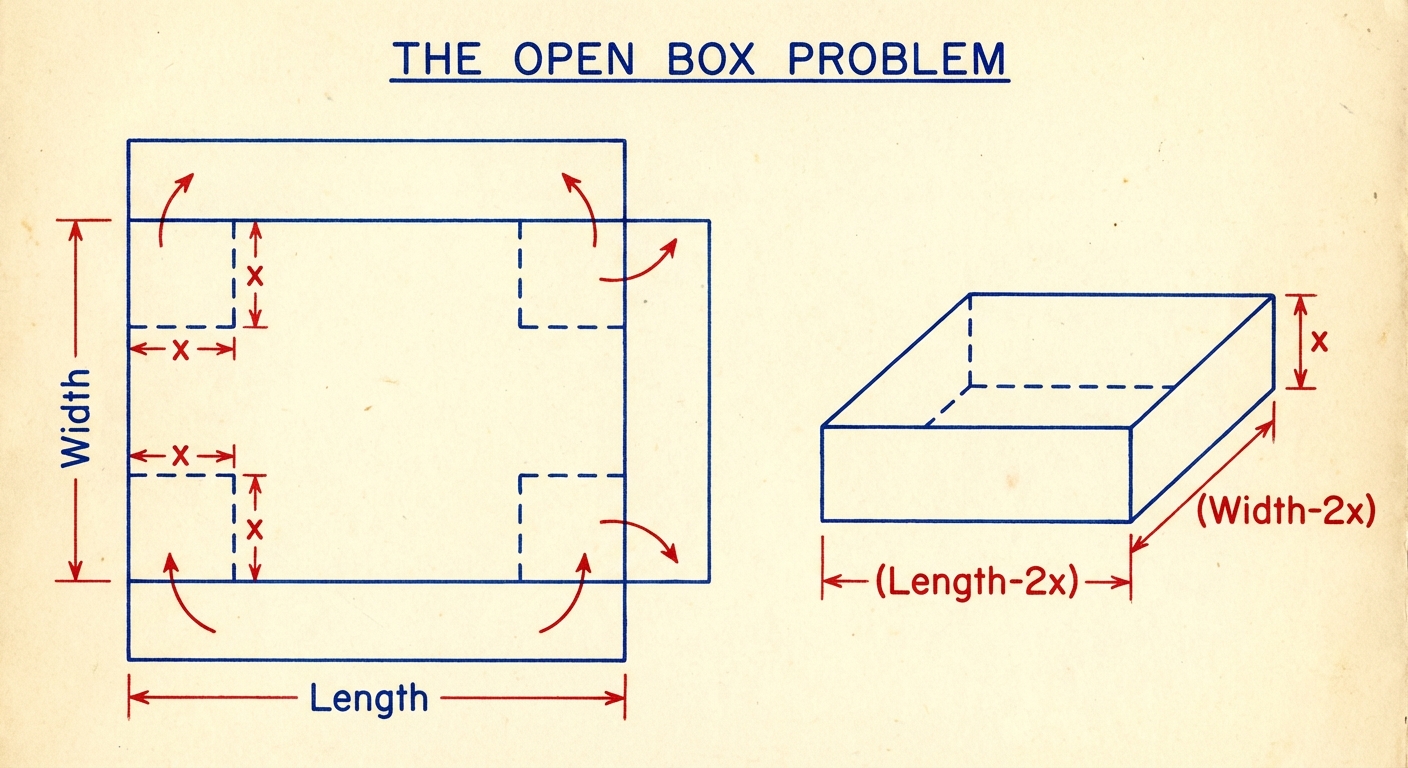
Solution:
Primary Equation (Volume):
Domain:
Side lengths must be positive:
$20 - 2x > 0 \implies x < 10$ $x > 0$
Domain: $(0, 10)$ (physically, though we can treat it as $[0, 10]$ for the Candidates Test).Differentiate:
Expand first: $V(x) = 4x^3 - 100x^2 + 600x$Find Critical Points:
Set $V'(x) = 0$:
Using the quadratic formula, we get approximate values $x \approx 3.92$ and $x \approx 12.74$.Test:
$x \approx 12.74$ is outside the domain ($x < 10$).
Our only critical point is $c \approx 3.92$.
Using the Second Derivative Test: $V''(x) = 24x - 200$. At $x=3.92$, $V'' < 0$, so the curve is concave down, indicating a Maximum.
Example 2: Minimal Distance
Problem: Find the point on the graph $y = \sqrt{x}$ that is closest to the point $(4, 0)$.
Strategy Tip: To minimize distance $D = \sqrt{(x2-x1)^2 + (y2-y1)^2}$, you can minimize the square of the distance, $S = D^2$, because the minimum of the square occurs at the same $x$-value as the minimum of the root.
Objective Function:
Constraint:
$y = \sqrt{x} \implies y^2 = x$Substitute:
Differentiate:
$S'(x) = 2x - 7$
$2x - 7 = 0 \implies x = 3.5$Verify:
$S''(x) = 2$ (Positive, Concave Up $\rightarrow$ Minimum).
The closest point is $(3.5, \sqrt{3.5})$.
Common Mistakes & Pitfalls
$f'$ vs $f$ Confusion:
- Mistake: Seeing the graph of $f'$ go down and assuming $f$ is decreasing.
- Correction: If $f'$ goes down, $f$ is concave down. $f$ is only decreasing if $f'$ is negative (below the axis).
Neglecting Endpoints:
- Mistake: Finding the local max at a critical point but forgetting that the absolute max might occur at the start or end of the interval.
- Correction: Always use the Candidates Test on closed intervals.
Assuming Justification:
- Mistake: Stating "It's a max because the graph goes up then down."
- Correction: Use Calculus language. "There is a maximum at $x=c$ because $f'(x)$ changes from positive to negative."
Units in Optimization:
- Mistake: Forgetting to answer the specific question asked (e.g., finding $x$ when the question asks for the "Maximum Area").
- Correction: Reread the question. If asked for dimensions, give $L$ and $W$. If asked for Volume, plug $x$ back into $V(x)$.