Comprehensive Guide to AP English Literature Unit 6: Longer Fiction or Drama II
Character Complexity and Nuance
Unit 6 builds upon earlier units by deepening the analysis of character development in longer works (novels and plays). In longer narratives, characters often exhibit conflicting values or undergo significant transformations that drive the thematic meaning of the work.
The Function of Foil Characters
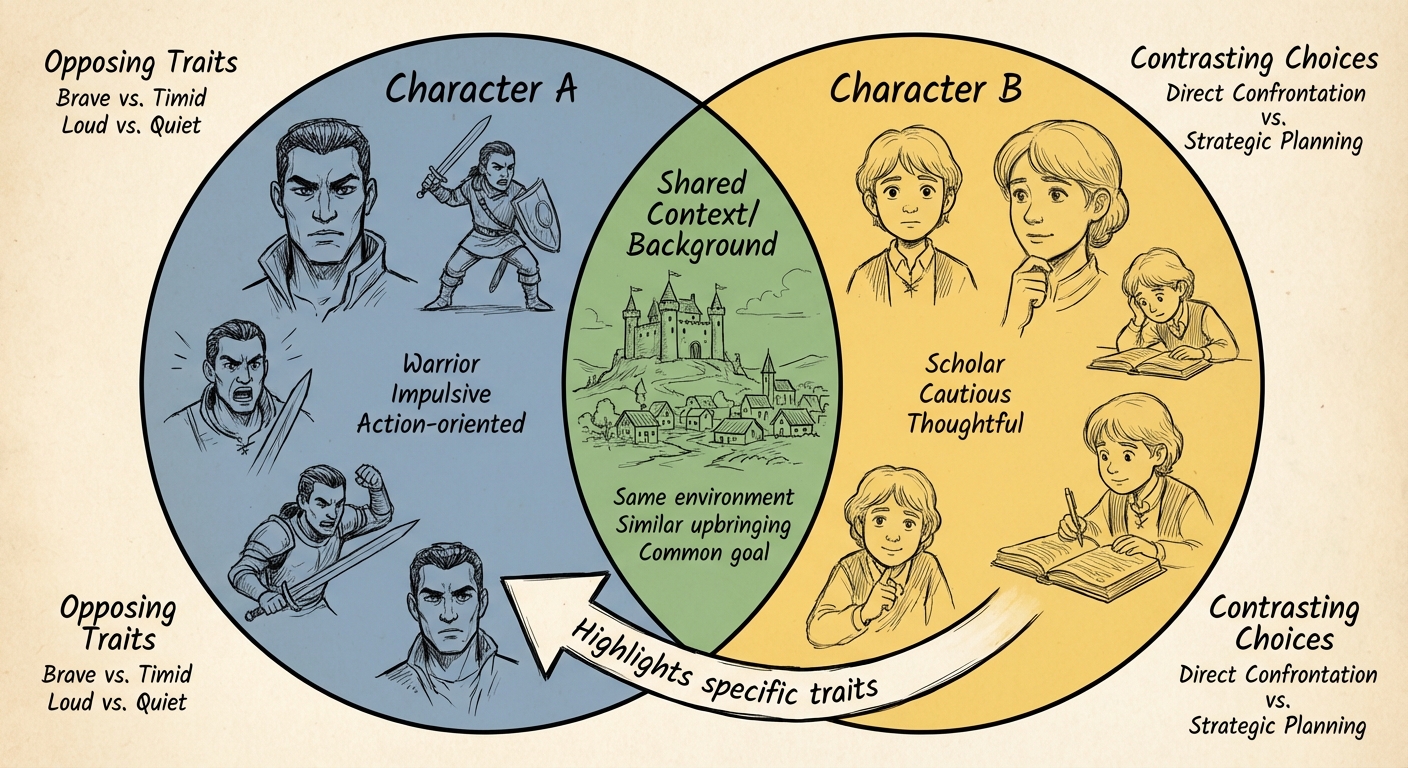
A Foil Character is a character whose purpose is to accentuate or draw attention to the qualities of another character, most often the protagonist. While foils are often antagonists, they do not have to be enemies; they simply provide a point of contrast.
- Contrast and Opposition: The core mechanism of a foil is opposition. By placing two characters with contrasting traits side-by-side, the author highlights the strengths or weaknesses of the protagonist. For example, a decisively violent character might highlight the protagonist's localized hesitation or morality.
- Similarities: To be an effective foil, characters usually share a set of similarities (age, social status, goals) that make the divergence in their choices meaningful. If two characters have nothing in common, the comparison falls flat.
- Illuminating Traits: The ultimate goal of analyzing a foil is not just to say "they are opposites," but to explain what specific trait is revealed.
- Example: In Hamlet, Laertes is a foil to Hamlet. Both young men have murdered fathers and seek revenge. Laertes acts immediately and rashly (action), highlighting Hamlet’s tendency to overthink and philosophize (inaction).
Character Inconsistency and Competing Values
In longer works, complex characters (round/dynamic characters) often struggle with inconsistency.
- Internal Conflict: A character may hold competing values (e.g., duty to family vs. personal desire). The tension between these values creates inconsistency in behavior.
- Epiphany: A sudden realization that changes a character's understanding of themselves or the world. This often resolves the inconsistency or leads to a tragic downfall.
- Significance: When writing essays, do not dismiss contradictions as plot holes. Instead, analyze them as evidence of the character's psychological depth. Ask: What competing internal drive caused this shift in behavior?
Structure and Plot Delivery
While Unit 3 focused on plot basics, Unit 6 emphasizes how the arrangement of time and events affects the reader's experience and the work's meaning.
Non-Linear Narrative Structures
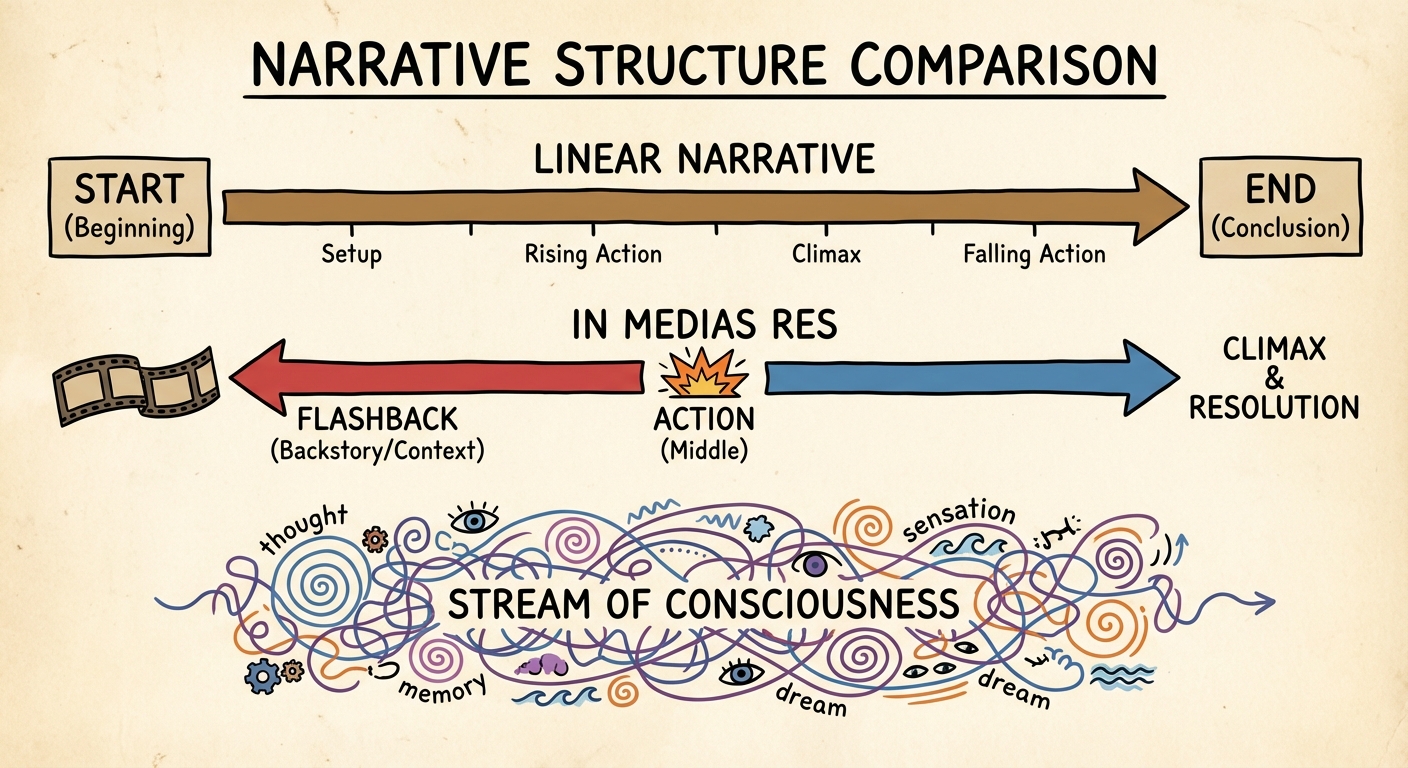
Authors often manipulate time to control pacing, build suspense, or mirror a character's psychological state.
- In Medias Res: A Latin phrase meaning "in the midst of things." This technique drops the reader directly into action without exposition.
- Effect: It creates immediate tension and disorientation, forcing the reader to piece together the context (exposition) as they go. It hooks the reader by raising questions immediately.
- Flashback (Analepsis): An interruption of the chronological sequence to inject background information or context.
- Function: Flashbacks are rarely just for information; they often explain the root of a character's current trauma, motivation, or fear. They create a juxtaposition between the past innocence and present corruption.
- Foreshadowing: Hints or clues about future events.
- Atmospheric Foreshadowing: Using weather or setting (e.g., a storm approaching) to suggest emotional turmoil.
- Dialogue Foreshadowing: A character making a casual remark that predicts their fate.
- Effect: It creates a sense of inevitability or fate, particularly in tragedies.
Stream of Consciousness
Stream of Consciousness is a narrative mode that attempts to depict the multitudinous thoughts and feelings which pass through the mind.
- Syntax and Flow: This style ignores standard sentence structure. It may be fragmented, repetitive, or run-on, mimicking the chaotic associative leaps of the human mind.
- Reader Intimacy: This technique places the reader directly inside the character's head, removing the filter of a narrator. It reveals raw, unedited fears and desires.
- Contrast with Interior Monologue: While similar, interior monologue is often more organized (the character talking to themselves), whereas stream of consciousness captures the pre-speech level of sensing and thinking.
Pacing and Tension
The manipulation of time creates pacing.
- Protracted Time: Spending many pages describing a few seconds of an event serves to heighten the significance of that moment (slowing down).
- Compressed Time: Skipping over years or months (speeding up) suggests those periods lacked significant change or conflict.
Narrative Perspective and Bias
Determining who is telling the story is as important as the story itself. Unit 6 focuses heavily on the distance between the narrator, the characters, and the reader.
Narrative Distance and Tone
- Physical Distance: Is the narrator part of the action (first-person) or observing from afar (third-person)?
- Emotional Distance: Does the narrator empathize with the characters, or are they clinical and detached?
- Tone: The narrator's attitude toward the subject. Tone is conveyed through diction (word choice) and syntax.
- Tip: Never just say "the author uses tone." Always use an adjective: "cynical tone," "elegiac tone," "wry tone."
Reliability and Bias
All narrators have a specific perspective, but some are Unreliable Narrators.
- Narrative Bias: The tendency to interpret events in a way that fits a pre-existing worldview or self-interest. Humans (and narrators) naturally filter out information that contradicts their beliefs.
- The Gap of Reliability: In sophisticated literature, there is often a discrepancy between what the narrator says and what the reader is expected to understand.
- Example: A narrator might claim they are perfectly sane while describing paranoid hallucinations. The reader sees the truth that the narrator denies.
- Irony: This gap creates Dramatic Irony, where the reader understands the implications of the story better than the teller.
Figurative Language in Long Works
In longer fiction, figurative language evolves from isolated metaphors into structural elements that span the entire work.
Archetypes
Archetypes are recurring patterns, symbols, or character types that appear across cultures and time periods. Understanding them helps predict plot movements and recognize universal themes.
- Character Archetypes:
- The Tragic Hero: A noble figure with a fatal flaw (hamartia) leading to downfall.
- The Scapegoat: A character who bears the blame for others' sins.
- The Mentor: A guide who provides wisdom (often disappears/dies to force protagonist growth).
- Situational Archetypes:
- The Journey: Physical or psychological movement from innocence to experience.
- The Fall: descent from a higher to a lower state of being.
Extended Symbolism and Motifs
- Motif: A recurring image, sound, action, or other figure that has a symbolic significance and contributes to the theme.
- Difference from Symbol: A symbol might appear once; a motif repeats.
- Function: Motifs unify the work. For example, repeated references to "sight" and "blindness" in Oedipus Rex track the protagonist's movement from physical sight/spiritual blindness to physical blindness/spiritual sight.
- Metaphor beyond Style: In Unit 6, metaphors are analyzed not just as "pretty language" but as structural frameworks. If a character is described as a "puppet," look for how the plot reinforces their lack of agency.
Literary Argumentation
Unit 6 culminates in writing about longer works (often preparing for the FRQ 3: Literary Argument).
The Thesis and Line of Reasoning
- Thesis Statement: Must make a defensible claim that creates an interpretation of the work as a whole. It cannot just state a fact.
- Formula: [Literary Element] + [Context of Work] + [Function/Meaning] = Thesis.
- Line of Reasoning: The logical sequence of claims that supports the thesis. Your paragraphs should not be random points; they should progress (e.g., Chronological analysis of character change, or grouping by thematic aspect).
Evidence and Commentary
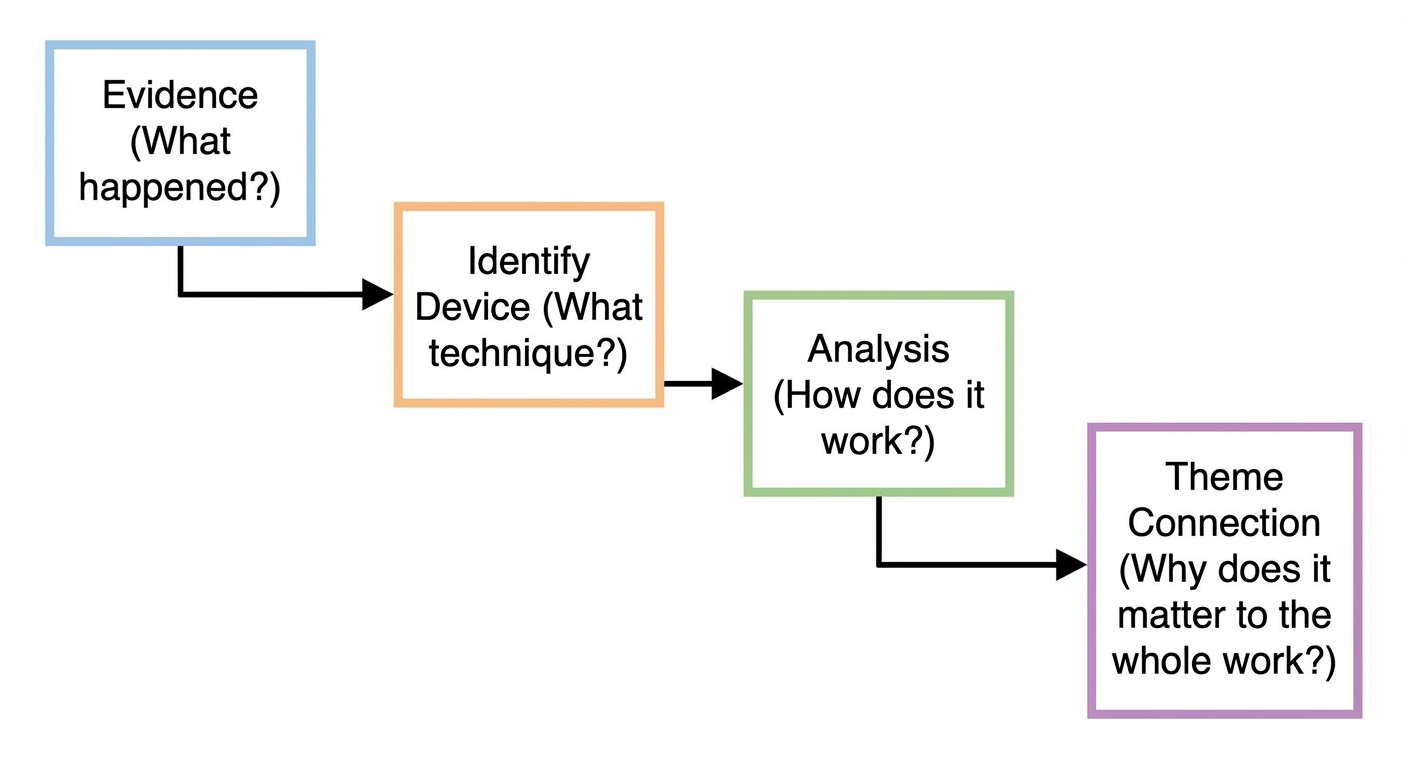
- Evidence: Specific references to the text. In FRQ 3, you often won't have the book in front of you, so you must memorize specific details (key scenes, specific symbols) rather than quoting verbatim.
- Commentary (The "So What?"): This is the most crucial part. It explains the logical relationship between the evidence and the claim.
- Avoid Summary: Do not retell the plot.
- Analysis: explain how the author uses the device to convey meaning.
- Connection: Connect every piece of evidence back to the "meaning of the work as a whole" (theme).
Considering Societal Context (Setting)
When analyzing longer works, the setting often reflects the values of a specific society or era. Arguments are strengthened when you explain how a character's conflict is a result of clashing with the mores of their specific time and place (e.g., rigid class structures in Victorian novels).
Common Mistakes & Pitfalls
- Confusing Author and Narrator: Never assume the narrator's views are the author's views. Authors often create unlikeable narrators to critique specific mindsets.
- Listing Foils without Purpose: Don't just identify that two characters are foils. You must explain what specific trait is highlighted by the comparison.
- Plot Summary in Essays: The most common error in AP Lit. If you are writing "Then he went to the store, and then he met her," you are summarizing. Only describe plot points if you are immediately analyzing why they matter to the theme.
- Ignoring Structure: Students often focus heavily on characters and forget to analyze how the story is told (flashbacks, pacing, stream of consciousness). Structure often dictates meaning.
- Vague Thematic Statements: Avoid "The theme is love." A theme must be a complete sentence expressing an opinion about the human condition (e.g., "The novel suggests that obsessively pursuing love leads to moral decay").