Universal Gravitation and Orbital Mechanics
7.1 Newton’s Law of Universal Gravitation
The Fundamental Law
Before Newton, gravity was often thought of as a terrestrial force restricted to Earth. Sir Isaac Newton unified celestial and terrestrial mechanics by proposing that gravity is a universal attractive force acting between all matter.
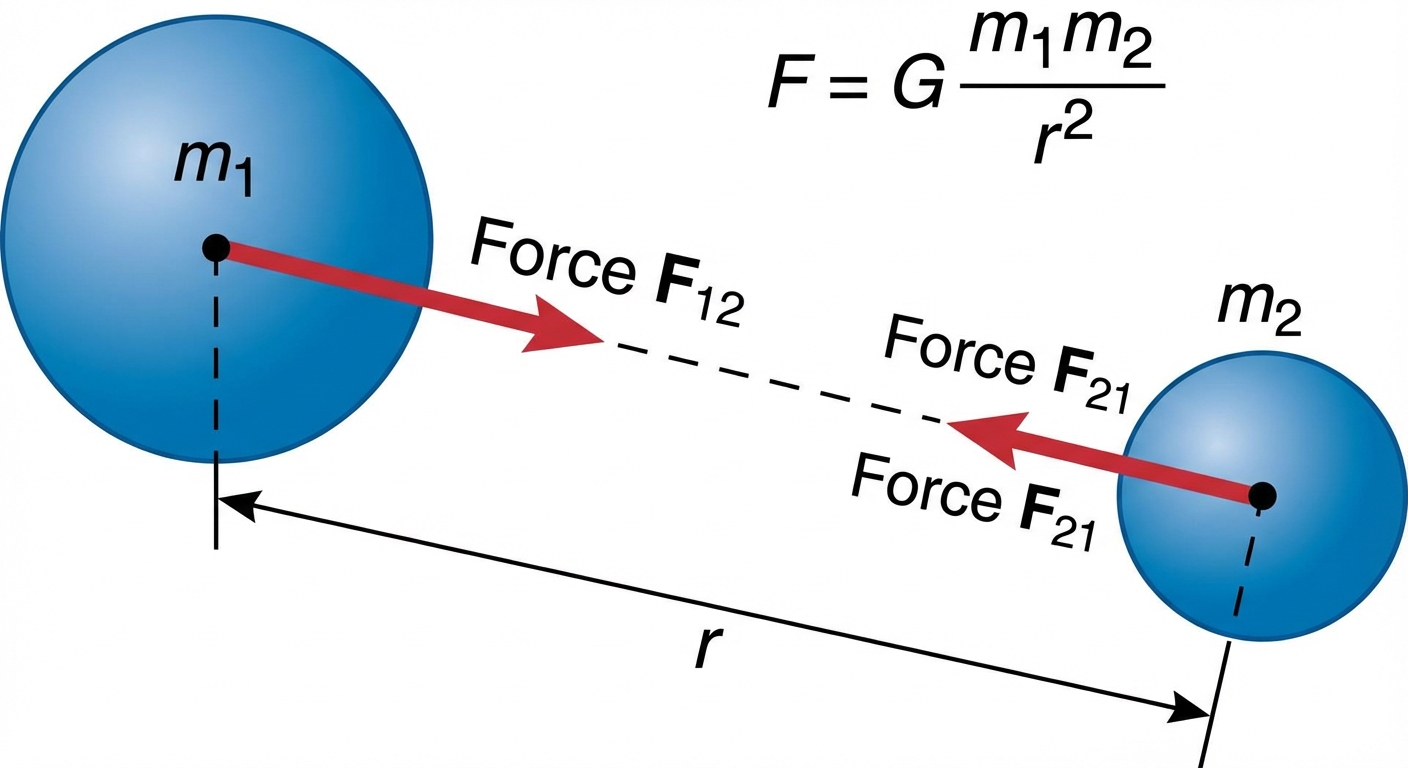
Newton’s Law of Universal Gravitation states that every particle of matter attracts every other particle with a force directly proportional to the product of their masses and inversely proportional to the square of the distance between their centers.
Where:
- $F_g$ is the magnitude of the gravitational force (Newtons, N)
- $G$ is the Universal Gravitational Constant ($6.67 \times 10^{-11} \, \text{N}\cdot\text{m}^2/\text{kg}^2$)
- $m1$ and $m2$ are the masses of the two objects (kg)
- $r$ is the distance between the centers of mass of the two objects (m)
Important Properties of Gravitational Force
- Action-Reaction Pairs: According to Newton's Third Law, the force $m1$ exerts on $m2$ is equal in magnitude and opposite in direction to the force $m2$ exerts on $m1$.
- Inverse-Square Law: The force decreases rapidly as distance increases. If you double the distance ($2r$), the force drops to $\frac{1}{4}$ of its original value.
- Superposition Principle: The net gravitational force on a mass due to multiple other masses is the vector sum of the individual forces.
7.2 Gravitational Fields ($g$)
Defining the Field
A gravitational field is a region of space surrounding a mass where another mass would experience a force. We define the gravitational field strength ($g$), often called acceleration due to gravity, as the force per unit mass.
Equation for a Point Mass (or outside a sphere):
Where $M$ is the source mass creating the field. Note that $g$ is a vector pointing toward the center of the source mass.
The Shell Theorem
Newton proved two crucial points regarding spherical symmetry (vital for AP Physics C):
- Outside a Spherical Shell: A uniform spherical shell of matter attracts a particle outside it as if all the shell's mass were concentrated at its center.
- Inside a Spherical Shell: A uniform spherical shell exerts zero net gravitational force on a particle located anywhere inside it.
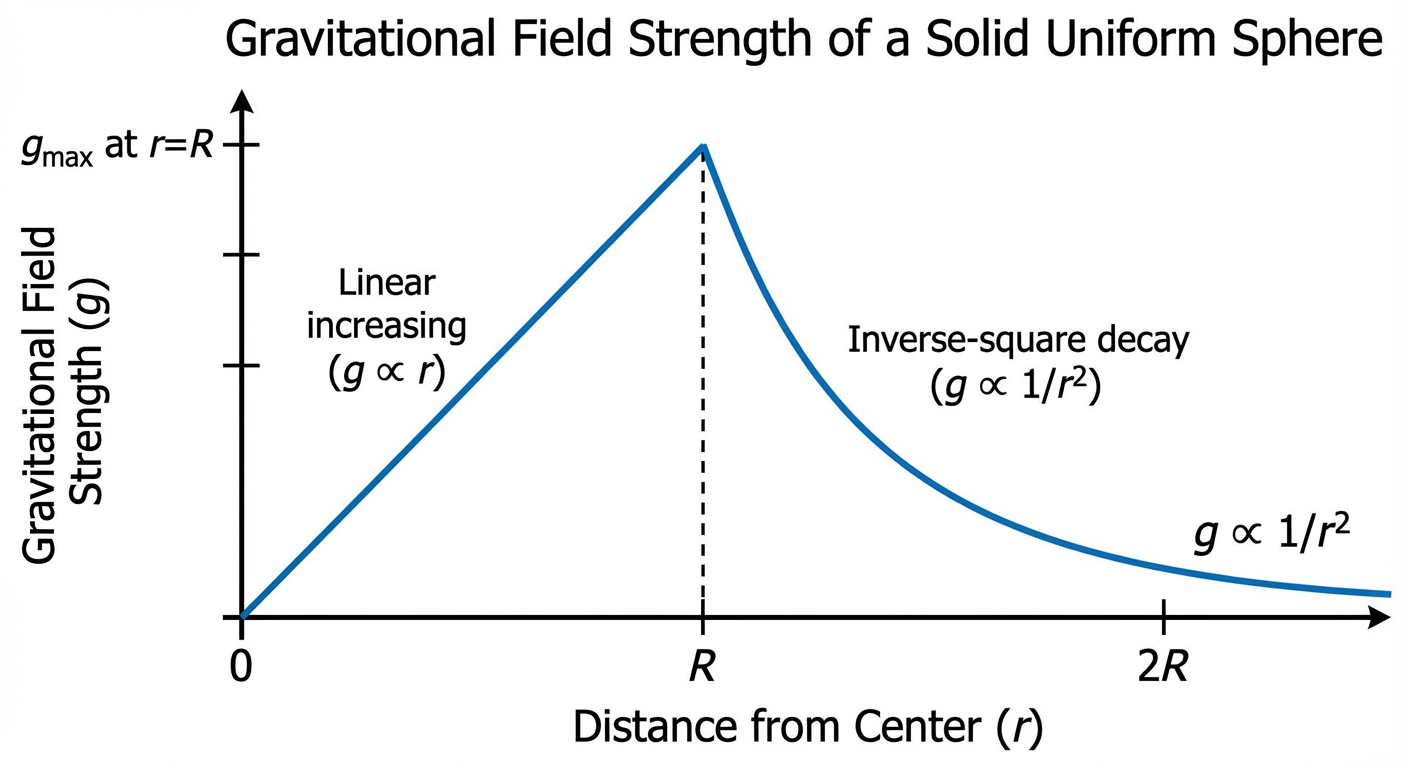
Gravitational Field of a Solid Uniform Sphere
For a planet of mass $M$ and radius $R$ with uniform density $\rho$:
- Outside the planet ($r \ge R$): Behaves like a point mass.
- Inside the planet ($r < R$): The gravity is determined only by the mass enclosed within the radius $r$. The outer shell cancels out. Since mass enclosed scales with volume ($r^3$), the field becomes linear.
Common Mistakes:
- Mistake: Assuming $g$ is constant (9.8 m/s²) in problems involving satellites or high altitudes.
- Correction: $g$ is only $\approx 9.8$ near Earth's surface. You must use $GM/r^2$ for orbits.
7.3 Gravitational Potential Energy ($U_g$)
Definition
In AP Physics C, we move away from the approximation $PE = mgh$ (which assumes constant gravity). Instead, we use the universal definition.
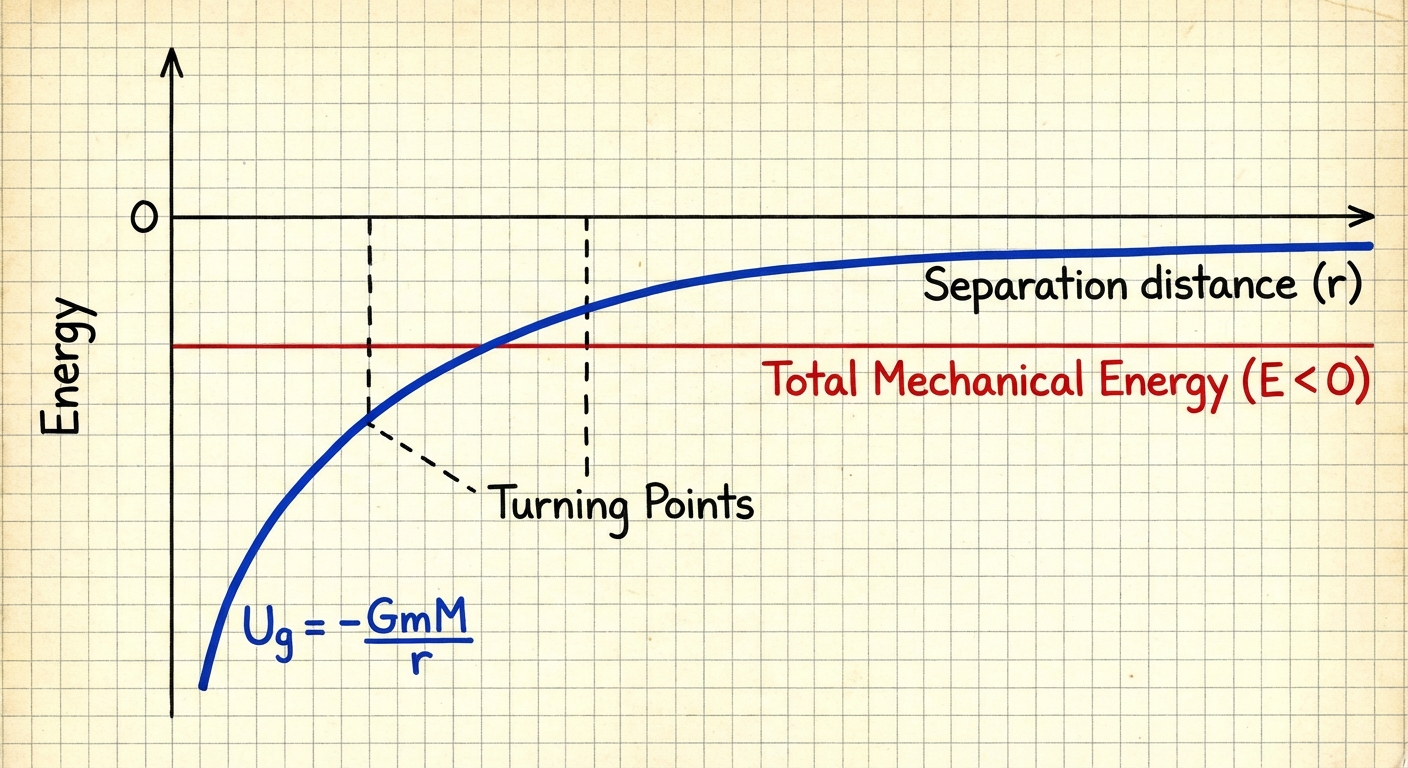
Gravitational Potential Energy ($U_g$) is the work done by an external agent to bring a system of masses from infinite separation to a distance $r$. Because gravity is an attractive force, we define potential energy as zero at infinity.
- Why Negative? You must do positive work to separate the masses (move them to $\infty$). Therefore, bound systems have negative potential energy.
- Scalar Quantity: Unlike force, energy is a scalar. When calculating total $U_g$ for a system of 3+ particles, simply sum the scalar energies of each pair.
Relationship between Force and Potential Energy
Force is the negative gradient of potential energy:
(The negative sign in the force indicates attraction, pointing towards decreasing $r$).
7.4 Kepler’s Laws of Planetary Motion
Before Newton, Johannes Kepler derived three empirical laws based on data from Tycho Brahe. These describe how planets move, while Newton explained why.
1. The Law of Ellipses
Every planet moves in an elliptical orbit, with the Sun at one of the two foci.
- Eccentricity ($e$): Describes how stretched the ellipse is. $e = c/a$, where $c$ is the distance from center to focus, and $a$ is the semi-major axis.
- $e=0$: Circle (Special case of an ellipse).
- $0 < e < 1$: Ellipse.
- Points of Interest:
- Perihelion: Closest point to the Sun (fastest speed).
- Aphelion: Farthest point from the Sun (slowest speed).
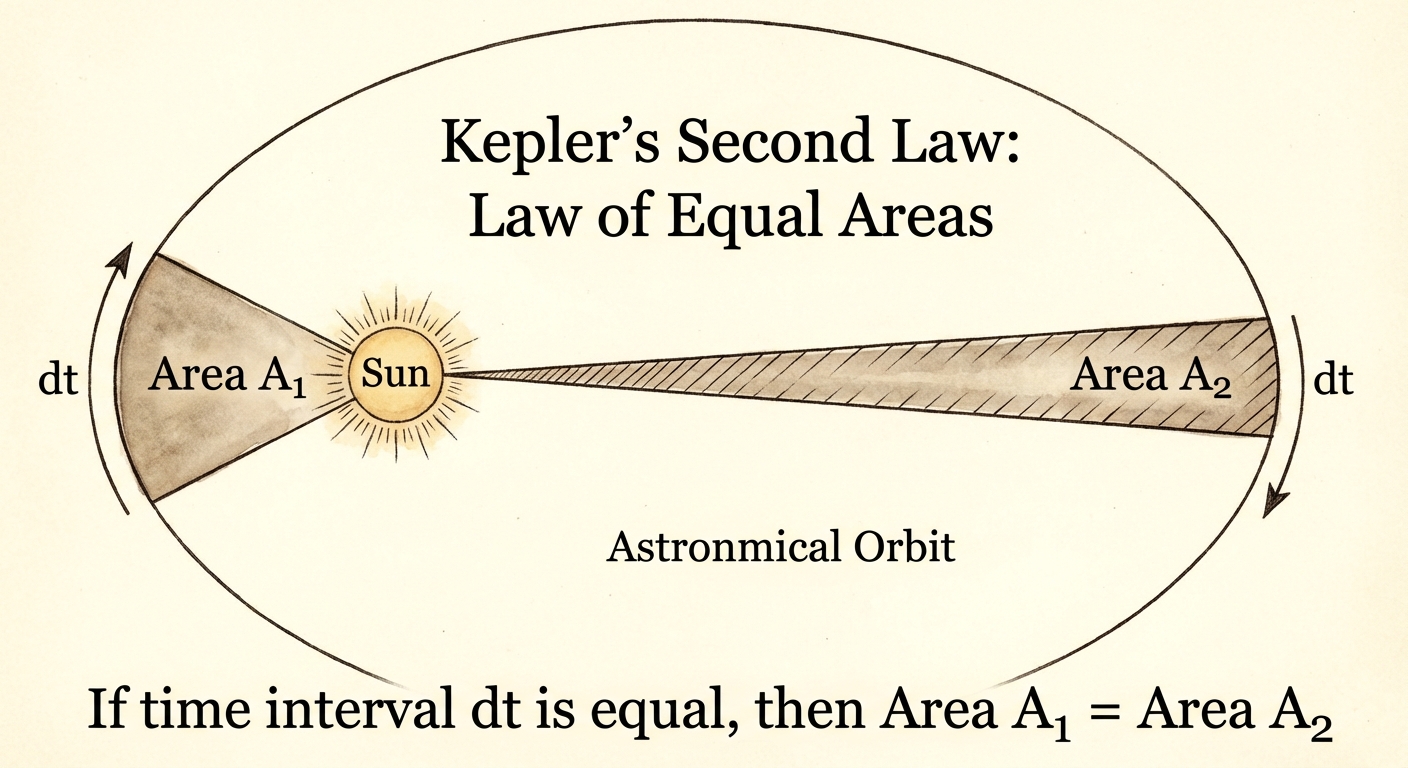
2. The Law of Areas
A line drawn from the Sun to a planet sweeps out equal areas in equal time intervals.
- Mathematically: $\frac{dA}{dt} = \text{constant}$.
- Physics Implication: This is a direct consequence of the Conservation of Angular Momentum.
- Gravity acts parallel to the radius vector ($r$), so it produces zero torque ($\tau = r \times F = 0$).
- Since $\tau{net} = 0$, angular momentum ($L$) is conserved.
(Where $p$ is perihelion and $a$ is aphelion).
3. The Law of Harmonics
The square of the orbital period ($T$) is directly proportional to the cube of the semi-major axis ($a$, or $r$ for circular orbits).
Derivation (Required for AP Exams):
For a circular orbit, Gravitational Force provides the Centripetal Force.
Substitute velocity $v = \frac{2\pi r}{T}$:
Note: The ratio $\frac{T^2}{r^3}$ depends only on the mass of the central body ($M$).
7.5 Satellite Motion and Energy
Orbital Velocity
To maintain a stable circular orbit, a satellite must have a specific tangential velocity derived from Newton's Second Law (as shown above):
- Notice $v$ is independent of the satellite's mass ($m$).
- As radius $r$ increases, orbital velocity decreases.
Total Mechanical Energy in Orbit
A satellite in orbit has both Kinetic Energy ($K$) and Potential Energy ($U_g$).
- Potential Energy: $U_g = -\frac{GMm}{r}$
- Kinetic Energy: $K = \frac{1}{2}mv^2$. Substituting $v^2 = GM/r$, we get $K = \frac{GMm}{2r}$.
- Total Mechanical Energy ($E$):
Energy Relations Summary:
| Energy Type | Formula | Relationship |
|---|---|---|
| Potential ($U_g$) | $-GMm/r$ | Negative |
| Kinetic ($K$) | $+GMm/2r$ | Positive; Half the magnitude of $U_g$ |
| Total ($E$) | $-GMm/2r$ | Negative; Equal to $-K$ |
Escape Velocity
Escape velocity is the minimum speed required for an object to break free from a planet's gravitational field (reach infinity with zero geometric speed). At infinity, $E_{total} = 0$.
Using Conservation of Energy:
- Note: $v{esc} = v{orb} \times \sqrt{2}$. It takes $\sqrt{2}$ times more speed to escape than to orbit.
7.6 Common Mistakes and Mnemonics
Common Mistakes and Pitfalls
- Confusing $r$ and $h$:
- The Trap: Problems often give the altitude ($h$) above the surface. Equations, however, require the distance from the center ($r$).
- The Fix: Always calculate $r = R_{planet} + h$.
- The Negative Sign in Potential Energy:
- The Trap: Students confuse vector direction (force) with scalar magnitude (energy). Also, thinking potential energy increases as you get closer.
- The Fix: $U_g$ becomes more negative (decreases) as you get closer. It becomes less negative (increases toward zero) as you move away.
- Applying $mgh$ in Space:
- The Trap: Using $U=mgh$ for satellites.
- The Fix: $mgh$ assumes $g$ is constant (flat earth approximation). Never use it for large distances. Use $-GMm/r$.
- Inverse Square vs. Isotope:
- Force and Field follow $1/r^2$. Potential Energy and Potential follow $1/r$. Don't mix up the exponents.
Mnemonics
- Total Energy is Negative: Think of the satellite as being stuck in a "hole" or "well" (Earth's gravity field). It has negative energy because it owes energy to the universe to get out.
- Kepler's 3rd Law: "The Square is Cubed". The Period (time) is Squared, the Radius (distance) is Cubed. ($T^2 \propto r^3$).
Center of Mass Note (The Barycenter)
While we usually assume the sun is stationary, strictly speaking, both the planet and the sun orbit their common center of mass, called the barycenter. For the Earth-Sun system, this point is deep inside the Sun, so the stationary approximation works well. For binary star systems of equal mass, the barycenter is halfway between them.