Unit 2: Differentiation: Definition and Fundamental Properties
The derivative as a limit: from average change to instantaneous change
Average rate of change (the idea you already know)
When a function describes how one quantity depends on another, you often want to measure how fast the output is changing as the input changes. Over an interval, that “how fast” is the average rate of change, which is the slope of the secant line through two points.
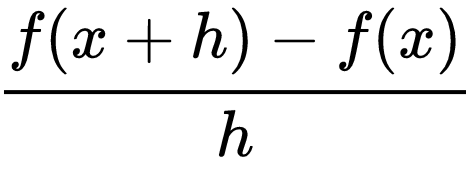
If the function is and you look from input to input , the average rate of change is
In coordinate language, this is the familiar
This is a slope (“rise over run”) and is the rate of change over an interval of time (or an interval of any input). In context, it might mean average velocity (change in position over change in time), average cost per item, average temperature increase per hour, and so on.
Instantaneous rate of change and the tangent line
Many real questions are about a precise moment: your speed right now, or the exact steepness of a curve at a particular point. That is the instantaneous rate of change, which is what the average rate of change becomes when the interval shrinks to a single point.
For a straight (linear) line, slope is always “rise over run.” For a curved graph, you can’t pick two points on the curve and call that “the slope at a point” because different pairs give different secant slopes. Instead:
- A secant line intersects the graph at two points and approximates slope.
- A tangent line touches the curve at exactly one point and has the same direction the curve is heading at that point.
You approximate the slope at a point by using secant lines with points closer and closer together (the closer the points are, the more accurate the approximation). The “perfect” limiting secant is the tangent line.
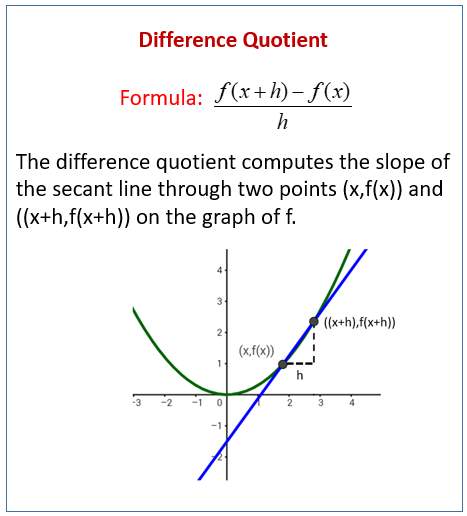
To turn “shrink the interval” into mathematics, start with the secant slope between and :
Simplify the denominator:
Now let to force the second point to approach the first.
Definition of the derivative at a point
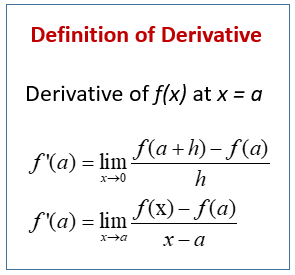
The derivative of at is defined by the limit (when it exists):
This is called the definition of the derivative. Conceptually, the derivative is the rate of change at a specific point, so we use a limit to find the slope as the change in input becomes infinitesimally small.
What it is:
- A single number (for a fixed ) representing the slope of the tangent line to at .
- The instantaneous rate of change of with respect to at .
How it works conceptually:
- Compute slopes of secant lines for smaller and smaller .
- If those slopes approach a single value, that value is the derivative.
Equivalent limit definition (approaching with )
You may also see
This is the same idea written with the second point’s -value approaching .
Worked example: derivative from the definition
Find the derivative of
at a general point using the limit definition.
Start with
Compute:
Substitute:
Expand and simplify the numerator:
So
Factor out :
Cancel (this is exactly why you must simplify before substituting ):
Now substitute :
So the derivative function is
Common misconception to avoid: plugging in too early gives , which is undefined.
Tangent line equation using the derivative
Once you know the slope at , you can write the tangent line at that point. The point on the curve is and the slope is .
Point-slope form:
Exam Focus
- Typical question patterns:
- “Use the limit definition to find for a given function.”
- “Find the slope of the tangent line to at .”
- “Write the equation of the tangent line at a given point.”
- Common mistakes:
- Substituting before simplifying and getting stuck at .
- Mixing up secant slope (average rate) with tangent slope (instantaneous rate).
- Using the wrong point in point-slope form (for a tangent at , the point must use ).
Derivative notation, meaning, and units
Notation you must be fluent with
AP Calculus uses multiple equivalent notations for derivatives. They mean the same derivative but emphasize different interpretations.
| Meaning | Common notation | Notes |
|---|---|---|
| Derivative of at input | Read “f prime of x.” | |
| Derivative of with respect to | Emphasizes rate of change. | |
| Derivative of with respect to | Same idea, different symbol. | |
| Value at a point | or | A number (slope at that point). |
A key distinction:
- is a number.
- is a new function that gives the slope at every input where it exists.
First and second derivative shorthand (common in notes)
You will also see derivative notation presented like this:
| Function | First Derivative | Second Derivative |
|---|---|---|
| or |
In typed or handwritten notes, the second derivative is sometimes written with “double-prime” marks (for example, it may look like f”); the standard calculus notation to interpret that is .
The derivative as a function (not just a slope)
When the limit exists for each in an interval, you can define the derivative function:
It outputs the slope of at each input. This matters because many problems ask about how fast a function changes across a whole region.
Units of the derivative
Tracking units is a strong way to check interpretation. If has units “output units” and has units “input units,” then has units
Example: if is position in meters and is time in seconds, then is meters per second.
Differentiation at a point vs. over an interval
These are related but not the same:
- Average rate of change on :
- Instantaneous rate of change at :
- The derivative function:
Worked example: interpreting derivative language
Suppose:
- is the cost in dollars to produce items.
Then:
- is marginal cost, measured in dollars per item.
- is the approximate cost to produce the 101st item (more precisely: the rate at which cost is changing at ).
Exam Focus
- Typical question patterns:
- “Interpret the meaning of in context, including units.”
- “Given a statement about a rate of change, identify what derivative it represents.”
- “Distinguish between and .”
- Common mistakes:
- Treating like a point or like a function output without specifying the input.
- Ignoring units, leading to misinterpretations (especially in motion and economics contexts).
- Confusing average rate of change with instantaneous rate of change.
Estimating derivatives from graphs, tables, and verbal descriptions
Estimating slope from a graph
Often you are not given a formula for . If you are given a graph and asked to estimate , you are estimating the slope of the tangent line.
A reliable process:
- Draw the tangent line as carefully as you can at .
- Choose two convenient points on your tangent line (not necessarily on the curve) to compute slope.
- Compute slope as rise over run.
A common pitfall is using two points on the curve near . That gives a secant slope, which may be close, but can be inaccurate if the curve bends strongly.
Estimating from a table (difference quotients)
If you have a table of values, you approximate the derivative at using nearby points.
Forward difference:
Backward difference:
Symmetric (central) difference (often best when data are smooth):
Why symmetric is often better: it balances error from looking only to one side. AP problems sometimes provide data on both sides specifically to encourage a central estimate.
One-sided derivatives and corners
Even if a function is continuous, the derivative at a point might fail to exist. A key diagnostic is whether left-hand and right-hand slopes match.
One-sided derivatives:
Then exists only if both one-sided derivatives exist and are equal.
Graphically:
- A corner or cusp occurs when the left-hand slope and right-hand slope are different (or infinite in different ways).
- A vertical tangent corresponds to an “infinite” slope; in many AP contexts you treat this as not differentiable at that point.
Example: estimating from a table
Suppose you have values near :
| 1.9 | 2.0 | 2.1 | |
|---|---|---|---|
| 5.72 | 6.00 | 6.31 |
Estimate using a symmetric difference with :
Interpretation: near , the function is increasing at about 2.95 output units per input unit.
Exam Focus
- Typical question patterns:
- “Estimate from a graph (slope of the tangent).”
- “Estimate from a table using a difference quotient.”
- “Decide whether exists based on graph features (corner, cusp, discontinuity).”
- Common mistakes:
- Using points on the curve instead of points on the tangent line when estimating graph slopes.
- Forgetting the denominator in a symmetric difference is , not .
- Assuming continuity automatically implies differentiability.
Differentiability, continuity, and when derivatives fail to exist
What it means to be differentiable
A function is differentiable at if the derivative limit exists there:
If that limit exists and is finite, the graph has a well-defined tangent slope at .
Differentiability implies continuity
A crucial theorem in AP Calculus:
- If is differentiable at , then is continuous at .
In symbols, if exists, then
Important warning: the converse is false.
- Continuous does not necessarily mean differentiable.
Common reasons a function is not differentiable
If you see any of these at , the derivative typically does not exist.
- Discontinuity (jumps, holes, infinite discontinuities)
- Corner (left and right slopes differ)
- Cusp (slopes become infinite in opposite directions)
- Vertical tangent (slope is not finite)
Example: a classic corner
Consider
At , the function is continuous, but the slope from the left is and the slope from the right is , so the derivative does not exist at .
Differentiability on an interval
You may be asked about differentiability on an interval like or .
Two common subtleties:
- Endpoints: differentiability at an endpoint of a closed interval is usually discussed via one-sided derivatives.
- Piecewise functions: you must check differentiability at the “break points,” even if each piece is differentiable on its own interior.
Exam Focus
- Typical question patterns:
- “Is differentiable at ? Justify using a graph or one-sided derivatives.”
- “Explain why differentiability implies continuity (or use the implication to conclude continuity).”
- “Identify points where does not exist from a graph.”
- Common mistakes:
- Stating “continuous so differentiable” (not true).
- Missing non-differentiable points in piecewise graphs at corners or cusps.
- Treating a vertical tangent as having derivative (it does not; it is not a finite slope).
Fundamental derivative rules (built from the limit definition)
Using the limit definition every time is tedious, so calculus develops rules that make taking derivatives fast while still being grounded in the definition.
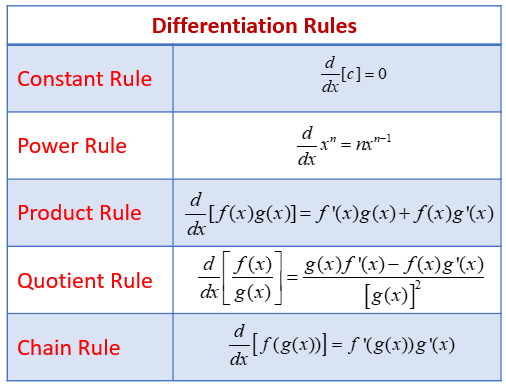
Constant rule
If
where is a constant, then
Example: if , then .
Power rule (for positive integer powers)
For
where is a positive integer, the derivative is
A helpful description: multiply down and decrease the power.
Examples:
- becomes
- becomes
The power rule works for polynomials.
Constant multiple rule
If
then
Meaning: you can “pull the constant out,” scaling the slope by the same constant.
Sum and difference rules
If
then
If
then
Worked example: differentiating a polynomial
Differentiate
Differentiate term-by-term:
So
Common mistake to avoid: subtracting 1 from the coefficient instead of the exponent, or rewriting as and then forgetting so the derivative is just .
Worked example: tangent line using basic rules
Find the tangent line to
at .
Derivative:
Slope at :
Point on the curve:
Point-slope form:
Simplify:
Exam Focus
- Typical question patterns:
- “Find for a polynomial or a simple combination using rules.”
- “Find the slope of the tangent line at and write the tangent line equation.”
- “Given that represents a rate, compute it from a formula and interpret.”
- Common mistakes:
- Forgetting the constant multiple rule (for example, differentiating as ).
- Dropping signs when applying the sum/difference rule.
- Confusing (a number) with (a function value).
Product and quotient rules
Some functions are built by multiplying or dividing simpler functions. You can sometimes expand and simplify first (for instance, multiplying two polynomials and then using the power rule), but that can take time and increase algebra errors. The product and quotient rules give a direct path.
Product rule
If
then
A common memory cue is “1d2 + 2d1” (first times derivative of second, plus second times derivative of first).
Example situation: for something like
you could multiply it out and then use the power rule, but the product rule avoids that extra expansion.
Quotient rule
If
then
A common memory cue is “low d high - high d low / low^2” (denominator times derivative of numerator, minus numerator times derivative of denominator, all over the denominator squared).
Exam Focus
- Typical question patterns:
- “Differentiate a product of two functions (especially polynomials or trig/exponential pieces).”
- “Differentiate a quotient and simplify; evaluate at a point.”
- “Use a memory cue correctly to avoid sign/order errors.”
- Common mistakes:
- Forgetting that the product rule is not “multiply the derivatives.”
- Dropping parentheses in the quotient rule, leading to sign mistakes.
- Squaring only part of the denominator instead of all of .
Derivatives of trigonometric functions
These are often treated as “memory derivatives” because they are easier to memorize than to derive on the spot.
Trigonometric functions are central in calculus because they model periodic motion (waves, rotations, oscillations). Their derivatives are also periodic.
Core trig derivatives
You should know these as fundamental facts:
From these, additional standard trig derivatives include:
Radian measure (important subtlety)
These derivative formulas assume the input is measured in radians. On the AP exam, trig inputs are understood to be radians unless stated otherwise.
Example: slope of a trig function at a point
Let
Differentiate term-by-term:
Then the slope at is
Example: interpreting a trig derivative in context
Suppose a Ferris wheel height above ground is modeled as
where is in meters and is in seconds.
Instantaneous vertical velocity:
At ,
Interpretation: at that moment, height is increasing at 10 meters per second.
Common mistake to avoid: differentiating as without the negative sign.
Exam Focus
- Typical question patterns:
- “Differentiate an expression involving and using basic rules.”
- “Compute for a trig function and interpret the result.”
- “Use a derivative to find a tangent line slope on a trig graph.”
- Common mistakes:
- Missing the negative sign in .
- Mixing up which trig derivative goes with which function (especially and ).
- Forgetting that these standard derivatives assume radian input.
Derivatives of exponential and logarithmic functions
These are also commonly treated as “memory derivatives.”

Exponential and logarithmic functions model growth and decay and “undoing growth.” Their derivatives are powerful because they preserve recognizable forms.
Natural exponential function
For
the derivative is
Meaning: the rate of change of at any point equals its current value.
Example:
Then
Natural logarithm
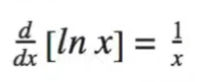
For the natural logarithm,
This is defined for .
Example:
Then
Common mistake to avoid: the derivative of is not found by changing the inside (it is exactly ).
Exponential functions with other bases
For and ,
Example:
Then
Logarithms with other bases
Use change of base:
Then
Exam Focus
- Typical question patterns:
- “Differentiate expressions involving and using basic rules.”
- “Interpret for an exponential model (growth/decay) in context.”
- “Differentiate or (often with bases like 2 or 10).”
- Common mistakes:
- Treating as (confusing with the power rule).
- Forgetting domain restrictions: requires .
- Forgetting the factor in .
Connecting derivatives to motion and other real-world rates
A major theme in AP Calculus is that derivatives are not just abstract slopes; they measure real rates.
Position, velocity, and acceleration
If is position as a function of time, then:
- Velocity is the derivative of position:
- Acceleration is the derivative of velocity (second derivative of position):
Units:
- If is meters and is seconds, then is meters per second and is meters per second squared.
Example: computing velocity from position
Let
Then
And
Interpretation:
So at seconds, velocity is (position units per time unit), meaning the object is moving in the negative direction.
Common mistake to avoid: confusing negative velocity with “slowing down.” Negative velocity is direction; speeding up/slowing down depends on velocity and acceleration together.
Marginal analysis (economics)
If is total cost to produce units, then is marginal cost.
If is revenue, then is marginal revenue.
If is profit, then
and
Local linearity (the “zoomed-in line” idea)
If is differentiable at , then near the graph looks almost like a line. That tangent line gives a local approximation:
Exam Focus
- Typical question patterns:
- “Given , find and interpret .”
- “Given a contextual function, state what means in words and units.”
- “Use the tangent line idea to approximate behavior near a point (often informally).”
- Common mistakes:
- Mixing up position with velocity .
- Ignoring units when interpreting derivatives in context.
- Treating a derivative value as an average rate rather than an instantaneous rate.
Higher-order derivatives and basic notation (first look)
What a second derivative represents
If tells you the rate of change of , then the second derivative tells you the rate of change of the rate of change.
Notation:
and if :
In motion contexts: position, then velocity, then acceleration.
Computing a second derivative
You find a second derivative by differentiating again.
Example:
First derivative:
Second derivative:
Exam Focus
- Typical question patterns:
- “Find and for a polynomial.”
- “Interpret in a motion context if position is given.”
- “Use notation correctly (distinguish , , and functions).”
- Common mistakes:
- Forgetting that is the derivative of , not .
- Confusing the meaning of a negative second derivative (it does not automatically mean the function is decreasing).
- Dropping constants or making sign errors on the second differentiation.