Unit 8: Solid and Hazardous Waste Management
Unit 8: Solid and Hazardous Waste Management
Types of Solid Waste Disposal
Municipal Solid Waste (MSW) refers to the refuse collected by municipalities from households, small businesses, and institutions. It is commonly known as "trash" or "garbage." In the US, the composition is primarily paper, food scraps, and yard trimmings.
Sanitary Landfills
The primary method of disposal in developed nations is the Sanitary Landfill. Unlike open dumps of the past, these are engineered systems designed to isolate waste from the environment.
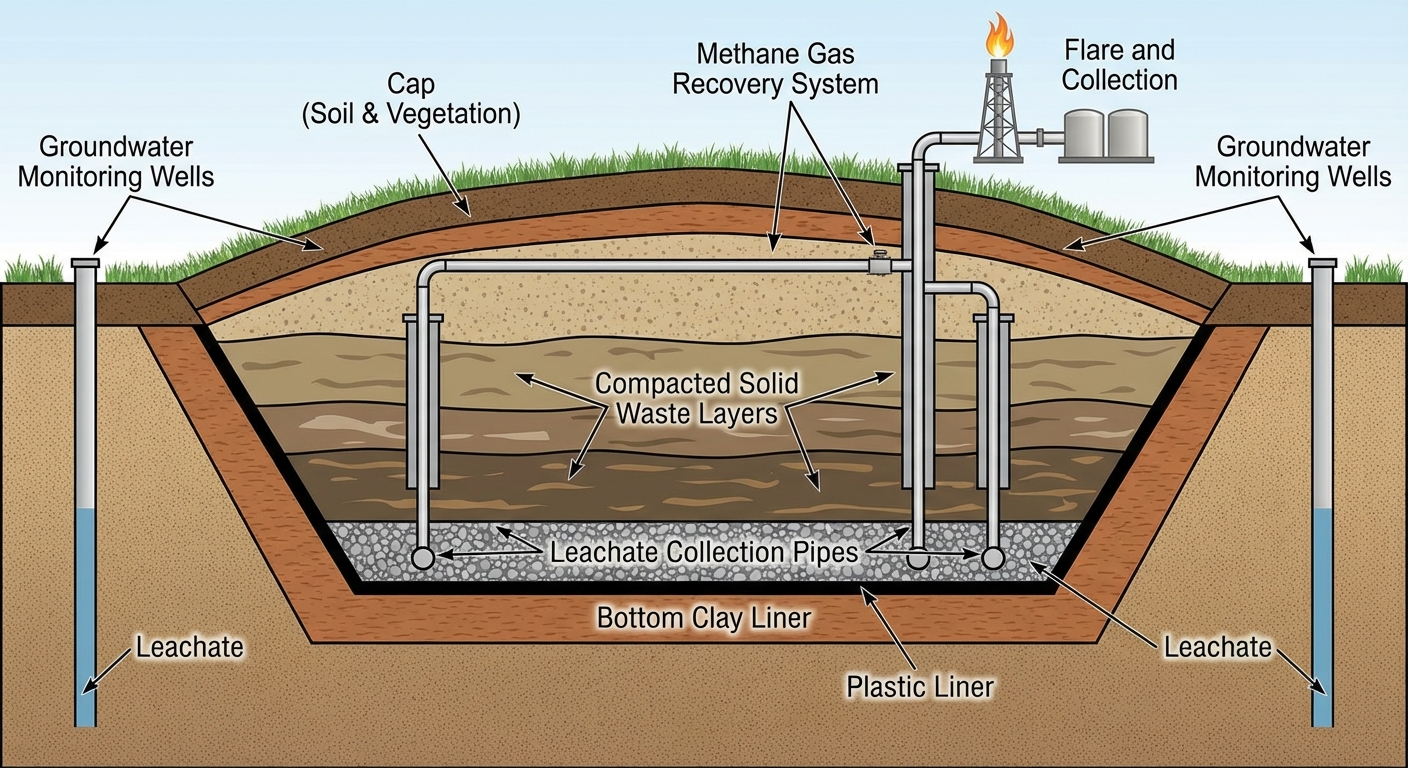
Key Components of a Sanitary Landfill:
- Clay or Plastic Liner: A bottom layer made of impermeable clay or plastic prevents liquid waste from leaking into groundwater.
- Leachate Collection System: Leachate is the liquid that passes through the compacted solid waste. It contains toxic chemicals and heavy metals. Pipes at the bottom collect this fluid to be treated.
- Methane Collection System: Because waste is compacted and buried, it undergoes anaerobic decomposition (without oxygen). This produces Methane ($CH_4$), a potent greenhouse gas. Pipes collect this gas to be flared (burned off) or burned to generate electricity.
- Cap / Soil Cover: At the end of every day, waste is covered with soil to reduce pests (rats, birds) and smell. When full, the landfill is capped with clay/soil/vegetation.
Pros and Cons
| Pros | Cons |
|---|---|
| Can handle large volumes of waste | Produces $CH4$ (greenhouse gas) and $CO2$ |
| Filled ground can be repurposed (parks, golf courses) | Potential for leachate to contaminate groundwater |
| Low operating costs after construction | NIMBY (Not In My Backyard) attitude makes siting difficult |
Incineration (Waste-to-Energy)
Incineration involves burning waste at high temperatures. Many modern facilities are Waste-to-Energy plants, where the heat generated boils water to create steam, which turns a turbine to generate electricity.
- Volume Reduction: Reduces waste volume by up to 90%.
- Pollutants: Releases air pollutants such as Particulate Matter (PM), Dioxins, and Nitrogen Oxides ($NO_x$). Scrubbers and electrostatic precipitators are required to filter emissions.
- Ash: Produces bottom ash (toxic) which must be disposed of in hazardous waste landfills.
Ocean Dumping & Other Methods
- Ocean Dumping: Specifically prohibited by the Ocean Dumping Act (US) and international treaties (MARPOL). It creates large floating garbage patches (e.g., Great Pacific Garbage Patch) and leads to wildlife ingestion/entanglement.
- Tires: Discarded tires are problematic. If stockpiled, they hold stagnant water (breeding ground for mosquitoes/disease vectors) and are highly flammable.
Waste Reduction Methods
The most sustainable approach to waste is avoiding its creation. This is visualized through the waste management hierarchy.
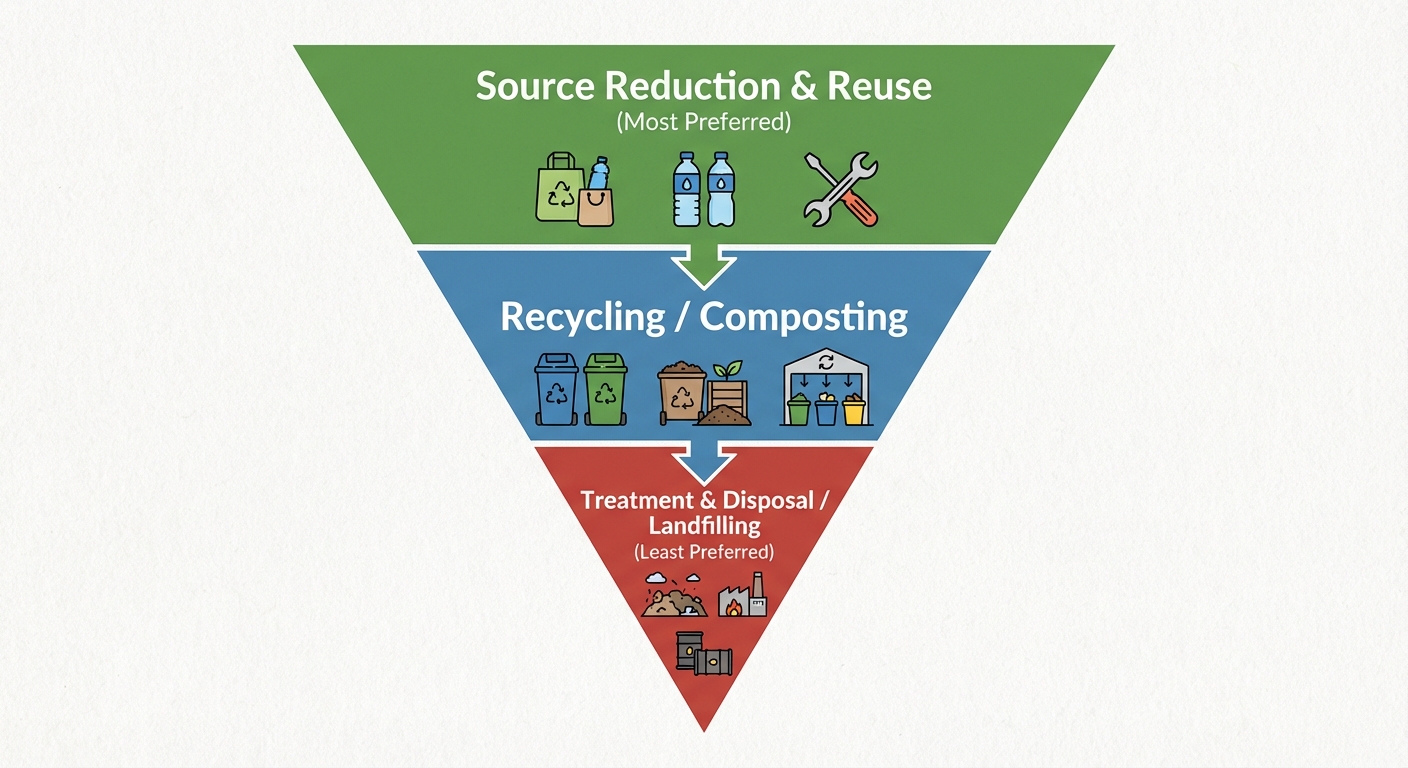
The Three Rs (In Order of Priority)
- Reduce (Source Reduction): The optimal strategy. Minimizing the amount of material used (e.g., double-sided printing, lightweight packaging). It saves the most energy and resources.
- Reuse: Using a product again for the same function without processing (e.g., refillable glass milk bottles, thrift stores).
- Recycle: Processing materials into new products. This is the least efficient of the three because it requires energy and capital for collection and processing.
- Closed-loop recycling: Turning a product into the same product (aluminum can $\rightarrow$ aluminum can).
- Open-loop recycling: Turning a product into a different product (plastic bottle $\rightarrow$ fleece jacket).
Composting
Composting is the controlled biological decomposition of organic matter (food scraps, yard trimmings, paper) under aerobic conditions.
- Benefits: Reduces landfill volume, produces nutrient-rich organic fertilizer, reduces methane production (since aerobic decomposition produces $CO2$, which is less potent than $CH4$).
- Drawbacks: distinct odor, attracts vermin if not managed correctly.
Hazardous Waste and E-Waste
Hazardous Waste is material harmful to human health or the environment (ignitable, corrosive, reactive, or toxic).
E-Waste (Electronic Waste) includes discarded TVs, computers, and phones.
- Issue: Contains persistent heavy metals like Lead ($Pb$), Mercury ($Hg$), and Cadmium ($Cd$).
- Disposal: Often illegally exported to developing nations for primitive recycling, exposing workers to toxic fumes.
Relevant Laws (US)
There are two critical laws you must distinguish:
- RCRA (Resource Conservation and Recovery Act): The "Proactive" law. It governs the disposal of solid and hazardous waste. Key concept: "Cradle-to-Grave" tracking. The generator of the waste is responsible for it from creation until final disposal.
- CERCLA (Comprehensive Environmental Response, Compensation, and Liability Act): The "Reactive" law. Also known as the Superfund Act. It funds the cleanup of abandoned hazardous waste sites (e.g., Love Canal) and allows the EPA to sue responsible parties for cleanup costs.
Sewage Treatment
Wastewater treatment aims to remove contaminants from sewage (toilet waste, shower water, etc.) before releasing it into waterways.
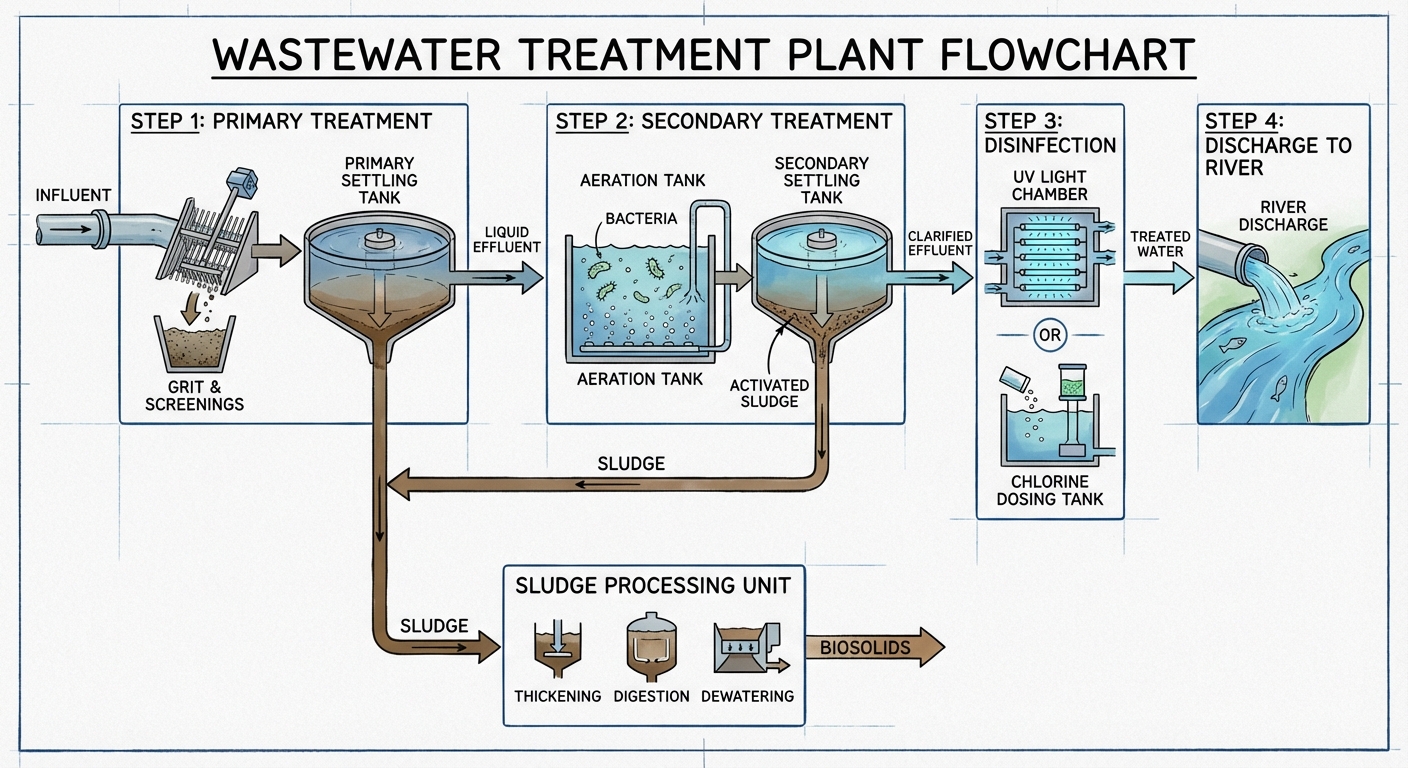
1. Primary Treatment (Physical)
- Objective: Removal of large solids.
- Mechanism: Screens/Grates remove sticks, rags, and plastics. Settling Tanks (Grit Chambers) allow heavy grit and sand to sink.
- Result: Solid waste settles out as Sludge. The liquid acts as the influent for the next stage.
2. Secondary Treatment (Biological)
- Objective: Breakdown of biological organic matter (feces, food) to reduce BOD (Biological Oxygen Demand).
- Mechanism: Aeration Tanks pump oxygen into the water to encourage aerobic bacteria to digest organic dissolved solids. The water then goes to a secondary clarifier where bacteria settle out.
- Result: Significant reduction in pathogens and organic waste.
3. Tertiary Treatment (Chemical/Advanced)
- Objective: Removal of inorganic nutrients (Nitrogen and Phosphorus) to prevent eutrophication in receiving waters.
- Mechanism: Specialized filters or chemical processes.
- Disinfection: Before release, water is treated with Chlorine, Ozone, or UV Light to kill remaining bacteria/viruses.
Sludge and Septic Systems
- Sewage Sludge: The solid material remaining after treatment. It can be dried and landfilled, incinerated, or treated to become soil amendments (fertilizer), provided it is free of heavy metals.
- Septic Systems: Used in rural areas unconnected to municipal lines. Wastewater flows into a septic tank (solids settle), and liquid moves to a leach field where soil microbes decompose the waste.
Common Mistakes & Pitfalls
- Confusing RCRA and CERCLA:
- Mnemonic: RCRA is Rcurring (current waste tracking). CERCLA is Cleanup (past mistakes/superfund).
- "Recycling is the best": Students often assume recycling is the best solution. Reduction is always environmentally superior because it prevents resource extraction entirely.
- Primary vs. Secondary Treatment:
- Remember: Primary = Physical (gravity/screens). Secondary = Biological (bacteria/bubbles). Tertiary is generally chemical.
- Leachate vs. Runoff:
- Leachate is the toxic liquid dripping through trash in a landfill. Runoff is water moving over the land surface.
- Aerobic vs. Anaerobic in Landfills:
- Deep within a landfill, there is no air. Therefore, decomposition is anaerobic, producing Methane. If it were aerobic (like composting), it would produce $CO_2$.