Synthesizing and Evaluating Perspectives: The Conversation of Sources
Introduction to Big Idea 3
In AP Seminar, Big Idea 3, Evaluate Multiple Perspectives, is the pivot point where research shifts from simple information gathering to complex analysis. It is not enough to find sources; you must understand who is speaking, why they hold that view, and how their view relates to others.
Think of your research topic as a round-table debate. Your job is not to pick a side immediately, but to map out who sits at the table, what "lens" they are looking through, and how their arguments interact. This unit focuses on identifying the complexity of an issue by recognizing that solutions are rarely binary (Yes/No).
Essential Questions
According to the College Board curriculum, you must be able to answer these questions by the end of this unit:
- What patterns or trends can be identified among the arguments about this issue?
- What are the implications and/or consequences of accepting or rejecting a particular argument?
- How can I connect multiple perspectives? What other issues, questions, or topics do they relate to?
- From whose perspective is this information being presented, and how does that affect my evaluation?
1. Distinguishing Key Terms: Lens, Perspective, and Stakeholder
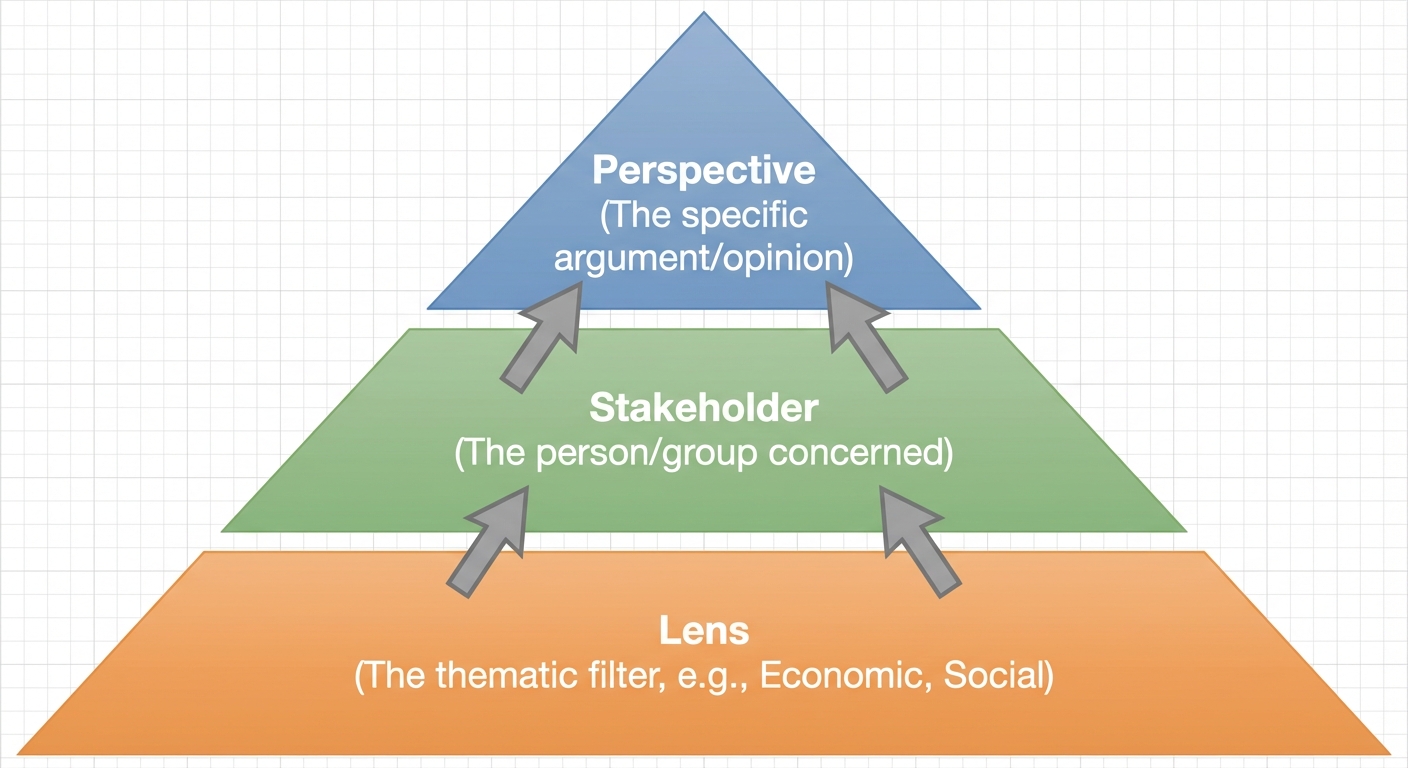
A major pitfall in AP Seminar is using these three terms interchangeably. They act as a hierarchy of analysis.
The Hierarchy
- The Lens (The Filter): A broad category or filter through which a topic is examined. Lenses narrow the scope of your research.
- Common AP Lenses: Environmental, Scientific, Economic, Political, Historical, Social, Cultural, Artistic/Philosophical, Futuristic, Ethical.
- The Stakeholder (The Person): The specific individuals, groups, or organizations affected by the issue or invested in the outcome.
- The Perspective (The Argument): The specific viewpoint or stance a stakeholder takes within a specific lens. A perspective usually involves a claim and its underlying assumptions.
Worked Example: Topic — Artificial Intelligence in Schools
| Level | Description |
|---|---|
| Lens | Ethical |
| Stakeholder | Academic Integrity Officers / Deans |
| Perspective | AI creates a moral hazard in education by eroding the value of original thought and making plagiarism undetectable, requiring strict bans. |
| Contrast | Educational Lens / Student Stakeholder / Perspective: AI tools are necessary equity aids that level the playing field for students with learning disabilities, requiring regulation rather than bans. |
Note: A single lens (e.g., Economic) can contain conflicting perspectives (e.g., A CEO arguing AI saves money vs. A Union Rep arguing AI kills jobs). Do not assume everyone within a "lens" agrees.
2. Analyzing the Argument (Critique and Evaluation)
Once you have identified a source's perspective, you must evaluate its validity (is the logic sound?) and credibility (is the source trustworthy?).
Assessing Credibility: The RAVEN Mnemonic
Use this mnemonic to evaluate if a source is reliable enough to include in your Performance Tasks (IRR/IWA):
- R - Reputation: Does the author/publication have a history of accuracy?
- A - Ability to Observe: Was the author present? Do they have access to the data?
- V - Vested Interest: Does the author gain financially or politically from this argument? (Note: Vested interest creates bias, but doesn't automatically disqualify a source—you just must acknowledge it).
- E - Expertise: Does the author have relevant credentials (PhD, lived experience, professional history)?
- N - Neutrality: Is the language objective, or loaded with emotion?
Evaluating the Line of Reasoning (LOR)
LO 3.1 requires you to assess the strength of an argument. When reading a source, map the LOR:
- Inductive Reasoning: Moves from specific observations to general generalizations (Prone to "Hasty Generalization" fallacies).
- Deductive Reasoning: Moves from general premises to specific conclusions (If $A=B$ and $B=C$, then $A=C$).
Ask yourself:
- Does the evidence directly support the specific claim?
- Are there logical gaps?
- Does the author acknowledge counter-arguments (concessions) and then refute them?
3. Synthesizing Perspectives: The Conversation
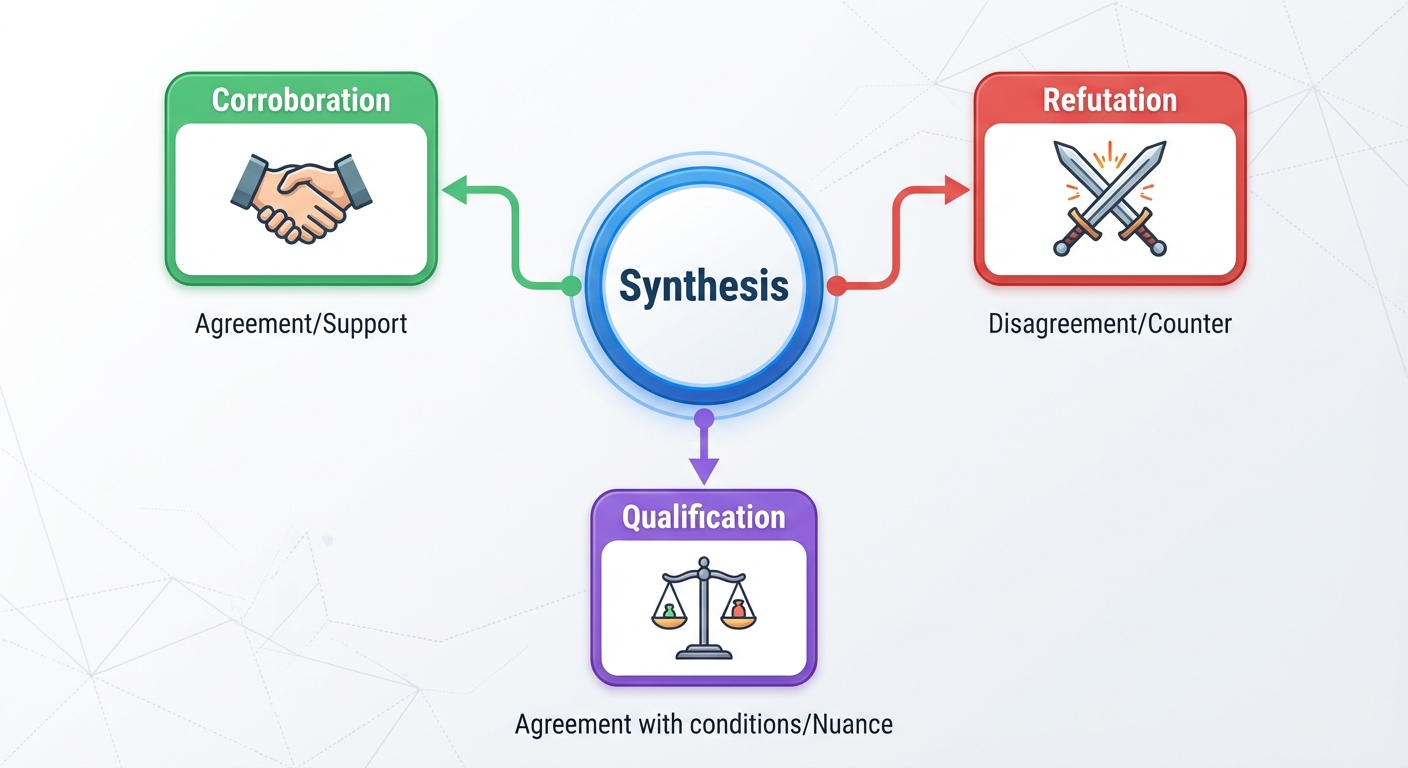
Synthesis (LO 3.2A) is the act of connecting sources. In your Individual Research Report (IRR) and Individual Written Argument (IWA), sources should not live in isolation. They must talk to each other.
The Three Moves of Synthesis
1. Corroboration (Agreement)
One source backs up another, perhaps from a different angle.
- Example: "While Dr. Smith argues for solar energy from an economic standpoint, citing cost savings, Environmentalist Jane Doe corroborates this by highlighting the ecological benefits of reduced emissions."
2. Refutation (Disagreement)
One source directly contradicts or challenges the evidence/claims of another.
- Example: "Smith claims the policy is beneficial for employment; however, recent data from the Department of Labor contradicts this, suggesting a 5% increase in unemployment."
3. Qualification (Nuance/Context)
One source suggests the other is true only under specific conditions.
- Example: "Jones argues that homework improves test scores. However, a 2023 Stanford study qualifies this finding, noting that benefits only appear in students above the 7th grade, rendering the argument less relevant for primary education."
4. Evaluate Implications and Limitations
Evaluating a perspective requires looking forward. If we accept an argument, what happens next? If we reject it, what is lost?
Implications (Consequences)
Implications are the potential outcomes if a perspective is prioritized.
- Formula:
- Example: If we accept the argument that user privacy is absolute, the implication is that law enforcement may lose tools necessary to stop cybercrime.
Limitations (Boundaries)
Limitations acknowledge where an argument fails to account for all variables.
- Scope Limitation: The argument only applies to urban areas, not rural ones.
- Methodological Limitation: The study relied on self-reported data, which may be biased.
5. Exam Application: EOC and Performance Tasks
How does Big Idea 3 explicitly show up in your AP Score?
Performance Task 1: The IRR
- The Goal: You evaluate a narrow scope of sources without taking a side.
- The Task: You must explicitly discuss the strengths and weaknesses of the sources you chose. "Although Source A is outdated (limitation), its author is the leading expert in the field (strength)."
Performance Task 2: The IWA
- The Goal: You build your own argument.
- The Task: You must position your argument in the context of others. You cannot just state your opinion; you must explain why your perspective is superior to the alternate perspectives you discovered.
End of Course Exam (Part A)
- The Task: You are given one text. You must identify the author's argument, line of reasoning, and valid evidence.
- The Skill: Identifying the perspective (e.g., "The author writes from a distinct American, libertarian perspective…").
Common Mistakes & Pitfalls
1. Confusing "Lens" with "Perspective"
- Mistake: "I am researching the Economic Perspective."
- Correction: There is no single "Economic perspective." Economists disagree constantly. You are researching "Economic arguments" or the "Economic Lens," within which you will find competing perspectives (e.g., Keynesian vs. Classical).
2. "Cherry-Picking" Agreement
- Mistake: Only selecting sources that agree with your initial hunch.
- Correction: You must actively seek out dissenting voices (Big Idea 3). If you cannot find a valid counter-argument, your topic is likely too simple (e.g., "Murder is bad" has no counter-perspective).
3. Surface-Level Evaluation
- Mistake: Stating "This source is credible because it is from a .gov website."
- Correction: Being a government site doesn't make an argument effectively reasoned. You must look at the content of the argument, not just the URL foundation. Does the conclusion follow the premises?
4. Ignoring Context
- Mistake: Treating a source from 1990 the same as a source from 2024.
- Correction: Perspectives change over time. Historical context acts as a lens itself. A perspective on "privacy" meant something very different before the internet.