Unit 2: Ancient Mediterranean Art and Architecture (3500 BCE–300 CE)
Foundations of Civilization: Ancient Near East and Egypt
This section covers the artistic production of the early complex societies in the Fertile Crescent (Mesopotamia) and the Nile Valley (Egypt). In AP Art History, the focus here is on how art was used to validate political power, communicate with the divine, and ensure the afterlife.
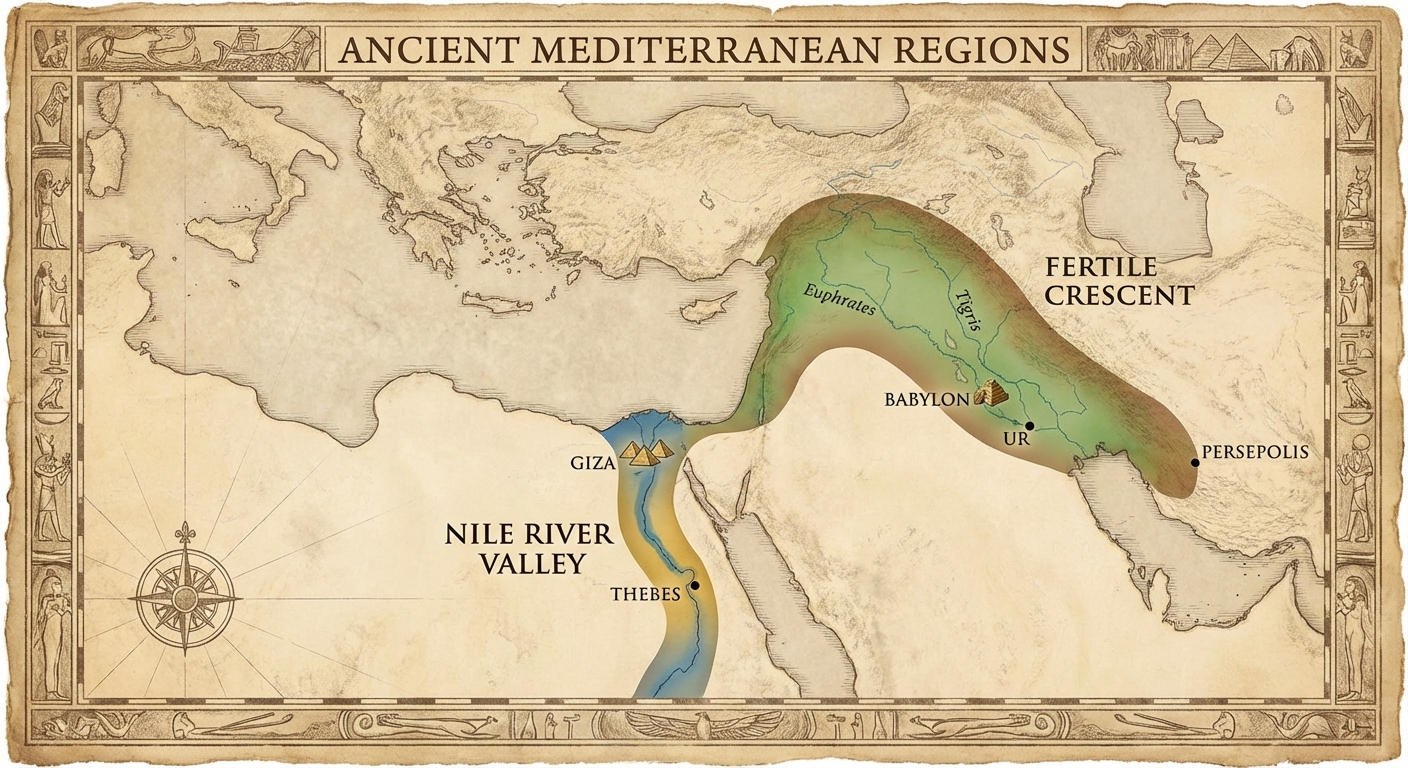
Sumerian Art & Architecture: The Threshold of History
Sumer, located in modern-day Iraq, is often cited as the birthplace of writing (cuneiform) and the city-state. Since stone was rare in Mesopotamia, their architecture relied heavily on mud brick, leading to significant erosion over millennia.
The Ziggurat and Religious Space
Unlike Egyptian pyramids (which were tombs), Ziggurats were massive, stepped platforms supporting a temple. They were conceptualized as "man-made mountains" to bridge the gap between earth and the heavens.
- Required Work: White Temple and its ziggurat (Uruk, c. 3500–3000 BCE).
- Cella: The central focus of the temple, a small room reserved for the divinity.
- Bent-Axis Approach: Visitors had to walk around the structure and turn corners to reach the entrance, turning the ascent into a physical journey.
- Theocratic Rule: The temple was the literal center of the city, reflecting that the god owned the city-state.
Votive Offerings and Narrative
Sumerian art introduced visual conventions that would last for thousands of years.
Required Work: Statues of votive figures (Tell Asmar, c. 2700 BCE).
- Function: These were not idols to be worshipped, but stand-ins for the donor. They were placed in the temple to offer constant prayer to the god Abu.
- Form: Wide, staring eyes symbolize eternal wakefulness and duty.
Required Work: Standard of Ur (c. 2600–2400 BCE).
- Registers: Horizontal bands used to organize a visual narrative.
- Hierarchy of Scale: The most important figure (the king) is drawn larger than everyone else. This is a crucial concept for the entire unit.
- Sides: One side depicts "War" (trampling enemies), the other "Peace" (banquet/tribute), showing the dual responsibilities of the ruler.

Mesopotamian Empires: Babylon, Assyria, and Persia
As city-states grew into empires, art shifted from strictly religious devotion to political propaganda and intimidation.
Babylon: Law and Order
- Required Work: The Code of Hammurabi (Babylon, c. 1792–1750 BCE).
- This is a Stele (an upright stone slab) inscribed with laws.
- Visuals: At the top, King Hammurabi receives the tools of sovereignty directly from the sun god, Shamash. This legitimizes the laws—breaking the law means defying god.
- Perspective: Shows an early attempt at foreshortening in the god's beard and throne.
Assyria: Power and Intimidation
The Assyrians were a warrior culture, and their palace art reflects dominance.
- Required Work: Lamassu from the Citadel of Sargon II (c. 720–705 BCE).
- Composite Creature: Winged bull with a human head.
- Function: Apotropaic (warding off evil/enemies) guardian figures at gates.
- Conceptual View: They have five legs. Seen from the front, they stand firm (2 legs); seen from the side, they stride forward (4 legs). This ensures the creature looks complete from both strict viewing angles.
Persia: Multicultural Tolerance
- Required Work: Audience Hall (apadana) of Darius and Xerxes at Persepolis.
- Context: The Persian Empire was vast. To maintain control, they adopted a policy of tolerance rather than brute force.
- Artistic Synthesis: The architecture combines Greek, Egyptian, and Mesopotamian styles (e.g., fluted columns, animal protomes).
- Reliefs: Instead of war, the walls depict representatives of 23 subject nations bringing tribute peacefully.
Ancient Egyptian Art: Permanence and the Afterlife
Egyptian art is defined by consistency. For 3,000 years, the style remained largely unchanged (with one major exception: The Amarna Period). The driving force was Ma’at (divine order/balance) and the assurance of the afterlife.
The Canon of Proportions and Early Dynastic Art
Egyptian artists utilized a strict grid system to draw the human body.
Twisted Perspective (Composite View): Shoulders and eyes are frontal; head, hips, and legs are in profile. This was not a lack of skill, but a desire to show the most identifiable parts of the body to ensure the spirit (ka) could recognize its image.
Required Work: Palette of King Narmer (c. 3000–2920 BCE).
- Commemorates the unification of Upper and Lower Egypt.
- Establishes the standard iconography of the pharaoh: smiting enemies, bull tail, and the two crowns of Egypt.
Old Kingdom: The Age of Pyramids
Required Work: Great Pyramids (Menkaure, Khafre, Khufu) and Great Sphinx.
- Shape: The ben-ben (pyramidal stone) symbol of the sun god Re.
- Material: Limestone and granite. Unlike the mud-brick Near East, Egypt had abundant stone, allowing for monumentality and permanence.
Required Work: King Menkaure and Queen.
- Greywacke: An incredibly hard, dark stone chosen for durability.
- Pose: Rigid, left foot forward (symbol of life/movement, but no weight shift), attached to the stone block. Idealized bodies (physically perfect) represented the divine nature of the Pharaoh.
New Kingdom: Temples and Tombs
Burials moved to the Valley of the Kings (hidden tombs), and massive Pylon Temples were built for the living to worship.
Required Work: Temple of Amun-Re and Hypostyle Hall.
- Axial Plan: A straight line of access from the entrance to the sanctuary.
- Clerestory Lighting: A raised section of roof that allowed light into the dark hall; an architectural innovation.
Required Work: Mortuary Temple of Hatshepsut.
- Designed to blend organically with the cliff face behind it.
- Asserts the power of one of the few female pharaohs.
The Amarna Period: A Stylistic Revolution
For a brief period, Pharaoh Akhenaten changed the religion from polytheism to monotheism (worship of the sun disk, Aten). The art style changed drastically.
- Required Work: Akhenaten, Nefertiti, and three daughters.
- Style Shift: Curvilinear forms, elongated skulls, heavy hips, and protruding bellies. The figures look androgynous.
- Intimacy: A rare depiction of the royal family in a casual, loving domestic setting.

Return to Tradition
After Akhenaten, the old gods returned.
Required Work: Tutankhamun’s Tomb (innermost coffin).
- Gold and semiprecious stones (lapis lazuli) indicate immense wealth and the divine skin of the gods (gold).
Required Work: Last judgment of Hu-Nefer (from his Book of the Dead).
- A continuous narrative scroll showing the judgment of the soul.
- Concept: Weighing of the Heart against the Feather of Ma'at. If the heart is lighter, the soul enters the afterlife.
Comparison: Near East vs. Egypt
| Feature | Ancient Near East | Ancient Egypt |
|---|---|---|
| Focus | Life on earth, appeasing volatile gods, glorifying kings | The Afterlife, maintaining Ma'at, permanence |
| Primary Material | Mud Brick (ephemeral) | Stone (permanent) |
| Architecture | Ziggurats (Platforms for temples) | Pyramids (Tombs) & Pylon Temples |
| Geography | Open to invasion (Tigris/Euphrates flood unpredictably) | Protected by deserts (Nile floods predictably) |
Common Mistakes & Pitfalls
- Ziggurats vs. Pyramids: Do not confuse them. Ziggurats are solid platforms with a temple on top for the living/priests. Pyramids are tombs (usually) with chambers inside for the dead.
- "Realistic" vs. "Naturalistic": Avoid saying Egyptian art isn't "good" because it isn't realistic. It is stylized and idealized on purpose. They knew to draw realistically (see The Seated Scribe), but for Pharaohs, they chose a divine, timeless formula.
- The Seated Scribe: Students often forget why he looks "flabby." He is not a king. His sagging chest and realistic face indicate a life free of manual labor (high status), but he is not divine, so he does not need the perfect body of a Pharaoh.
- Amarna Period: Remember this is the exception, not the rule. If you see an Egyptian figure with a pot belly and curvy lines, it is likely Akhenaten’s era.