Unit 9: Indigenous Arts of The Pacific
Oceanic Art: Concepts, Rituals, and Geography
Introduction to Pacific Cultures
The Pacific region forms one of the most geographically vast yet sparsely populated areas of human habitation. Unit 9 covers the art of Oceania, which encompasses Australia and the Pacific Islands. These cultures are geographically divided into three major regions: Micronesia (small islands), Melanesia (black islands), and Polynesia (many islands).
Despite the vast distances, these cultures share a common heritage in the Lapita people (ancient seafarers) and engage in complex exchange systems. Art here is rarely purely decorative; it is functional, active, and spiritual.
Key Concepts: Mana and Tapu
To understand Pacific art, you must grasp two foundational spiritual concepts found across most island cultures:
- Mana: A supernatural power, force, or spiritual essence. It resides in persons, animals, inanimate objects, and works of art. A chief has high mana; a beautifully carved weapon has mana.
- Tapu: The system of strict rules and prohibitions (taboos) that protect mana. For example, a commoner cannot touch a chief's shadow (tapu) because the chief’s mana is too potent and dangerous.
Gender Roles in Art Production
Production is traditionally divided by gender, though both forms hold high status:
- Men's Arts: Usually involve hard materials (wood, stone, bone, shell) and correspond with rituals of war, seafaring, and ancestor worship.
- Women's Arts: Usually involve soft materials (fibers, weaving, tapa cloth, mats). These are crucial for exchange rituals and establishing social bonds.

Micronesian Art: Navigation and Architecture
Micronesia consists of thousands of small atolls north of Melanesia. Life here revolves strictly around the ocean.
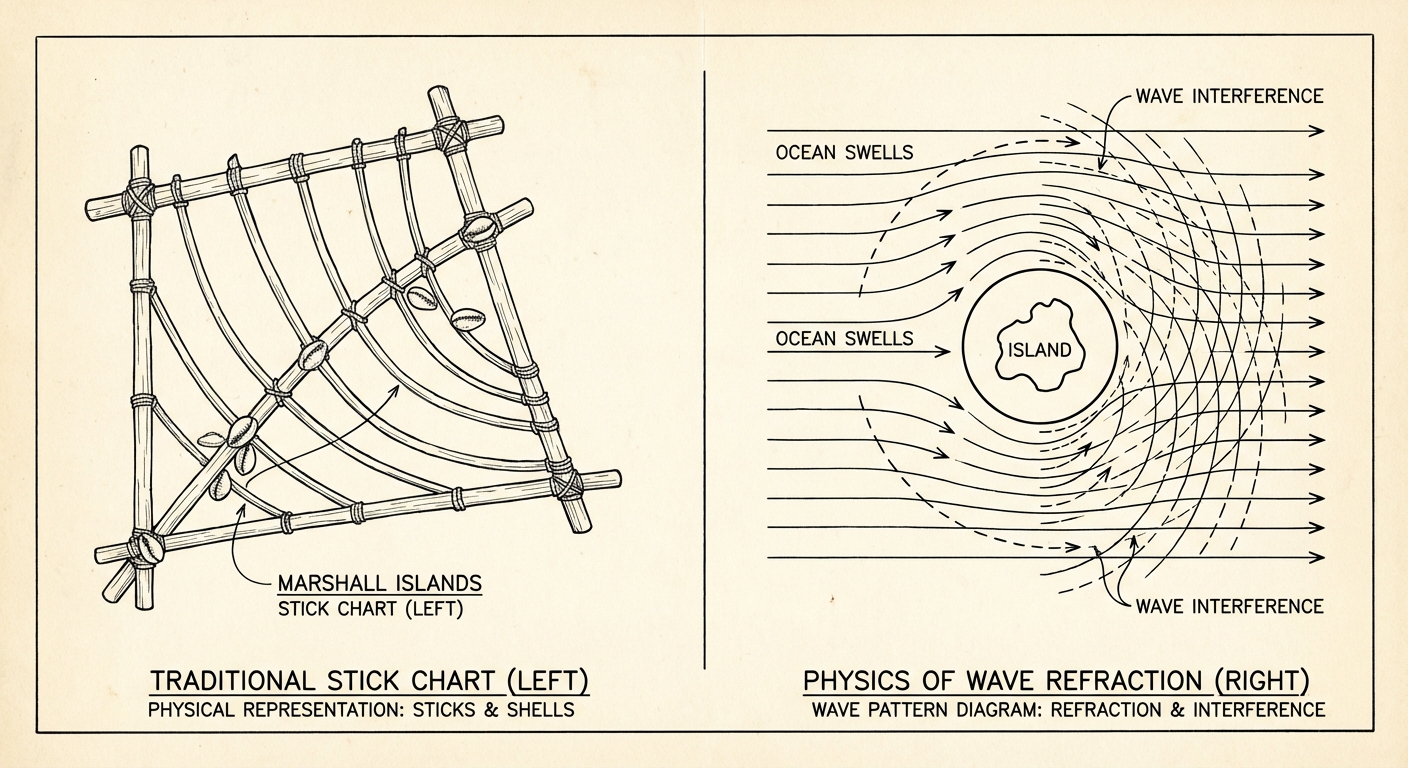
Marshall Islands Navigation Charts
Because islands in Micronesia are low-lying atolls often invisible from a distance, navigation was a matter of life and death. Navigators held high status.
- The Object: Navigation Chart (19th–20th century).
- Materials: Wood and fiber (coconut fiber), Cowrie shells.
- Function: These are not maps in the Western sense (they were not taken on voyages). They are memory aids and instructional tools used on land to teach young navigators how to read the sea.
- Form & Analysis:
- Sticks: Represent wave patterns, swells, and currents.
- Shells: Represent the position of islands.
- Wave Dynamics: The charts depict how ocean swells bend and refract around islands (visualizing the invisible).
Polynesian Art: Hierarchy and Lineage
Polynesia includes Hawaii, New Zealand (Aotearoa), Easter Island (Rapa Nui), and Tahiti. Societies here are generally highly stratified (strict class structures) ruled by chiefs and lineages tracing back to the gods.
Rapa Nui: The Moai
Rapa Nui (Easter Island) is the most isolated inhabited landmass on Earth.
- The Object: Moai on platform (ahu) (c. 1100–1600 CE).
- Materials: Volcanic tuff (soft stone for the body), Basalt (vibrant red scoria for the topknots), Coral (eyes).
- Form:
- Minimalist, imposing figures with heavy brows, elongated ears, and strong jawlines.
- They stand on platforms called ahu.
- Many have pukao (red cylinders) on their heads, representing hair/topknots or headdresses.
- Function: They represent deified ancestors. Their backs face the sea, and their eyes watch over the island, projecting mana onto the community.
- Context: The "Ecological Crisis" theory suggests the construction of these statues (moving them on wooden rollers) led to deforestation and societal collapse, though recent scholarship suggests the statues may have been "walked" upright using ropes.
Maori Art: The Meeting House and Ancestry
The Maori are the indigenous people of New Zealand. Their art is characterized by curvilinear forms and spirals.
1. Tamati Waka Nene (Portrait)
- Artist: Gottfried Lindauer (a Czech/Western painter).
- Subject: A Maori Chief who converted to Christianity.
- Significance: While the style is Western realism (oil on canvas), the function is traditional Maori. The painting acts as an embodiment of the ancestor.
- Key Symbols:
- Moko: Facial tattoos. These are unique legal signatures and records of lineage/status.
- Tewhatewha: A weapon/staff showing his power as a warrior chief.
- Eye in the staff: Usually made of abalone (paua) shell; outlines the presence of a spirit.
2. The Meeting House (Wharenui)
The Maori meeting house is not just a building; it is conceptually the body of the ancestor.
- Barge boards: The ancestor's outstretched arms.
- Ridge pole: The ancestor's spine.
- Rafters: The ancestor's ribs.
- Interio carvings: Poupou (relief panels) represent specific genealogy. Upon entering, you are entering the protective body of the ancestor.

Melanesian Art: Ritual and Ephemerality
Melanesia (including Papua New Guinea) is structurally different from Polynesia. Power is often achieved through grade-taking ceremonies and wealth exchange rather than just inherited lineage. Art is often ephemeral (made to be destroyed).
New Ireland: Malagan Display
New Ireland is a province of Papua New Guinea. The Malagan is both a cycle of rituals and the art objects themselves.
- Context: Malagan ceremonies are complex funerary rites that also settle debts and transfer land rights.
- The Process:
- When someone dies, their soul remains near the village.
- Carvings are commissioned. These are intricate, fretwork wood carvings combining human and animal forms (birds, fish).
- The Reveal: The sculptures are displayed in a temporary house.
- Destruction: Once the ceremony is over, the sculptures are often burned or allowed to rot. The mana has served its purpose.
- Note: Today, many are sold to tourists or museums, but the traditional intent was destruction.
- Copyright: Specific designs belong to specific clans. You cannot copy a design without purchasing the rights to it.
The Abelam: Yam Masks
The Abelam people (Papua New Guinea) focus heavily on agriculture, specifically the cultivation of long yams.
- Yam Cults: The size of the yam determines the status of the grower. Yams are believed to have spirits.
- Masking: Woven masks are created not for humans, but to be placed on the prize-winning yams during festivals. The yams are "dressed" as ancestors.
- Spirit Houses: The Abelam build massive A-frame spirit houses (Korambo) filled with paintings, serving as initiating sites for men.
Australian Aboriginal Art
While distinct from the island cultures, Australian Aboriginal art represents the longest continuous art tradition in the world (over 40,000 years).
The Dreaming (Dreamtime)
This is the core belief system—a parallel reality where ancestral beings created the landscape. The land itself is a record of these ancestors.
Bark Painting and Styles
- Materials: Eucalyptus bark, ochre (earth pigments).
- X-Ray Style: Common in Arnhem Land. Animals are depicted showing internal organs (spine, heart) to represent the creature's life force and physical reality, emphasizing the connection between hunter and prey.
- Dot Painting: A more modern adaptation (1970s onwards) of traditional sand/body painting designs onto canvas. The dots often disguise sacred knowledge from non-initiated viewers.
Common Mistakes & Pitfalls
- Confusing Mana and Tapu: Remember, Mana is the battery (power), Tapu is the insulation (laws/protection). Without Tapu, high Mana would be dangerous to ordinary people.
- "Primitive" Misconception: Students often describe Pacific art as "primitive" due to the lack of metal tools. Avoid this. These works show incredible mathematical complexity (navigation charts) and engineering (Moai).
- Destruction vs. Preservation: Western art conserves objects. In Melanesian Malagan rituals, the act of making and displaying is the art; the object is meant to die, just like the person it honors. Don't assume allowing art to rot is "neglect."
- Mixing up the Regions:
- Polynesia: Hierarchical, kings/chiefs, huge stone/wood works (Moai, Hawaii).
- Melanesia: Fragmented, "Big Man" societies, ephemeral/masking art (Papua New Guinea).
- Micronesia: Atolls, navigation focus.
Exam Comparison Table
| Feature | Polynesian Art | Melanesian Art |
|---|---|---|
| Social Structure | Stratified (Chiefs/Kings) | "Big Man" / Clan-based |
| Art Longevity | Permanent (Stone, Heirlooms) | Ephemeral (Made to be destroyed) |
| Focus | Genealogy & Ancestral Power | Spirit communication & initiation |
| Example | Moai (Rapa Nui) | Malagan (New Ireland) |