Masterpieces of the Golden Age: Renaissance Narratives and Poetic Forms
Historical Context: The Spanish Renaissance
The Siglo de Oro (Golden Age) is a period of flourishing arts and literature in Spain, generally spanning the 16th and 17th centuries. Unit 2 specifically focuses on the 16th Century (El siglo XVI), marked by the growing influence of the Renaissance.
Key Cultural Shifts
- Anthropocentrism: A shift from God-centered medieval thought to Human-centered thought.
- Imperial Power: Spain was a global superpower under Charles V and Philip II, creating a context of national pride but also hidden internal decay.
- Reformation & Counter-Reformation: The tension between Protestantism and Catholicism influenced the strict censorship and moral themes in literature.
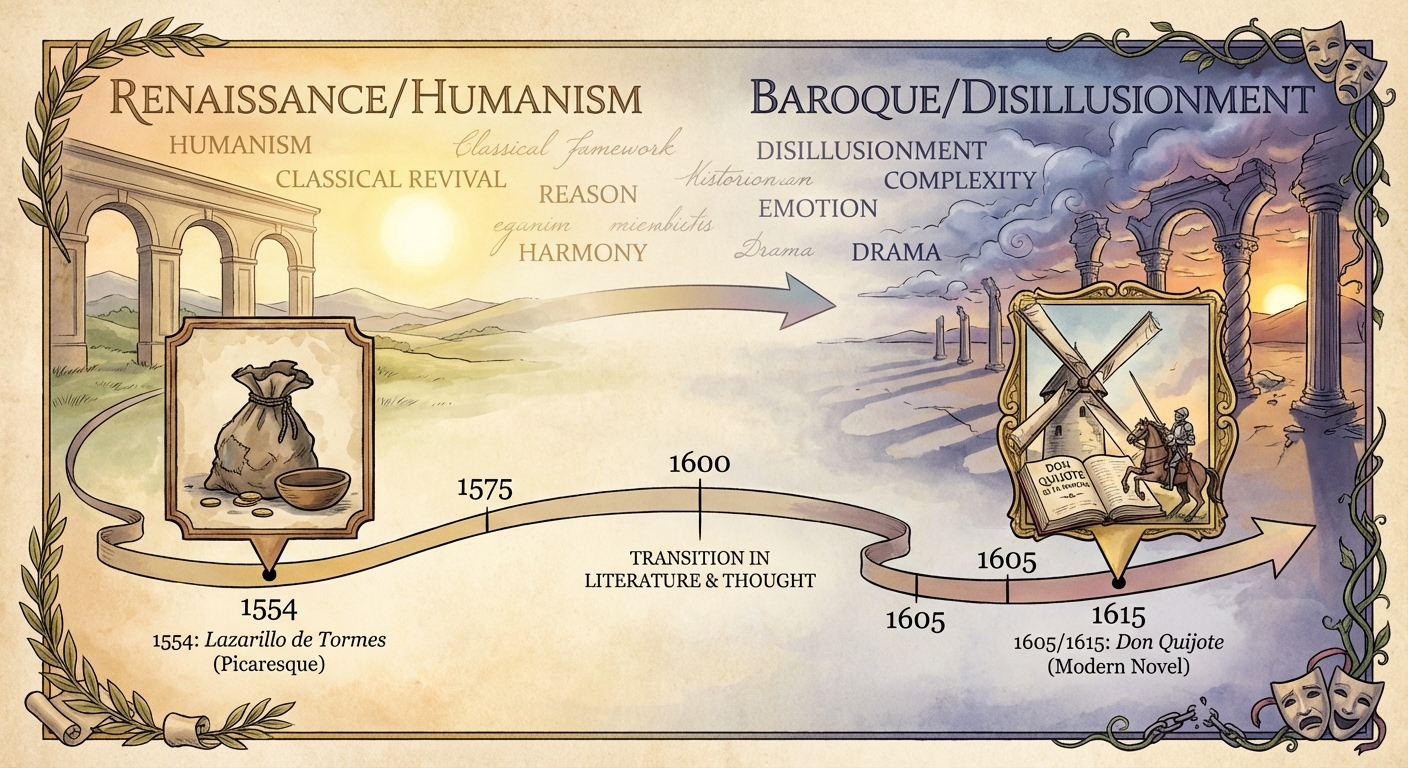
The Picaresque Novel: Lazarillo de Tormes
Definition: The Picaresque Novel is a genre of prose fiction that depicts the adventures of a roguish, but appealing hero (a pícaro) of low social class who lives by his wits in a corrupt society.
Work Overview
- Title: La vida de Lazarillo de Tormes y de sus fortunas y adversidades
- Author: Anonymous (likely due to the book's anticlerical content).
- Date: 1554.
- Format: Epistolary novel (written as a letter).
Narrative Structure
Lázaro creates a generic defense to a superior, whom he addresses as "Vuestra Merced" (Your Grace). This figure is the narratario (the specific audience within the text).
- Perspective: First-person limited (Yo protagonist). This creates a subjective view of reality.
- Episodic Nature: The story is divided into a Prologue and seven "Tratados" (Treatises), each involving a different master.
Key Masters and Social Critique
- El Ciego (The Blind Man):
- Teaches Lázaro to be cunning; marks Lázaro's loss of innocence.
- Theme: Cruelty and survival.
- Moment: The incident with the stone statue (the bull) teaches Lázaro he must be "waker than the devil."
- El Clérigo (The Priest):
- Represents the corruption of the church.
- Theme: Hypocrisy and avarice. The priest starves Lázaro while hoarding bread.
- El Escudero (The Squire):
- Represents the obsession with appearance vs. reality and false noble honor (la honra).
- Lázaro actually feels pity for him and feeds him, reversing the servant-master role.
Major Themes
- Las sociedades en contacto: Displays the rigid class structure of 16th-century Spain.
- El individuo en su entorno: How poverty forces moral compromise.
- Anticlericalism: Severe criticism of the clergy’s greed.
Note: While Lazarillo is a funny book, it is a bitter satire. Lázaro "succeeds" in the end only by accepting his wife's affair with an Archpriest to maintain material comfort.
The First Modern Novel: Don Quijote de la Mancha
Although published in the early 17th century (Part I in 1605), the AP curriculum often studies the roots of Don Quijote alongside Renaissance prose because it parodies the literary forms popular in the 16th century (Chivalric Romances).
Work Overview
- Author: Miguel de Cervantes.
- Genre: Parody / Proto-modern novel.
- Structure: Meta-fiction (fiction about fiction).
The Duality of Being
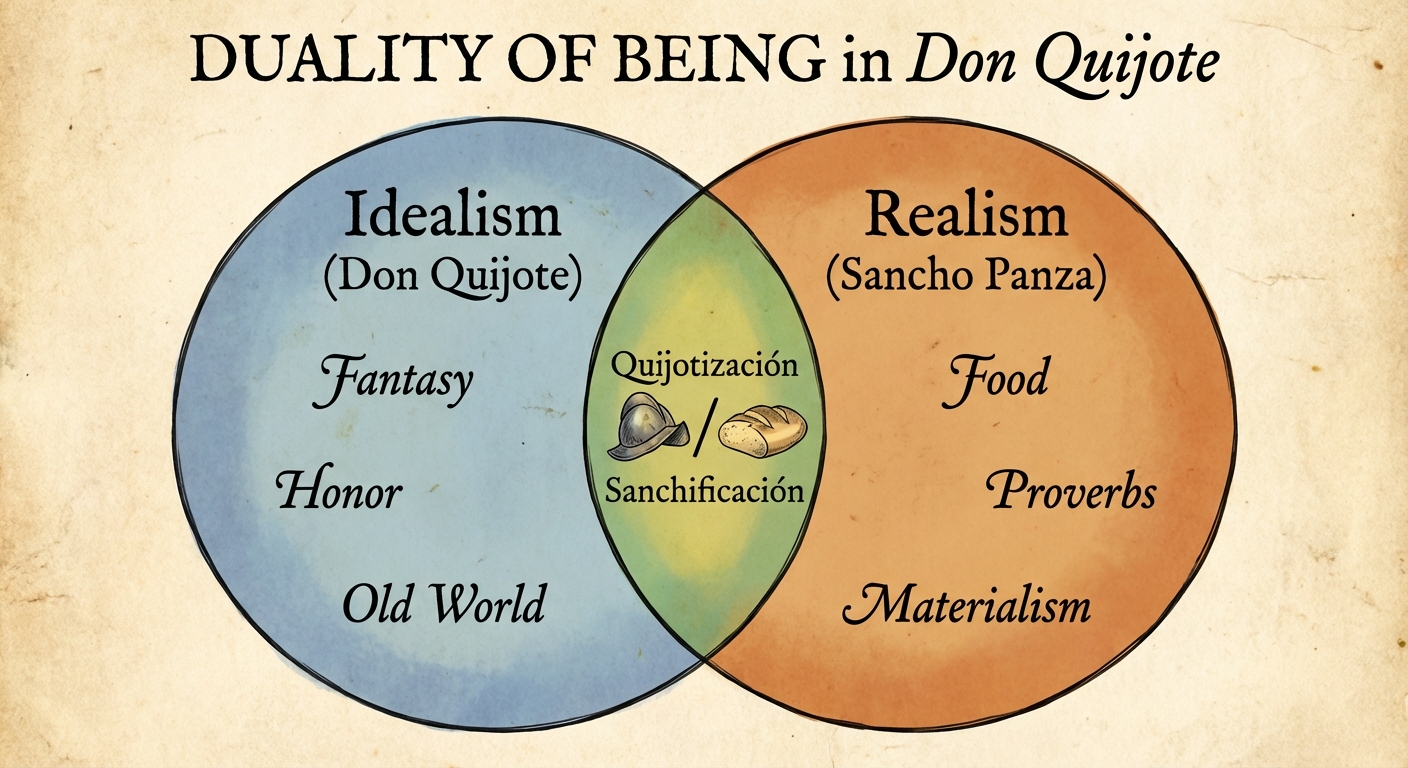
The central conflict is the collision between extreme idealism and harsh realism, personified by the two protagonists:
| Character | Representation | Evolution |
|---|---|---|
| Don Quijote | Idealism, Madness, Literary Fantasy, The Spirit | Undergoes Sanchificación (becomes more realistic). |
| Sancho Panza | Realism, Materialism, Folk Wisdom, The Flesh | Undergoes Quijotización (begins to share Quijote's dreams). |
Key Literary Devices
- Parody: Cervantes mocks the Libros de caballerías (books of chivalry) by placing a knight in the real, dusty world of La Mancha rather than a magical kingdom.
- Intertextuality: The characters eventually learn that a book has been written about them (in Part II).
- Polyphonic Narration: Cervantes frames the story as a translation of a text by a fictional Moorish historian, Cide Hamete Benengeli, adding layers of narrator reliability.
Renaissance Poetry: Garcilaso de la Vega
The Spanish Renaissance in poetry is defined by the importation of Italian forms (Petrarchism) introduced by Boscán and perfected by Garcilaso de la Vega.
Sonnet XXIII ("En tanto que de rosa y azucena")
This is the quintessential Renaissance poem for the AP exam.
Structure: The Italian Sonnet
- Verses: 14 lines total.
- Meter: Endecasílabo (11 syllables per line) — this is Arte Mayor.
- Stanzas: Two quartets (cuartetos) followed by two tercets (tercetos).
- Rhyme: Consonant rhyme (ABBA ABBA CDE DCE or similar).
Analysis by Stanza
- Quartets: Describe the beauty of a young woman using nature metaphors.
- Rosa (Rose) = Passion/Red lips.
- Azucena (Lily) = Purity/Pale skin.
- Oro (Gold) = Blonde hair.
- Tercets: Deliver the advice and the consequence.
- Imperative: "Coged" (Gather/Seize) the fruit of youth.
- Consequence: Time will turn everything to snow (white hair/old age).
Key Theme: Carpe Diem
Latin for "Seize the day." The poem urges the woman to enjoy her youth before El Tiempo (personified) destroys it. This reflects the Renaissance focus on the human experience in the present moment, contrasting with the Medieval focus on the afterlife.
Comparison Table: Medieval vs. Renaissance
| Feature | Medieval (Edad Media) | Renaissance (Renacimiento) |
|---|---|---|
| Worldview | Theocentrism (God-centered) | Anthropocentrism (Human-centered) |
| Purpose | Didactic (Moral teaching) | Aesthetic (Beauty) & Human experience |
| Poetry Form | Romance (8 syllables) | Sonnet (11 syllables) |
| Hero | Perfect Noble (El Cid) | Flawed Anti-hero (Lazarillo) or Madman (Quijote) |
Common Mistakes & Pitfalls
- Confusing the Authors: Students often forget that Lazarillo is Anonymous. Do not attribute it to Cervantes.
- Misunderstanding the "Honor" Concept: In Lazarillo, the Squire's honor is negative—it is vanity. In earlier medieval texts, honor was positive (bravery). Ensure you identify this shift to appearances over substance.
- Missing the Satire: When reading Lazarillo or Quijote, do not take the events literally. If Quijote sees a giant, remember the text is critiquing his madness, not establishing a fantasy world.
- Counting Syllables: In Garcilaso’s poetry, remember to apply Sinalefa (blending the final vowel of one word with the starting vowel of the next) to get the correct 11-syllable count.
- Example: "En tanto que de_oro…" counts as one syllable junction.
- Quijote's Dual Nature: Do not simply label Quijote as "crazy." He is "el cuerdo loco" (the sane madman)—his speeches on arms and letters often show high intelligence, making his madness specific to chivalry.