Unit 1: Global Prehistory Study Guide
Introduction to Global Prehistory (30,000–500 BCE)
Global Prehistory refers to the time period before the invention of written records. Because there are no texts to interpret these works, art historians rely on ethnography (the study of existing cultures), archeological context, and formal analysis to understand their meaning. This era spans the Paleolithic (Old Stone Age) and the Neolithic (New Stone Age).
Key themes in this unit include human interaction with the natural world, death and burial rituals, and the importance of shamanism and spiritual connection.
Cave Paintings: The Great Hall of the Bulls and Altamira
The Paleolithic Context
Paleolithic humans were hunter-gatherers. Their art was primarily focused on animals, which were essential for survival. It is crucial to understand that these paintings were not created for decoration (art for art's sake).
The Great Hall of the Bulls (Lascaux, France)
Included in the AP curriculum, this site (c. 15,000–13,000 BCE) typifies Paleolithic parietal art (wall art).
- Materials & Techniques: Artists used charcoal, iron ore, and plants to create pigments. They often used the natural contours of the rock wall to suggest the volume of the animal, making the image feel 3D.
- Subject Matter: Horses, deer, bison, and elk. Note that humans are rarely depicted in Paleolithic cave art; when they are, they are stick figures, contrasting with the detailed naturalism of the animals.
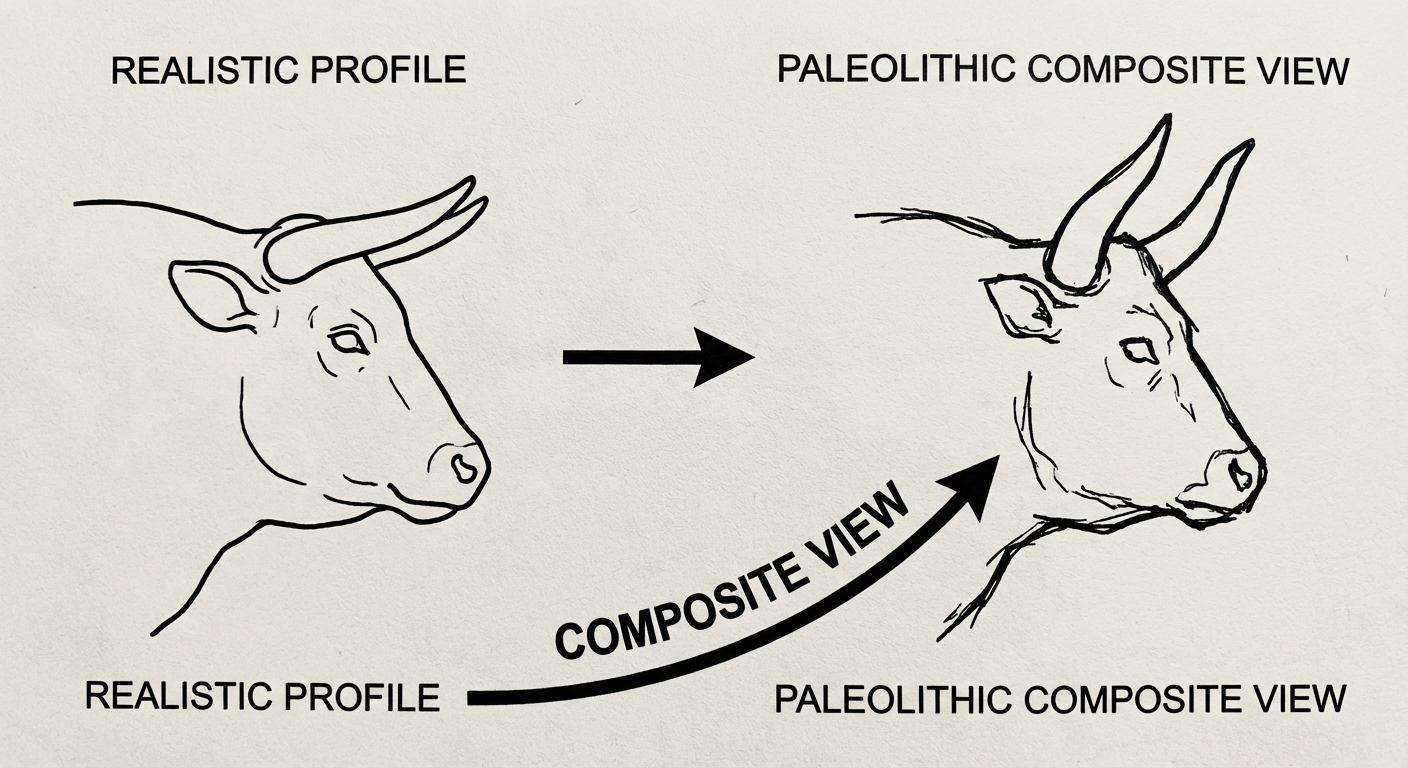
- Twisted Perspective (Composite View): This is a specific stylistic convention where the artist shows the animal's body in profile but turns the horns or head to a frontal view. This ensures the viewer sees all defining features of the animal—a descriptive rather than strictly optical approach.
Theory & Function
While the exact meaning is unknown, several theories dominate:
- Hunting Magic: Creating the image ensures a successful hunt.
- Shamanism: The caves were sites for rituals where a shaman (a spiritual leader) would communicate with spirits. The deep, dark locations of these paintings suggest they were not for public viewing but for sacred ceremonies.
Early Sculpture and Portable Art
Unlike the fixed cave walls, mobiliary art (portable art) could be carried by nomadic peoples. These objects often served functional, spiritual, or lineage-based purposes.
Notable Examples
1. Apollo 11 Stones (Namibia, c. 25,500–25,300 BCE)
- Form: Charcoal on stone.
- Significance: These are some of the oldest artworks ever found. They depict a feline-like animal with human legs, suggesting a therianthrope (part human, part animal), which relates to shamanistic transformation.
2. Camelid Sacrum in the Shape of a Canine (Central Mexico, 14,000–7,000 BCE)
- Material: The sacrum is a triangular bone at the base of the spine.
- Concept: In Mesoamerican cosmology, the sacrum is often viewed as a "second skull" and the seat of the soul. By carving it into a canine skull, the artist utilized the dense, spiritual bone to possibly house a spirit or ancestor.
3. The Ambum Stone (Papua New Guinea, c. 1500 BCE)
- Form: Greywacke (a very hard stone).
- Function: While likely a pestle used for grinding herbs or food, its detailed zoomorphic form (resembling an echidna embryo) suggests ritual significance.
4. Tlatilco Female Figurine (Central Mexico, 1200–900 BCE)
- Form: Ceramic with traces of pigment.
- Style: Distinctive "bifurcated" (two-headed) face on a single body. This suggests a fascination with duality (life/death, normal/supernatural). The wide hips and pinched waist emphasize fertility, unrelated to sexualized nudity.
Jade Cong and Early Chinese Art
The transition to the Neolithic period brought agriculture, settlement, and social stratification. The Liangzhu Culture (3300–2200 BCE) in China produced sophisticated jade experimentation.
The Jade Cong
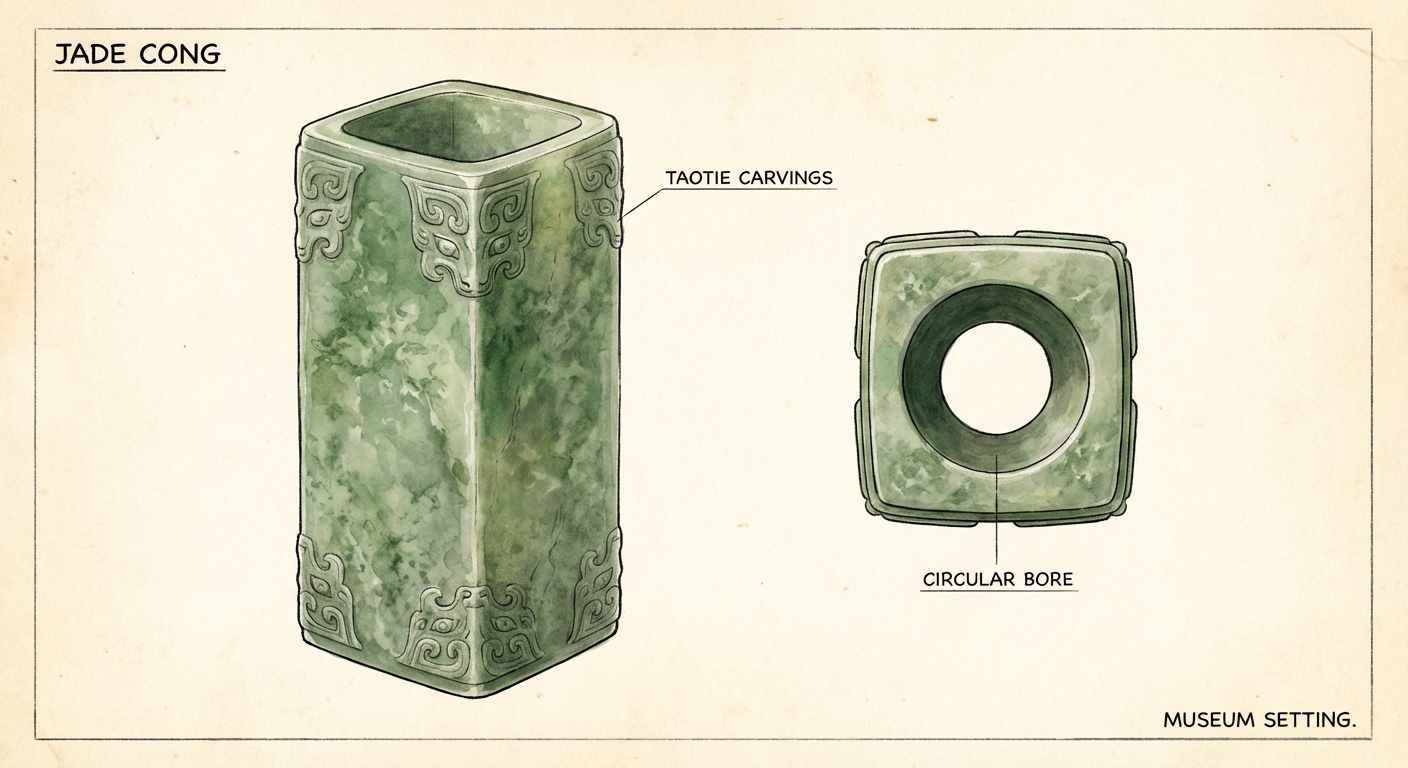
- Material: Jade (Nephrite). Jade is extremely hard and cannot be carved with stone tools. It must be abraded (sanded down) using sand and water. This labor-intensive process implies that the culture had a social hierarchy—wealthy elites could command the labor required to produce these rectilineal tubes.
- Form: A square, hollow tube with a circular inner hole.
- Symbolism:
- Square: Represents the Earth.
- Circle: Represents the Heavens/Sky.
- Axis Mundi: The hollow center might represent a connection between the human and spiritual worlds.
- Motifs: The corners are often decorated with taotie (mask-like faces), which become a recurring motif in Bronze Age Chinese art.
Megalithic Structures: Stonehenge
Stonehenge (Wiltshire, UK, c. 2500–1600 BCE) is the definitive example of Neolithic monumental architecture.
Construction Phases
Stonehenge was not built in a day, nor by a single generation. It evolved over roughly 1,000 years, moving from a simple ditch (henge) to the complex stone structure we see today.
Structural Engineering
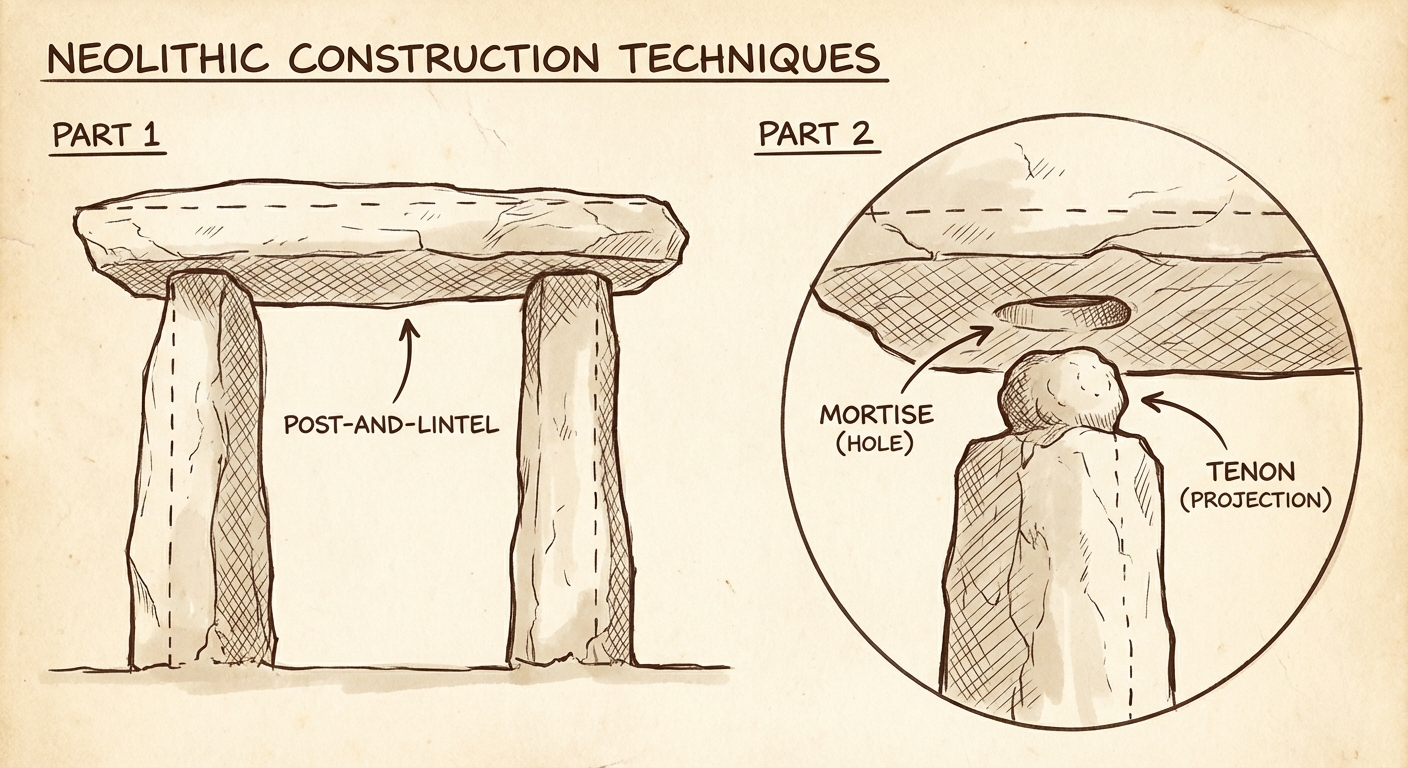
To create the massive trilithons (structures with two vertical stones topped by a horizontal one), builders used specific architectural techniques:
- Post-and-Lintel: Two upright stones (posts) support a horizontal beam (lintel).
- Mortise-and-Tenon: A woodworking technique adapted for stone. The top of the post has a projecting knob (tenon) that fits into a hole (mortise) on the lintel to secure it in place.
Function and Significance
- Solar Calendar: The "Heel Stone" aligns precisely with the rising sun on the Summer Solstice. This indicates the culture's deep understanding of astronomy and agricultural cycles.
- Burial Site: Excavations have revealed cremation burials, suggesting the site was a domain of the dead/ancestors, whereas nearby wood structures (Durrington Walls) were for the living.
Key Comparisons: Paleolithic vs. Neolithic
| Feature | Paleolithic (Old Stone Age) | Neolithic (New Stone Age) |
|---|---|---|
| Lifestyle | Hunter-Gatherer, Nomadic | Settled Agriculture, Domesticated Animals |
| Art Format | Portable (mobiliary), Cave Walls | Architecture, Ceramics, Monuments |
| Subject | Animals (Naturalistic), Humans (Abstract) | Humans, Ritual Objects, Geometry |
| Example | Lascaux (Great Hall of Bulls) | Stonehenge, Jade Cong |
Common Mistakes & Pitfalls
- "Primitive" Myth: Do not assume prehistoric means "unskilled." The realism in the Running Horned Woman or the engineering of Stonehenge demonstrates complex cognitive and technical abilities.
- Written Records: Students often claim we know exactly what these works meant. We don't. Always use phrases like "scholars suggest," "likely intended for," or "associated with," rather than stating definitive facts about meaning.
- The Dinosaur Error: Humans and dinosaurs did not assume coexistence. Never mention dinosaurs in an Art History essay.
- Material Confusion: Do not confuse carving (cutting) with abrasion (sanding). Works like the Jade Cong and Ambum Stone were largely created through abrasion due to the hardness of the stone.
- Geography: Remember this unit is global. Do not focus solely on Europe. Apollo 11 Stones are African; Camelid Sacrum is North American; Terra Cotta Fragment is from the Pacific (Lapita).
Memory Aids
- Coconuts P.L.M. (For Stonehenge Construction):
- Post and Lintel
- Mortise and Tenon
- Jade is Hard Work: If you see Jade in prehistory, think High Status. Because it took so long to make, only the elite could own it.