AP Calculus BC Unit 3 Study Guide: Composite, Implicit, Logarithmic, and Inverse Differentiation
Composite Functions and the Chain Rule
What a composite function is (and why it changes how you differentiate)
A composite function is a function built by plugging one function into another. If you have an “inside” function %%LATEX0%% and an “outside” function %%LATEX1%%, the composite is written as:
You can think of this as a two-step machine: start with an input %%LATEX3%%, apply %%LATEX4%% to get %%LATEX5%%, and then feed that output into %%LATEX6%% to get %%LATEX7%%. This matters for differentiation because a small change in %%LATEX8%% does not directly produce a small change in %%LATEX9%%. Instead, %%LATEX10%% first changes %%LATEX11%%, and that change then affects %%LATEX12%%. The derivative must account for both layers of change.
A useful real-world analogy is temperature conversion inside another formula. Suppose an object’s length depends on temperature in Celsius, but your sensor measures Fahrenheit. Your final output “length as a function of Fahrenheit” is a composite: Fahrenheit %%LATEX13%% Celsius %%LATEX14%% length. The overall rate of change must multiply the “F-to-C” rate by the “length-to-C” rate.
The Chain Rule: what it says and why it’s multiplication
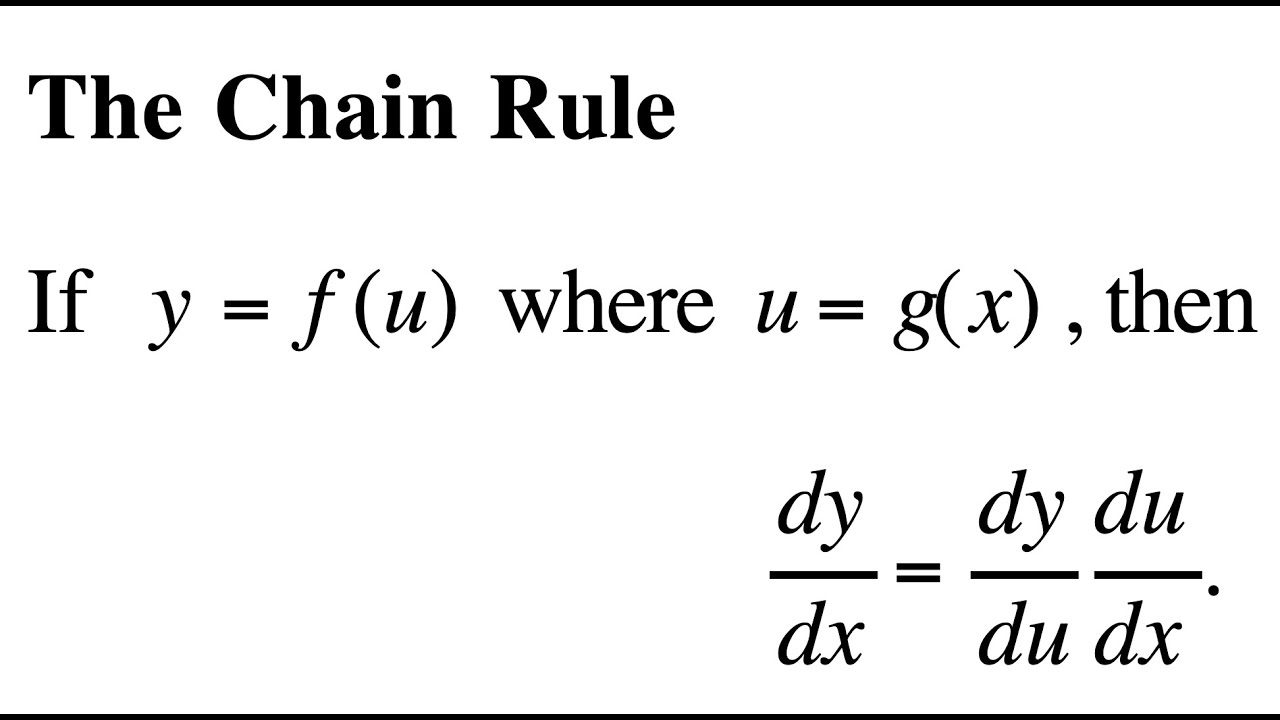
When finding the derivative of a composite function, take the derivative of the outside function with the inside function treated as the variable (leaving the inside alone), and then multiply by the derivative of the inside function.
If , then:
You’ll also see it written with substitution language. If %%LATEX17%% and %%LATEX18%%, then:
Conceptually, the multiplication comes from chained rates: %%LATEX20%% measures how fast the inside changes as %%LATEX21%% changes, and measures how fast the outside changes as its input changes.
A popular memory trick (especially for power-type composites) is: “douter, inner, dinner”. Differentiate the outside (“douter”), keep the inside (“inner”), then multiply by the derivative of the inside (“dinner”). For example, for you “drop the power down,” reduce the exponent by one, keep the inside unchanged, and multiply by the derivative of the inside.
Recognizing when you need the Chain Rule
You need the Chain Rule whenever the function is a basic function of something other than .
Common signals include a power applied to a nontrivial expression, trig of something complicated, and exponentials/logs whose inputs are not just :
A common misconception is thinking that only parentheses mean Chain Rule. Parentheses are a clue, but composition can appear without them, such as %%LATEX30%%, which typically means %%LATEX31%%.
Worked examples (Chain Rule fundamentals)
Example 1: Power of a linear-quadratic expression
Differentiate:
Let %%LATEX33%%. The outside is %%LATEX34%%, so:
and
Multiply and substitute back:
A frequent error is stopping at %%LATEX38%% and forgetting the factor %%LATEX39%%.
Example 2: Trig composite with a radical
Differentiate:
Let . Then:
and
So:
Equivalently:
Exam Focus
- Typical question patterns: Find %%LATEX46%% for a function with multiple layers (power, trig, exponential, log). Find the slope of the tangent line at a given %%LATEX47%% value by differentiating and evaluating. Translate a composition given in words (for example, a conversion inside a model).
- Common mistakes: Differentiating the outside but forgetting to multiply by the derivative of the inside. Rewriting incorrectly (for example, treating %%LATEX48%% and %%LATEX49%% as the same expression). Algebra mistakes after applying the Chain Rule, especially with negative exponents and radicals.
Advanced Chain Rule Patterns (and combining with other rules)
Why “just knowing the Chain Rule” is not enough
On the AP exam, most realistic derivatives are not a single clean composite. They combine multiple differentiation rules, so your real skill is structure recognition: identify the outermost operation first (sum, product, quotient, composition), then work inward.
Useful derivative facts you’ll combine with the Chain Rule
If %%LATEX50%% is a function of %%LATEX51%%, then:
A common “silent mistake” is applying these as if %%LATEX59%%. For example, students often write %%LATEX60%% and forget the needed factor .
Product Rule and Chain Rule together
If , then:
If either factor is composite, you still use the product rule on the outside, and then use the Chain Rule inside %%LATEX64%% and/or %%LATEX65%%.
Example 1: Product with an exponential composite
Differentiate:
Product rule gives:
Chain rule on the exponential:
So:
Factoring is optional but nice:
A common error is writing %%LATEX71%% and forgetting the inner derivative factor %%LATEX72%%.
Quotient Rule and Chain Rule together
If , then:
Again, if %%LATEX75%% or %%LATEX76%% is composite, apply the Chain Rule inside those derivatives.
Example 2: Quotient with trig composite
Differentiate:
Let %%LATEX78%% and %%LATEX79%%. Then:
So:
Simplify:
Or split it:
A very common mistake is differentiating %%LATEX85%% as %%LATEX86%% but forgetting the factor .
Repeated chain rule (multiple layers)
Some functions have more than two layers, so it helps to name the layers and go one derivative at a time.
Example 3: Multi-layer composite
Differentiate:
Start with the outer power:
Differentiate the inside:
Combine:
Equivalent simplified form:
A common mistake is differentiating %%LATEX93%% as %%LATEX94%% and forgetting the inner derivative .
Exam Focus
- Typical question patterns: Differentiate expressions that combine product/quotient rules with embedded composites. Find %%LATEX96%% after finding %%LATEX97%% (this often requires careful rewriting and repeated rule use). Differentiate correctly even when simplification is not required.
- Common mistakes: Using product rule when you should use chain rule (or vice versa), especially for expressions like %%LATEX98%% versus %%LATEX99%%. Dropping parentheses and changing meaning, for example interpreting ambiguously instead of reading what is written. Simplifying in a way that loses domain information (for example, rewriting radicals or logs without checking where expressions are defined). Also, if a second derivative is required, it’s usually worth simplifying the first derivative before differentiating again.
Implicit Differentiation
What “implicit” means and why implicit differentiation exists
A function is given explicitly when %%LATEX101%% is isolated, like %%LATEX102%%. Many relationships are implicit, where %%LATEX103%% and %%LATEX104%% are mixed together, like:
This equation describes a circle, and it does not represent %%LATEX106%% as a single function of %%LATEX107%% on the full circle. But you can still find the slope of the curve at a point. That slope is %%LATEX108%%, and implicit differentiation is how you compute it without solving for %%LATEX109%%.
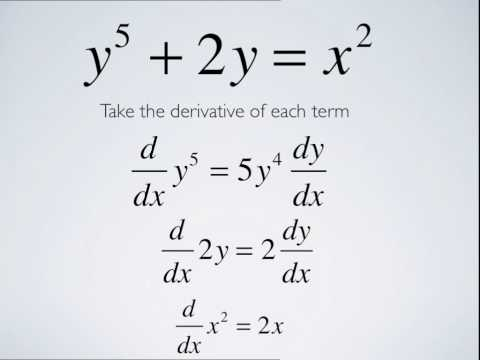
The key idea is that even if %%LATEX110%% is not isolated, it is still a function of %%LATEX111%%, meaning %%LATEX112%%. So when you differentiate terms involving %%LATEX113%%, you must apply the Chain Rule and include a factor of %%LATEX114%%. A quick way to say this is: if the variable you’re differentiating doesn’t match %%LATEX115%%, you need to “follow it up” with .
The core procedure
To implicitly differentiate an equation involving %%LATEX117%% and %%LATEX118%%:
- Differentiate both sides with respect to .
- When differentiating terms containing %%LATEX120%%, multiply by %%LATEX121%%.
- Collect all terms on one side.
- Factor out .
- Solve for .
It’s not a special “new rule”; it’s ordinary differentiation plus the Chain Rule applied to . The AP exam loves to test this, often mixed with product rule, trig, or evaluation at a point.
A note about and reciprocals
Sometimes it’s helpful to think in the other direction. When the derivative exists and is nonzero, the derivatives of inverse relationships satisfy:
This reciprocal idea can help you reason about swapping variables or about inverse functions, but on typical implicit differentiation problems you usually differentiate with respect to %%LATEX128%% and solve for %%LATEX129%% directly.
Worked examples (basic implicit differentiation)
Example 1: Circle
Differentiate implicitly:
Differentiate both sides:
Solve:
Common error: writing %%LATEX133%% instead of %%LATEX134%%.
If you’re asked for the derivative at a point, you can often plug in early to avoid extra algebra later. Here, at :
Example 2: Implicit with a product
Differentiate implicitly:
Differentiate both sides; for %%LATEX138%% use product rule because both %%LATEX139%% and %%LATEX140%% vary with %%LATEX141%%:
Group terms:
Solve:
Common error: treating %%LATEX146%% as constant in %%LATEX147%% and writing derivative %%LATEX148%% instead of %%LATEX149%%.
Tangent lines and normal lines to implicitly defined curves
Once you have , plug in a point to get the tangent slope.
- Tangent line slope at %%LATEX151%% is %%LATEX152%%.
- Normal line slope is the negative reciprocal (when the tangent slope is not zero):
Example 3: Tangent line to a circle
For %%LATEX154%%, at %%LATEX155%%:
Point-slope form:
Second derivatives via implicit differentiation
Sometimes you need %%LATEX158%%. After finding %%LATEX159%%, differentiate again with respect to %%LATEX160%%, remembering that %%LATEX161%% still depends on .
Example 4: Second derivative for a circle
Start from:
Differentiate:
Use product form :
and
So:
Substitute :
Combine:
On the circle, , so:
Common mistakes include forgetting to include or substitute %%LATEX174%% when it appears during the second-derivative work, and treating %%LATEX175%% as constant.
Exam Focus
- Typical question patterns: Given an equation in %%LATEX176%% and %%LATEX177%%, find %%LATEX178%%. Find the equation of a tangent line at a specified point on an implicitly defined curve. Find %%LATEX179%% and evaluate at a point (often for concavity).
- Common mistakes: Forgetting the factor %%LATEX180%% when differentiating terms like %%LATEX181%% or %%LATEX182%%. Not using product rule on terms like %%LATEX183%%. Algebra errors when collecting and solving for .
Logarithmic Differentiation (a powerful application of implicit differentiation)
What it is and when you should use it
Logarithmic differentiation means taking of both sides to simplify differentiation. It’s especially helpful when:
- You have variables in both the base and exponent, like .
- You have complicated products/quotients of powers, like:
It works because logarithms turn multiplication into addition and powers into multiplication.
Key properties:
A common misconception is that logarithmic differentiation is only for . It’s really a general simplification tool.
The standard process
Start with %%LATEX192%%. Take %%LATEX193%% of both sides, expand using log rules, then differentiate. The left side becomes %%LATEX194%% (Chain Rule). Solve for %%LATEX195%% by multiplying by %%LATEX196%%, and substitute the original expression back for %%LATEX197%%.
Worked examples
Example 1: Differentiating
Let:
Take logs:
Power property:
Differentiate:
Product rule:
So:
Common error: trying to use the power rule on %%LATEX205%% as if it were %%LATEX206%%.
Example 2: Simplifying a product/quotient of powers
Differentiate:
Take logs:
Expand:
Differentiate:
So:
Multiply by :
A common mistake is forgetting %%LATEX214%%, including the inner derivative factors like %%LATEX215%% and .
Exam Focus
- Typical question patterns: Differentiate expressions like %%LATEX217%% or %%LATEX218%%. Differentiate messy products/quotients of powers where log properties simplify the work. Set up the derivative correctly even if the final simplification is not required.
- Common mistakes: Forgetting that differentiating %%LATEX219%% gives %%LATEX220%%. Forgetting domain issues conceptually (since %%LATEX221%% requires %%LATEX222%%), which can matter in interpretation. Not multiplying by at the end.
Derivatives of Inverse Functions
What an inverse function is (conceptually)
Two functions %%LATEX224%% and %%LATEX225%% are inverses if they undo each other:
Graphically, the graphs of %%LATEX228%% and %%LATEX229%% are reflections across %%LATEX230%%. Not every function has an inverse on its entire domain; to have an inverse function, %%LATEX231%% must be one-to-one (or you restrict the domain so it becomes one-to-one).
The key derivative relationship
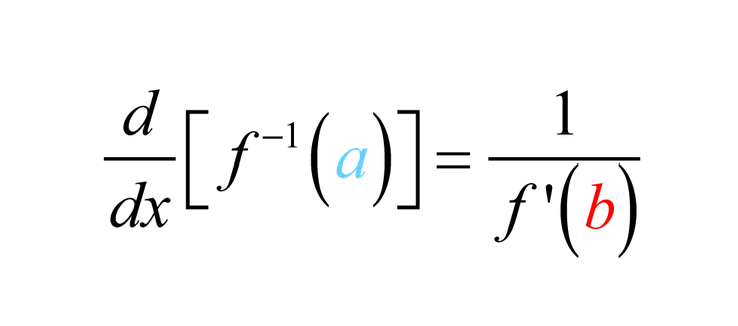
If %%LATEX232%% is differentiable and one-to-one, %%LATEX233%%, and , then:
A common equivalent form is:
The slope becomes a reciprocal because reflection across %%LATEX237%% swaps “rise” and “run,” but you must evaluate at corresponding points. The point %%LATEX238%% on %%LATEX239%% corresponds to %%LATEX240%% on .
A point-swap way to remember evaluations
If %%LATEX242%% and %%LATEX243%%, then %%LATEX244%%. So if you want %%LATEX245%%, you find and take the reciprocal:
Students often say this informally as: “swap the point and take the reciprocal of the slope.” Just be careful to swap correctly: the original point %%LATEX248%% on %%LATEX249%% becomes on the inverse.
Worked examples
Example 1: Use a table-style point correspondence
Suppose you know:
Then and:
Example 2: Using the general formula
Let:
Find %%LATEX256%%. First find %%LATEX257%% such that :
Then:
So:
Connecting inverse derivatives to implicit differentiation
Start from:
Differentiate both sides:
Solve:
This makes inverse-function derivatives feel less like a standalone formula and more like a direct application of Chain Rule plus implicit thinking.
Exam Focus
- Typical question patterns: Given values like %%LATEX267%% and %%LATEX268%%, find %%LATEX269%%. Given an explicit function, find %%LATEX270%% by solving %%LATEX271%% first. Conceptual questions about why the slope is a reciprocal because of reflection across %%LATEX272%%.
- Common mistakes: Using %%LATEX273%% without evaluating at the correct corresponding input. Forgetting the point swap %%LATEX274%%. Ignoring the condition %%LATEX275%% (if %%LATEX276%%, the inverse has an undefined slope there). Also note: the AP test often only includes about 1 to 2 inverse-derivative questions, so this is usually a “high accuracy, low volume” skill.
Inverse Trigonometric Functions and Their Derivatives
Why inverse trig derivatives matter
Inverse trig functions appear when you solve trig equations for an angle and later when you integrate. In differentiation, the main skills are recognizing inverse trig as inverse functions and applying the derivative formulas with Chain Rule.
Inverse trig functions are commonly written as:
You may also see %%LATEX280%% to mean %%LATEX281%%. This is not the reciprocal of sine (that reciprocal is ). That notation confusion is one of the most common errors.
Domain restrictions (why inverse trig functions are single-valued)
To define an inverse, each trig function is restricted to a principal range where it is one-to-one:
- %%LATEX283%% outputs angles in %%LATEX284%%
- %%LATEX285%% outputs angles in %%LATEX286%%
- %%LATEX287%% outputs angles in %%LATEX288%%
These restrictions matter for sign decisions when simplifying expressions like .
Derivative formulas (including Chain Rule versions)
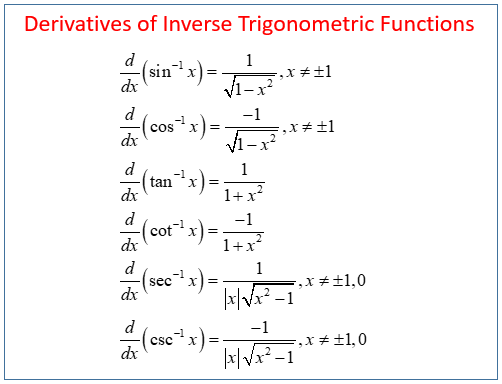
Standard inverse trig derivatives:
Also commonly used (and often included on derivative charts):
With Chain Rule, for :
A frequent mistake is forgetting to square the entire inside expression in the denominator, for example writing %%LATEX300%% instead of %%LATEX301%%.
How one of these is derived (so it’s not just memorization)
Let . Then by definition:
Differentiate implicitly:
So:
Use the identity %%LATEX306%% with %%LATEX307%%:
The positive root matches the principal range %%LATEX309%% where %%LATEX310%%. Therefore:
Worked examples
Example 1: Chain rule with inverse trig
Differentiate:
Let %%LATEX313%%, so %%LATEX314%%. Then:
So:
Simplify:
Common mistake: writing %%LATEX318%% in the denominator instead of %%LATEX319%%.
Example 2: Differentiating an expression involving inverse trig and algebra
Differentiate:
Product rule:
So:
Simplifying trig expressions with inverse trig (common AP skill)
To simplify expressions like %%LATEX323%%, let %%LATEX324%% so . Then:
because %%LATEX327%% implies %%LATEX328%%. Therefore:
A classic mistake is writing without using the principal range to pick the sign.
Exam Focus
- Typical question patterns: Differentiate inverse trig composites like %%LATEX331%%. Use implicit differentiation ideas to justify inverse trig derivatives. Simplify expressions like %%LATEX332%% or as part of a derivative or evaluation.
- Common mistakes: Confusing %%LATEX334%% with %%LATEX335%%. Losing the Chain Rule factor . Choosing the wrong sign when converting from an inverse trig output angle to a trig value.
Putting It All Together: Multi-Concept Differentiation and Interpretation
Why AP problems mix techniques
AP Calculus questions often test whether you can select and combine tools correctly, not just execute a single rule in isolation. In this unit, common blends include Chain Rule with implicit differentiation, inverse function derivatives evaluated from point data, logarithmic differentiation for variable exponents, and inverse trig derivatives with algebraic simplification. Another major theme is interpretation: once you compute a derivative, you may need to interpret it as a slope or a rate of change, or use it to write a tangent line.
Strategy for choosing a method (structure-first thinking)
A reliable workflow is to identify the outermost structure first.
- If %%LATEX337%% and %%LATEX338%% are mixed, plan for implicit differentiation.
- If you see a function inside another function, you will almost certainly use the Chain Rule.
- If two expressions are multiplied, use product rule unless it’s clearly easier to multiply out first.
- If there is a variable in an exponent (or a messy product/quotient of powered factors), consider logarithmic differentiation.
- If you’re finding the derivative at a point, it can be efficient to plug in the point once you have a usable expression (and sometimes earlier) to avoid unnecessary algebra.
Worked example 1: Implicit + trig + chain rule
Differentiate implicitly:
Differentiate both sides with respect to %%LATEX340%%. The left side needs Chain Rule because the input is %%LATEX341%%:
Differentiate with product rule:
So:
Solve for :
A common mistake is differentiating %%LATEX350%% as %%LATEX351%% and stopping, forgetting to multiply by .
Worked example 2: Derivative of an inverse function from an implicit relation
Suppose is differentiable and you are told:
and satisfies:
Find .
Differentiate implicitly:
So:
Evaluate at %%LATEX360%% using %%LATEX361%%:
Now use the inverse derivative relationship. Since %%LATEX363%%, we know %%LATEX364%%, and:
Thus:
This is very AP-style because it links implicit differentiation, evaluation at a point, and inverse derivatives.
Worked example 3: Logarithmic differentiation with an inverse trig component
Differentiate:
Take logs:
Bring exponent down:
Differentiate both sides:
Product rule:
Chain rule for the log:
So:
Multiply by :
Common mistakes include differentiating %%LATEX376%% as %%LATEX377%% (forgetting the derivative of %%LATEX378%%), or trying to use the power rule directly on %%LATEX379%%.
Exam Focus
- Typical question patterns: Differentiate an expression that requires picking the correct outermost rule (product/quotient/log differentiation) and then using Chain Rule internally. Use implicit differentiation to find a derivative and then evaluate at a point on the curve. Combine inverse function derivative facts with information given as values, tables, or implicit relationships.
- Common mistakes: Choosing an inefficient method (for example, using quotient rule on an expression where logarithmic differentiation is cleaner). Failing to track what depends on %%LATEX380%% (treating %%LATEX381%% or %%LATEX382%% as constants in implicit problems). Mixing up evaluation points for inverse derivatives. Also, when evaluating derivatives at a point, check whether parts of the expression become %%LATEX383%% or , and take advantage of that to simplify your arithmetic; with practice, you can mentally take certain derivatives quickly.