Comprehensive Guide to AP Environmental Science Unit 5: Agriculture
The Green Revolution
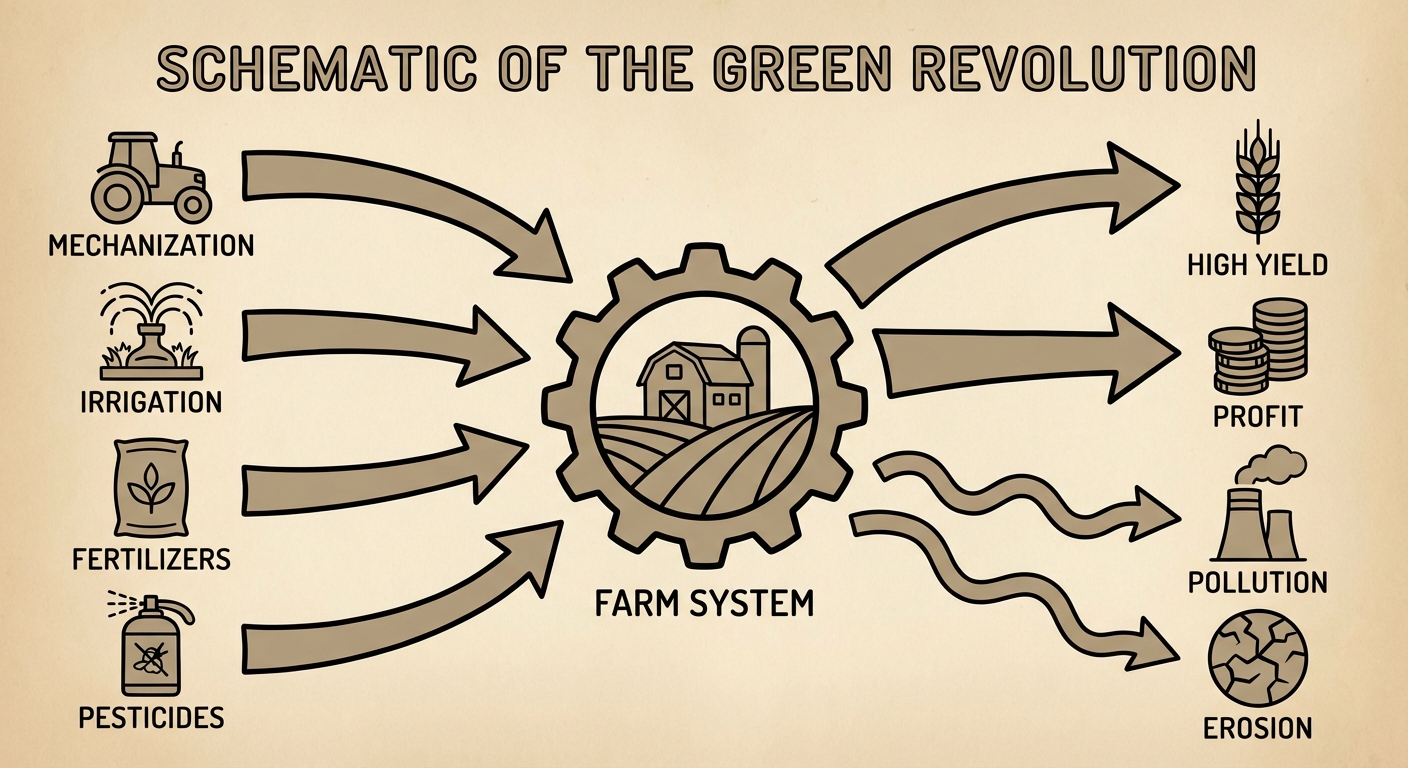
The Green Revolution refers to a shift in agricultural practices in the twentieth century that drastically increased food production through new technologies and high-yield crop varieties. While it prevented global famine as the population exploded, it introduced significant ecological consequences.
Key Components
- Mechanization: The shift from human and animal labor to fossil-fuel-based machinery (tractors, combines).
- Pros: Increases profits and efficiency; farms can become much larger.
- Cons: Relies heavily on fossil fuels (releasing $CO_2$ and particulates); compacts the soil, reducing water-holding capacity.
- Genetically Modified Organisms (GMOs): Crops engineered for specific traits, such as drought tolerance (e.g., drought-tolerant corn) or pest resistance (e.g., Bt corn).
- Pros: Higher yields, less land use, reduced need for pesticides (in some cases).
- Cons: Lowers genetic diversity, making crops vulnerable to new diseases.
- Fertilizers and Pesticides: Synthetic inputs to boost growth and kill competitors.
- Monocropping: Cultivating a single species (e.g., corn or soy) over a large area year after year.
- Benefit: increased efficiency in planting and harvesting.
- Drawback: depletes specific soil nutrients rapidly and increases soil erosion.
Impacts of Agricultural Practices
Modern agriculture alters natural systems. Understanding these impacts is central to the APES curriculum.
Soil Degradation
- Tilling: Turning over the soil before planting. While it kills weeds, it disturbs the soil structure, leading to massive soil erosion by wind and water. It also releases sequestered carbon into the atmosphere as $CO_2$.
- Slash-and-Burn Farming: A method usually occurring in tropical rainforests where vegetation is cut and burned to clear land for agriculture.
- The ash provides temporary nutrients, but the soil is quickly depleted, leading to desertification (the process by which fertile land becomes desert).
Fertilizer Impacts
- Synthetic Fertilizers: (Haber-Bosch process). They are easily applied and absorbed but easily wash away.
- Eutrophication: Runoff often carries nitrogen and phosphorus into nearby waterways. This causes algal blooms, which block sunlight. When the algae die, bacteria decompose them, consuming oxygen and creating hypoxic zones (dead zones) where aquatic life cannot survive.
Irrigation Methods
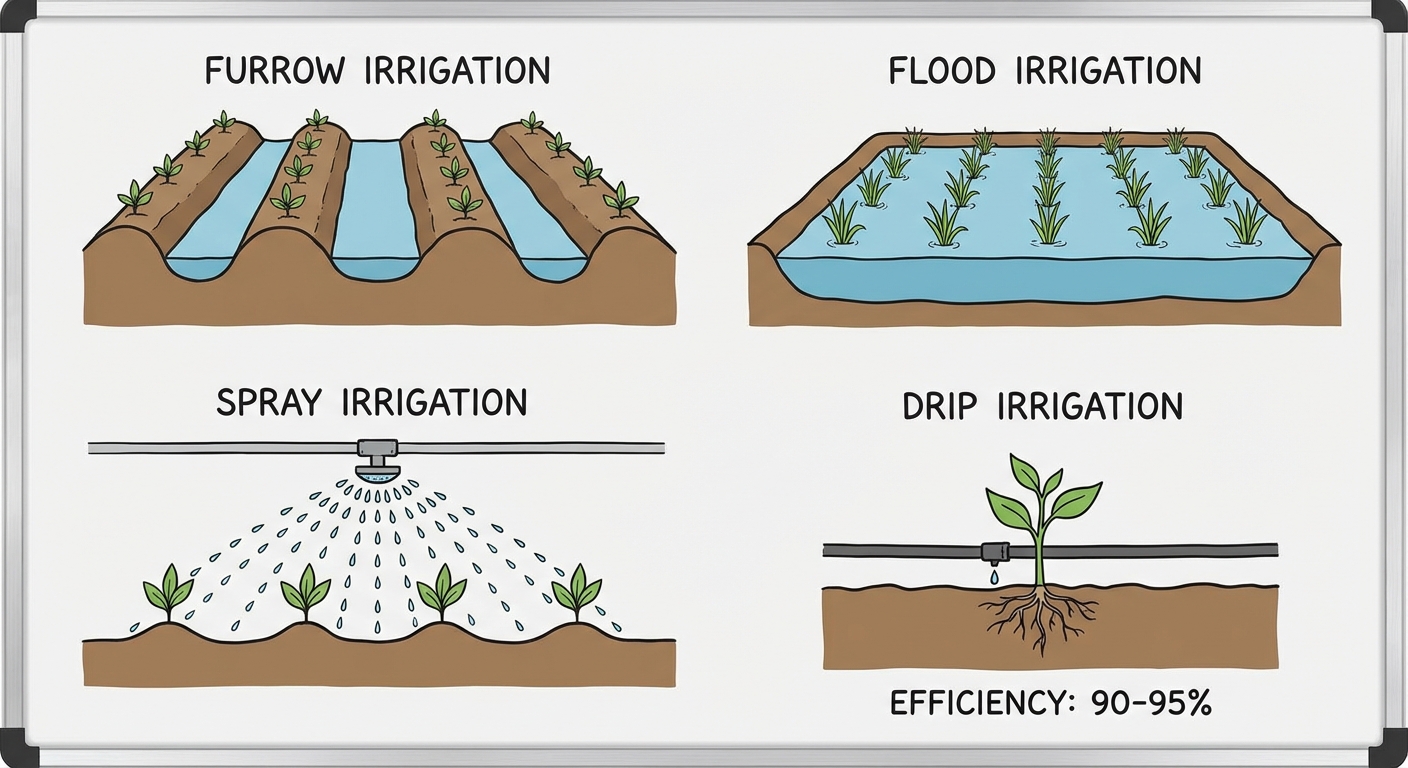
Irrigation uses approximately 70% of the world's freshwater. The efficiency of water use varies drastically by method.
Comparison of Methods
| Method | Description | Efficiency | Pros/Cons |
|---|---|---|---|
| Furrow | Cutting furrows (trenches) between crop rows and filling them with water. | ~66% | Pros: Low cost, low tech. Cons: High evaporation/runoff; significant soil erosion. |
| Flood | Flooding an entire field with water. | ~80% | Pros: Simple but disruptive to plant growth. Cons: Leads to waterlogging (roots drown due to lack of $O_2$). |
| Spray | Pumping water into apparatuses that spray it across fields (e.g., center-pivot). | 75%–95% | Pros: More efficient than flood. Cons: Expensive machinery and energy use. |
| Drip | Perforated hoses release small amounts of water directly at plant roots. | >95% | Pros: Most efficient; reduces weed growth. Cons: Very expensive; labor-intensive setup. |
Problems with Irrigation
- Waterlogging: Occurs when soil remains under water for prolonged periods, impairing root growth because roots cannot get oxygen.
- Salinization: A major problem in arid climates. Irrigation water contains small amounts of salt. When the water evaporates, the salt remains in the soil. Over time, salt concentrations reach toxic levels.
- Remedy: Flush the field with large amounts of freshwater to leach salts down below the root zone (though this uses even more water).
- Aquifer Depletion: Overusing groundwater (e.g., the Ogallala Aquifer in the US) can cause saltwater intrusion in coastal areas and sinkholes.
Pest Control Methods
Protecting crops from pests (weeds, insects, fungi) is a constant battle. The APES exam focuses heavily on the consequences of chemical intervention vs. integrated approaches.
The Pesticide Treadmill
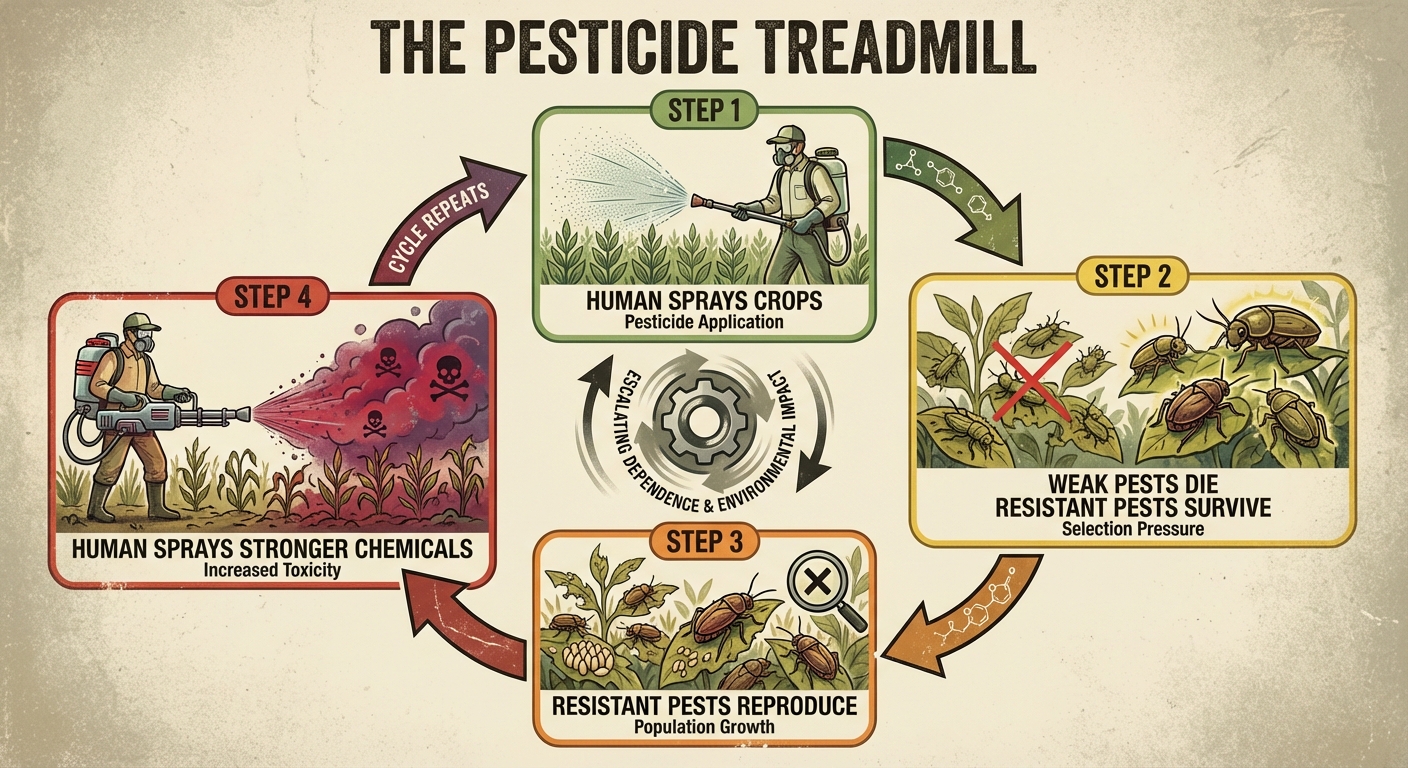
Unlike physical removal, chemical pesticides force natural selection.
- Pesticide is applied.
- Most pests die, but a few with a genetic resistance mutation survive.
- Survivors reproduce, passing the resistance trait to offspring.
- The farmer must use a stronger pesticide or higher dose.
This cycle is known as the Pesticide Treadmill.
Integrated Pest Management (IPM)
IPM is an ecosystem-based strategy that focuses on long-term prevention of pests or their damage through a combination of techniques. The goal is reduction, not total elimination.
Hierarchy of IPM (Start at the bottom):
- Biocontrol: Using natural predators (e.g., ladybugs to eat aphids) or bacteria (Bacillus thuringiensis).
- Intercropping: Planting different crops mixed together (e.g., push-pull system) to confuse pests or provide habitat for predators.
- Crop Rotation: Changing crops each season disrupts the life cycle of pests specific to one crop.
- Physical Barriers: Traps, fences, or picking pests by hand.
- Chemical Control: Used only as a last resort and in small, targeted quantities.
Meat Production Methods
As global affluence increases, meat consumption rises. Meat production is significantly less energy-efficient than plant agriculture due to the laws of thermodynamics (10% rule).
CAFOs (Concentrated Animal Feeding Operations)
Also known as feedlots. Large-scale industrial rearing of animals (cows, hogs, poultry) in high density.
- Advantages: Maximizes land use; keeps consumer prices low; efficient production.
- Disadvantages:
- Antibiotic Resistance: Antibiotics are given prophylactically to prevent disease spread in crowded conditions, adhering to the rise of "superbugs."
- Waste Management: Generates massive amounts of manure (often stored in lagoons). These lagoons can leak nitrates and bacteria (E. coli) into groundwater or overflow during floods.
- Diet: Animals are fed grains (corn/soy) rather than grass, which is energy-intensive to grow.
Free-Range Grazing
Animals roam on open land and feed on grass.
- Advantages: No preventative antibiotics needed; waste is spread naturally as fertilizer; mimics natural ecosystem; meat often has higher nutritional value.
- Disadvantages: Requires vast amounts of land; much more expensive for consumers.
- Overgrazing: If too many animals graze on limited land, they eat the grass faster than it can grow back. This leaves soil exposed to erosion and leads to desertification.
- Tragedy of the Commons: Overgrazing is a classic example of this concept when occurring on public lands.
Aquaculture (Fish Farming)
While distinct from terrestrial meat, it follows similar principles.
- High density leads to disease spread and waste accumulation.
- Escaped fish can become invasive species or outcompete native wild populations.
Common Mistakes & Pitfalls
- Biomagnification vs. Bioaccumulation:
- Bioaccumulation happens in one individual over its life (toxins build up in fat).
- Biomagnification happens up the food chain (the eagle has higher toxin ppm than the fish it eats). DDT and Mercury are the classic examples.
- Confusing Salinization and Acidification:
- Salinization comes from irrigation and evaporation.
- Acidification comes from acid rain or fertilizer runoff (nitrogen).
- IPM Misconception: Students often think IPM means "Organic" or "No Chemicals." This is wrong. IPM allows chemicals, but only when other methods fail and economic thresholds are crossed.
- GMO Definition: Do not say GMOs are "bad for your health" without nuance. The AP exam focuses on ecological impacts (loss of biodiversity) rather than unproven human health effects.