Comprehensive Guide to Force and Translational Dynamics
Systems, Fields, and Contact Forces
In AP Physics 1, dynamics is the study of why objects move the way they do. Before we can analyze motion, we must define what we are analyzing and what is influencing it.
Defining the System
The first step in any force problem is defining the System. A system is the specific object or group of objects that you are analyzing. Everything outside the system is the surroundings or environment.
- Single-Object System: We treat a rigid body as a particle. We analyze forces acting external to this object.
- Multi-Object System: We group connected objects (like a train of carts) together. Internal forces (like tension between the carts) cancel out and do not affect the motion of the center of mass of the system.
Types of Forces
A force ($F$) is an interaction between two objects that can cause a change in motion. It is a vector quantity (has magnitude and direction).
1. Contact Forces
These require physical touching between the system and the environment.
- Normal Force ($F_N$): Perpendicular force related to surface contact.
- Friction ($F_f$): Parallel force resisting sliding.
- Tension ($F_T$ or $T$): Pulling force through a rope, string, or cable.
- Spring Force ($F_s$): Restoring force from a deformed elastic object.
- Applied Force ($F_{app}$): General push or pull.
2. Field Forces (Long-Range)
These act over a distance without physical contact.
- Gravitational Force ($F_g$): The attractive force between two masses (usually Earth and an object).
Newton's First Law: Inertia
"An object at rest stays at rest, and an object in motion stays in motion with the same speed and in the same direction unless acted upon by an unbalanced force."
The Concept of Inertia
Inertia is the property of an object to resist changes in its state of motion.
- Mass ($m$) is the quantitative measure of inertia.
- The more mass an object has, the harder it is to accelerate.
- Note: Inertia is not a force. You never say "Inertia pushed the object."
Equilibrium
When the net force ($
u F$) on an object is zero, the object is in equilibrium.
There are two types of equilibrium:
- Static Equilibrium: The object is at rest ($v = 0$).
- Dynamic Equilibrium: The object moves with constant velocity ($v = \text{constant}$, $a = 0$).
Key Concept: If velocity is constant, the net force is ZERO. This is a common trap in MCQ questions.
Free-Body Diagrams (FBDs)
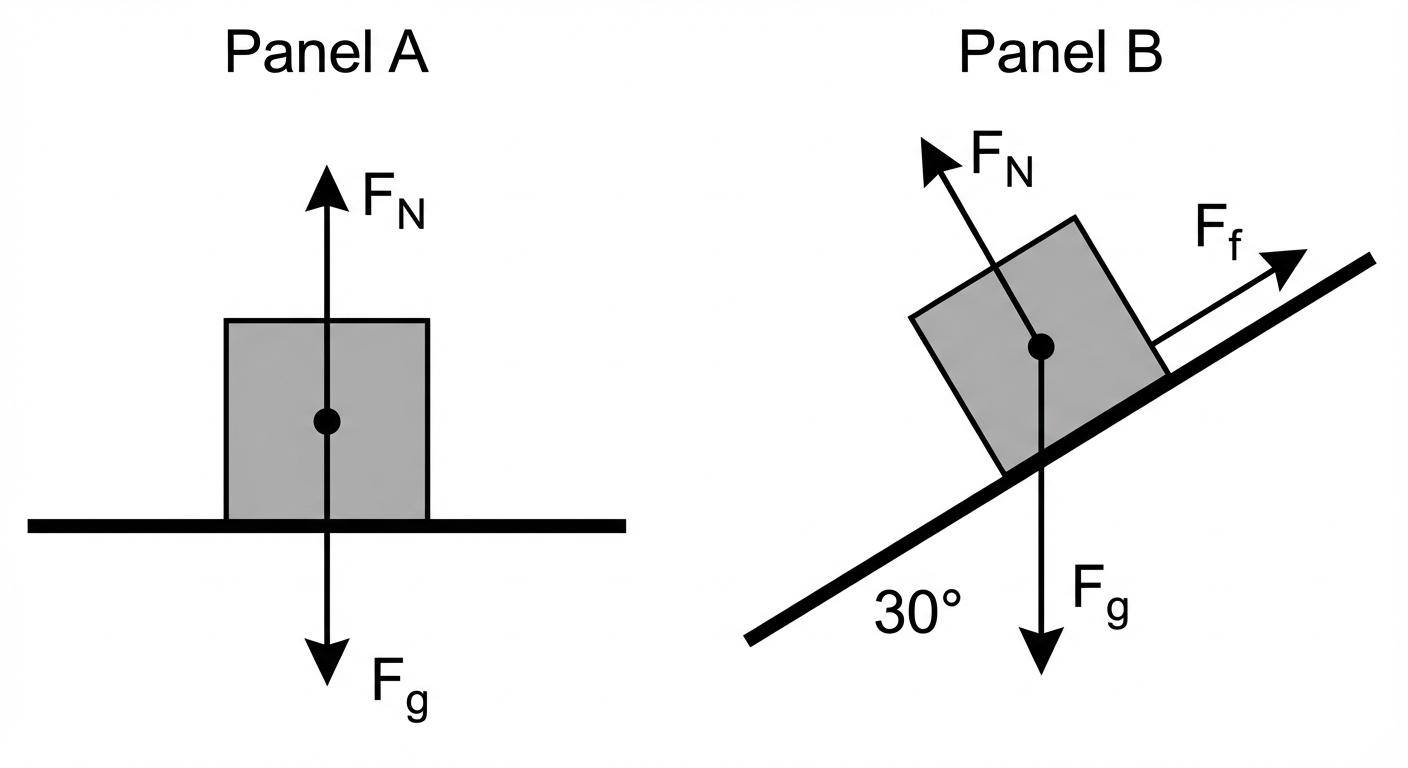
The Free-Body Diagram is the most critical tool in Unit 2. It is a visual representation of all forces acting on a system.
Rules for Drawing FBDs (College Board Standards)
- Represent the object as a dot or a box.
- Draw arrows originating from the dot pointing away in the direction of the force.
- Label every vector (e.g., $Fg$, $FN$, $T$).
- Do not include components in the main diagram (draw them off to the side if needed for math).
- Do not include velocity or acceleration vectors in the FBD.
Common Mistakes in FBDs
- The "Force of Motion": Students often draw a forward force just because an object is moving. If a ball is sliding on ice without friction, there is no forward force acting on it, even if it has forward velocity.
- Internal Forces: If analyzing a whole train, do not draw the tension between cars.
- Action-Reaction Pairs: Do not draw the force the object exerts on the ground; only draw the force the ground exerts on the object.
Newton's Second Law: $F=ma$
This law provides the mathematical link between force and motion.
Or, in its arguably more useful form:
Interpreting the Equation
- Cause and Effect: Net force is the cause; acceleration is the effect.
- Direction: The acceleration vector points in the exact same direction as the net force vector.
- Independence: Forces in the $x$-direction only affect acceleration in the $x$-direction; forces in the $y$-direction only affect acceleration in the $y$-direction.
Worked Example: The Elevator Problem
A 60 kg student stands in an elevator. Calculate the Normal Force ($F_N$) exerted by the floor on the student if the elevator accelerates upward at $2.0 \, m/s^2$. ($g \approx 10 \, m/s^2$)
Solution:
- FBD: $FN$ points up, $Fg$ points down.
- Newton's 2nd Law ($y$-axis): $\Sigma Fy = may$
- Equation: $FN - Fg = ma$
- Substitute: $FN - mg = ma \rightarrow FN = m(g+a)$
- Calculate: $F_N = 60(10 + 2) = 720 \, N$
Note: The student feels heavier because the floor must support their weight AND provide the extra force to accelerate them upward.
Gravitational Force and Weight
Weight is the force of gravity acting on an object.
- $m$: Mass (kg) — Scalar, never changes regardless of location.
- $g$: Gravitational field strength ($N/kg$) or acceleration due to gravity ($m/s^2$). On Earth, $g \approx 9.8 \, m/s^2$ (AP exams often allow $10 \, m/s^2$).
Mass vs. Weight Table
| Feature | Mass ($m$) | Weight ($F_g$) |
|---|---|---|
| Definition | Measure of inertia/matter | Force regarding gravity |
| Type | Scalar | Vector |
| Units | Kilograms ($kg$) | Newtons ($N$) |
| Dependency | Constant everywhere | Changes based on gravity |
Normal Force and Friction
Normal Force ($F_N$)
The Normal Force is a contact force exerted by a surface perpendicular to the object reacting against it.
- It is a specific response force.
- Crucial Rule: $F_N$ is not always equal to $mg$. It depends on the scenario (inclines, applied vertical forces, elevators).
Friction ($F_f$)
Friction is a resistive force parallel to the surface, opposing the direction of attempted or actual sliding.
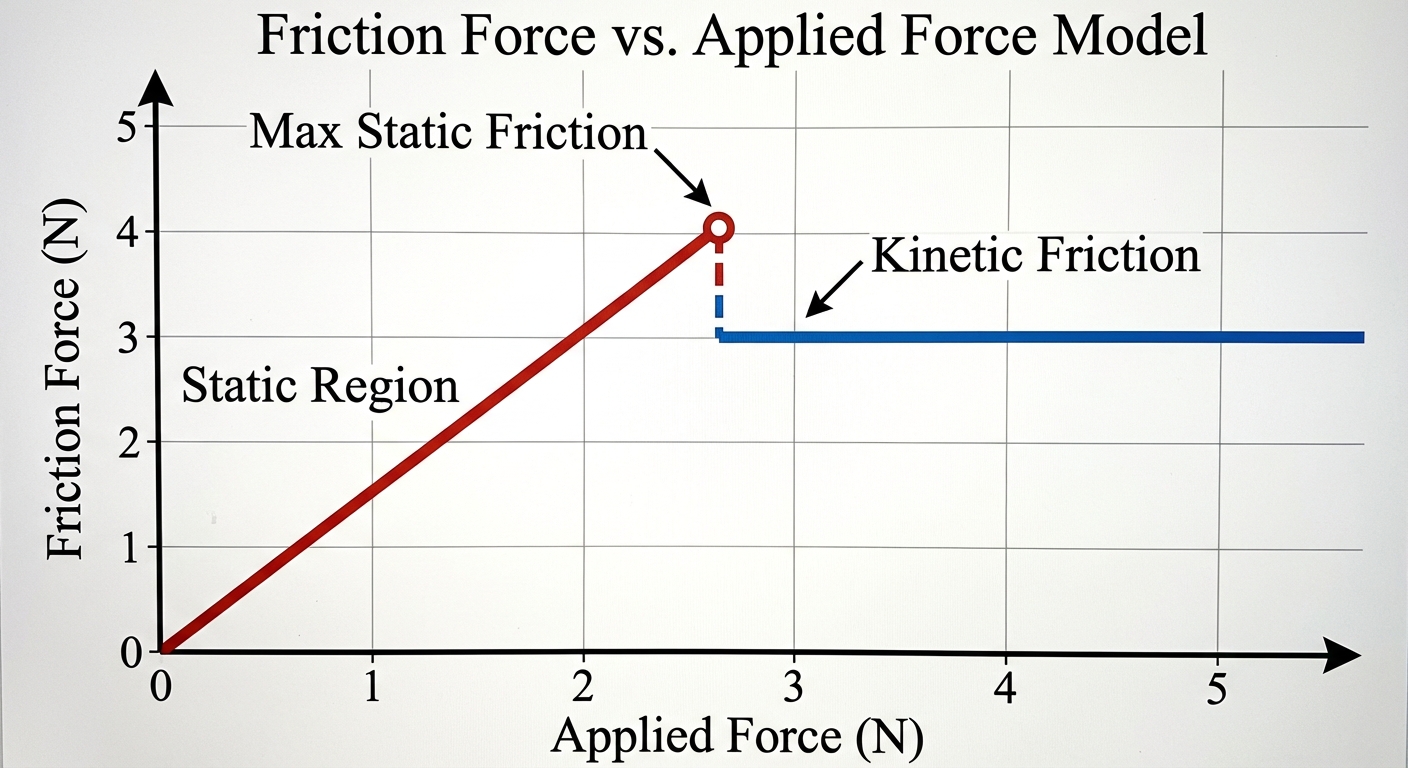
1. Static Friction ($F_{fs}$)
Acts when surfaces are not sliding relative to each other. It prevents motion.
- It is a "smart" force. It will match the applied force exactly until it reaches a maximum limit.
- Formula (Inequality):
- $\mu_s$: Coefficient of static friction (dimensionless, depends on materials).
2. Kinetic Friction ($F_{fk}$)
Acts when surfaces are sliding relative to each other.
- It is generally constant regardless of speed.
- Formula (Equality):
Key Comparisons
- Usually $\mus > \muk$ (It is harder to start moving an object than to keep it moving).
- Friction does NOT depend on surface area of contact.
Newton's Third Law: Interaction Pairs
"For every action, there is an equal and opposite reaction."
This phrasing is famous but often misunderstood. A better phrasing is:
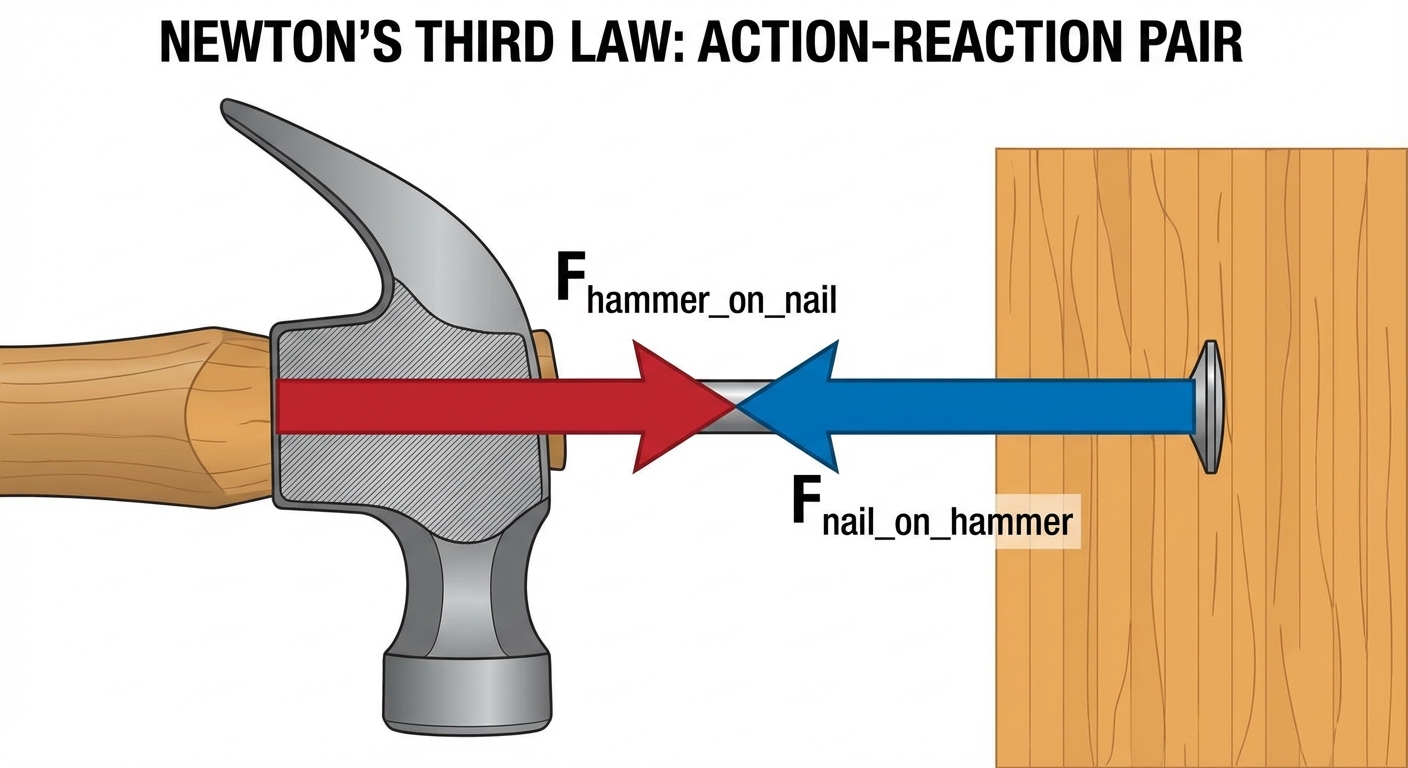
"When Object A exerts a force on Object B, Object B exerts a force of equal magnitude and opposite direction on Object A simultaneously."
Rules for Third Law Pairs
- Must involve two different objects (If both forces act on the same object, they are not a pair).
- Must be the same type of force (Gravity pairs with gravity; Normal pairs with Normal).
Example:
- You push a wall ($F{hand \to wall}$). The wall pushes you back ($F{wall \to hand}$).
- Reference: A bug hits a windshield. The force on the bug is equal to the force on the car. The acceleration of the bug is massive because its mass is tiny ($a = F/m$).
Tension and Pulleys
Tension ($T$) is the pulling force transmitted via a string, rope, or cable.
- Ideal Strings: Massless and unstretchable. Tension is uniform throughout the string.
- Ideal Pulleys: Massless and frictionless. They only change the direction of the force, not the magnitude.
The Atwood Machine
An Atwood machine consists of two masses ($m1, m2$) connected by a string over a pulley.
Strategy: The System Method
Instead of solving two separate systems, "unfold" the system mentally into a straight line.
- Net Driving Force: The difference in weights (or weight vs friction).
- Total Mass: The sum of all moving masses.
- System Acceleration:
Inclined Planes
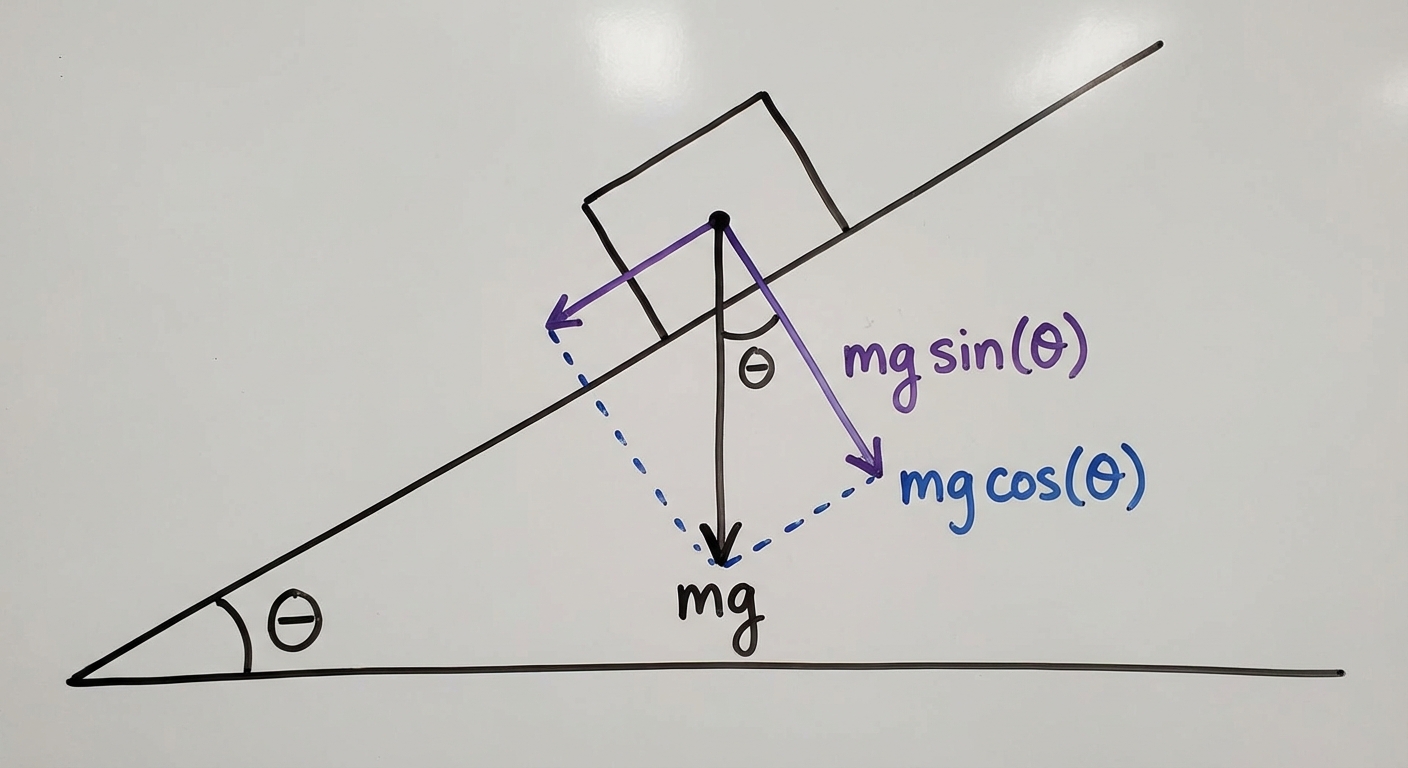
When an object sits on a ramp, gravity acts straight down, but the motion is constrained along the slope. It is mathematically easier to tip the coordinate system.
- x-axis: Parallel to the slope (down the ramp).
- y-axis: Perpendicular to the slope.
Vector Components on an Incline
Gravity ($mg$) must be broken into components:
Perpendicular Component (into the ramp):
(Controls Normal Force)Parallel Component (down the ramp):
(Causes acceleration)
Memory Aid:
"Sine slides down the Side." (The Sine acts down the incline).
"Cosine keeps it Close." (The Cosine pushes close against the surface).
Standard Incline Equations
If a block slides down an incline with friction:
- $y$-direction: $FN - mg\cos\theta = 0 \implies FN = mg\cos\theta$
- $x$-direction: $mg\sin\theta - F_f = ma$
- From this, you can often derive that acceleration $a = g(\sin\theta - \mu\cos\theta)$. Notice mass cancels out!
Spring Forces (Hooke's Law)
Springs exert a restoring force proportional to the displacement from their equilibrium (rest) position.
- $k$: Spring constant ($N/m$). Represents stiffness (high $k$ = stiff spring).
- $x$: Displacement from equilibrium ($m$).
- Direction: Always opposite to the displacement.
Common Mistakes & Pitfalls
- Assuming $FN = mg$: This is only true on a flat surface with no vertical acceleration or extra vertical forces. On an incline, $FN = mg\cos\theta$. In an elevator accelerating up, $F_N > mg$.
- Newton's 3rd Law Confusion: Students often think the "reaction" to the Earth pulling a book down ($Gravity$) is the table pushing the book up ($Normal$). WRONG. These act on the same object. The reaction to Earth pulling the book is the book pulling the Earth up.
- Static vs. Kinetic Friction: Using $\muk$ for a stationary object or $\mus$ for a moving one. Check if it's sliding!
- Inertia as a Force: Never draw "Inertia" on a Free Body Diagram. It is a property, not a force.
- Centripetal Force: (Preview for Unit 3) Never label a force "$F_c$" on a diagram. Centripetal force is the result of other forces (like tension, gravity, or friction), not a physical force itself.