Master Guide: AP Precalculus Unit 2 - Logarithmic Functions
Logarithmic Expressions and Functions
The Definition of a Logarithm
At its core, a logarithm is an exponent. It allows us to solve for the variable when it is located in the exponent of an equation. Logarithms are the inverse functions of exponential functions.
Consider the exponential equation $b^y = x$. To isolate $y$, we rewrite this in logarithmic form:
Where:
- $b$ is the base (must be $b > 0$ and $b \neq 1$).
- $x$ is the argument (must be $x > 0$).
- $y$ is the exponent that base $b$ needs to reach $x$.
Common and Natural Logarithms
While a logarithm can have any valid base, two specific bases are used so frequently in calculus and science that they have unique notations:
| Name | Base | Notation | Example |
|---|---|---|---|
| Common Logarithm | Base 10 | $\log(x)$ | $\log(100) = 2$ because $10^2 = 100$ |
| Natural Logarithm | Base $e$ | $\ln(x)$ | $\ln(e) = 1$ because $e^1 = e$ |
Evaluating Expressions
To evaluate a logarithm without a calculator, ask yourself: "The base to the power of what equals the argument?"
- Example 1: Evaluate $\log_2(32)$.
- Thought process: $2^? = 32$. Since $2^5 = 32$, the answer is $5$.
- Example 2: Evaluate $\log_{5}\left(\frac{1}{25}\right)$.
- Thought process: $5^? = \frac{1}{25}$. Since $5^2 = 25$ helping us find the magnitude, and negative exponents create reciprocals, $5^{-2} = \frac{1}{25}$. The answer is $-2$.
Logarithmic Function Graphs and Transformations
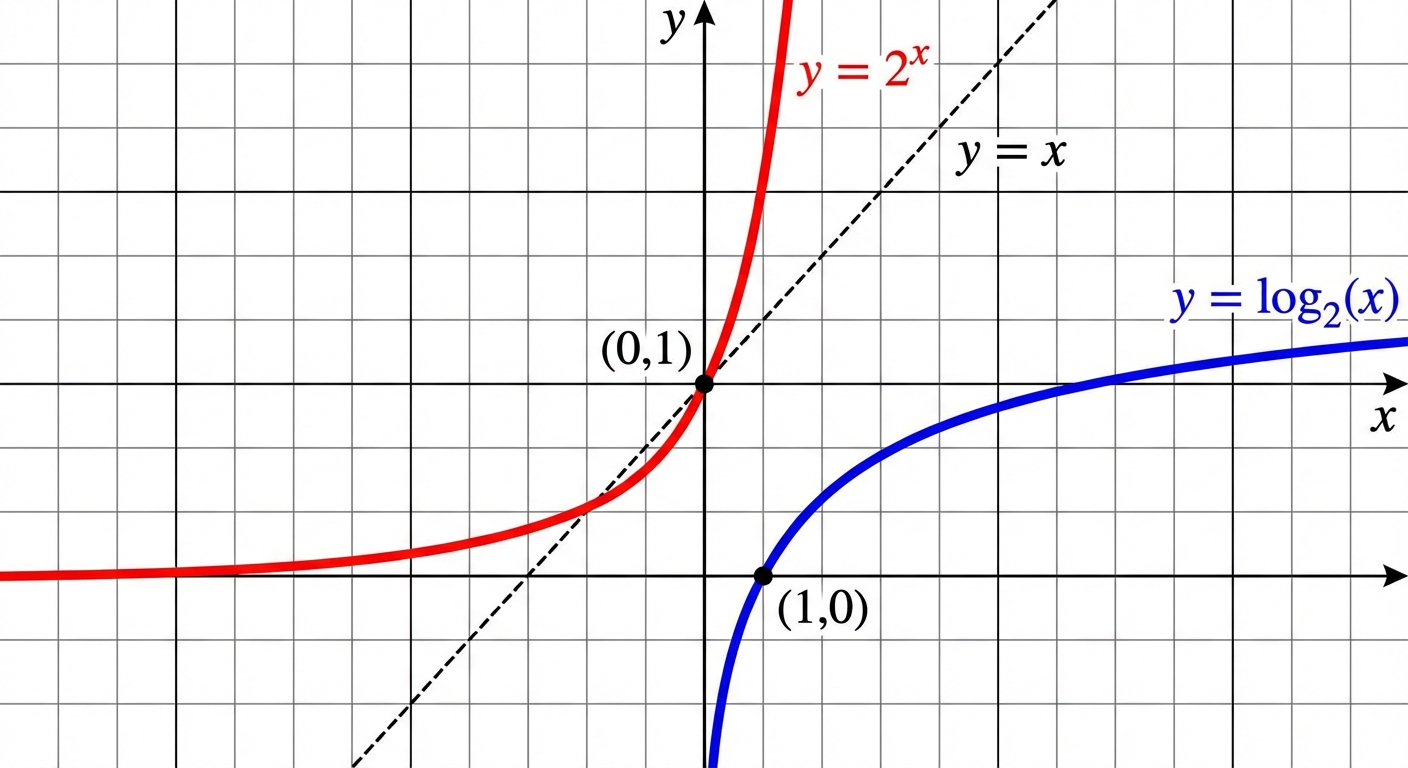
Because logarithmic functions are inverses of exponential functions, their graphs reflect the exponential graph across the line $y = x$. This swaps the domain and range.
Key Features of the Parent Function $f(x) = \log_b(x)$
- Domain: $(0, \infty)$. You cannot take the log of a zero or negative number.
- Range: $(-\infty, \infty)$.
- Vertical Asymptote: There is always a vertical asymptote at $x = 0$ (the y-axis) for the parent function.
- Intercept: The graph passes through $(1, 0)$ because $b^0 = 1$.
- Concavity:
- For $b > 1$, the function is increasing and concave down (increasing at a decreasing rate).
- For $0 < b < 1$, the function is decreasing and concave up.
Transformations
The general form for a transformed logarithmic function is:
- Vertical Asymptote: Located at $x = h$.
- Horizontal Shift: $h$ shifts the graph left or right. Defined by the argument becoming zero ($x-h=0$).
- Vertical Shift: $k$ shifts the graph up or down.
- Dilation/Reflection: $a$ determines vertical stretch/compression and reflection across the x-axis.
Worked Example: Visualizing Transformations
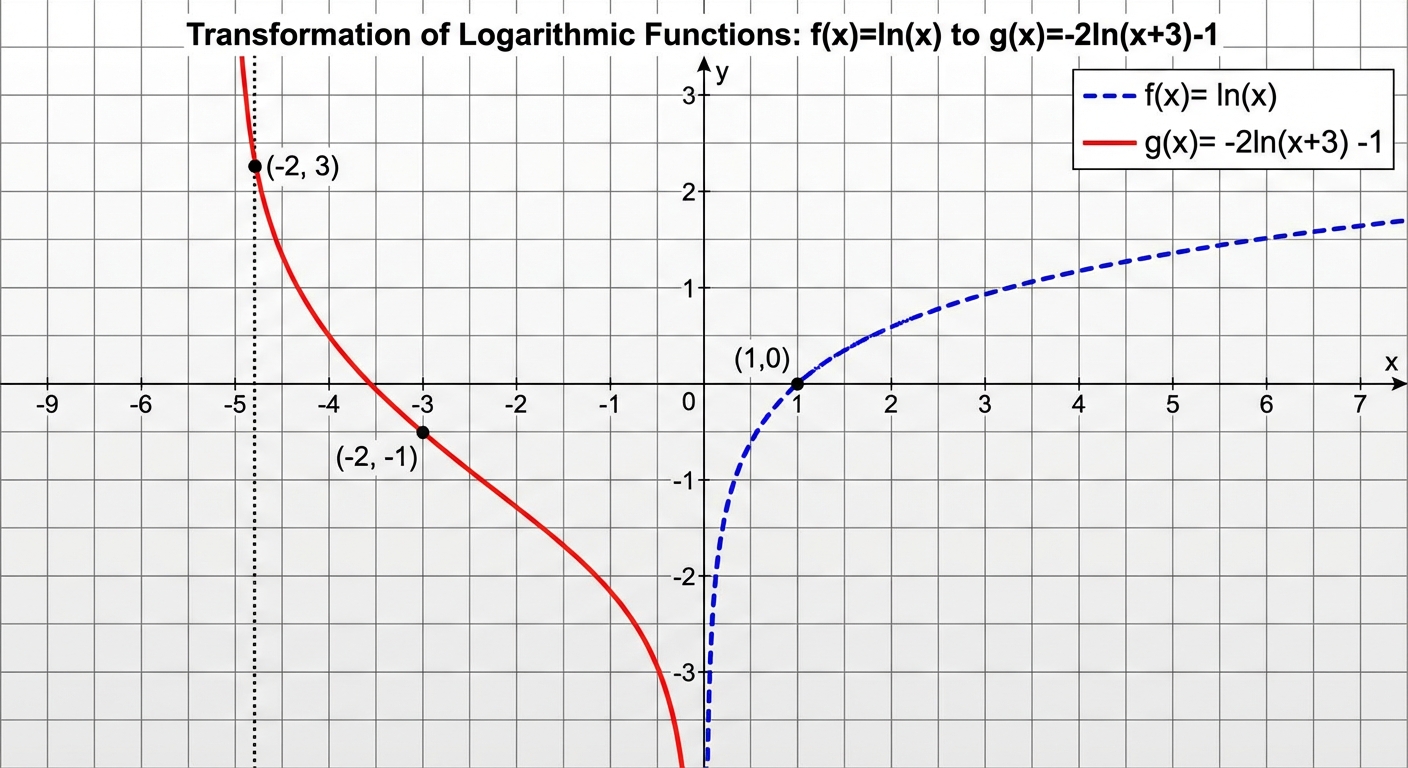
Describe the transformation of $g(x) = -2 \ln(x + 3) - 1$ from the parent function $f(x) = \ln(x)$.
- Shift Left 3: Due to $(x+3)$, the Vertical Asymptote moves from $x=0$ to $x=-3$.
- Vertical Stretch by 2: The $2$ acts as a dilation factor.
- Reflection: The negative sign flips the graph over the x-axis (changing it from increasing to decreasing).
- Shift Down 1: The $-1$ moves the whole graph down.
Properties of Logarithms
Logarithmic properties allow us to expand complex arguments into simpler terms or condense multiple logs into a single term. These are derived directly from exponent rules.
The Three Fundamental Laws
Product Property: The log of a product is the sum of the logs.
Quotient Property: The log of a quotient is the difference of the logs.
Power Property: The exponent on the argument moves to the front.
Change of Base Formula
Calculators often only have $\log$ and $\ln$ buttons. To evaluate a log with a different base, $c$, use:
Example: Expansion
Expand $\log_3\left(\frac{9x^4}{\sqrt{y}}\right)$.
\begin{aligned} \log3(9x^4) - \log3(y^{1/2}) & \quad \text{(Quotient Rule)} \ \log3(9) + \log3(x^4) - \log3(y^{1/2}) & \quad \text{(Product Rule)} \ 2 + 4\log3(x) - \frac{1}{2}\log_3(y) & \quad \text{(Power Rule & Evaluation)} \end{aligned}
Solving Exponential and Logarithmic Equations
Type 1: Solving Exponential Equations
If the variable is in the exponent, take the logarithm of both sides (usually $\ln$) to bring the variable down using the Power Property.
Example: Solve $5^{2x} = 18$.
Type 2: Solving Logarithmic Equations
If the variable is inside a log, isolate the log term and then exponentiate both sides (convert to exponential form).
Example: Solve $\log2(x) + \log2(x-2) = 3$.
- Condense first (crucial step):
- Exponentiate (base 2):
- Solve Quadratic:
- Check for Extraneous Solutions:
If we plug $x = -2$ back into the original equation, we get $\log_2(-2)$, which is undefined. Therefore, $x = -2$ is extraneous.
Final Answer: $x = 4$.
Common Mistakes & Pitfalls
The "False" Distributive Property:
- Mistake: $\log(a + b) \rightarrow \log(a) + \log(b)$ NO!
- Correction: There is no property for the log of a sum. $\log(a) + \log(b) = \log(ab)$.
Ignoring Domain Restrictions (Extraneous Solutions):
- Mistake: Solving a log equation and keeping all answers derived from the algebra.
- Correction: Always plug solutions back into the original log terms. If any argument is negative or zero, that solution is extraneous.
Confusing Inverses:
- Mistake: Thinking $\frac{\log x}{\log y} = \log(x-y)$.
- Correction: That is the Change of Base formula resulting in $\log_y(x)$. The property is $\log(\frac{x}{y}) = \log x - \log y$.
Notation Errors:
- Mistake: Writing $\logb x^p$ when you mean $(\logb x)^p$.
- Correction: The Power Property only applies if the exponent is immediately attached to the argument inside the log, not the whole function.