Unit 1: Foundations of American Democracy
Ideals of Democracy
At the core of the United States political system lie five fundamental values derived largely from the Enlightenment era. These ideals form the lens through which we interpret the Constitution and American political culture.
Key Concepts and Definitions
- Limited Government: The government is restricted in what it may do, and every individual has certain rights that government cannot take away. This prevents tyranny.
- Natural Rights: Fundamental rights of all humans, not received from a government, but bestowed by nature or God. John Locke famously defined these as "life, liberty, and property."
- Popular Sovereignty: The concept that political power resides with the people. Government draws its authority from the consent of the governed.
- Republicanism: A representative form of government where the people elect officials to create and enforce laws, rather than voting directly on every issue.
- Social Contract: An agreement between the ruled and their rulers (ideas from Rousseau and Locke). The people surrender some freedom to the state in exchange for protection of their natural rights. If the government breaks this contract, the people have the right to revolt.
The Declaration of Independence
Thomas Jefferson drafted this document (1776) as a breakup letter to Great Britain. It is the practical application of Enlightenment philosophy.
- Locke’s Influence: Jefferson changed Locke's "property" to "the pursuit of happiness."
- Function: It establishes the ideals of the U.S. (liberty, equality), but it constitutes no legal power or framework for governance today.
Types of Democracy
While the U.S. is a representative democracy (republic), political scientists categorize how influence is distributed into three models. Note that the U.S. exhibits characteristics of all three simultaneously.
| Model | Definition | Example | Key Document |
|---|---|---|---|
| Participatory Democracy | Broad participation in politics and civil society by citizens. Direct action. | Town hall meetings, referendums, initiatives. | Brutus No. 1 (Argued for small, local republics). |
| Pluralist Democracy | Group-based activism by nongovernmental interests striving for impact on political decision-making. | Interest groups (NRA, NAACP) lobbying Congress. | Federalist No. 10 (Factions compete and check each other). |
| Elite Democracy | Decisions are made by elected representatives acting as trustees; emphasizes limited participation by the wealthy or educated. | The Electoral College, Supreme Court appointments. | Constitution (Original intent of Senate elections). |
The Constitution: Drafting and Compromise
The Constitution was not the first U.S. government. It replaced the Articles of Confederation, which failed due to a lack of centralized power.
The Failure of the Articles of Confederation
Under the Articles, the national government was weak on purpose (fear of tyranny).
- Weaknesses: No power to tax, no standing army, no regulation of interstate commerce, requiring 9/13 states to pass laws and 13/13 to amend.
- Tipping Point: Shays' Rebellion (1786). Farmers rebelled against foreclosures. The weak federal government could not raise an army to stop it, proving the need for a stronger central fix.
Major Compromises at the Convention
When delegates met to fix the Articles, they created a new blueprint.
The Great (Connecticut) Compromise: Solved the dispute between large and small states regarding representation.
- Virginia Plan: Representation based on population (favored large states).
- New Jersey Plan: Equal representation per state (favored small states).
- Result: A Bicameral Legislature. The House of Representatives is based on population; the Senate has equal representation (2 per state).
The Three-Fifths Compromise: Southern states wanted slaves counted for representation (to gain power) but not taxation. The compromise counted 3 out of every 5 slaves for both representation and direct taxation.
The Electoral College: A compromise between the election of the President by a vote in Congress and election by popular vote of qualified citizens.
Importation of Slaves: Congress could not ban the slave trade for 20 years (until 1808).
The Amendment Process (Article V)
The Constitution is a living document because it is adaptable, though difficult to change.
- Proposal: 2/3 vote in both houses of Congress OR National Convention called by 2/3 of states.
- Ratification: 3/4 of state legislatures OR 3/4 of state ratifying conventions.
Separation of Powers and Checks and Balances
These two concepts are distinct but often confused.
- Separation of Powers: The division of government responsibilities into distinct branches to limit any one branch from exercising the core functions of another.
- Legislative: Makes laws.
- Executive: Enforces laws.
- Judicial: Interprets laws.
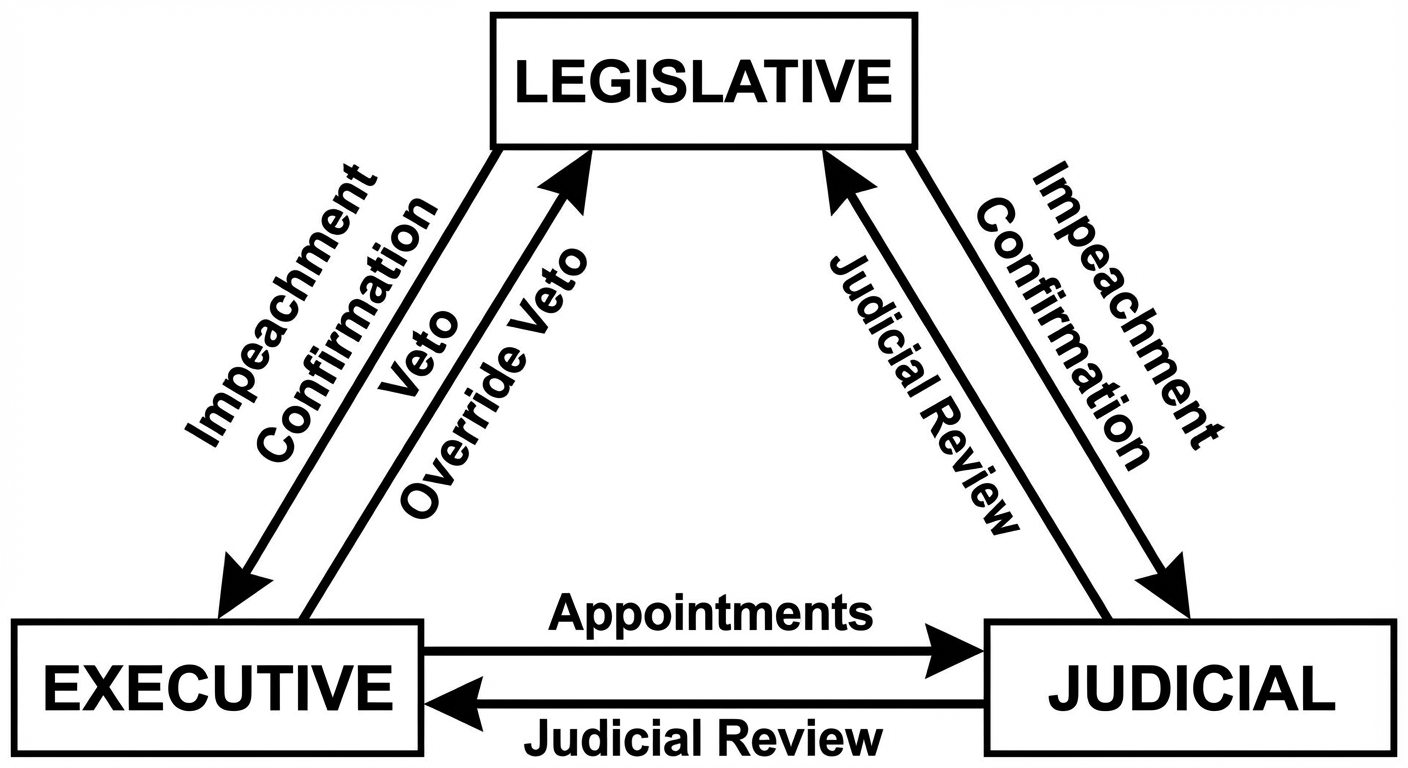
- Checks and Balances: Giving each of the branches the power to restrict the actions of the others.
Madison's Argument: Federalist No. 51
James Madison argued that "Ambition must be made to counteract ambition." By giving each branch a will of its own and the means to defend itself, no single branch would become tyrannical.
Real-World Examples of Checks
- Congress vs. President: Congress passes a bill -> President vetoes it -> Congress overrides veto (2/3 vote).
- President vs. Courts: President nominates judges -> Senate confirms them.
- Courts vs. Congress/President: The Supreme Court declares a law or executive action unconstitutional (Judicial Review).
Federalism
Federalism is the sharing of power between a national government and the states. This is a "vertical" division of power.
Categories of Power
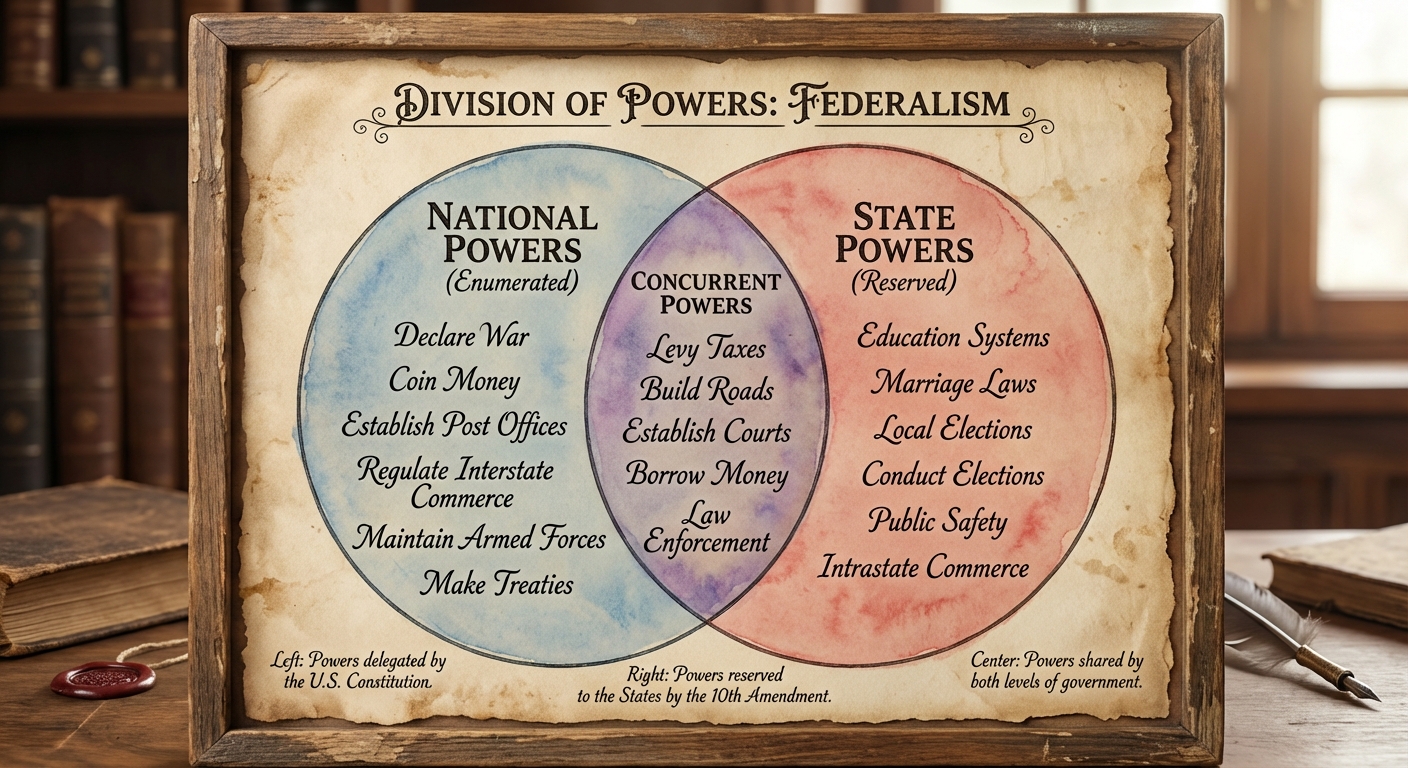
- Exclusive/Enumerated Powers: Powers belonging only to the federal government (e.g., maintain army, declare war, coin money, regulate interstate commerce).
- Reserved Powers: Powers held by the states, derived from the 10th Amendment (e.g., schools, marriage/driver’s licenses, conducting elections).
- Concurrent Powers: Powers held by both (e.g., levying taxes, borrowing money, establishing courts).
Constitutional Clauses defining Federalism
- Supremacy Clause (Article VI): The Constitution and federal laws are superior to state laws.
- Commerce Clause (Article I, Sec 8): Congress regulates commerce with foreign nations and between states. This has been used to significantly expand federal power.
- Necessary and Proper Clause (Elastic Clause): Congress can make laws "necessary and proper" to carry out their enumerated powers. implied powers.
Evolution of Federalism
- Dual Federalism (Layer Cake): Clear separation between state and federal spheres (up to the 1930s).
- Cooperative Federalism (Marble Cake): Boundaries are blurred; federal government intervenes in state areas (e.g., The New Deal, Interstate Highway System).
- Fiscal Federalism: The pattern of spending, taxing, and providing grants in the federal system.
Types of Grants (The "Carrot")
- Categorical Grants: Money for a specific purpose (e.g., "Build a bridge here"). Strings attached.
- Block Grants: Money for a general purpose (e.g., "Transportation"). States prefer these because they offer more flexibility.
- Mandates: Orders the states must follow (sometimes unfunded, like the Americans with Disabilities Act).
Key Supreme Court Cases
McCulloch v. Maryland (1819)
- Issue: Can Congress create a bank? Can a state tax that bank?
- Ruling: Yes to bank (Necessary and Proper Clause); No to tax (Supremacy Clause).
- Significance: Established Implied Powers and reaffirmed federal supremacy.
United States v. Lopez (1995)
- Issue: Could Congress use the Commerce Clause to ban guns in school zones?
- Ruling: No. Possessing a gun is not an economic activity.
- Significance: First modern limit on the reach of the Commerce Clause; a win for state power (Devolution).
Common Mistakes & Pitfalls
Separation of Powers vs. Federalism:
- Mistake: Using the terms interchangeably.
- Correction: Separation of Powers is Horizontal (Legislative/Executive/Judicial). Federalism is Vertical (National vs. State).
The Declaration is NOT Law:
- Mistake: Citing the Declaration of Independence as the legal basis for a right.
- Correction: The Declaration states our ideals, but the Constitution is the supreme law. You cannot "violate" the Declaration in a legal sense.
Articles of Confederation vs. Constitution:
- Mistake: Thinking the Bill of Rights was in the Articles.
- Correction: The Articles had no Bill of Rights and no strong executive. The Bill of Rights was added to the Constitution to satisfy Anti-Federalist concerns.
Federalist No. 10 vs. No. 51:
- Mistake: Confusing Madison's two essays.
- Memory Aid: Fed 10 is about factions (looks like 'IO' -> Interest Groups/Organisations). Fed 51 is about Separation of Powers (5 roughly equals 1? No. Ambition counteracts ambition).