Unit 5: Analytical Applications — Existence Theorems and Extrema Analysis
The Mean Value Theorem (MVT)
The Mean Value Theorem is one of the most significant existence theorems in calculus. It connects the average rate of change of a function over an interval to the instantaneous rate of change at a specific point within that interval.
Definitions and Conditions
For the Mean Value Theorem to apply, a function $f(x)$ must satisfy two specific hypotheses:
- Continuity: $f(x)$ must be continuous on the closed interval $[a, b]$.
- Differentiability: $f(x)$ must be differentiable on the open interval $(a, b)$.
If these conditions are met, the theorem guarantees that there exists at least one number $c$ such that $a < c < b$ where:
Geometric Interpretation
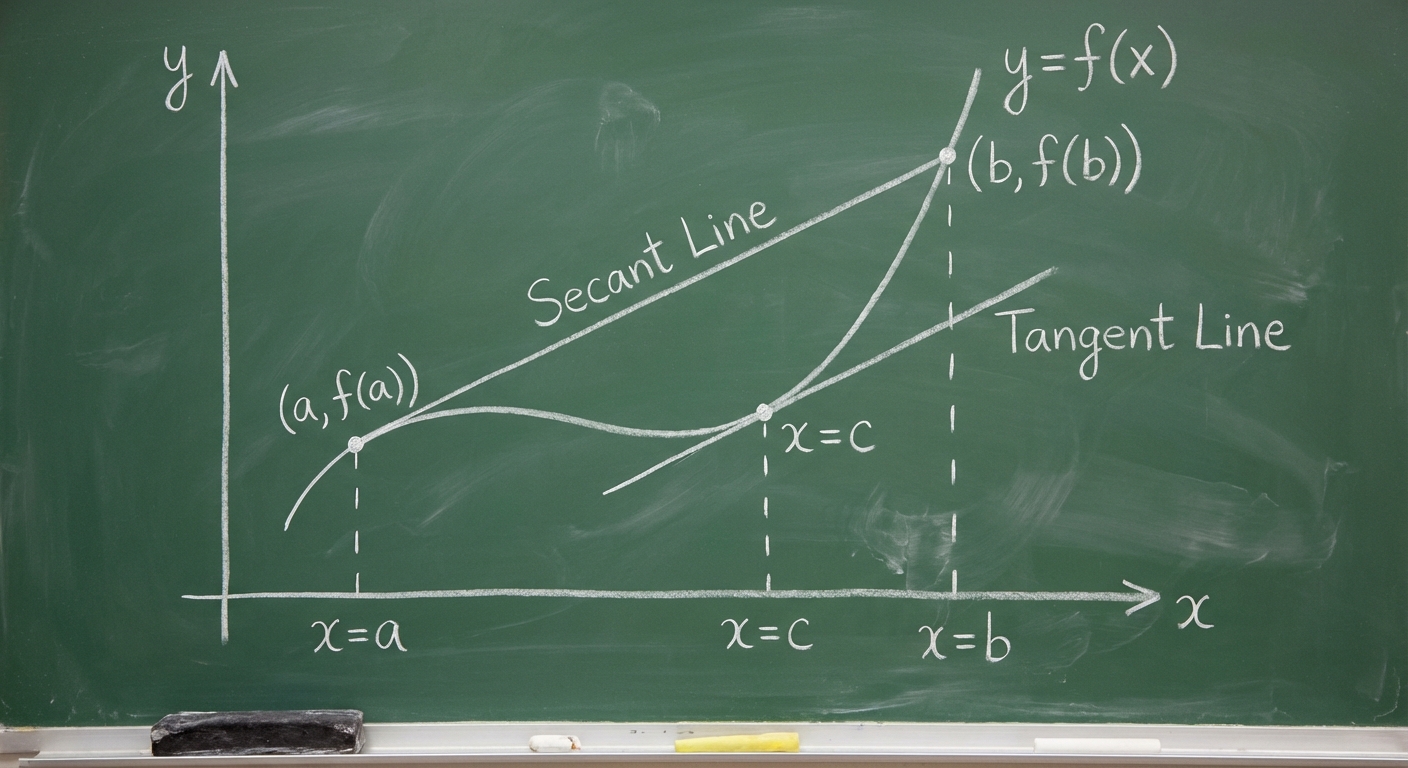
Geometrically, the Right Hand Side (RHS) of the equation represents the slope of the secant line connecting the endpoints $(a, f(a))$ and $(b, f(b))$. The Left Hand Side (LHS), $f'(c)$, represents the slope of the tangent line at $x=c$.
The theorem implies that somewhere between points $A$ and $B$, there is at least one point on the curve where the tangent line is parallel to the secant line connecting $A$ and $B$.
Rolle's Theorem
Rolle's Theorem is a special case of the MVT. It demands the same continuity and differentiability conditions, but adds a third condition: $f(a) = f(b)$.
If $f(a) = f(b)$, then the slope of the secant line is 0. Therefore, there must be at least one $c$ in $(a, b)$ such that:
This guarantees the existence of a horizontal tangent.
Worked Example: MVT
Problem: Find the value(s) of $c$ that satisfy the MVT for $f(x) = x^3 - x$ on the interval $[0, 2]$.
Solution:
- Check Conditions: $f(x)$ is a polynomial, so it is continuous and differentiable everywhere. Conditions satisfied.
- Calculate Average Rate of Change:
- Set Derivative Equal to Average Slope:
- Solve for c:
- Check Interval: We only keep values in $(0, 2)$.
(The negative value is outside the interval).
Extreme Value Theorem and Finding Extrema
The Extreme Value Theorem (EVT)
The Extreme Value Theorem guarantees the existence of absolute extrema under specific conditions. It states:
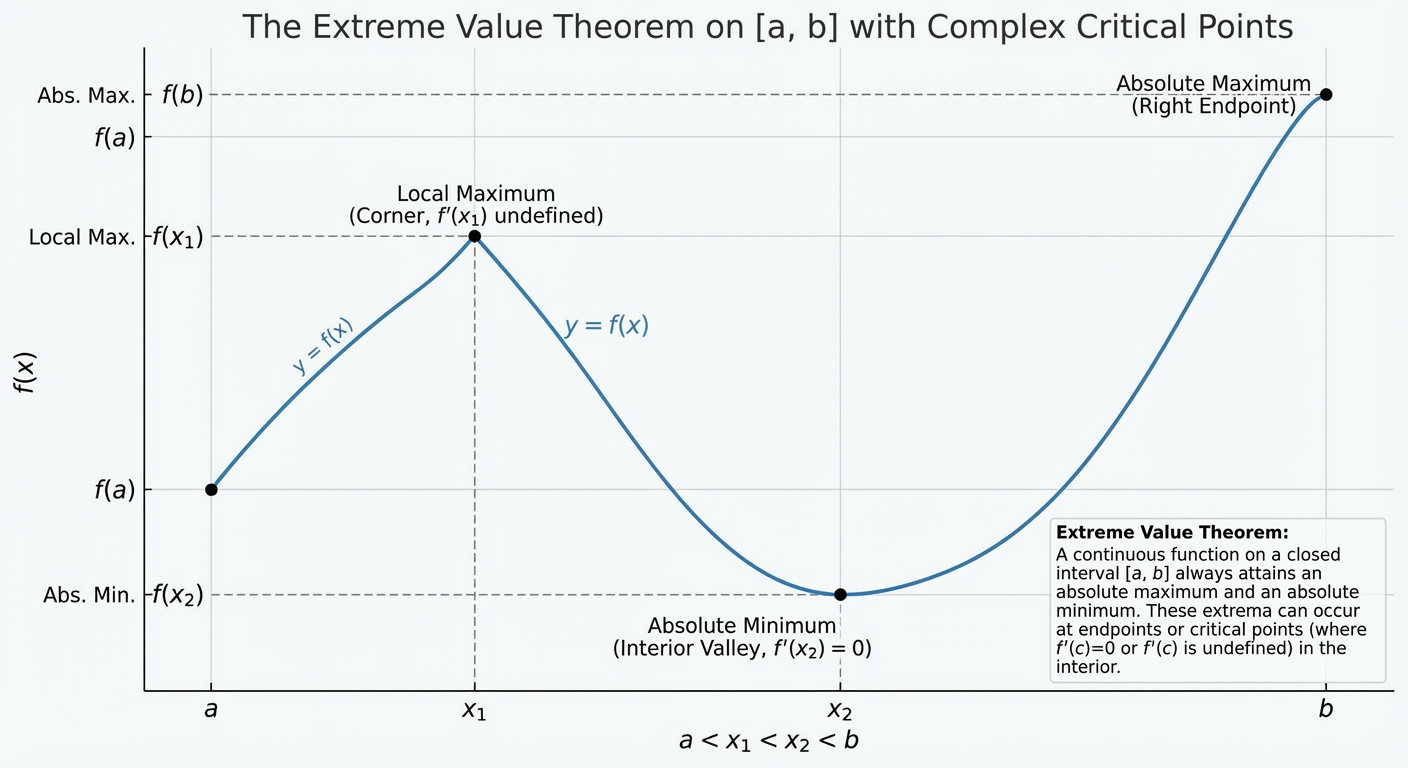
If $f(x)$ is continuous on a closed interval $[a, b]$, then $f(x)$ attains both an Absolute Maximum and an Absolute Minimum on $[a, b]$.
Unlike MVT, differentiability is not required for EVT—only continuity.
Critical Points
To find extrema, we must locate Critical Points. A critical point occurs at $x=c$ if:
- $f'(c) = 0$ (Stationary point)
- $f'(c)$ is undefined (Points of non-differentiability, like corners or cusps)
Types of Extrema
- Local (Relative) Extrema: The highest or lowest point in a specific neighborhood (e.g., a "peak" or "valley"). Found using the First or Second Derivative Tests.
- Absolute (Global) Extrema: The highest or lowest $y$-value on the entire domain or interval.
Candidates Test for Absolute Extrema
When finding absolute extrema on a closed interval, you should not rely solely on the First Derivative Test (number lines). Instead, use the Candidates Test (also known as the Closed Interval Method or Table Method).
Algorithm: The Candidates Test
To find the absolute max/min of continuous function $f$ on $[a, b]$:
- Differentiate: Find $f'(x)$.
- Find Critical Points: Solve $f'(x) = 0$ and identify where $f'(x)$ is undefined. Keep only the critical points strictly inside $(a, b)$.
- Evaluate: Calculate the function value $f(x)$ at:
- Every valid critical point found in Step 2.
- The endpoints $a$ and $b$.
- Compare: The largest $y$-value is the Absolute Maximum; the smallest $y$-value is the Absolute Minimum.
Worked Example: Candidates Test
Problem: Find the absolute maximum and minimum of $f(x) = 2x^3 - 3x^2 - 12x + 1$ on the interval $[-2, 3]$.
Solution:
Find Derivative: $f'(x) = 6x^2 - 6x - 12$.
Identify Critical Points:
Set $f'(x) = 0$:
Critical points at $x = 2$ and $x = -1$. Both are inside $[-2, 3]$.Evaluate Candidates (Table Method):
- Endpoint $x = -2$:
- Critical Point $x = -1$:
- Critical Point $x = 2$:
- Endpoint $x = 3$:
- Endpoint $x = -2$:
Conclusion:
- Absolute Maximum: $8$ (occurs at $x = -1$)
- Absolute Minimum: $-19$ (occurs at $x = 2$)
Common Mistakes & Pitfalls
- Ignoring Conditions: Students often apply MVT to functions that are not differentiable (e.g., $f(x) = |x|$ on $[-1, 1]$). Always state that the conditions (continuity and differentiability) are met before applying the theorem.
- MVT vs. IVT: Do not confuse the Mean Value Theorem (about derivatives/slopes) with the Intermediate Value Theorem (about function values/y-coordinates).
- Forgetting Endpoints: When asked for absolute extrema on a closed interval, you must check the endpoints. The max/min is essentially a competition between the peaks/valleys and the starting/ending points.
- Location vs. Value: Read the question carefully.
- "Where does the maximum occur?" asks for the x-value.
- "What is the maximum?" asks for the y-value (function value).
- Critical Point Omission: Students frequently forget that points where the derivative is undefined (like cusps) are also critical points and possible locations for extrema.