Comprehensive Guide to Pacific Art (Oceania)
Unit Overview: The Pacific (700–1980 CE)
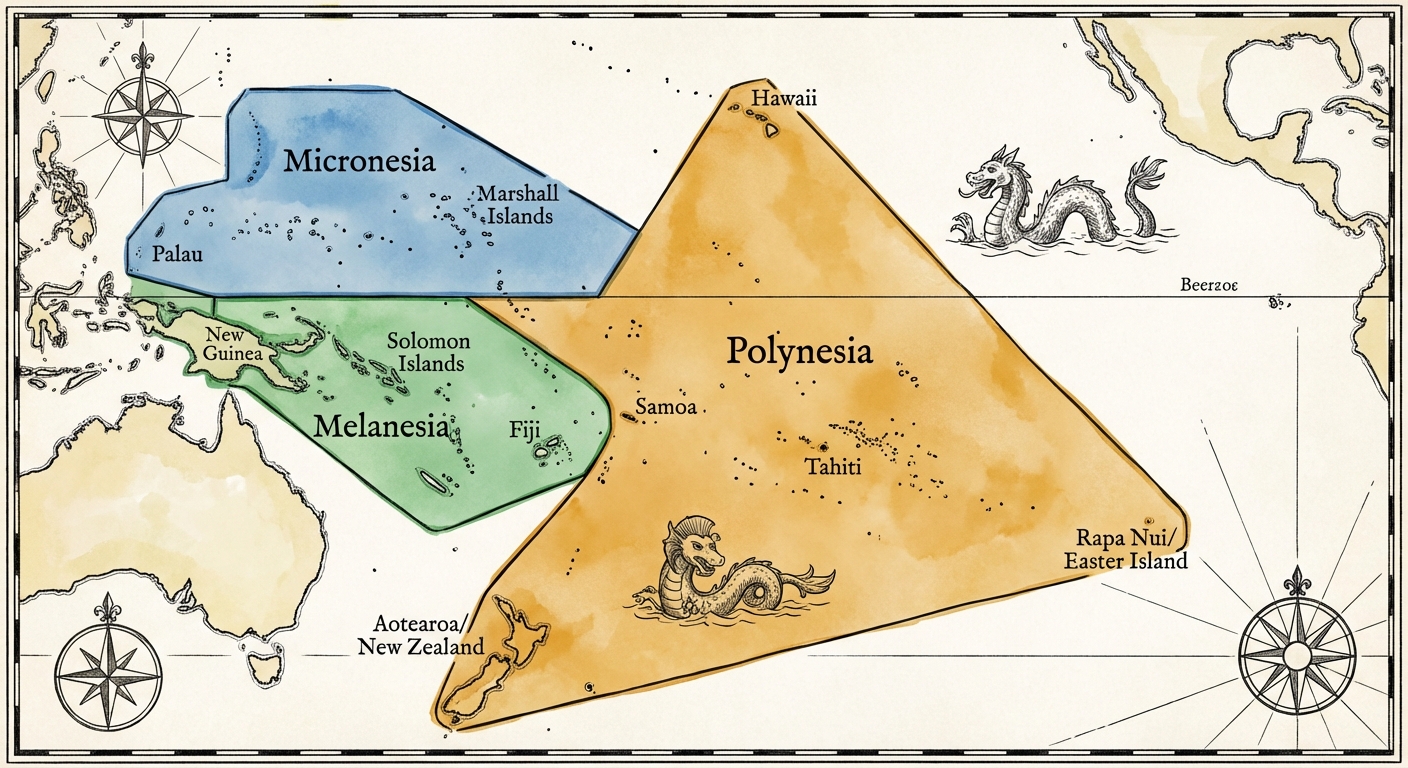
This unit covers the arts of Oceania, a vast geographic region comprising over 25,000 islands. The curriculum focuses on three distinct sub-regions: Micronesia (small islands), Melanesia (black islands), and Polynesia (many islands). Despite the geographic spread, these cultures share common ancestry (the Lapita people) and thematic concerns surrounding genealogy, spiritual power (mana), and the active performance of art.
Key Regional Distinctions
- Micronesia: North of Melanesia. Known for navigation skills and rank-based societies.
- Melanesia: Includes New Guinea and surrounding islands. Known for ephemeral art often destroyed after ceremonies.
- Polynesia: The "triangle" formed by Hawaii, New Zealand, and Easter Island. Known for stratified societies and hierarchy.
Core Concepts and Belief Systems
Before analyzing specific works, you must understand the two governing principles of Pacific life and art. These are the most frequently tested concepts in this unit.
1. Mana (Spiritual Power)
- Definition: A supernatural force or power that may be concentrated in a person, an object, or a place.
- Accumulation: Mana is not constant; it can be gained or lost through one's actions, lineage, or—in the case of art—the specific materials and rituals used to create the object.
- Visual Manifestation: High-status objects (like the politician's staff or a chief's cloak) are containers for mana.
2. Tapu (Sacred Rules)
- Definition: A system of strict laws, prohibitions, and sanctity (the origin of the English word taboo).
- Function: Tapu protects mana. If common people touch an object with high mana (like a chief's head), it could be dangerous for both parties.
- Artistic Impact: Many art objects are wrapped or enclosed to contain their mana and protect the community from its intensity.
Materials, Techniques, and Gender Roles
Pacific art is deeply gendered. The division of labor is strict, and the materials used often dictate who creates the art.
| Gender | Primary Materials | Art Forms | Symbolism |
|---|---|---|---|
| The Male Domain | Hard materials: Wood, Stone, Bone, Turtle Shell | Carving (statues, canoes), tattooing (often men), architecture | Permanence, ritual structure, connection to endurance |
| The Female Domain | Soft materials: Fibers, Pandanus, Bark, Dyes | Weaving, Tapa (bark cloth) making, Pottery | Ephemerality, wrapping (protection), social cohesion |
Multimedia and Performance
Unlike Western art, which is often static (hanging on a wall), Pacific art is often performative. Masks are meant to be danced; cloaks are meant to be worn; charts are meant to be touched. The "art" is often the action of the ritual, not just the object left behind.
Region 1: Micronesia
➼ Nan Madol
- Location: Pohnpei, Micronesia
- Date: c. 700–1600 CE
- Materials: Basalt boulders and prismatic columns
- Patron: Saudeleur Dynasty
Form & Construction
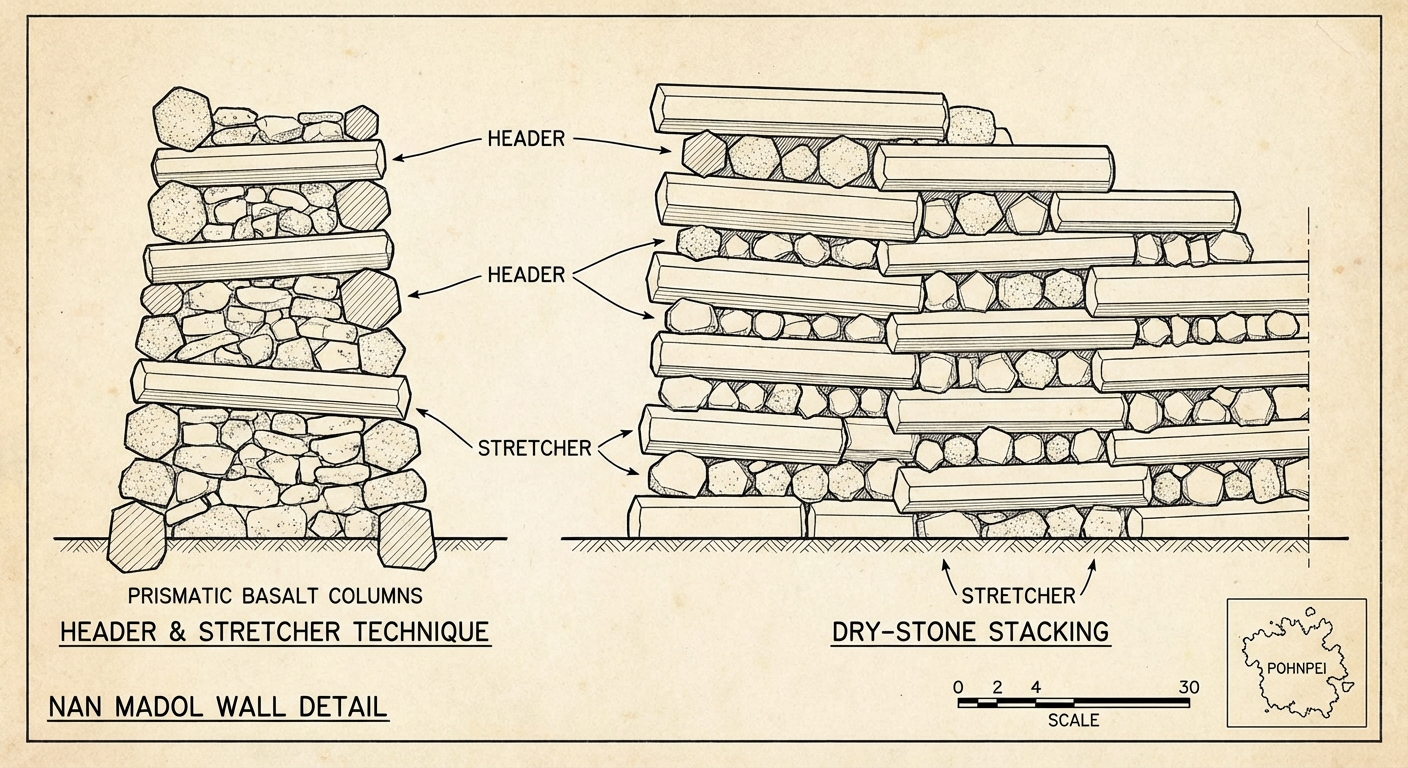
- A megalithic capital city built on 92 artificial islands atop a coral reef.
- Log-Cabin Style: The walls are constructed by stacking natural prismatic basalt columns (shaped like logs) in a header-and-stretcher pattern. No mortar was used.
- Some walls reach 25 feet high. The complex weights an estimated 750,000 tons.
Function & Context
- Political Center: It served as the administrative and ceremonial center for the Saudeleur dynasty.
- Social Control: The layout secluded the upper classes from the commoners. The king forced local chiefs to live at Nan Madol to monitor them, effectively stripping their power—similar to Louis XIV at Versailles.
- Sacred vs. Secular: One sector (Madol Powe) was for funerary rituals; the other (Madol Pah) was for administration.
- Ecological History: It lacked fresh water and food, which had to be brought by commoners. When the supply chain broke, the city was abandoned.
➼ Navigation Chart
- Location: Marshall Islands, Micronesia
- Date: 19th to early 20th century
- Materials: Wood and fiber, cowrie shells
Form
- Mattang: A specific type of training chart used to teach young navigators.
- Composition: Diagonal and curved wooden sticks represent wave swells and currents. Cowrie shells represent the position of islands.
- Buoyancy: Often made of wood that floats in case it falls overboard.
Function (CRITICAL DISTINCTION)
- Mnemonics: These charts were NOT taken on voyages. They were memorized on land prior to departure. Carrying a chart was a sign of incompetence.
- Physics of the Ocean: The chart maps the disruption of ocean swells by land masses (diffraction and reflection).
➼ Female Deity
- Location: Nukuoro, Micronesia
- Date: c. 18th–19th century
- Materials: Wood (Breadfruit tree)
Form
- Abstraction: Extremely minimalist and geometric. Ovoid head, tapering chin, no facial features, clean lines.
- Proportion: Elongated torso, short legs, sketching of kneecaps and navel.
Function & Context
- Ritual Object: Represented a specific deity (likely the goddess Kawe).
- Festival: During the harvest festival (mataariki), the figure was adorned with flowers, mats, and feathers. It was placed in a central temple.
- Western Reception: While originally religious, these figures strongly influenced modern Western artists (like Alberto Giacometti and Henry Moore) due to their "modernist" abstraction.
Region 2: Polynesia
➼ Moai on Platform (Ahu)
- Location: Rapa Nui (Easter Island)
- Date: c. 1100–1600 CE
- Materials: Volcanic tuff (figures), basalt (base), red Scoria (topknots), coral (eyes)
Form
- Stylization: Heavily oversized heads (1/3 to 1/2 of the total height), prominent eyebrows, elongated ears, heavy chins.
- Backs: Many feature intricate carved designs (possibly tattoos) added later.
- Eyes: Originally inlaid with white coral and obsidian pupils to "activate" the mana.
Function & Context
- Ancestor Worship: They represent deified ancestors who face inland to watch over and protect their descendants. (They do not look out to sea).
- Ahu: The stone platform is sacred; it marks burial grounds.
- Ecological Crisis: The movement of these massive statues (likely "walked" upright using ropes) contributed to deforestation. As the ecosystem collapsed, confidence in the ancestors faded, leading to the toppling of many Moai.
➼ ‘Ahu ‘ula (Feather Cape)
- Location: Hawaii
- Date: Late 18th century
- Materials: Feathers (‘i’iwi and ‘o’o birds), olona fiber netting
Form & Symbolism
- Color: Red = Royal divinity/Chiefs; Yellow = Rare and precious (tapped into the scarcity economy).
- Design: Semi-circular shape with geometric crescents.
Function & Context
- Protection: The dense fiber netting offered physical protection in battle, but the chanting done during creation imbued the cape with mana, offering spiritual protection.
- Reciprocity: These were often gifted to early European explorers (like Captain Cook) as high-status diplomatic gifts.
➼ Staff God
- Location: Rarotonga, Cook Islands
- Date: Late 18th–early 19th century
- Materials: Wood, tapa, fiber, feathers
Form
- The Shaft: A long wooden core. The top represents the creator god (Tangaroa). The bottom represents the phallus (generative power).
- The Wrapping: The central shaft is wrapped in enormous rolls of tapa cloth made by women.
Analysis (Key Concept: Manava)
- The wooden core (carved by men) provides the structure, but the bark cloth and feathers (processed by women) contain the manava (spirit) of the deity.
- Missionary Impact: Christian missionaries destroyed the phalluses, deeming them obscene. This work is one of the few surviving examples, yet it is still "castrated" (the bottom is missing).
➼ Hiapo (Tapa)
- Location: Niue
- Date: c. 1850–1900
- Materials: Tapa (bark cloth), freehand painting
Technique
- Process: Inner bark of mulberry trees is stripped, soaked, and beaten with an ike (mallet) into cloth.
- Decoration: Unlike other islands that use stencils, Niuean tapa uses freehand painting. It creates complex geometric patterns alongside organic motifs (leaves, flowers).
Social Context
- Women's Wealth: Tapa is a form of currency and prestige. It is presented at weddings, funerals, and coronations.
- Soft Architecture: Tapa is often used to divide spaces or wrap sacred objects.
➼ Tamati Waka Nene
- Artist: Gottfried Lindauer
- Date: 1890 CE
- Materials: Oil on canvas
- Subject: Maori Chief
Context
- Posthumous: Painted after the chief died, based on a photo.
- Ancestral Presence: For the Maori, this is not just a picture; it is an embodiment of the ancestor. It is hung in the Wharenui (meeting house) and spoken to.
Iconography of Power
- Moko: The facial tattoo is a unique signature of identity and mana.
- Kiwi Feather Cloak: Symbolizes high status.
- Tewhatewha: A hand weapon with feathers and an abalone eye (paua shell)—shows he is a warrior but the feathers show he can contain his aggression (peace).
➼ Presentation of Fijian Maps and Tapa Cloths
- Subject: Visit of Queen Elizabeth II to Fiji
- Date: 1953
- Media: Multimedia performance / Photography
Significance
- Performance Art: The "work" is the procession.
- Ngatu: The women presented enormous rolls of painted bark cloth (ngatu) to the Queen.
- Political Context: The simplest form of art (mats/cloth) is elevated to the highest status to honor the monarch. It shows the continuity of tradition despite colonization.
Region 3: Melanesia
➼ Malagan Display and Mask
- Location: New Ireland, Papua New Guinea
- Date: 20th century
- Materials: Wood, pigment, fiber, shell
Concept: Ephemerality
- These sculptures are created for one-time use during a funerary cycle (Malagan ceremonies) that can last months or years.
- Once the soul of the deceased leaves the sculpture during the final ceremony, the object loses its mana. It is then destroyed, left to rot, or sold to tourists.
Form
- Visual Complexity: Intricate carving, often described as "visual puzzle."
- Copyright: Specific designs belong to specific families. You must buy the right to use a specific pattern.
- Ges: The spiritual double of an individual represented in the mask.
➼ Buk (Mask)
- Location: Torres Strait (between Australia and New Guinea)
- Date: Mid- to late 19th century
- Materials: Turtle shell, wood, feathers, fiber
Form
- Material Uniqueness: One of the only traditions in the world to use turtle shell as the primary sculptural medium. Material was heated and bent.
- Hybridity: Combines a human face (ancestor) with a frigate bird (totem animal) on top.
- Motion: Part of a costume featuring grass skirts; the dancer would mimic the movements of the bird.
Function
- Used in male initiation rituals and funerary rites. The mask connects the wearer to the supernatural world and ancestral lineage.
Common Mistakes & Pitfalls
Confusing "Primitive" with "Simple":
- Correction: Never describe Pacific art as primitive. The abstraction (like in Nukuoro figures) is a sophisticated aesthetic choice, not a lack of skill. The navigation charts show advanced scientific understanding.
Misunderstanding the Navigation Chart's Use:
- Correction: Students often think sailors looked at these while sailing. They did not complete the test if you say this. They were study tools used on land for memorization.
The Direction of the Moai:
- Correction: A common myth is that they look out to sea. They look inland to watch over the villages (except for a few specific examples). Their backs are to the sea.
Static vs. Active Art:
- Correction: Do not analyze these works only as museum objects. You must discuss how they were used (danced, wrapped, smashed, exchanged). The context of the ritual is often more important than the aesthetic of the object.
Patriarchy and Art:
- Correction: Don't assume only men made art. While men carved wood (hard), women created textiles/tapa (soft), which held equal or greater ritual importance in exchanging mana.