Comprehensive Guide to Asymptotic Behavior in Calculus
Infinite Limits and Vertical Asymptotes
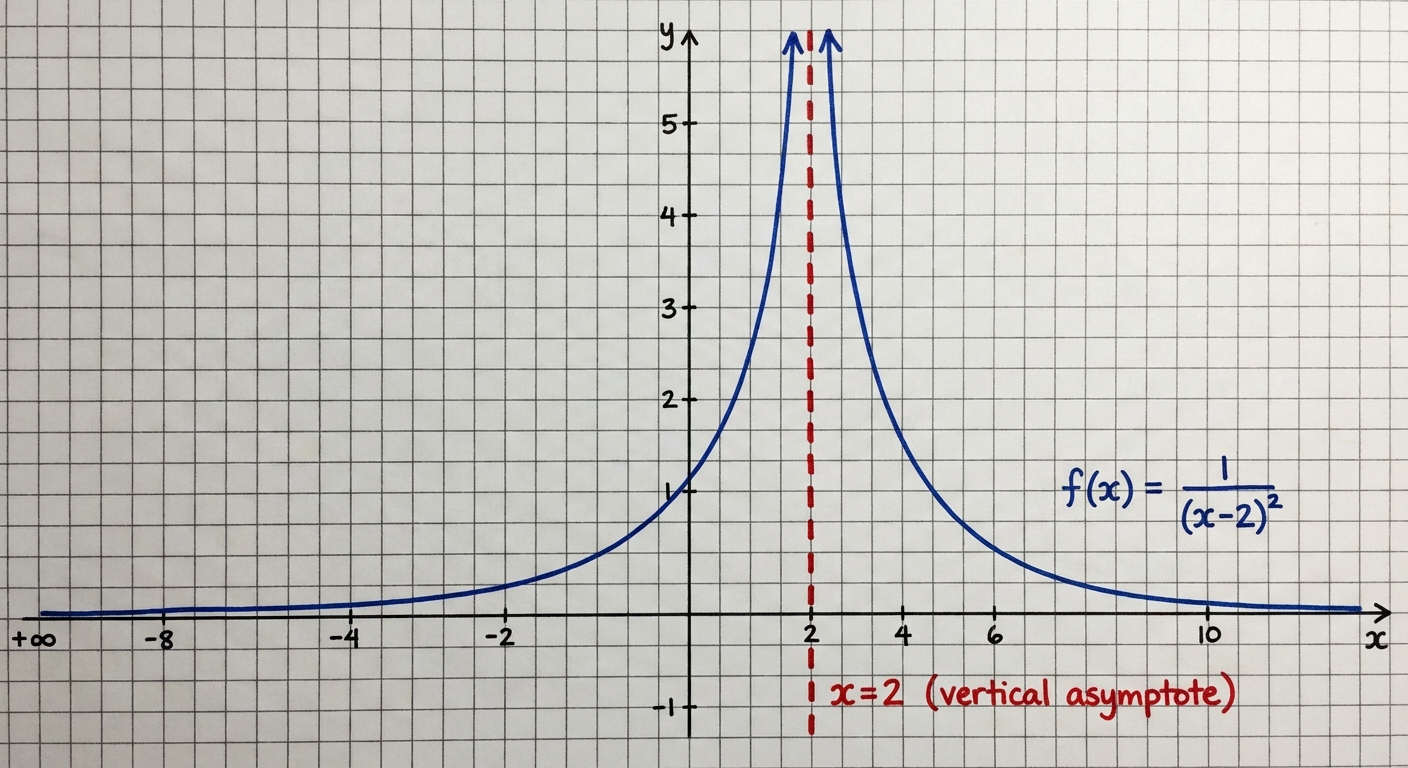
When we analyze the behavior of a function $f(x)$ as $x$ gets arbitrarily close to a specific number $c$, we sometimes find that the function's values grow without bound. This concept defines the Vertical Asymptote.
Definitions and Concepts
An Infinite Limit occurs when the values of $f(x)$ increase or decrease without bound as $x$ approaches a number $c$.
- If the limit approaches infinity, the limit technically does not exist (DNE) in the strict sense, but we use the notation $\infty$ or $-\infty$ to describe the specific behavior of the unbounded growth.
- Vertical Asymptote (VA): The line $x = c$ is a vertical asymptote of the graph of $f$ if at least one of the following statements is true:
- $\lim_{x \to c^-} f(x) = \pm \infty$
- $\lim_{x \to c^+} f(x) = \pm \infty$
Determining Vertical Asymptotes Algebraically
For rational functions $f(x) = \frac{N(x)}{D(x)}$:
- Factor both the numerator and the denominator completely.
- Cancel any common factors. (Factors that cancel create a hole or removable discontinuity, not a VA).
- Set the remaining denominator equal to zero and solve for $x$.
Example 1: Identifying VA vs. Holes
Find the vertical asymptotes of $f(x) = \frac{x^2 - 4}{x^2 + x - 6}$.
Solution:
- Factor:
- Cancel $(x-2)$. The simplified function is $g(x) = \frac{x+2}{x+3}$ for $x \neq 2$.
- Set denominator to 0: $x + 3 = 0 \implies x = -3$.
- Conclusion: There is a Vertical Asymptote at $x = -3$. There is a hole at $x = 2$.
Limits at Infinity and Horizontal Asymptotes
While infinite limits look at function behavior near a specific vertical line, Limits at Infinity analyze the End Behavior of the function—what happens to $y$ as $x$ gets extremely large (positive) or extremely small (negative).
Definitions and Concepts
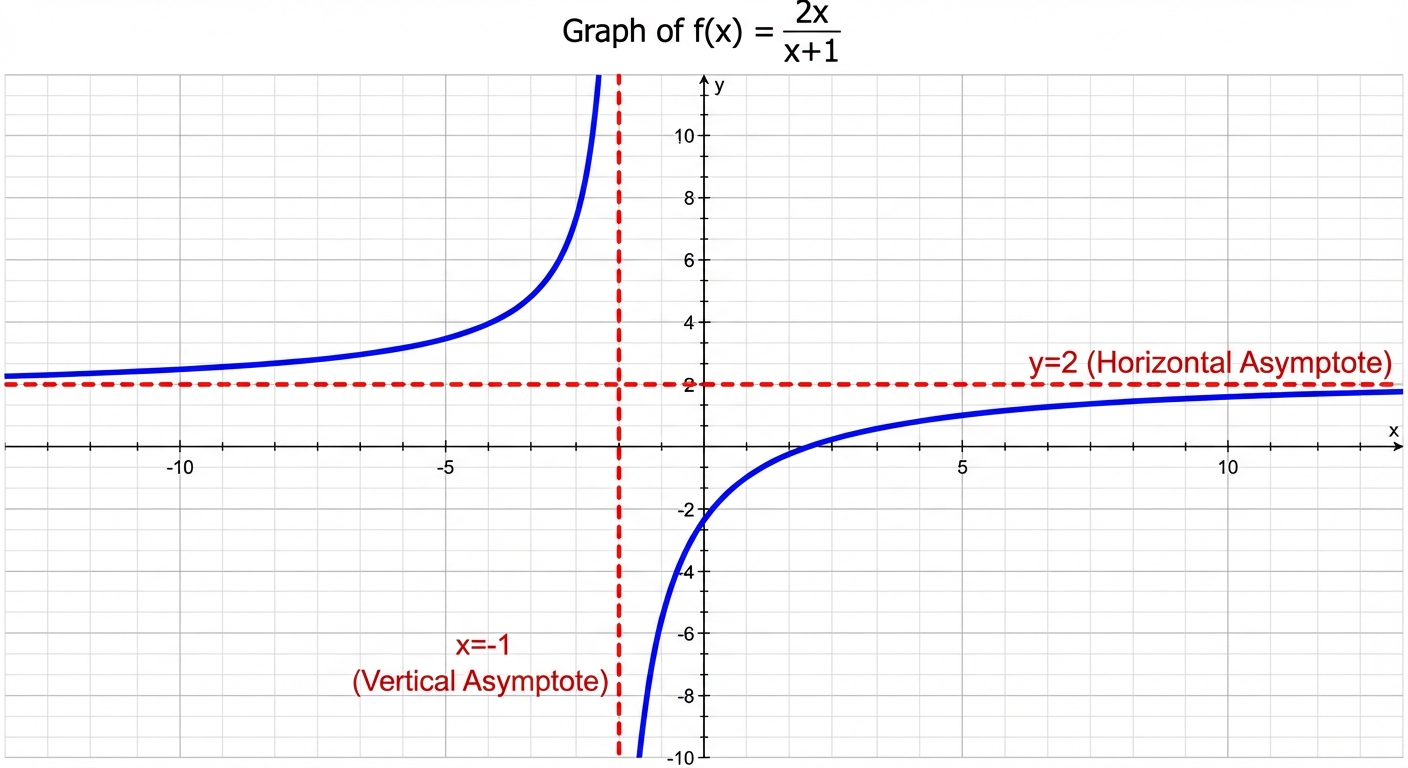
The line $y = L$ is a Horizontal Asymptote (HA) of the graph of $f$ if either:
Note: A function can have at most two horizontal asymptotes (one to the right, one to the left), but unlike vertical asymptotes, a graph can cross its horizontal asymptote.
Rules for Rational Functions
When evaluating $\lim_{x \to \pm \infty} \frac{N(x)}{D(x)}$, compare the degree (highest exponent) of the numerator ($n$) and denominator ($d$).
| Condition | Resulting Limit | Horizontal Asymptote |
|---|---|---|
| Degree $n < d$ (Bottom Heavy) | Limit is $0$ | $y = 0$ |
| Degree $n = d$ (Balanced) | Limit is ratio of leading coefficients | $y = \frac{an}{bn}$ |
| Degree $n > d$ (Top Heavy) | Limit is $\pm \infty$ | None (Slant possible) |
Example 2: Horizontal Asymptotes
Evaluate $\lim_{x \to \infty} \frac{3x^2 - 5x}{2x^2 + 9}$.
Solution:
Since the degree of the numerator (2) equals the degree of the denominator (2), we take the ratio of the leading coefficients.
Therefore, there is an HA at $y = 1.5$.
Relative Rates of Growth (Dominance)
In AP Calculus BC, you deal with functions more complex than simple polynomials. When taking limits at infinity, you must understand which functions "dominate" (grow faster) than others. The faster-growing function controls the limit.
The Hierarchy of Growth
As $x \to \infty$, the growth rates generally follow this order (from slowest to fastest):
\ln(x) \ll x^n \ll b^x \text{ (where } b>1) \ll x! \ll x^x
Application Rules
- Fast / Slow: If the numerator grows faster than the denominator, the limit is $\pm \infty$.
- Slow / Fast: If the denominator grows faster than the numerator, the limit is $0$.
- Same Growth Type: You may need L'Hôpital's Rule or algebraic simplification.
Example 3: Comparing Growth Rates
Evaluate $\lim_{x \to \infty} \frac{x^{100}}{e^x}$.
Solution:
Although $x^{100}$ is a massive polynomial, exponential functions ($e^x$) eventually grow much faster than any polynomial.
- Since the denominator dominates ($Fast$ on bottom, $Slow$ on top), the fraction gets smaller and smaller.
- $\lim_{x \to \infty} \frac{x^{100}}{e^x} = 0$.
Common Pitfalls and Mistakes
1. The Radical Trap (Negative Infinity)
When dealing with limits as $x \to -\infty$ involving even roots (like square roots), remember that $\sqrt{x^2} = |x|$, not just $x$.
- If $x \to -\infty$, then $\sqrt{x^2} = -x$.
- Incorrect: $\lim_{x \to -\infty} \frac{\sqrt{4x^2+1}}{x} = \sqrt{4} = 2$
- Correct: The denominator is negative, but the numerator is positive. The signs must be tracked implicitly or by substitution. $\lim_{x \to -\infty} \frac{\sqrt{4x^2+1}}{x} = -2$.
2. Confusing Asymptote Types
- Vertical Asymptotes are $x = \dots$ (Look for division by zero).
- Horizontal Asymptotes are $y = \dots$ (Look for limits at infinity).
- Don't mix up the variables!
3. Crossing Asymptotes
Students often believe graphs can never touch an asymptote. This is true for Vertical Asymptotes (the function is undefined there), but false for Horizontal Asymptotes. A function can oscillate around or cross its HA multiple times before settling down (e.g., $f(x) = \frac{\sin x}{x}$ crosses $y=0$ infinitely many times).