Study Guide: Unit 1 - Le Famiglie e le Comunità in Modern Italy
This study guide covers the "Family Structures and Values" section of Unit 1. It is designed to prepare you for the AP Italian Language and Culture exam, specifically focusing on the Confronto Culturale (Cultural Comparison) and Interpretive Communication tasks.
Family Roles and Relationships (Ruoli e Relazioni in Famiglia)
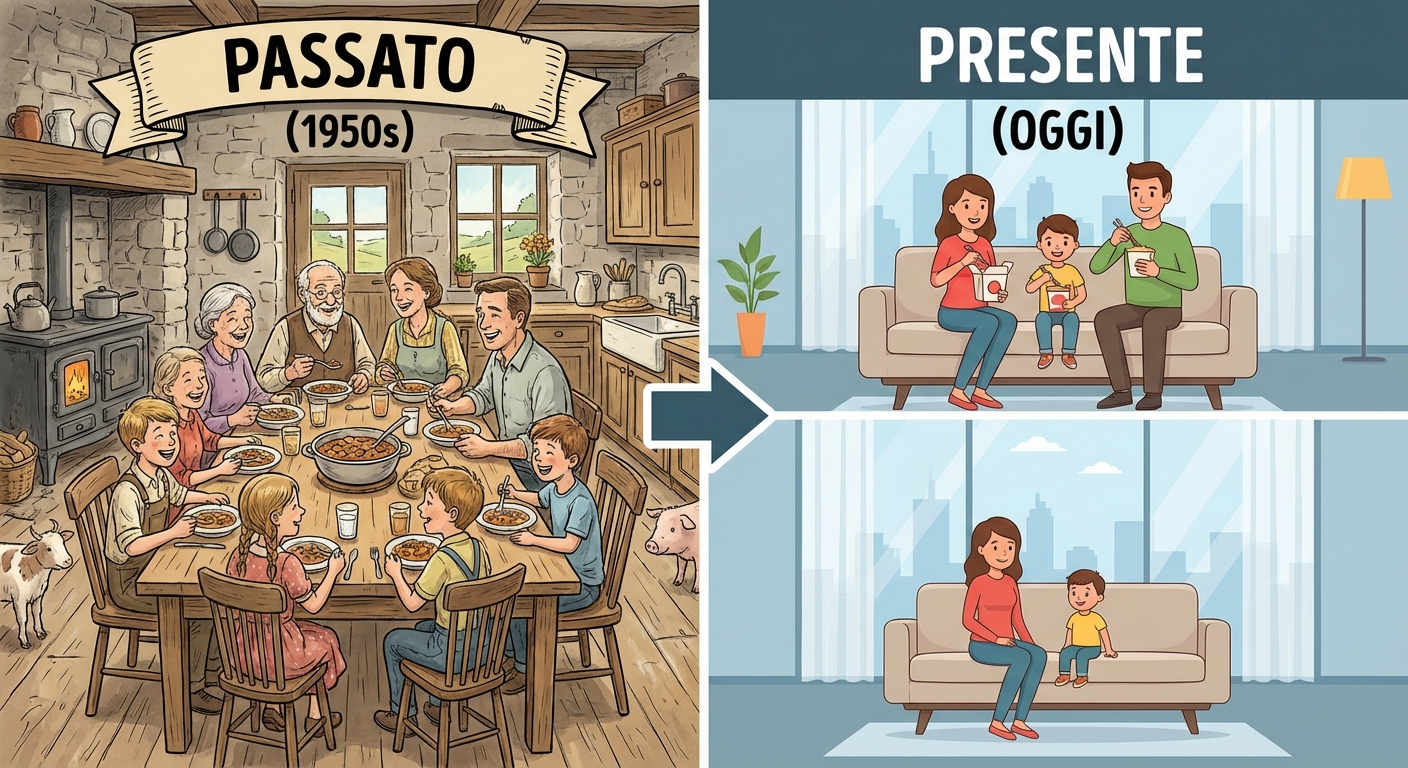
The concept of family (la famiglia) is the cornerstone of Italian society, but it has undergone drastic changes in the last 50 years. To succeed on the AP exam, you must understand the transition from the traditional model to the modern reality.
The Shift: Traditional vs. Modern
Historically, the Italian family was patriarchal (patriarcale) and agricultural, especially in the South (Mezzogiorno). It was a famiglia allargata (extended family) living under one roof.
Today, the dominant model is the famiglia nucleare (nuclear family), consisting only of parents and children.
- Working Women: The role of women has shifted from solely domestic managers (casalinghe) to active participants in the workforce. However, a cultural expectation often remains for women to handle the majority of housework and childcare, a phenomenon known as the "double burden."
- New Family Structures: Since the legalization of divorce (1970) and civil unions (unioni civili, 2016), family structures have diversified to include:
- Famiglie monoparentali: Single-parent families.
- Famiglie di fatto: Cohabiting couples who are not married.
- Famiglie ricostituite: Blended families (step-parents/step-children).
The Relationship Between Parents and Children
Italian parents tend to be protective (protettivi). A unique cultural phenomenon in Italy is the prolonged stay of children in the parental home.
- I Bamboccioni: This roughly translates to "big babies" (though somewhat derogatory, it is a key sociological term). It refers to young adults (ages 20–35) who still live with their parents.
- Reasoning: Unlike in the US, this is often due to economic necessity (disoccupazione giovanile - youth unemployment), high cost of living, and strong family bonds, rather than laziness.
- Il Mammismo: This refers to the intense attachment Italian men often have to their mothers. While often stereotyped in comedy, the maternal bond is culturally respected and central to family dynamics.
Key Vocabulary Table
| Italian Term | English Definition | Context/Notes |
|---|---|---|
| Il capofamiglia | Head of the household | Historically the father; now shared. |
| Il nucleo familiare | Family unit | Used in formal/demographic contexts. |
| I parenti | Relatives | False Friend alert: Does not mean parents. |
| I genitori | Parents | The correct term for mother/father. |
Customs, Ceremonies, and Traditions
Italy is a country deeply rooted in tradition, where religious sacraments often double as major social and cultural events. Even for non-practicing Catholics, these milestones are essential for family unity.
Religious Milestones as Social Events
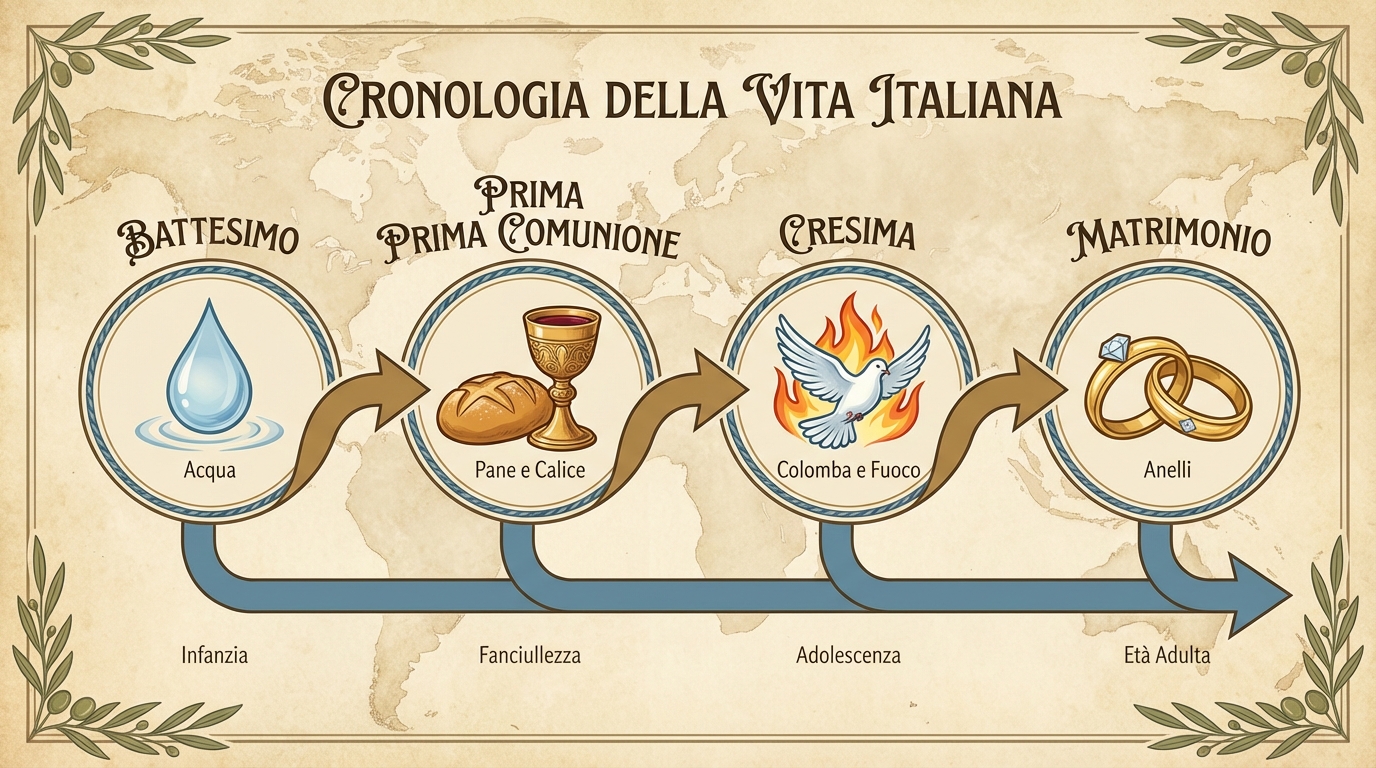
The life of an Italian child is punctuated by sacraments that serve as reasons for the extended family to gather:
- Il Battesimo (Baptism): The official entrance into the community.
- La Prima Comunione (First Communion): Usually around age 8–9.
- La Cresima (Confirmation): Adolescence.
- Il Matrimonio (Marriage): While marriage rates are declining, the traditional Italian wedding is still a lavish, all-day affair involving extensive food and hundreds of guests.
Note for the Exam: When comparing to your own culture, note that in Italy, these events are rarely private; they are community celebrations involving distant relatives (parenti lontani).
Il Pranzo della Domenica (Sunday Lunch)
Perhaps the most enduring secular ritual is Sunday Lunch.
- Concept: It is a non-negotiable weekly gathering, usually at the grandparents' house.
- Structure: It is not a quick meal. It lasts hours, consisting of multiple courses (antipasto, primo, secondo, contorno, dolce, caffè).
- Significance: This is where family news is shared, politics are debated, and intergenerational bonds are solidified.
Major Holidays
- Natale (Christmas): Strictly family-oriented. There is a saying: "Natale con i tuoi, Pasqua con chi vuoi" (Christmas with your family, Easter with whomever you want).
- Ferragosto (August 15th): While a public holiday, families often travel together to the beach or mountains during this time.
Generational Differences and Perspectives
Italy faces a severe demographic crisis that shapes the perspective of different generations.
L'Inverno Demografico (Demographic Winter)
Italy has one of the lowest birth rates (tasso di natalità) in the world.
- Zero Growth: The population is aging rapidly.
- Causes: Economic instability, lack of childcare support structures (asili nido), and women choosing careers over large families.
- Impact: A generation of "only children" (figli unici) is growing up without aunts, uncles, or cousins of their own age, drastically changing the concept of the "big Italian family."

The Role of Grandparents (I Nonni)
In the US, elderly care often involves nursing homes. In Italy, i nonni act as the primary social safety net.
- Nonni-sitter: Because state childcare is scarce or expensive, grandparents often raise the grandchildren while parents work.
- Pension Support: In times of economic crisis, the grandfather's pension (la pensione) typically supports the younger, unemployed generations.
- Respect: Elders are generally accorded higher respect and social integration in Italy than in many individualistic societies.
Common Mistakes & Pitfalls
Here are the most frequent errors students make when discussing family on the AP Exam:
"Parenti" vs. "Genitori":
- Wrong: "Amo i miei parenti" (when meaning Mom and Dad).
- Right: "Amo i miei genitori." Parenti means relatives (uncles, cousins, etc.).
Stereotyping Size:
- Mistake: Assuming all Italians have 10 siblings.
- Correction: Acknowledge the denatalità (low birth rate). Most modern Italian families are small.
Grammar of "Famiglia":
- Mistake: "Le famiglie è…" or "La famiglia sono…"
- Correction: La famiglia is singular. Use "La famiglia è importante."
Confusing "Bamboccioni":
- Mistake: Thinking Italians live at home just because they are lazy.
- Correction: Always mention the socio-economic context (unemployment, housing costs) to show cultural competence.