Comprehensive Guide to the ACT Optional Writing Test
Deconstructing the ACT Writing Prompt
The ACT Writing test is a 40-minute essay exam that presents a complex issue and three different perspectives on that issue. Your goal is to develop your own perspective while analyzing the relationship between your view and the provided perspectives.
The Anatomy of the Prompt
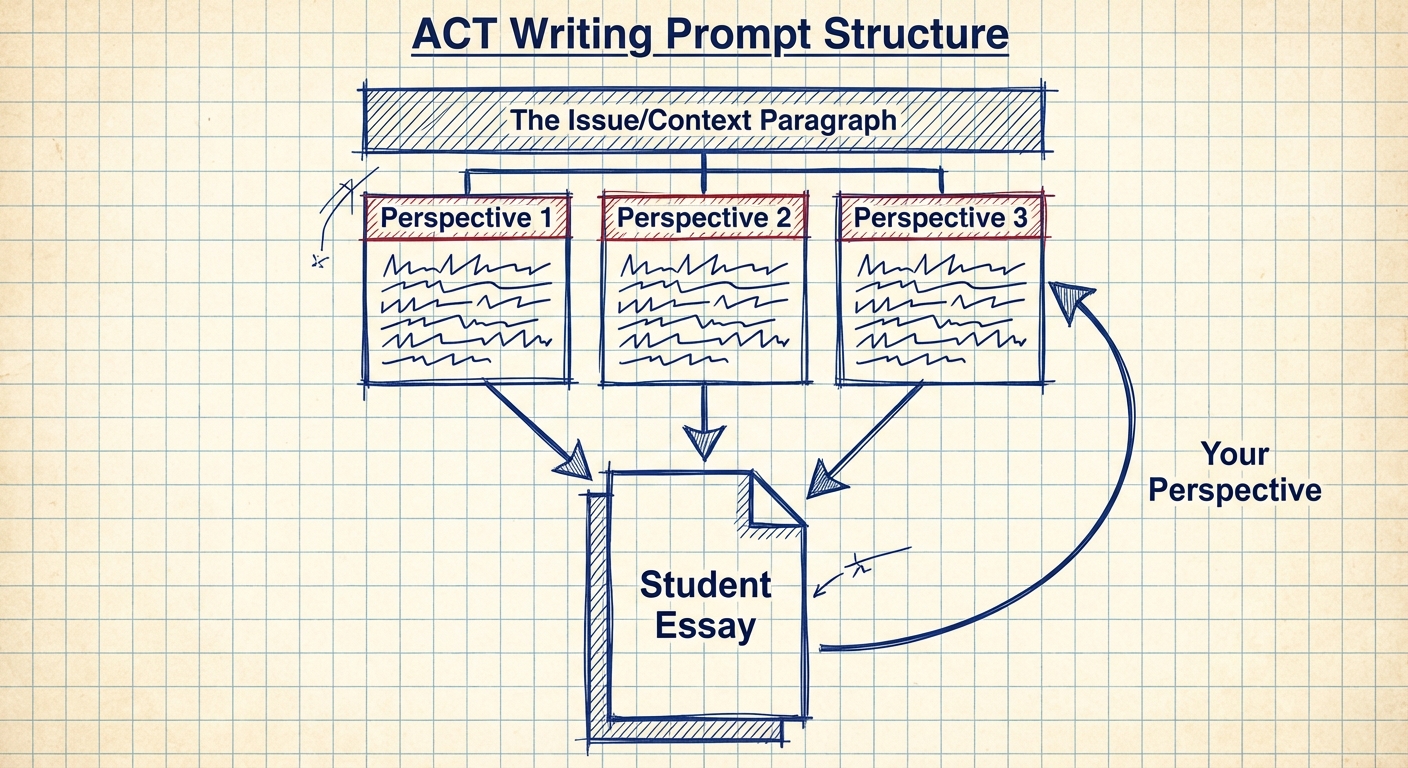
Unlike the SAT or other essay tests, the ACT prompt has a very specific, predictable structure. It always consists of three components:
- The Context Paragraph: This introduces a debatable topic (e.g., "Intelligent Machines," "Public Health vs. Freedom," "The Value of Fame"). It provides background information but remains neutral.
- The Three Perspectives: You are given three distinct boxes containing short arguments regarding the topic.
- Perspective One: usually a strong argument for a specific side.
- Perspective Two: usually a strong argument against that side.
- Perspective Three: usually offers a nuanced, middle-ground, or philosophical take.
- The Task: Instructions telling you to analyze the perspectives, state your own, and explain the relationships between them.
The Core Objective
Your essay must accomplish three things to score highly:
- Analyze complex issues: Do not treat the topic as black-and-white.
- Evaluate the given perspectives: You must address the perspectives provided in the prompt.
- Develop your own argument: You are not just summarizing; you are arguing a thesis.
The Scoring Rubric: The Four Domains
The ACT uses an analytic scoring rubric. Two readers score your essay from 1–6 in four domains. These scores are added to give you a domain score of 2–12. The final writing score is the average of the four domain scores.
1. Ideas and Analysis
This measures how well you understand the issue and the perspectives.
- Key Requirement: A clear, precise Thesis Statement.
- Nuance: High scorers discuss the implications and complexities of the issue, rather than just stating "Plan A is good."
2. Development and Support
This measures how well you back up your claims.
- Reasoning: Explain why you believe what you believe.
- Evidence: Use specific examples (history, current events, literature, or logical hypotheticals). Vague generalizations result in lower scores.
3. Organization
This measures the structure and flow of your essay.
- Grouping: Do ideas logically progress?
- Transitions: Use strong transitional phrases (e.g., "Conversely," "In alignment with Perspective 2," "Despite this potential benefit…") to connect paragraphs.
4. Language Use
This measures your command of standard written English.
- Vocabulary: Use precise, varied vocabulary (without forcing "SAT words" incorrectly).
- Sentence Structure: Vary your sentence length and structure (simple, compound, complex).
| Domain | Low Score (1-2) | High Score (5-6) |
|---|---|---|
| Ideas | Vague thesis; ignores perspectives. | Complex thesis; integrates perspectives seamlessly. |
| Development | Repetitive; circular logic; no examples. | Detailed reasoning; varied and specific examples. |
| Organization | No paragraph breaks; jarring jumps. | Logical sequencing; strong transitions; unified paragraphs. |
| Language | Basic errors; repetitive words. | Sophisticated syntax; precise word choice; formal tone. |
Strategic Time Management
You have exactly 40 minutes. Failing to finish the essay is the most common reason for a low score. Use the P.O.W.E.R. method, heavily modified for this exam's constraints.
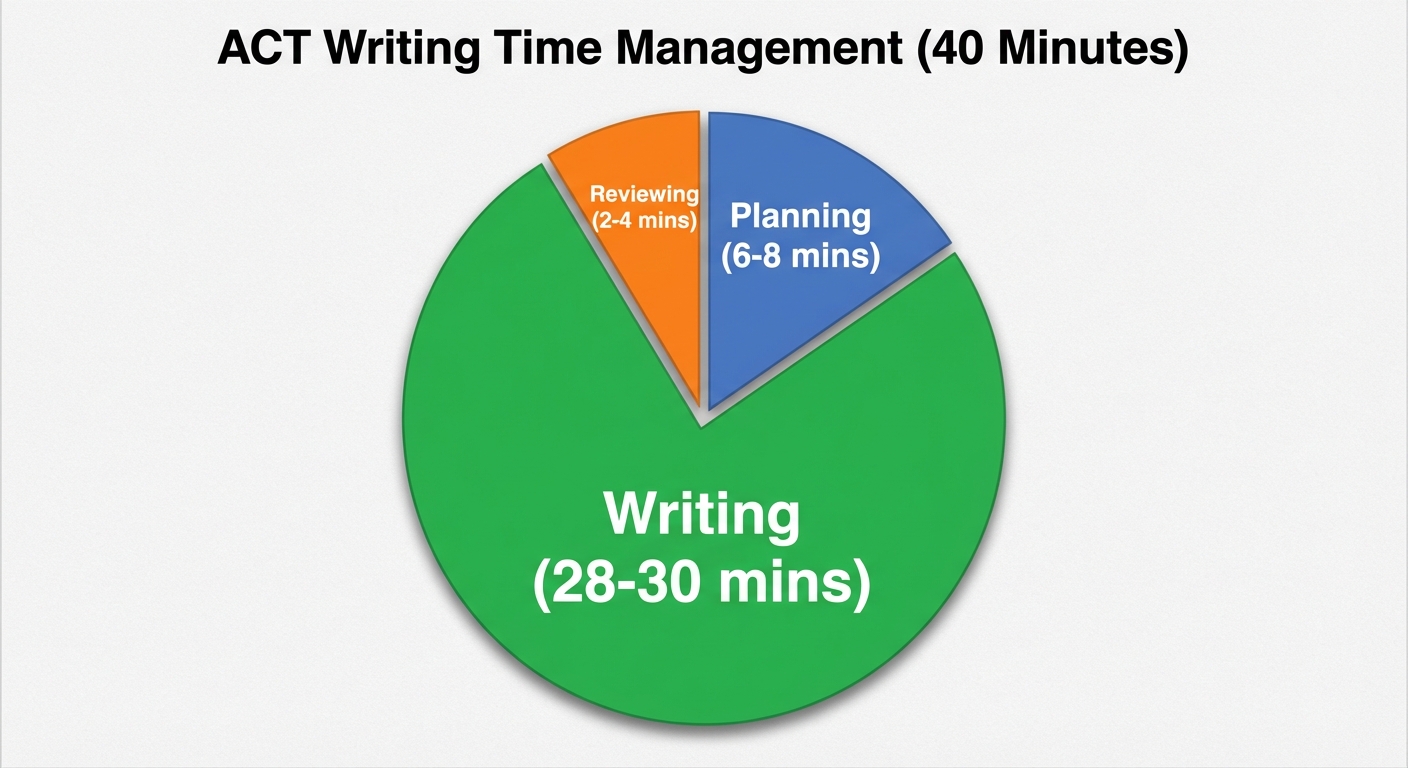
Phase 1: Planning (6–8 Minutes)
Do not skip this. A poorly planned essay will wander and fail the Organization domain.
- Read and Annotate: Circle key terms in the context paragraph. Briefly summarize each perspective in 2-3 words (e.g., "P1: Efficiency," "P2: Loss of Humanity," "P3: Adaptation").
- Formulate Your Thesis: Decide your stance. It can match one of the perspectives, combine two, or be completely different.
- Outline: Sketch 4-5 paragraphs. deciding which perspective you will discuss in which paragraph.
Phase 2: Writing (28–30 Minutes)
Write efficiently. Focus on clarity over flowery language. If you are running out of time, prioritize finishing the conclusion over adding a third example.
Phase 3: Reviewing (2–4 Minutes)
Check for:
- Subject-verb agreement.
- Clear thesis placement.
- Legibility.
Structuring Your Argument
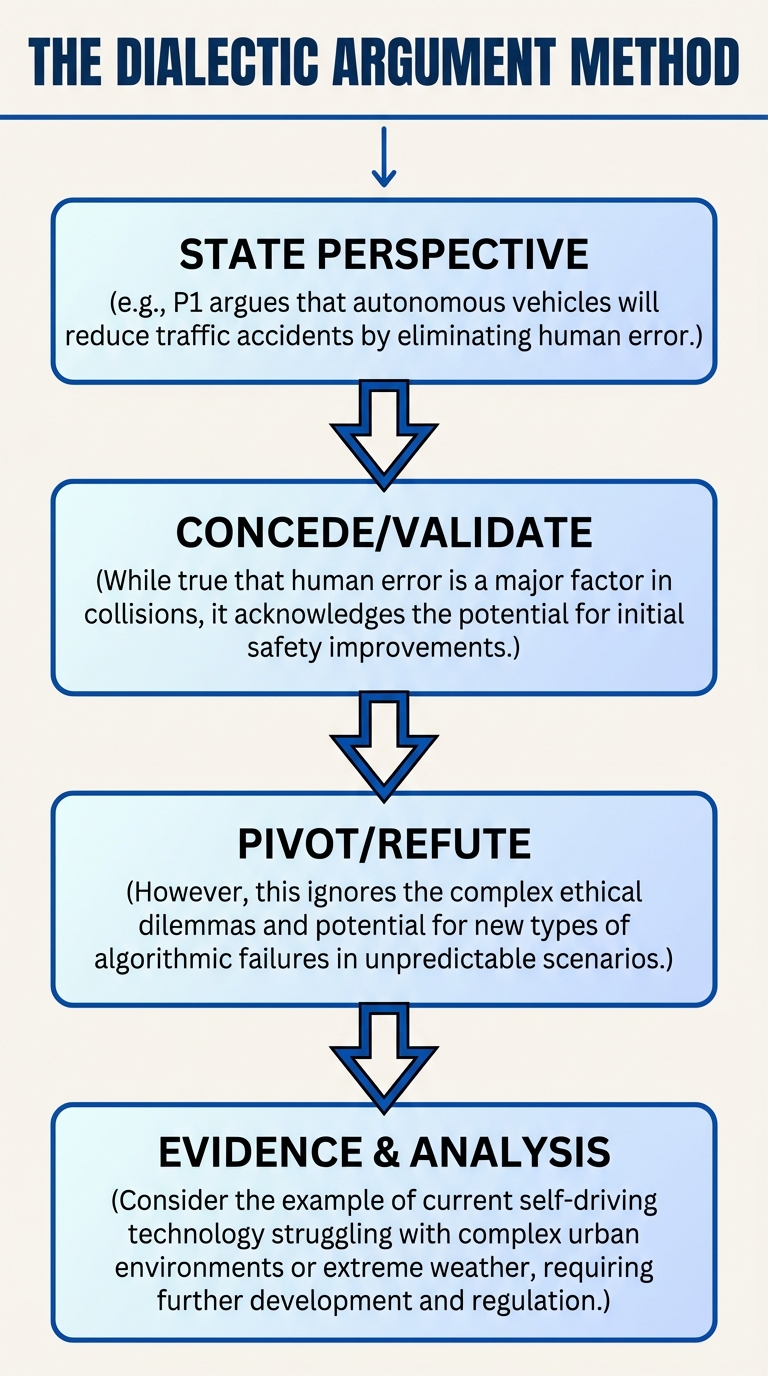
The most effective structure for the ACT essay is not a simple 5-paragraph essay where you ignore the counter-arguments. You must engage in a Dialectic—a conversation between ideas.
The Thesis Statement
Your thesis must appear in the introduction (usually the last sentence). It needs to be complex.
- Weak: "Automation is bad for society."
- Strong: "While automation offers undeniable economic efficiency as suggested by Perspective One, we effectively surrender our human agency when we allow algorithms to dictate our choices, ultimately making society more fragile."
Body Paragraph Strategy
Do not simply write one paragraph per perspective. Instead, organize by arguments.
Template Structure:
Introduction:
- Hook: Broad statement about the issue.
- Context: Briefly mention the debate.
- Thesis: Your specific stance.
Body Paragraph 1 (Concession/Counter-Argument):
- Acknowledge the strongest opposing view (often one of the provided perspectives).
- "Proponents of Perspective One argue that…"
- Validate it briefly, then refute it using logic or evidence.
Body Paragraph 2 (Your Main Support):
- Present your primary argument.
- Align it with a perspective if applicable ("Much like Perspective Three suggests…").
- Provide a concrete example (e.g., The Industrial Revolution, AI in medicine).
Body Paragraph 3 (Nuance/Extension):
- Add depth. Analyze the implications.
- Address the final perspective.
- Explain the relationship: "While Perspective Two fears this change, Perspective Three correctly identifies that adaptation is inevitable."
Conclusion:
- Restate the thesis in new words.
- The "So What?": End with a broader implication for society.
Analyzing Perspectives & Relationships
The prompt explicitly asks you to "explain the relationship between your perspective and those provided." This is where many students lose points.
Types of Relationships
When mentioning a perspective (P1, P2, or P3), use specific verbs to define the relationship:
- Alignment: "My position resonates with P1…", "Aligns with…", "Bolsters…"
- Partial Agreement: "While P2 is correct that [x], it fails to account for [y]…"
- Opposition: "Contrary to P3…", "P1 overlooks the crucial fact that…"
Example of Integration
Prompt Topic: Censorship
- Perspective 1 claims censorship protects society.
- Your text: "Perspective One argues that censorship acts as a shield for societal stability. However, this definition of 'protection' is shortsighted. As history demonstrates during the Enlightenment…"
Note: You do not need to quote the perspectives directly. Paraphrasing shows better comprehension.
Rhetorical Strategies & Language
To score a 10-12, your language must be persuasive.
Use Specific Examples
Avoid "General Hypotheticals" (e.g., "If a student goes to school…"). Use Specifics:
- History: WWII, The Great Depression, The Roman Empire.
- Current Events: Climate Change policies, Social Media algorithms, Space X.
- personal Experience: permitted, but less effective than academic examples unless the experience is very unique and applicable.
Transitional Devices
Good transitions act as road signs for the reader.
- Addition: Furthermore, Moreover, Likewise.
- Contrast: Conversely, Nevertheless, On the other hand.
- Causation: Consequently, Therefore, Thus.
Common Mistakes & Pitfalls
- Ignoring the Perspectives: If you write a brilliant essay but never mention Perspective 1, 2, or 3, you cannot get a perfect score in Ideas/Analysis.
- The "Fence Sitter": Trying to agree with everyone. You must take a definitive stance. It is okay to agree partially, but you must have a clear hierarchy of values.
- Handwriting Issues: If the grader cannot read it, they cannot score it. Print if your cursive is messy.
- Off-Topic Examples: Using a pre-memorized example (like "The Great Gatsby") that doesn't actually fit the specific nuance of the prompt.
- Running Out of Space: You only have the provided pages in the booklet. If you write large, manage your space carefully.
Final Checklist for Exam Day
- [ ] Did I clearly state a thesis?
- [ ] Did I evaluate all three perspectives?
- [ ] Did I explain how my view relates to theirs?
- [ ] Did I use specific examples?
- [ ] Is my handwriting legible?