Unit 1: Ancient Civilizations and the Roots of the African Diaspora
Geography and the Bantu Expansion
To understand the cultures "Before the Diaspora," you must first understand the physical stage upon which these civilizations were built and the major demographic shifts that populated the continent.
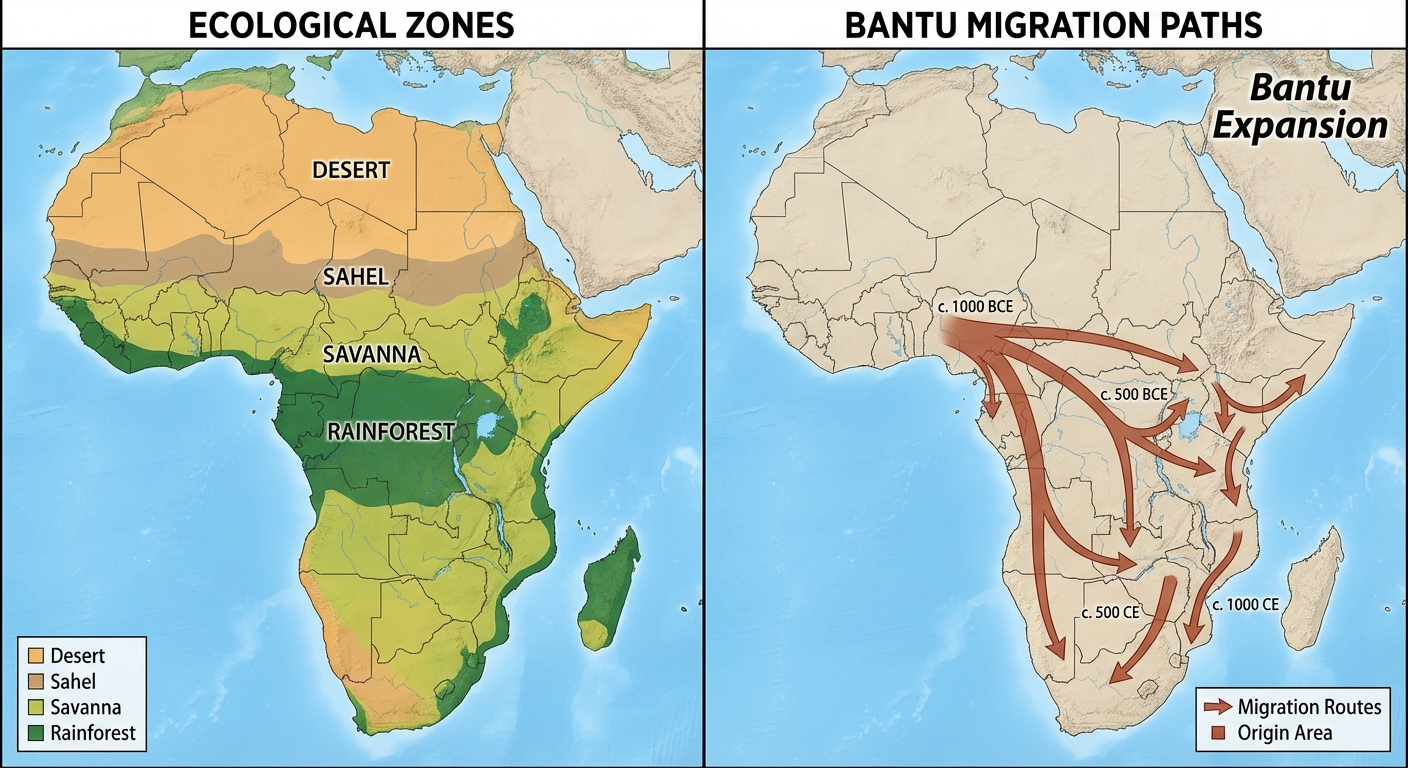
diverse Ecological Zones
Africa is the second-largest continent, characterized by distinct climate zones that dictated how societies developed.
- The Maghreb: The northern coast participating in Mediterranean trade.
- The Sahara: The world's largest hot desert. While a barrier, it was also a bridge for the Trans-Saharan Trade.
- The Sahel: A semi-arid transition zone south of the Sahara (literally "shore" in Arabic). This is where the great Sudanic empires (Ghana, Mali, Songhai) flourished due to trade hubs.
- Savanna: Grasslands supporting large-scale agriculture and animal husbandry.
- Tropical Rainforests: Dense vegetation in Central/West Africa; historically difficult for horses/cattle (due to tsetse flies) but rich in root crops (yams).
The Bantu Expansion
One of the largest human migrations in history, occurring roughly between 1500 BCE and 1000 CE. Speakers of Proto-Bantu languages migrated from the border region of modern-day Nigeria and Cameroon throughout Central, Eastern, and Southern Africa.
Impact of the Migration:
- Linguistics: Spread the Bantu language family (ancestral to Swahili, Zulu, Kongo, etc.).
- Metallurgy: Spread iron-smelting technology, allowing for clearer farming land and better weapons.
- Agriculture: Transitioned regions from hunter-gatherer lifestyles to settled agriculture (yams, sorghum, millet).
West African Empires (The Sudanic States)
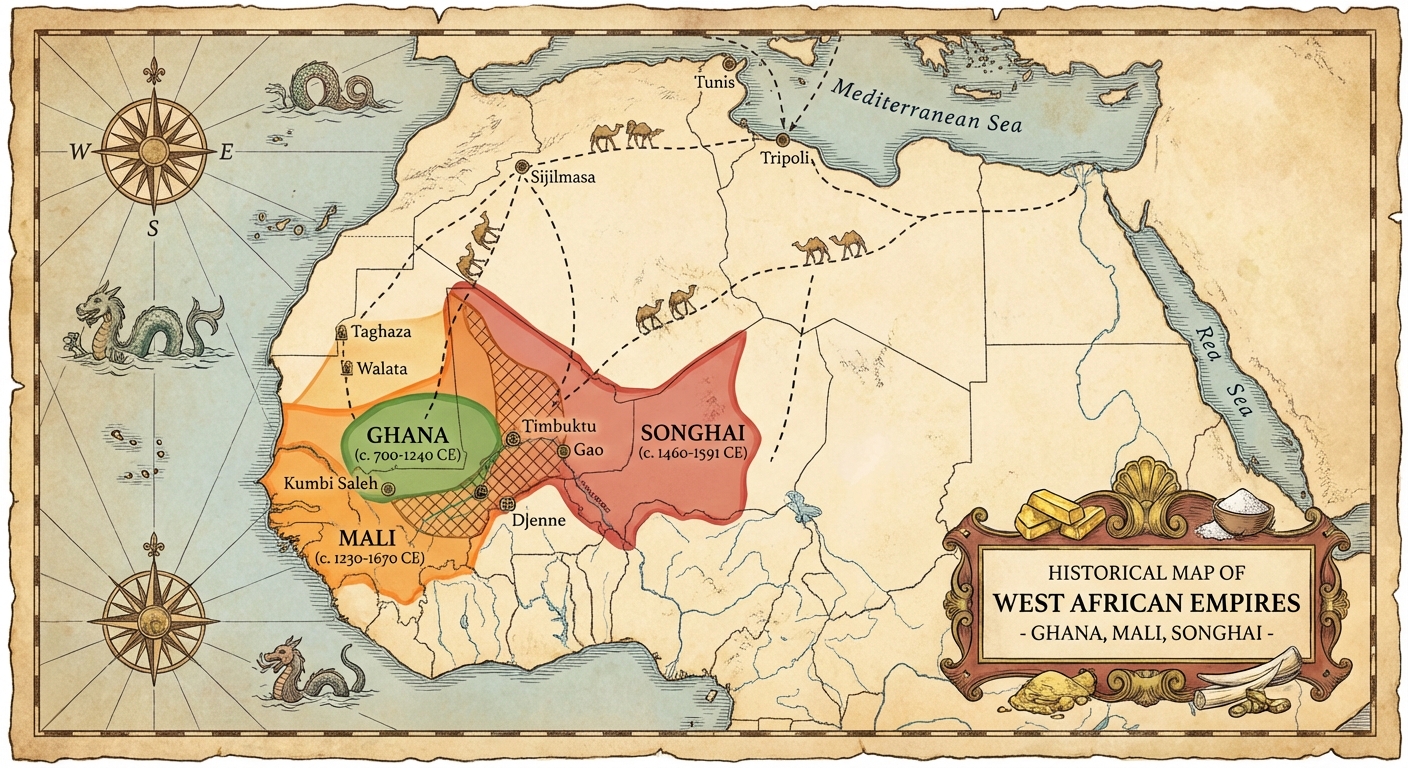
The most frequently tested topic in this section is the succession of three major empires in the Western Sahel. These states rose to power by controlling the lucrative Gold-Salt Trade across the Sahara.
1. Empire of Ghana (c. 300–1100 CE)
Often called Wagadu by its distinct Soninke people, "Ghana" was actually the title of the king (meaning "Warrior King").
- Economic Base: Located between the desert salt mines (Taghaza) and the forest gold fields (Wangara). They did not own the gold mines but taxed every ounce entering or leaving their territory.
- Technology: Early mastery of iron weapons allowed them to conquer neighbors who used bone or stone tools.
- Religion: The ruling class practiced traditional animist religions but allowed Muslim traders to dwell in separate districts, facilitating trade without forced conversion.
2. Empire of Mali (c. 1235–1670 CE)
Founded by likely the most famous figure in West African oral history, Sundiata Keita (the "Lion Prince"), who united the Mandinka people.
- The Epic of Sundiata: An oral epic recounting Sundiata's triumph over the sorcerer-king Soumaoro Kanté. It serves as a primary source for understanding Mali's political philosophy.
- Mansa Musa: The most famous ruler (ruled 1312–1337). He is renowned for his 1324 Hajj (pilgrimage) to Mecca.
- Significance: His caravan distributed so much gold in Cairo that it destabilized the economy (inflation). This put West Africa on European maps (e.g., the Catalan Atlas).
- Timbuktu: developed under Mali as a major hub of Islamic scholarship, home to the Sankore Madrasah and vast libraries of manuscripts.
3. Empire of Songhai (c. 1464–1591 CE)
The largest of the three empires, centered around the capital of Gao.
- Sunni Ali Ber: A military conqueror who captured Timbuktu and Djenne. He was known for a syncretic approach to Islam (mixing it with local practices).
- Askia Muhammad: A devout Muslim ruler who strengthened the administration, standardized weights and measures, and strengthened ties with the broader Muslim world.
- Collapse: The empire fell in 1591 to Moroccan forces equipped with gunpowder weapons (arquebuses), which the Songhai lacked.
Comparison of Empires
| Feature | Ghana | Mali | Songhai |
|---|---|---|---|
| Peak Era | 800–1050 CE | 1235–1350 CE | 1464–1591 CE |
| Primary Ethnicity | Soninke | Mandinka | Songhai |
| Key Leader | Tenkamenin (generic) | Sundiata, Mansa Musa | Sunni Ali, Askia Muhammad |
| Religious Stance | Traditional (Islam tolerated) | Islam (Ruling class) + Traditional | Islam (State religion) |
| Legacy | Initial trade network | Timbuktu, Gold expansion | Bureaucracy, Rationalized trade |
Diverse African Societies: Beyond the West
While the AP course focuses heavily on West Africa (the primary source of the Atlantic Diaspora), you must know other major civilizations to counter the "primitive" narrative.
The Kingdom of Aksum (Ethiopia)
Located in the Horn of Africa, Aksum was a naval power connecting Roman, Persian, and Indian trade routes.
- Christianity: King Ezana adopted Christianity in the 4th century CE, making Ethiopia one of the oldest Christian nations in the world.
- Architecture: Famous for massive stone obelisks called stelae, which marked royal tombs (demonstrating engineering mastery).
The Swahili Coast
A string of city-states (like Kilwa, Mombasa, Zanzibar) on the East African coast.
- Culture: A fusion of Bantu foundation with Arab/Persian influences. Swahili is a Bantu language with heavy Arabic loanwords.
- Trade: Integrated into the Indian Ocean Trade network, exchanging gold, ivory, and slaves for porcelain (China) and cotton (India).
Great Zimbabwe
A powerful inland kingdom in Southern Africa.
- Architecture: Built massive stone enclosures (zimbabwe means "stone houses") without mortar. The Great Enclosure is the largest ancient structure south of the Sahara.
- Economy: Wealth accumulated through cattle herding and control of the gold trade to the Swahili coast.
African Cultural Practices and Knowledge Systems
Governance and Social Structure
Not all African societies were centralized empires. Many were Stateless Societies (decentralized), governed by consensus among lineage groups rather than a single king.
- Matrilineal Society: In many cultures (e.g., the Akan), descent and inheritance were traced through the mother’s line. This did not mean women ruled (matriarchy), but that political legitimacy came from the female bloodline.
- Age Grades: Social organization where cohorts of people born around the same time move through responsibilities (warrior, elder, judge) together.
Oral Tradition and The Griot
History in West Africa was largely recorded orally, not because they lacked the capacity for writing, but due to cultural preference for the spoken word's power.
- Griot (Djeli): Hereditary oral historians, musicians, and advisors to kings. They held the memory of the civilization.
- Role: They were "living libraries." To kill a griot was considered equivalent to burning down a library.
- Instrument: The Kora (a 21-string bridge-harp) is often used to accompany storytelling.
Religion and Syncretism
Before the dominance of Islam or Christianity, most societies practiced indigenous religions characterized by:
- Supreme Creator: Belief in a distant, all-powerful creator god.
- Animism: Spirits exist in nature (trees, rivers) and must be respected.
- Ancestor Veneration: Ancestors act as intermediaries between the living and the divine.
Syncretism: When Islam expanded into West Africa (via trade, not conquest), it often blended with local customs. For example, a ruler might pray to Allah but still keep fetishes or amulets for protection to satisfy local tradition. This blending is called syncretism.
Common Mistakes & Pitfalls
Confusing "Ghana" the Empire with "Ghana" the Modern Country.
- Correction: They are in different locations. Modern Ghana adopted the name upon independence (1957) to honor the ancient empire's glory, but the ancient empire was located in modern-day Mali/Mauritania.
Viewing Africa as "Stateless" or "Tribal" only.
- Correction: Students often ignore the sophisticated bureaucracies of Songhai or the diplomatic weight of Mali. Avoid using the word "tribe" in academic writing; use "ethnic group," "nation," or "society."
Assuming Islam spread by Sword in West Africa.
- Correction: In the Middle East, Islam often spread by conquest. In West Africa, it spread primarily by trade. Merchants converted first for economic trust/credit networks; rulers followed later.
Misunderstanding "Oral History."
- Correction: Do not equate oral history with "myths" or "fairytales." Griots underwent rigorous training to ensure accuracy. It is a valid historical record alongside written text.