AP English Language: Unit 1 Mastery Guide
The Foundations of Rhetoric: Claims, Reasoning, and Evidence
1. The Rhetorical Situation
Before understanding claims, you must understand the context in which they exist. Every argument is born out of a specific situation. In Unit 1 of AP English Language, recognizing the Rhetorical Situation is the first step to both analyzing texts and writing your own.
A. Core Components
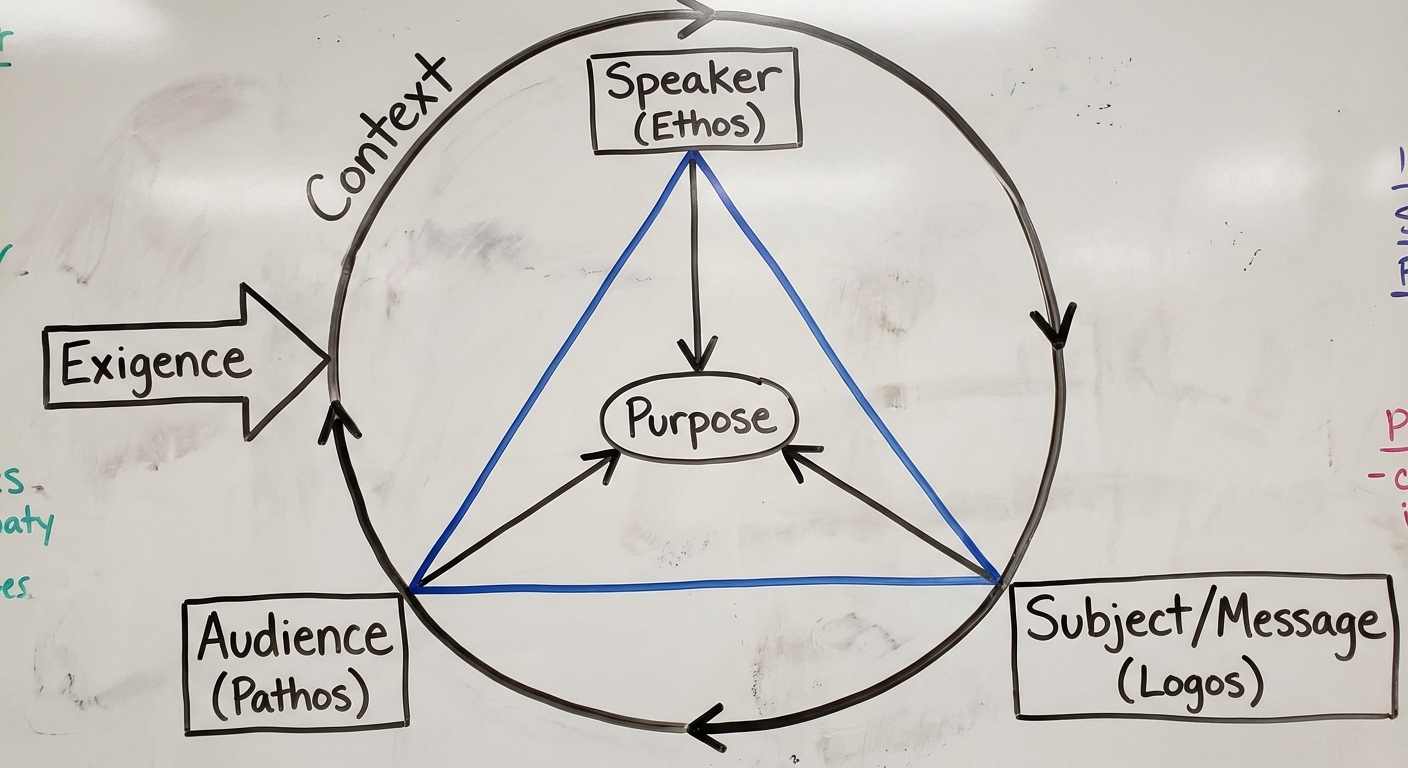
The College Board often refers to the rhetorical situation using specific elements. A common mnemonic to remember these is SPACE:
- Speaker: The person or group creating the text. Consider their persona, credibility (ethos), and background.
- Purpose: What the speaker wants the audience to think, feel, or do after reading/listening. It is never just "to inform"—it is to verify, to provoke, to condemn, etc.
- Audience: The specific group of people the text is directed at. Arguments change based on the audience's values and beliefs.
- Context: The time, place, and "climate" in which the text is written. What historical or cultural events are happening simultaneously?
- Exigence: The specific spark or catalyst that moved the speaker to write now. It is the "why now?" of the argument.
B. The Relationship to Claims
You cannot form a strong Claim without understanding the Audience (what do they value?) and the Exigence (what problem are you solving?).
2. Claims (The "What")
A. Definition and The Thesis Statement
A claim is an assertion or conclusion that you want your audience to accept. In the context of the AP exam (specifically Question 1, 2, and 3), your main claim constitutes your Thesis Statement.
Crucial Rule: A claim must be defensible. This means it cannot be a statement of fact (which cannot be argued) or a statement of personal preference (which cannot be proven logically).
B. Types of Claims
Arguments generally fall into three categories:
- Claims of Fact: Assert that something is true or false. (e.g., "Standardized testing does not accurately predict student intelligence.")
- Claims of Value: Argue that something is good or bad, right or wrong, desirable or undesirable. (e.g., "Competition is detrimental to the mental health of adolescents.")
- Claims of Policy: Propose a change or a specific course of action. (e.g., "Schools should replace letter grades with pass/fail metrics.")
C. Characteristics of a Strong AP Thesis
To score the Thesis point on the AP rubric, your claim must be:
- Debatable: Reasonable people could disagree.
- Specific: It narrows the scope of the argument.
- Aligned: It directly answers the prompt.
| Weak Claim | Strong Defensible Claim |
|---|---|
| Climate change is bad. (Too vague; broadly accepted fact) | While the impacts of climate change are global, developing nations bear a disproportionate burden due to limited resources for adaptation. (Complex, arguable, specific) |
| Competition helps people. (Simplistic) | Although competition drives innovation, it creates a toxic environment that undermines ethical behavior in professional settings. (Nuanced, establishes a "line of reasoning") |
3. Evidence (The "How")
A. Definition
Evidence is the specific information used to support the validity of a claim. In AP Lang terms, evidence effectively becomes the "data" of your argument.
B. Types of Evidence
The College Board looks for variety and specificity.
- Empirical/Statistical Evidence: Numbers, data, and studies. (e.g., "A study by the DOE showed literacy rates dropped by 12%.")
- Anecdotal Evidence: Personal stories or specific isolated examples. (e.g., "Frederick Douglass's experience with Mrs. Auld demonstrates the corrupting nature of power.")
- Expert Opinion: Quotes or ideas from recognized authorities.
- Analogical Evidence: Comparisons to similar situations (historical or hypothetical).
C. The "REHUGO" Mnemonic for Generating Evidence
When writing the Argument Essay (Q3), uses REHUGO to brainstorm evidence types:
- Reading (Books, articles)
- Entertainment (Movies, pop culture—use sparingly)
- History (Past events)
- Universal Truths (Philosophical concepts)
- Government (Politics, current events)
- Observation (Personal experience)
4. Reasoning & Commentary (The "Why")
A. Definition
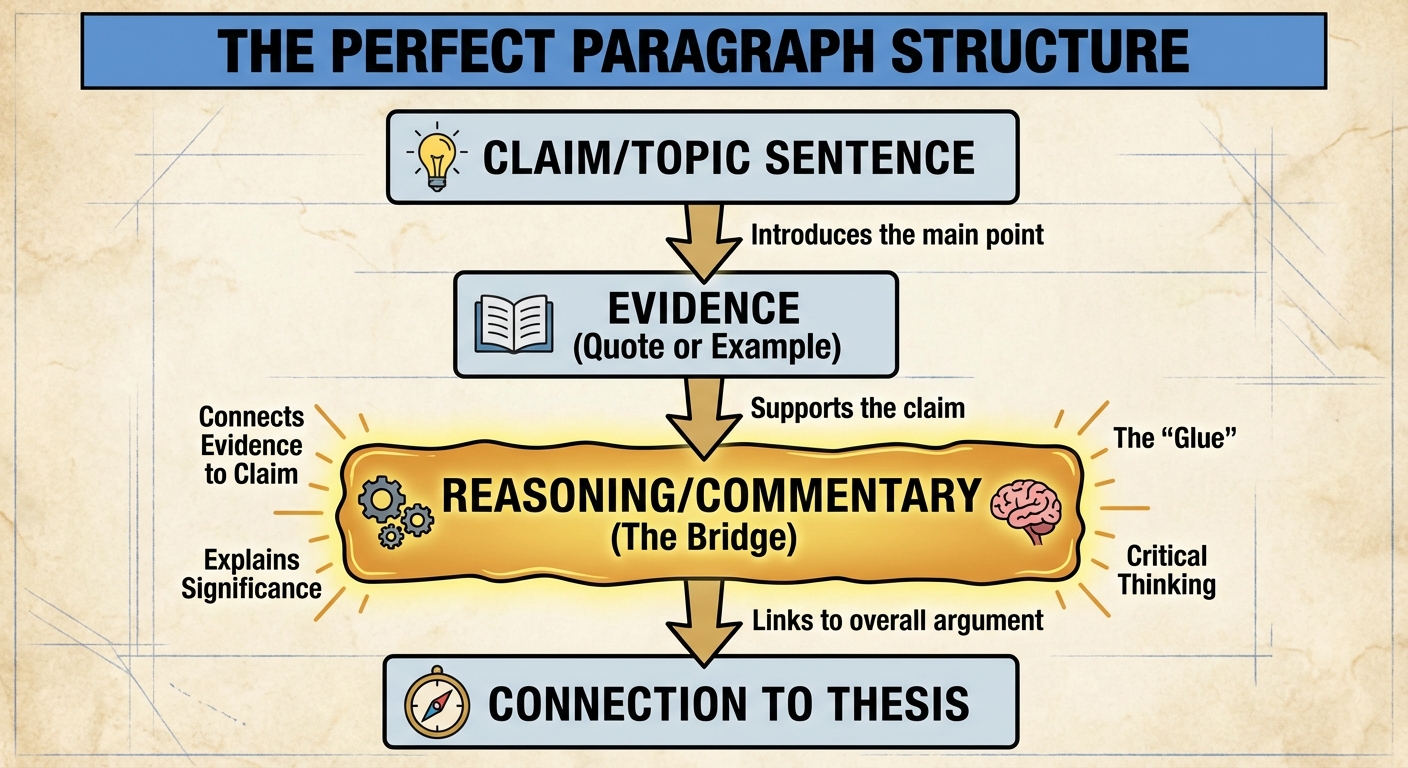
Reasoning, often called Commentary or Analysis in AP rubrics, is the intellectual work you do to connect your Evidence back to your Claim. It answers the question: "So what?"
B. Establishing a Line of Reasoning
A Line of Reasoning is the logical arrangement of claims and evidence that leads to a conclusion. It is the "thread" that ties your essay together.
- Inductive Reasoning: specific examples $\rightarrow$ general conclusion.
- Deductive Reasoning: general principle $\rightarrow$ specific conclusion.
C. How to Write Commentary
Do not assume the evidence speaks for itself. You must explain the underlying assumptions.
- Format: [Evidence] + [Transition] + [Explanation of significance] + [Tie back to Thesis]
- Verbs to use: Illustrates, implies, suggests, underscores, validates, contradicts.
Example of the Interplay:
Claim: School uniforms stifle individuality.
Evidence: "According to a 2022 survey, 85% of students reported feeling unable to express their personality through clothing."
Reasoning (The Glue): This statistic highlights a psychological disconnect between students and their environment. When adolescents cannot express their developing identities visually, they become detached from the school culture, proving that uniforms prioritize conformity over individual growth.
5. Rhetorical Analysis vs. Argumentation
Unit 1 covers both analyzing others' arguments and creating your own. The concepts of CRE (Claims, Reasoning, Evidence) apply differently to each:
Rhetorical Analysis (Q2)
- Your Task: Identify the author's claim and analyze how they use evidence and reasoning to persuade their specific audience.
- Focus: The choices the writer makes to support their claim.
Argument Essay (Q3)
- Your Task: Create your own claim (thesis) and support it with your own evidence and reasoning.
- Focus: Proving your position to be valid.
6. Common Mistakes & Pitfalls
The "Evidence Drop":
- Mistake: Quoting a statistic or text and moving immediately to the next point.
- Fix: Never end a paragraph with evidence. Always follow evidence with at least 2 sentences of commentary/reasoning.
Circular Reasoning:
- Mistake: Restating the claim as the reason. (e.g., "Exercise is good because it is beneficial.")
- Fix: Explain the mechanism. (e.g., "Exercise is beneficial because it releases endorphins and reduces cortisol.")
Confusing Topic Sentences with Facts:
- Mistake: Starting a paragraph with "In the text, the author talks about pollution."
- Fix: Topic sentences must be mini-arguments. "The author focuses on pollution to invoke a sense of urgency in the audience."
Vague claims:
- Mistake: "The author uses diction to show his point."
- Fix: Be specific. "The author employs aggressive military diction to characterize the opposing argument as an enemy aimed at destroying freedom."