Unit 3: Movement and Mindset — Migration, Culture, and Leadership
The Great Migration (First Wave)
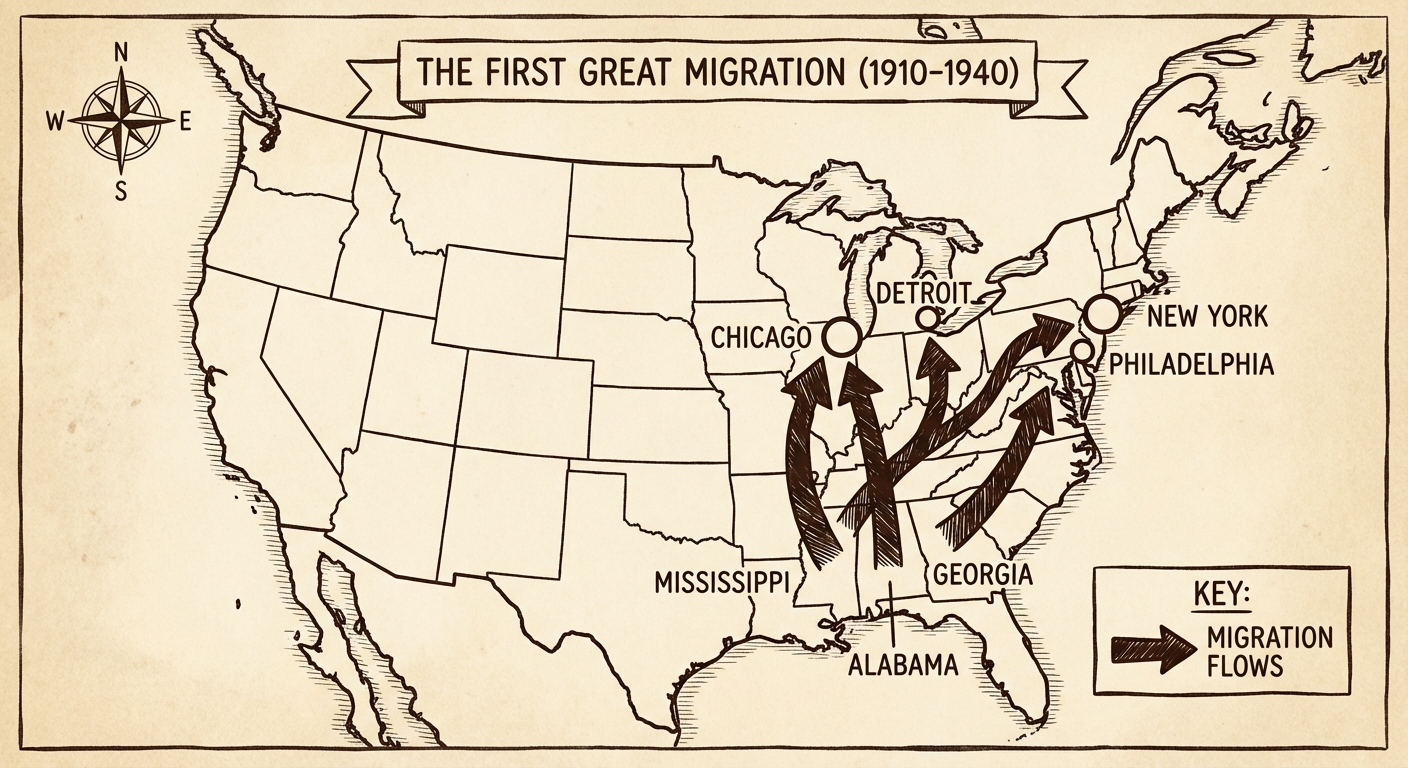
The Great Migration refers to the massive demographic shift of approximately six million African Americans from the rural South to the urban North and West. For the scope of AP African American Studies Unit 3, we focus primarily on the First Great Migration (c. 1910–1940), which fundamentally reshaped the political and cultural landscape of the United States.
Push and Pull Factors
Historians analyze this movement through "push" factors (reasons to leave) and "pull" factors (reasons to go).
The Push (Why leave the South?)
- Jim Crow Violence: The prevalence of racial terror, specifically lynching and mob violence, made the South physically unsafe.
- Economic Oppression: The sharecropping system trapped Black families in cycles of debt.
- Disenfranchisement: Literacy tests, poll taxes, and grandfather clauses stripped Black men of the right to vote.
- Environmental Disasters: The Boll Weevil infestation devastated cotton crops in the early 20th century, destroying the agricultural economy many Black laborers relied on.
The Pull (Why go North?)
- World War I Labor Shortages: As white men went to war and European immigration stalled, Northern factories (steel, automotive, meatpacking) desperately needed workers.
- Economic Opportunity: Higher wages in industrial centers (Chicago, Detroit, Pittsburgh, New York) compared to Southern agriculture.
- The Promise of Freedom: While not devoid of racism, the North offered civil liberties not available in the South, such as the right to vote and better educational opportunities for children.
Impact on Urban Centers
The sudden influx of Black residents into Northern cities created dense, vibrant communities but also triggered white backlash.
- Black Belts/Ghettoization: Due to restrictive covenants (housing deeds prohibiting sale to Black people) and redlining, Black migrants were forced into specific, overcrowded neighborhoods (e.g., Bronzeville in Chicago, Harlem in NYC).
- The Red Summer of 1919: Post-WWI racial tensions exploded into violence. White mobs attacked Black communities in over two dozen cities, prompted by competition for jobs and housing. Notably, Black veterans returning from WWI actively defended their communities, marking a shift toward militant self-defense.
The Harlem Renaissance and "The New Negro"
While the Great Migration moved bodies, the Harlem Renaissance moved minds. Spanning roughly the 1920s to the mid-1930s, this was a flowering of Black intellectual, literary, and artistic life centered in Harlem, New York, but impactful globally.
The "New Negro" Movement
Coined by philosopher Alain Locke, the term "New Negro" defined a generation that refused to submit to Jim Crow laws and racial segregation. This concept rejected the "Old Negro" stereotype of subservience and docility.
- Self-Definition: Artists sought to define Black identity on their own terms, embracing African heritage and Southern folk culture rather than mimicking white European standards.
- Political Agency: The movement was inextricably linked to civil rights. Art was seen as a tool for social uplift and a way to prove humanity to a white audience.
Key Cultural Pillars
Literature:
- Langston Hughes: Used jazz rhythms in poetry to depict the everyday lives of working-class Black people.
- Zora Neale Hurston: Celebrated Black Southern rural culture and dialect (e.g., Their Eyes Were Watching God).
- Claude McKay: Jamaican-born writer whose poem "If We Must Die" became an anthem for resistance during the Red Summer.
Visual Arts:
- Aaron Douglas: Known as the "Father of Black American Art," he used geometric styles and Ancient Egyptian/West African motifs to illustrate the Black experience.
Music:
- Jazz and Blues: The migration brought the Blues from the Delta to cities like St. Louis and Chicago. Jazz became the soundtrack of the era, breaking racial barriers in entertainment venues (though audiences remained largely segregated, as seen at the Cotton Club).
Black Intellectual Traditions: Strategies for Freedom
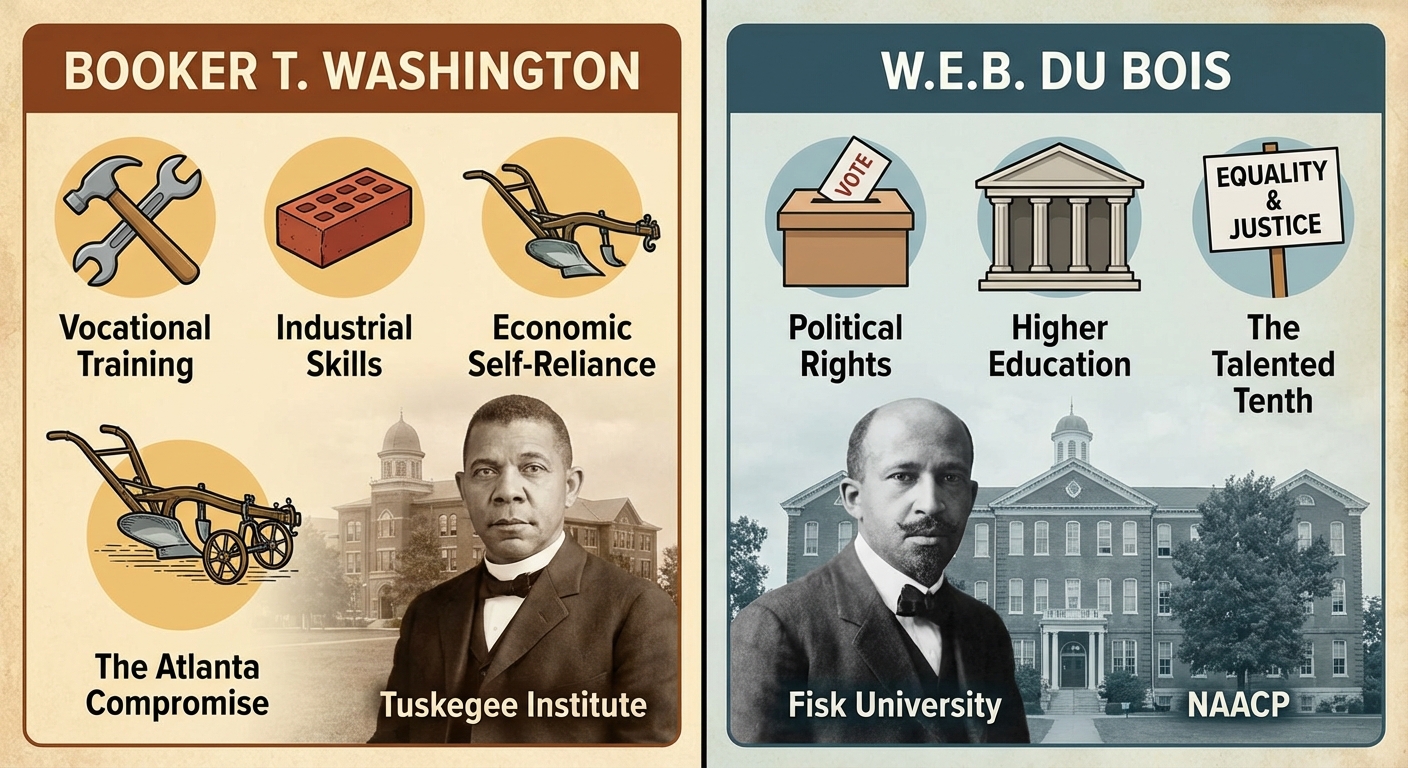
During the late 19th and early 20th centuries, two dominant philosophies emerged regarding how African Americans should achieve equality. This debate is often framed as Booker T. Washington vs. W.E.B. Du Bois.
Booker T. Washington: Accommodation and Self-Help
Washington, born into slavery, became the principal of the Tuskegee Institute. He was the most powerful Black leader of his time among white politicians and philanthropists.
- The Atlanta Compromise (1895): In a famous speech, Washington argued that Black people should accept segregation and disenfranchisement temporarily in exchange for economic opportunity.
- Philosophy:
- Industrial Education: Focus on vocational skills (farming, carpentry, mechanics) to build economic independence.
- Gradualism: Believed civil rights would come after Black people proved their economic value to the nation.
- "Cast down your bucket where you are": A metaphor urging Black Southerners to work with white Southerners for mutual economic progress rather than migrating or agitating.
W.E.B. Du Bois: Agitation and Civil Rights
Du Bois was the first African American to earn a Ph.D. from Harvard and a co-founder of the NAACP (National Association for the Advancement of Colored People).
- The Souls of Black Folk (1903): A seminal text where Du Bois explicitly criticized Washington's strategy.
- Philosophy:
- The Talented Tenth: The idea that the top 10% of the Black community should pursue classical, liberal arts education (law, medicine, philosophy) to become leaders and fight for civil rights.
- Immediate Equality: Demanded full political, civil, and social rights immediately. He argued that economic gains were impossible without the vote to protect them.
- Double Consciousness: Describes the internal conflict of being both "Black" and "American" in a society that devalues Blackness.
Marcus Garvey: A Third Approach
While Washington and Du Bois debated integration strategies, Marcus Garvey founded the Universal Negro Improvement Association (UNIA).
- Pan-Africanism: He advocated for Black pride, economic independence from white systems, and the "Back to Africa" movement.
- He clashed with Du Bois, whom he viewed as elitist, but shared Washington's focus on economic self-reliance.
Common Mistakes & Pitfalls
- Misunderstanding the "promised land": Do not assume the North was a racism-free paradise. Students often forget that while there was no de jure (legal) segregation in the North, there was intense de facto (customary) segregation, discrimination in hiring, and racial violence.
- Oversimplifying the Washington/Du Bois Debate: Avoid labeling Washington simply as a "traitor" or partial to white interests. While his methods were accommodationist, his hidden financing of civil rights court cases and focus on building Black institutions provided a foundation for later activism. Both men wanted Black advancement; they disagreed on the method.
- Restricting the Harlem Renaissance to Harlem: Remember that this was a national and international movement. Similar artistic renaissances happened in Chicago, Washington D.C., and Paris during this same era.
- Conflating Timelines: Don't confuse the First Great Migration (WWI era) with the Second Great Migration (WWII era). While related, the drivers and destinations evolved over time.