Unit 4 Master Notes: Momentum Conservation & Collision Theory
Conservation Principles and Collision Types
The Law of Conservation of Linear Momentum
The cornerstone of Unit 4 in AP Physics 1 is the Law of Conservation of Linear Momentum. This principle is as fundamental as the conservation of energy and provides the tools to solve problems involving collisions, explosions, and recoil.
Defining the System: Closed vs. Open
Before applying conservation laws, you must define your system—the collection of objects you are analyzing.
- Closed (Isolated) System: A system where the net external force acting on it is zero ($\sum \vec{F}_{ext} = 0$). In a closed system, the total linear momentum remains constant.
- Open System: A system where external forces (like friction from a track or gravity acting on a projectile) cause a change in the total momentum.
The Conservation Equation
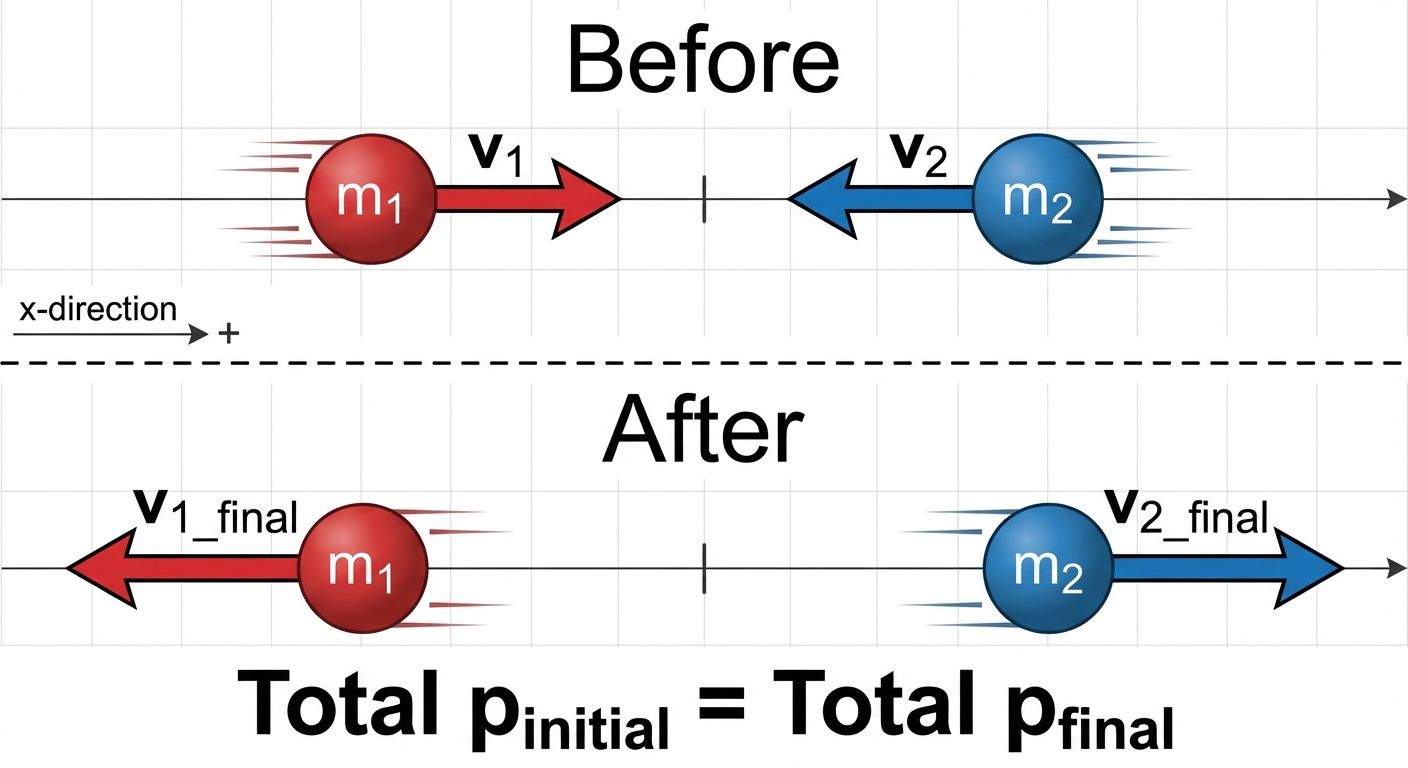
If a system is isolated, the total momentum vector immediately before an interaction equals the total momentum vector immediately after.
For a two-object system, this expands to:
Key Insight: Momentum is a vector. In one dimension, you must handle direction using positive $(+)$ and negative $(-)$ signs. In two dimensions, momentum is conserved independently in the $x$ and $y$ directions.
Motion of the Center of Mass
A crucial concept often tested in AP Physics 1 is the behavior of the Center of Mass (COM).
- If $\sum \vec{F}{ext} = 0$, the velocity of the center of mass ($\vec{v}{cm}$) remains constant.
- Even if the individual parts of the system collide, explode, or bounce, the COM continues moving in a straight line at a constant speed.
- Formula for Velocity of COM:
Classification of Collisions
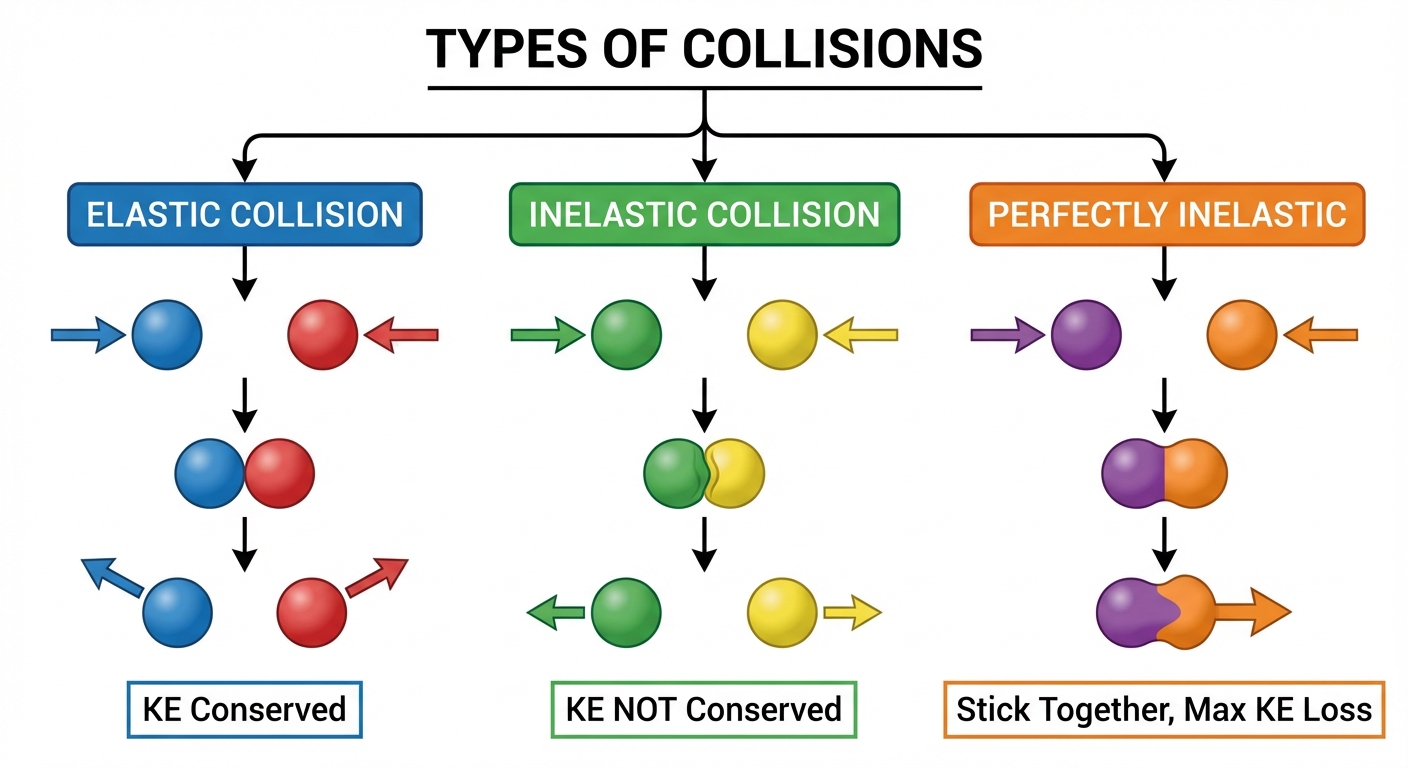
While momentum is conserved in all isolated collisions, Kinetic Energy ($K$) is not. Collisions are classified based on what happens to the system's total kinetic energy.
1. Elastic Collisions
In an elastic collision, objects bounce off each other without any permanent deformation or heat generation.
- Momentum: Conserved.
- Kinetic Energy: Conserved ($\sum Ki = \sum Kf$).
- Real-world examples: Billiard balls colliding, atoms bouncing off each other, a steel ball bouncing on a steel plate.
2. Inelastic Collisions
In an inelastic collision, objects bounce off each other, but some kinetic energy is transformed into internal energy (heat, sound, or deformation).
- Momentum: Conserved.
- Kinetic Energy: NOT Conserved ($\sum Ki > \sum Kf$). Energy is "lost" to the environment/internal modes.
- Real-world examples: A car crash where fenders identical, a rubber ball bouncing on the floor.
3. Perfectly (Totally) Inelastic Collisions
This is a specific subset of inelastic collisions where the objects stick together after impact and move with a common final velocity.
- Momentum: Conserved.
- Kinetic Energy: NOT Conserved (Maximum possible types of kinetic energy loss).
- Outcome: Objects combine effectively into one mass ($m1 + m2$) moving at $\vec{v}_f$.
Comparison Table
| Collision Type | Momentum Conserved? | Kinetic Energy Conserved? | Key Characteristic |
|---|---|---|---|
| Elastic | Yes | Yes | Bounces perfectly; no heat/sound |
| Inelastic | Yes | No | Bounces, but loses energy |
| Perfectly Inelastic | Yes | No | Sticks together; acts as one mass |
Explosions and Recoil
An "explosion" or "recoil" scenario is mathematically treated as a reverse perfectly inelastic collision.
- Scenario: A single system separates into multiple parts.
- Initial State: Often a single object at rest (or moving as a unit). $\vec{v}_i = 0$ is common.
- Final State: Parts move in opposite directions to conserve zero net momentum.
This explains why a cannon kicks back (recoils) when a cannonball is fired. The large mass of the cannon results in a small recoil velocity compared to the high velocity of the low-mass cannonball.
Worked Example: 1D Collision
Problem: A $2.0\,\text{kg}$ cart moving right at $4.0\,\text{m/s}$ collides with a $3.0\,\text{kg}$ cart moving left at $2.0\,\text{m/s}$. They stick together. Find the final velocity.
Solution:
- Identify System: The two carts (Closed system, friction negligible during impact).
- Define Direction: Right is $+$, Left is $-$.
- $m1 = 2\,\text{kg}, \quad v{1i} = +4.0\,\text{m/s}$
- $m2 = 3\,\text{kg}, \quad v{2i} = -2.0\,\text{m/s}$
- Choose Equation: (Perfectly Inelastic)
- Substitute:
The combined mass moves to the right at $0.4\,\text{m/s}$.
Common Mistakes & Pitfalls
- Ignoring Direction (Signs): This is the #1 error. If an object is moving left, its velocity must be entered as a negative number in the conservation equation. $p$ is a vector!
- Assuming Elasticity: Never assume $Ki = Kf$ unless the problem explicitly states the collision is "elastic." Most real-world collisions are inelastic.
- Mixing Conservation Laws: Don't confuse momentum with energy. Momentum is conserved in all isolated collisions; mechanical energy is only conserved in elastic ones.
- System Boundaries: Forgetting that external forces (like gravity on a falling ball, or friction on the ground over a long distance) mean momentum is not conserved for that specific duration. However, during the standard "impact" (milliseconds), we usually approximate external forces as negligible compared to the collision forces (Impulse Approximation).