Comprehensive Guide to Political Systems, Regimes, and Governments
Unit 1: Political Systems, Regimes, and Governments
1.1 The Practice of Political Science
Political scientists utilize specific methods to analyze the behaviors of governments and institutions. Success in AP Comparative Government requires distinguishing between types of data and understanding the limitations of statistical relationships.
Types of Political Analysis
- Empirical Statements: Fact-based statements that describe "what is." They rely on observation and data.
- Example: "China's GDP growth rate was 5% in 2023."
- Normative Statements: Value-based statements that describe "what ought to be." They rely on judgment or opinion.
- Example: "China should adopt more democratic reforms to improve human rights."
Data Analysis Methods
- Quantitative Analysis: Uses numerical data and statistical methods to assess political behavior.
- Tools: Surveys, census data, economic indices.
- Utility: Good for broad comparisons (e.g., "Does higher GDP correlate with democracy?").
- Qualitative Analysis: Uses in-depth textual or observational descriptions.
- Tools: Interviews, speeches, historical documents, case studies.
- Utility: Good for understanding the cause or nuance of a specific event (e.g., "Why did the Brexit vote succeed?").
Correlation vs. Causation
This is a critical distinction for the exam.
- Correlation: An apparent association between two variables.
- Positive Correlation: As $X$ increases, $Y$ increases (e.g., Education levels and political participation).
- Negative Correlation: As $X$ increases, $Y$ decreases (e.g., Corruption levels and judicial independence).
- Causation: A relationship where a change in one variable produces a change in the other.
- Rule: Correlation does not equal causation. Just because wealthy countries tend to be democracies does not prove that wealth causes democracy.
Key Comparative Indices
| Index Name | What it Measures | Highest/Best Score |
|---|---|---|
| Human Development Index (HDI) | Standard of living (Life expectancy, education, income) | 1.0 |
| Gini Index (Coefficient) | Income inequality within a country | 0 (0% = Perfect Equality) |
| Gross Domestic Product (GDP) | Total economic size | N/A (Higher is larger) |
| GDP per Capita | Standard of living (GDP divided by population) | N/A (Higher is richer) |
| Freedom House | Political rights and civil liberties | 100 (Most Free) |
| Corruption Perceptions Index | Perceived public sector corruption | 100 (Clean/Not Corrupt) |
| Fragile States Index | Vulnerability to collapse | 120 (High Alert/Failed) |
1.2 Defining Political Institutions
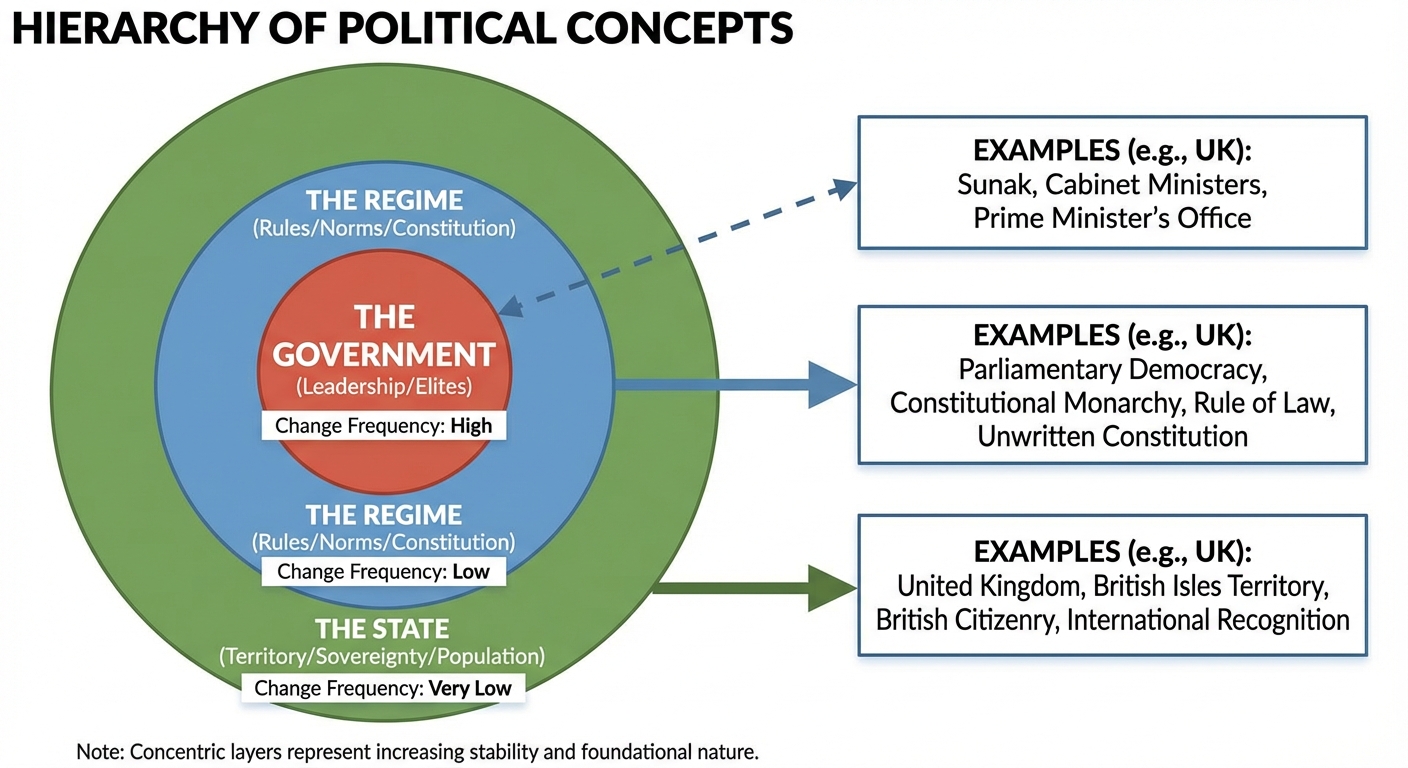
Students often confuse the state, the regime, and the government. You must view them as a hierarchy of endurance: States last centuries, regimes last decades, governments last years.
The State (The Hardware)
The State is a political organization that combines a permanent population with governing institutions to exercise control over a defined territory with international recognition.
- Sovereignty: The independent legal authority over a population in a particular territory. The state has the "monopoly on the legitimate use of force."
- Capacity: The ability of the state to wield power to carry out basic tasks (security, tax collection).
- Autonomy: The ability of the state to wield power independently of the public or international actors.
The Regime (The Operating System)
The Regime refers to the fundamental rules and norms of politics. It determines how power is acquired and used (e.g., Democracy vs. Authoritarianism).
- Regimes endure longer than governments but can be overturned by Revolutions.
- Example: The transition from the Shah (Monarchy) to the Islamic Republic (Theocracy) in Iran (1979) was a regime change.
The Government (The Operator)
The Government refers to the leadership or elite in charge of running the state.
- Governments change frequently through Elections (in democracies) or transitions of leadership.
- Example: Rishi Sunak replacing Boris Johnson in the UK was a change in government, not regime.
The Nation (The Identity)
The Nation is a group of people bound together by a common political identity (ethnicity, language, religion, culture).
- Nation-State: A state where the national identification and the political territory coincide (e.g., Japan; heavily Han areas of China).
- Multinational State: A state containing multiple nations (e.g., UK has English, Scottish, Welsh, N. Irish; Nigeria has Hausa, Yoruba, Igbo).
- Stateless Nation: A nation without a state of their own (e.g., Kurds in Iran/Iraq, Palestinians, Chechens in Russia).
1.3 Democracy vs. Authoritarianism
Democracy
A system where political power is exercised either directly or indirectly by the people.
Liberal Democracy (Substantive Democracy):
- Free, fair, and competitive elections.
- Civil Society: Groups independent of the state are allowed to organize.
- Rule of Law: All individuals including the government are held accountable to the law.
- Independent Judiciary and Civilian control of the military.
Illiberal Democracy (Procedural Democracy / Hybrid Regime):
- Holds elections that may appear competitive, but…
- Civil rights and liberties are restricted.
- State controls media.
- Course Examples: Russia (under Putin), Nigeria (historically, though improving).
Authoritarianism
A system where a small group of individuals exercises power over the state without being constitutionally responsible to the public.
- Rule BY Law: The state uses the law as a tool to control citizens, but the state itself is often above the law (common in China).
- Corporatism: A method where authoritarian systems create or sanction a limited number of organizations to represent the interests of the public and restrict those not set up by the state (to limit civil society).
Types of Authoritarian Regimes in AP Countries
- Theocracy: Rule based on religious authority.
- Example: Iran (Supreme Leader is a cleric).
- One-Party State: A single political party monopolizes politics and bans other parties.
- Example: China (Communist Party of China - CCP).
- Totalitarianism: The state seeks to control and transform all aspects of the state, society, and economy.
- Example: Elements of China under Mao; North Korea.
- Military Regime: Rule by military officials (Junta).
- Example: Nigeria (various periods between 1966-1999).
1.4 Democratization
Democratization is the transition from an authoritarian regime to a democratic one.
Phases of Democratization
- Transition: The toppling of the authoritarian regime.
- Consolidation: The maturation of the democratic regime where democracy becomes the "only game in town" and is unlikely to revert to authoritarianism.
- Requirement: Acceptance of election results by the losers.
Factors Influencing Democratization
- Economic Development: A rising middle class typically demands more rights.
- Civil Society: Strong NGOs and independent media pressure the state for reform.
- International Pressure: Sanctions or diplomatic pressure (e.g., EU requirements).
Democratic Backsliding (De-consolidation)
State-led debilitation of democratic institutions.
- Example: Russia transitioned toward democracy in the 1990s but has backslid into authoritarianism under Putin by removing checks and balances and restricting media.
1.5 Sources of Power and Authority
Power is the ability to make people do what they otherwise would not. Authority is the recognized right to use that power.
Sources of Authority (The Course Six)
| Country | Primary Sources of Authority |
|---|---|
| United Kingdom | Constitutionalism (rule of law), Tradition (Monarchy), Rational-Legal (Parliamentary elections). |
| Russia | Constitution (officially), but heavily relies on Charismatic Authority (Putin's strongman image) and Coercion. |
| China | One-Party Rule (CCP), Performance Legitimacy (economic growth), Nationalism, Ideology (Marxism-Leninism, Xi Jinping Thought). |
| Iran | Theocracy (Allah/Representative of the Imam), Constitution (mix of theocratic and democratic elements), Revolutionary Heritage. |
| Nigeria | Constitution (1999), Elections, but undermined by corruption and Patron-Clientelism (leaders exchanged favors for support). |
| Mexico | Constitution (1917), Elections, Transition from one-party dominance (PRI) to multi-party democracy. |
Key Concept: Rule of Law vs. Rule by Law
- Rule of Law: The law applies to everyone equally, including the President/Leader. (UK, Mexico has struggled but aims for this).
- Rule by Law: The leader uses the law as a weapon against opponents but ignores it for themselves. (China, Russia).
1.6 Change in Power and Authority
How do regimes or governments change?
- Elections: The primary method in democracies (UK, Mexico, Nigeria).
- Coups d'état: The military forcibly removes the existing government. The regime may change from democratic to military.
- Example: Nigeria has a history of coups mostly in the 60s, 70s, and 80s.
- Refolution: A public seizure of the state in order to overturn the existing government and regime.
- Example: Iran (1979) converted a Monarchy to a Theocratic Republic.
- Example: China (1949) established the PRC.
- Example: Russia (1917) Bolshevik revolution.
1.7 Federal vs. Unitary Systems
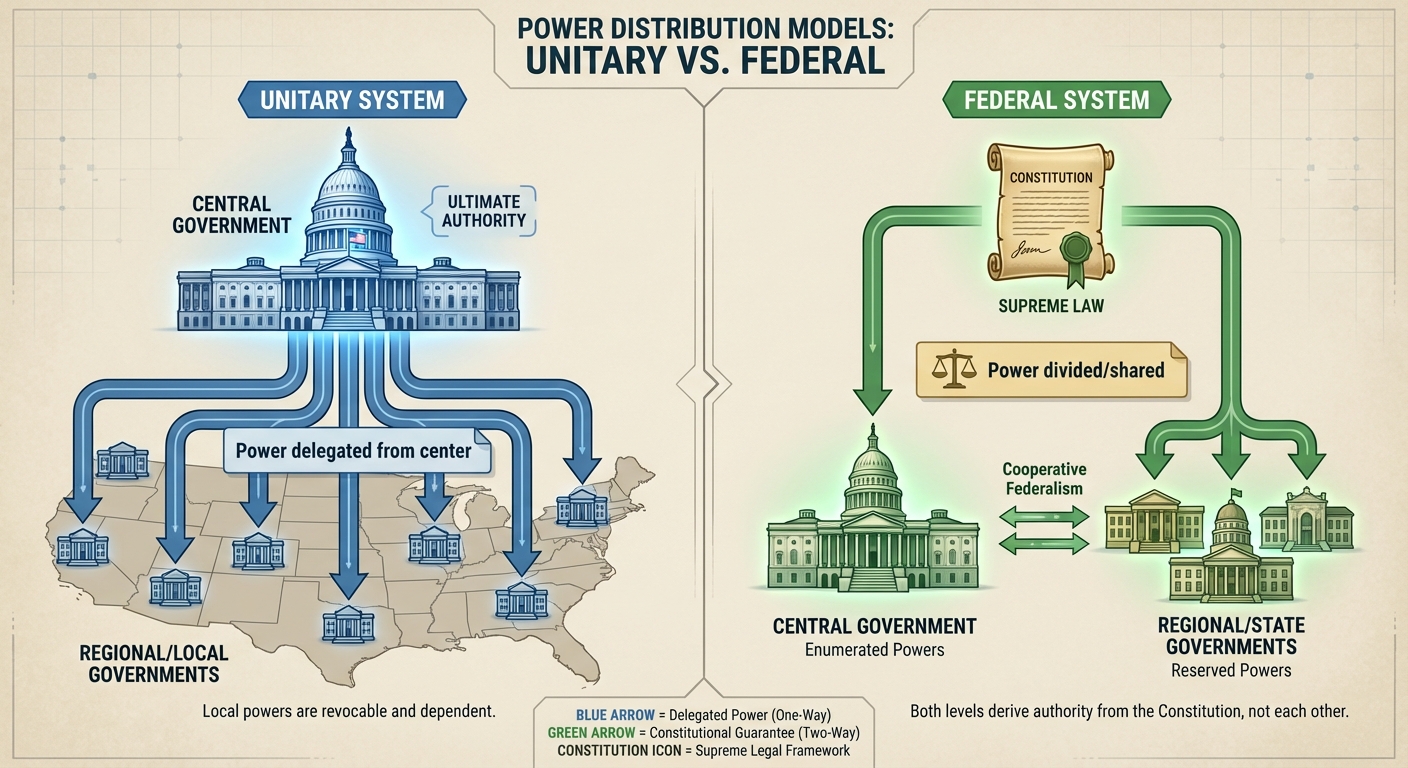
This describes how power is distributed geographically.
Unitary Systems
Power is concentrated at the national level. The central government may grant power to regions (devolution), but can take it back.
- United Kingdom: Power is in London (Westminster).
- Note: The UK uses Devolution (giving power to Scottish/Welsh parliaments), but London remains sovereign.
- China: Highly centralized unitary state. Beijing controls all provinces.
- Iran: Unitary state. Centralized religious and political control.
Federal Systems
Power is formally divided (usually by a constitution) between national and regional/local governments. Local powers usually cannot be easily taken away.
- Russia: Asymmetric Federalism. Some regions (Republics) have more rights than others, though Putin has centralized power significantly (creating a "federal in name only" situation).
- Mexico: Federal system (States). Historically centralized under the PRI, but federalism is becoming more real with genuine political competition.
- Nigeria: Federal system (36 States). Essential to manage the deep ethnic and religious divisions (Christian South vs. Muslim North).
Pros and Cons
| Feature | Unitary System | Federal System |
|---|---|---|
| Efficiency | High (uniform laws). | Lower (conflicting laws). |
| Equality | High (policy is the same everywhere). | Lower (richer regions have better services). |
| Participation | Lower local connection. | High (local elections matter). |
| Stability | Works well for homogenous populations. | Works well for diverse populations (diffuses ethnic conflict). |
1.8 Political Legitimacy
Legitimacy is the public belief that the government has the right to rule. Without it, states must rely on coercion (force).
Types of Legitimacy (Max Weber)
- Traditional: "It has always been this way."
- Example: The Queen/King in the UK; The religious authority in Iran.
- Charismatic: Based on the personality of the leader or revolutionary ideas.
- Example: Mao Zedong (China), Ayatollah Khomeini (Iran), Putin (Russia).
- Rational-Legal: Based on a system of laws and procedures (like strict election rules) that become highly institutionalized.
- Example: The UK Prime Minister (via Parliament), Mexico's President.
Sustaining vs. Undermining Legitimacy
- Sustaining:
- Economic growth (China uses this heavily).
- Successful elections (UK, Mexico).
- Nationalism (Russia, China).
- Undermining:
- Corruption (Nigeria, Russia).
- Election fraud (Iran 2009 protests).
- Economic collapse.
1.9 Political Stability
Stability is the ability of a state to maintain order and prevent successful challenges to its authority (like sedition or separatism).
Challenges to Stability
- Loss of Territory: Separatist movements (e.g., Chechnya in Russia, Uighurs in China, IPOB in Nigeria, Scotland in UK).
- Corruption: Destroys trust in the Rational-Legal system.
- Globalization: External economic crises or social media movements can destabilize regimes.
Strategies to Maintain Stability
- Coercion: Use of police/military (Tiananmen Square in China, crackdown on protests in Iran).
- Co-optation: Buying off critics or bringing them into the system (Corporatism).
- Political Rights: Allowing citizens to vent frustration through voting prevents revolution (UK, Mexico).
Common Mistakes & Pitfalls
- Confusing Nation and State:
- Wrong: "The UK is a nation."
- Right: "The UK is a state composed of four nations (English, Scottish, Welsh, Northern Irish)."
- Confusing Regime and Government:
- Wrong: "Putin is the regime of Russia."
- Right: "Putin heads the government of Russia; the regime is a mild authoritarian/hybrid system."
- Correlation vs. Causation:
- Wrong: "Poverty causes terrorism."
- Right: "There is a correlation between poverty and instability, which may create conditions for terrorism."
- Federalism vs. Decentralization:
- Just because the UK has a Scottish Parliament (Devolution), it is not a Federal system. In Federalism, the local power is constitutionally protected; in Unitary systems (UK), the central government gave the power and can theoretically take it back.
- Gini Index Interpretation:
- Wrong: "A high Gini index means the country is poor."
- Right: "A high Gini index means the country has high income inequality (gap between rich and poor). A country can be very rich (like the US) but have a relatively high Gini index."