Unit 4 Complete Review: Political Ideologies, Beliefs, and Policy
American Attitudes About Government and Politics
Core American Political Values
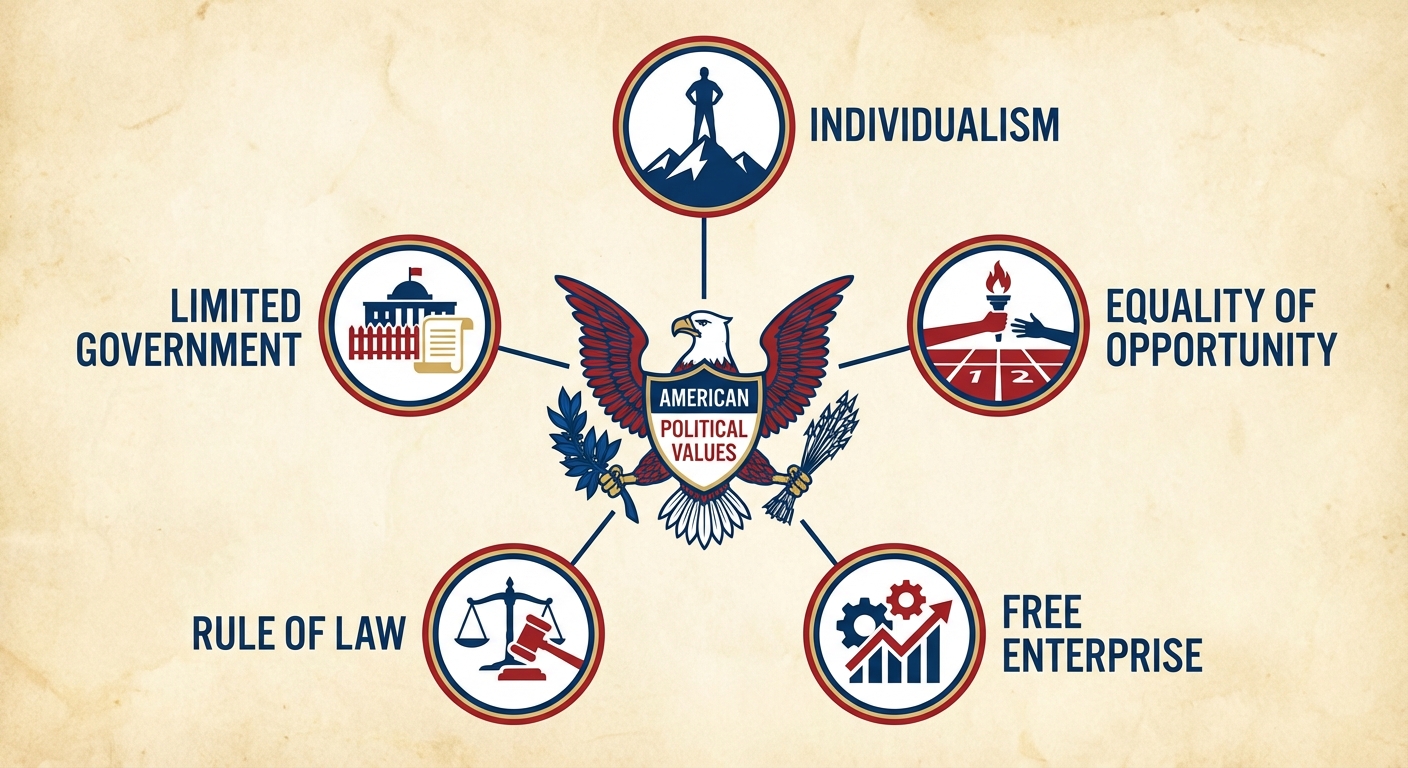
American political culture is built on a foundation of shared beliefs. While Americans often disagree on how to implement these values, the values themselves are largely universally accepted. The interpretation of these values drives political conflict.
Five Key Values
- Individualism: A belief in the fundamental worth and importance of the individual. It emphasizes self-reliance and personal responsibility.
- Example: The Bill of Rights protects individual liberties against government intrusion.
- Equality of Opportunity: All people should have the same chance to succeed based on their own effort and ability, but not necessarily equality of outcome.
- Conflict Point: Does this mean affirmative action is necessary to level the playing field, or does it mean the government should be colorblind?
- Free Enterprise: An economic system where private business operates in competition and largely free of state control (Laissez-faire roots).
- Rule of Law: The principle that no one, including public officials, is above the law. Laws apply equally to everyone.
- Mechanism: Transparency, predictable legal systems, and checks and balances.
- Limited Government: The government creates order and protects rights but is restricted by the Constitution.
Political Socialization
Political Socialization is the process by which individuals acquire their political beliefs and attitudes. This process is lifelong but most influential during childhood and young adulthood.
Agents of Socialization
| Agent | Influence Level | Description |
|---|---|---|
| Family | Highest | The #1 predictor of a person's party identification. Children often adopt their parents' views. |
| School/Education | High | Schools teach civic duty and patriotism. Higher education often correlates with more liberal social views. |
| Peers | Moderate | Social pressure to conform to group norms. |
| Media | Growing | The "new parent." Algorithms on social media create echo chambers reinforcing existing beliefs. |
| Religious Institutions | Variable | Evangelical Protestants tend to be conservative; Jews and Black Protestants tend to be liberal; Catholics are often swing voters. |
| Civic Organizations | Moderate | Unions, community groups, and non-profits shape specific policy views. |
| Globalization | Moderate | U.S. political culture influences the world (democratization), and the world influences the U.S. (diversity, trade). |
Temporal Factors affecting Socialization
- Generational Effects: Historical events experienced by a generation during their formative years (ages 14–24) shape their long-term views.
- Example: The Great Depression led the "Silent Generation" to value government safety nets. The Vietnam War/Watergate led Boomers to mistrust government.
- Lifecycle Effects: Political views change as a person ages. People generally become more politically active and arguably more conservative as they acquire property and families.
- Example: College students focus on student debt (liberal); Retirees focus on Social Security/Medicare protection.
Measuring Public Opinion
Public Opinion is the sum of individual attitudes about government, policies, and issues. Because it is not uniform, politicians look for Issue Publics (groups that care deeply about specific issues).
Types of Polls
- Benchmark Polls: The first poll taken in a campaign. Used to gather baseline information on a candidate's name recognition and public image.
- Tracking Polls: Continuous surveys that enable a campaign to chart its daily rise or fall in support.
- Entrance/Exit Polls: Conducted outside polling places on Election Day to predict legal outcomes and analyze voter demographics.
- Focus Groups: Small discussions (10–40 people) to get qualitative data (depth/feeling) rather than quantitative data (numbers).
Scientific Polling Metholodogy
To be considered valid, a poll must adhere to strict statistical standards.
- Defining the Universe: Identification of the group to be measured (e.g., "Registered Voters in Florida").
- Random Sampling: Every person in the universe must have an equal chance of being selected.
- Stratified Sampling: The population is divided into subgroups (race, gender, region) and weighted to ensure the sample represents the demographics of the universe.
- Sample Size: Usually, a sample of 1,000 to 1,500 respondents is sufficient to represent 300 million Americans.
- Neutral Wording: Questions must be objective to avoid emotional bias.
- Bad: "Do you support killing babies?" vs.
- Good: "Do you support a woman's right to choose in the first trimester?"
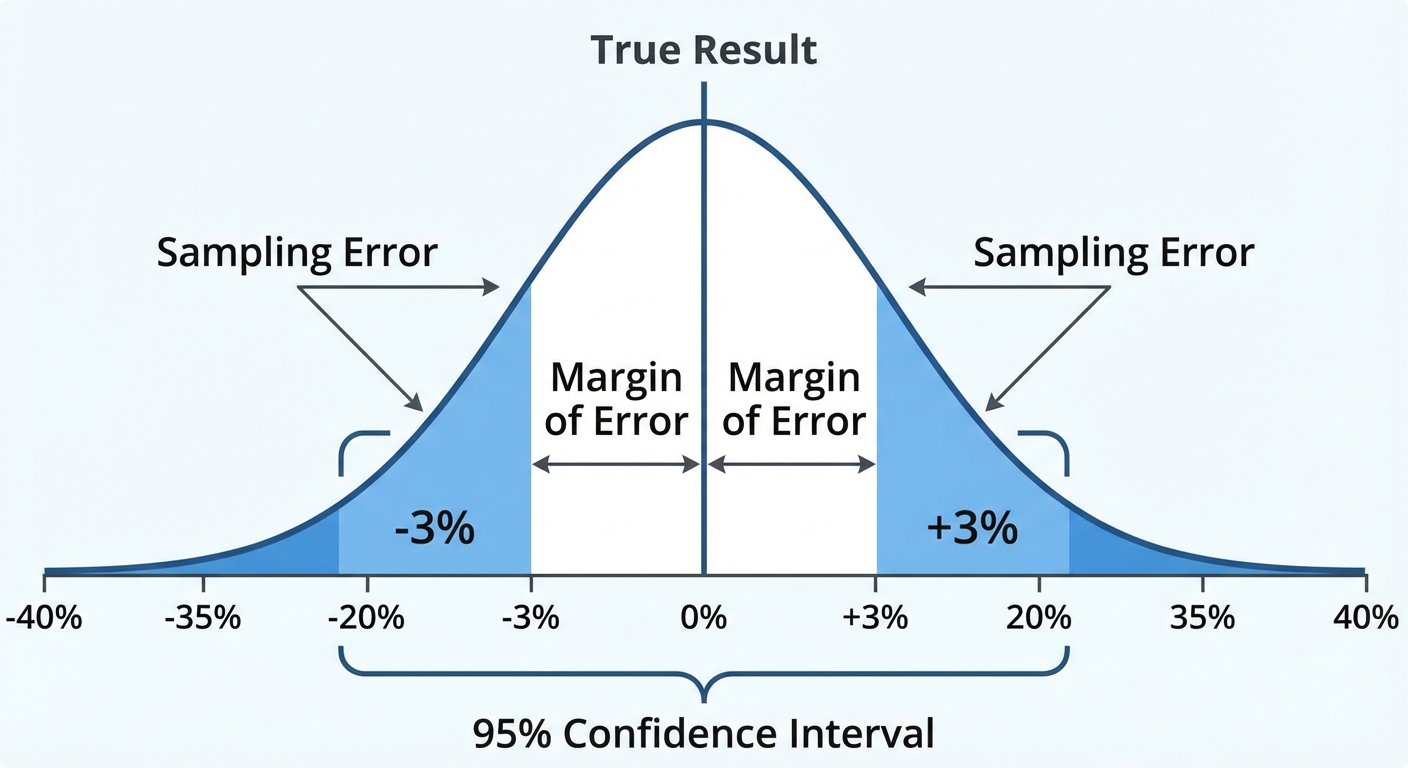
Formula: The accuracy of a poll is measured by the Margin of Error (Sampling Error).
A valid poll typically has a margin of error of +/- 3%.
means the true number is between 49% and 55%.
Problems with Polling
- Selection Bias: If the method excludes certain groups (e.g., polling only landlines misses young voters).
- Bradley Effect/Social Desirability Bias: Respondents tell pollsters what they think is "socially acceptable" rather than their true intent.
- Non-response Bias: People who refuse to participate may differ fundamentally from those who do.
Characteristics of Opinion
- Saliency: How important an issue is to a group (e.g., Social Security is salient to seniors).
- Intensity: How strongly people feel about the issue.
- Stability: How consistent the opinion is over time.
Political Ideologies
Political Ideology: A consistent set of beliefs about politics, public policy, and the role of government.
The Spectrum
| Ideology | Economic View | Social/Moral View | Key Demographics (General Trends) |
|---|---|---|---|
| Liberal (Left) | Government Intervention: Supports regulation, taxes on wealthy, social safety nets. | Personal Liberty: Supports privacy, LGBTQ+ rights, separation of church/state. | Urban, Women, Secular, Minorities, Post-grad education. |
| Conservative (Right) | Laissez-Faire: Lower taxes, deregulation, free markets. | Traditional Values: Pro-life, support religious influence, law and order. | Rural/Suburban, Men, Evangelical, White, South/Midwest. |
| Libertarian | Maximum Freedom: No taxes, no regulation, private ownership of everything. | Maximum Freedom: Decriminalize drugs, absolute free speech, privacy. | Often young white males. |
| Populist | Protectionist: Tariffs, support for working class. | Traditional: Often religious and socially conservative. | Working-class, rural. |
Party Platforms (Democratic vs. Republican)
- Democrats: Generally align with Liberal ideologies. Favor Keynesian economics, environmental regulation, and social equality programs.
- Republicans: Generally align with Conservative ideologies. Favor Supply-Side economics, defense spending, and protection of religious freedom.
Ideology and Policy Making
Economic Policy
The greatest divide between ideologies often stems from economic theory.
1. Fiscal Policy
Use of the federal budget (taxing and spending) to influence the economy. Controlled by Congress and the President.
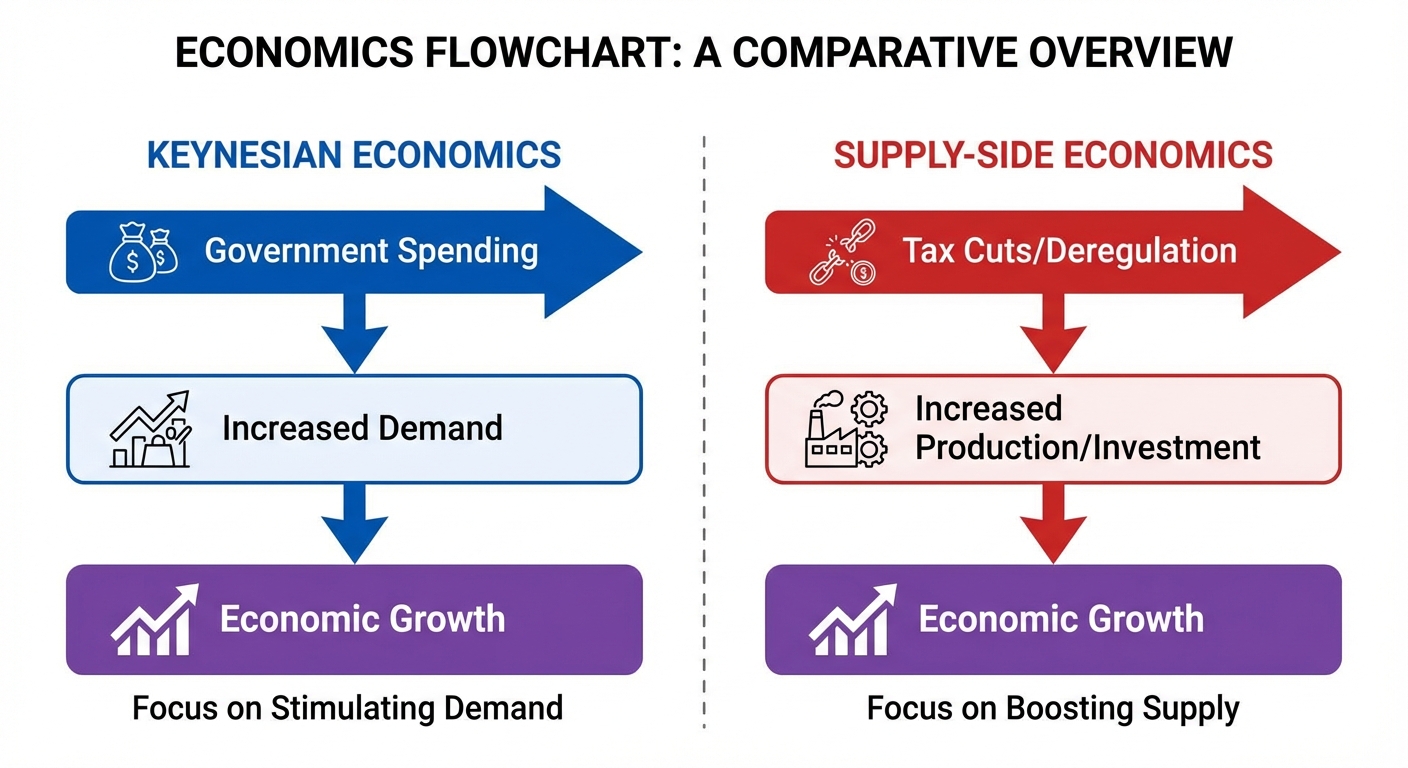
- Keynesian Economics (Liberal Preference):
- Developed by John Maynard Keynes.
- Theory: The government should stimulate the economy during recessions by spending money (even if it causes debt) to create demand.
- Motto: "Government is the gas pedal."
- Supply-Side Economics (Conservative Preference):
- Popularized during the Reagan era.
- Theory: The government should stimulate the economy by cutting taxes and deregulating businesses. Wealthy investors will expand production, and benefits will "trickle down."
- Motto: "Government is the brake; let off the brake."
2. Monetary Policy
Control of the money supply and interest rates to manage inflation. Controlled by the Federal Reserve (The Fed), an independent regulatory commission.
- Tools of the Fed:
- Reserve Requirement: How much cash banks must keep in the vault.
- Discount Rate: The interest rate the Fed charges banks.
- Open Market Operations: Buying/selling government bonds.
- Monetarism: The belief that inflation occurs when too much money chases too few goods. The Fed should keep the money supply steady.
Social Policy
- Liberals: Believe the government is responsible for social welfare (e.g., Affordable Care Act) and protecting rights of the accused.
- Conservatives: Believe private charity and local communities should handle welfare. Emphasize punishment for crime over rehabilitation.
- Privacy: Liberals generally interpret the Constitution as protecting a broad right to privacy (e.g., Roe v. Wade, contraception); Conservatives generally believe privacy rights are limited to the text of the Constitution.
Common Mistakes & Pitfalls
- Liberal vs. Libertarian: Don't confuse them! Liberals want more government in the economy; Libertarians want zero government in the economy. Liberals want government to protect civil rights; Libertarians want government to leave people alone entirely.
- Fiscal vs. Monetary Policy:
- Fiscal = Budget (Taxes/Spending). Done by Congress.
- Monetary = Money Supply (Interest Rates). Done by The Fed.
- Poll Validity: Just because a poll is large (e.g., 50,000 internet votes) doesn't mean it's accurate. If it isn't random, the data is useless.
- Generational vs. Lifecycle: Generational is about when you were born (historical context). Lifecycle is about how old you are now (aging process).
- Equality: Americans believe in Equality of Opportunity, not Equality of Outcome. Ideologies differ on how much government intervention is needed to ensure that opportunity.